Drug Sales Trends for AVAPRO
Payment Methods and Pharmacy Types for AVAPRO (2011)
Revenues by Pharmacy Type
Units Sold by Pharmacy Type
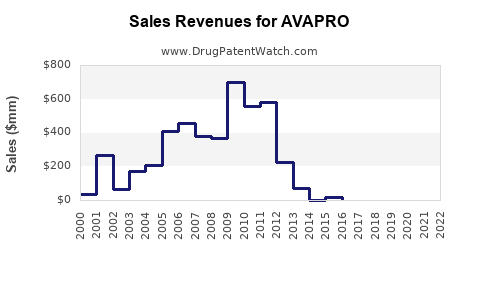
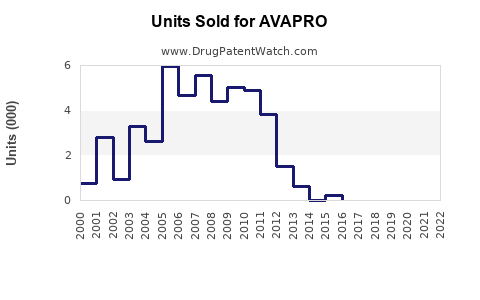
Annual Sales Revenues and Units Sold for AVAPRO
| Drug Name | Revenues (USD) | Units | Year |
|---|---|---|---|
| AVAPRO | ⤷ Start Trial | ⤷ Start Trial | 2022 |
| AVAPRO | ⤷ Start Trial | ⤷ Start Trial | 2021 |
| AVAPRO | ⤷ Start Trial | ⤷ Start Trial | 2020 |
| AVAPRO | ⤷ Start Trial | ⤷ Start Trial | 2019 |
| >Drug Name | >Revenues (USD) | >Units | >Year |
AVAPRO Market Analysis and Sales Projections: Irbesartan Generic Erosion, Market Size, and Commercial Outlook
AVAPRO, the branded formulation of irbesartan, is a mature antihypertensive with limited standalone commercial value. Its U.S. patent protection expired more than a decade ago, generic irbesartan is widely available, and Sanofi no longer reports AVAPRO as a major growth product. Future revenue is concentrated in low-priced generic irbesartan, combination products such as irbesartan/hydrochlorothiazide, and non-U.S. markets where brand persistence remains higher.
What is AVAPRO and who markets it?
AVAPRO is the U.S. brand name for irbesartan, an angiotensin II receptor blocker, or ARB. It is approved for hypertension and for diabetic nephropathy in patients with type 2 diabetes and hypertension.[1]
The product was developed through the Sanofi and Bristol-Myers Squibb partnership. Outside the United States, irbesartan has been marketed primarily under the Aprovel brand. AVAPRO HCT is the fixed-dose combination with hydrochlorothiazide.
| Attribute | AVAPRO |
|---|---|
| Active ingredient | Irbesartan |
| Drug class | Angiotensin II receptor blocker |
| U.S. brand | AVAPRO |
| Combination brand | AVAPRO HCT |
| U.S. approval | 1997 |
| Original U.S. NDA holder | Bristol-Myers Squibb |
| Commercial partner | Sanofi |
| Main indications | Hypertension; diabetic nephropathy associated with type 2 diabetes |
| Route | Oral tablet |
| Dosage strengths | 75 mg, 150 mg, 300 mg |
| Generic status | Widely available |
| Current market position | Mature branded product with generic substitution |
AVAPRO competes with losartan, valsartan, candesartan, olmesartan and telmisartan. Its clinical differentiation is limited because physicians can substitute among several ARBs based on formulary status, price, dosing preference and renal or cardiovascular considerations.
What patents protected AVAPRO?
The principal U.S. compound patent for irbesartan was U.S. Patent No. 5,599,724, assigned to Sanofi-related entities and covering irbesartan and related compounds. The patent had a term extending into 2012 after applicable patent-term adjustments and extensions.[2]
A separate patent estate covered formulations, combinations and methods of treatment. Those rights did not preserve meaningful branded-market exclusivity after generic irbesartan entered the U.S. market.
| Patent category | Commercial relevance |
|---|---|
| Irbesartan compound patent | Primary protection; expired around 2012 |
| Tablet formulation patents | Limited residual value after compound-patent expiry |
| Irbesartan/hydrochlorothiazide patents | Protected combination-product positioning |
| Method-of-use patents | Covered hypertension and diabetic nephropathy uses, subject to validity and enforceability limits |
| Manufacturing patents | Potentially relevant to process economics, but generally not a barrier to routine generic supply |
The key commercial event was the expiration of compound protection. Once generic manufacturers could sell irbesartan, the branded product lost pricing power even where formulation or method patents remained listed or asserted.
When did AVAPRO lose exclusivity?
AVAPRO lost practical U.S. market exclusivity in 2012, when generic irbesartan products entered following expiration of the relevant compound patent protection and resolution of related generic challenges.
The FDA Orange Book lists approved generic irbesartan products and irbesartan/hydrochlorothiazide products. The original AVAPRO brand therefore does not have the exclusivity profile of a currently protected small-molecule product.[3]
AVAPRO exclusivity timeline
| Event | Timing |
|---|---|
| U.S. approval of AVAPRO | 1997 |
| Core compound patent protection | Through approximately 2012 |
| Generic entry | 2012 |
| Broad generic substitution | 2012 onward |
| Current status | Mature generic market |
| Biosimilar exposure | Not applicable |
AVAPRO did not receive the type of long-duration market protection associated with biologics or newer specialty drugs. Its commercial life followed the conventional small-molecule pattern: strong branded sales during exclusivity, rapid erosion after generic entry and eventual migration to low-margin multisource supply.
What is the FDA and Orange Book status of AVAPRO?
AVAPRO is an FDA-approved small-molecule prescription drug. Its regulatory status is distinct from its commercial status: FDA approval remains relevant to labeling and therapeutic use, but approval does not confer current market exclusivity.
The FDA Orange Book identifies the reference-listed drug and approved abbreviated new drug applications for irbesartan. Generic manufacturers can rely on the reference product's safety and efficacy findings through the ANDA pathway, subject to bioequivalence requirements.[3]
FDA regulatory position
- AVAPRO is approved for hypertension.
- AVAPRO is approved for diabetic nephropathy in a defined type 2 diabetes population.
- Irbesartan is available through multiple ANDAs.
- AVAPRO HCT has generic combination-product competition.
- No biosimilar pathway applies because irbesartan is a chemically synthesized small molecule.
- A generic applicant could challenge relevant listed patents through a Paragraph IV certification, but the principal commercial patent barrier has already expired.
Which companies compete with AVAPRO?
The primary competitive set is the generic irbesartan market and the broader ARB category.
Direct irbesartan competitors
Generic irbesartan is supplied by multiple manufacturers, including large generic companies and contract-manufacturing networks. The market typically includes suppliers such as Teva, Mylan/Viatris, Lupin, Zydus, Torrent, Aurobindo and other approved ANDA holders, depending on the country and current supply status.
Therapeutic competitors
| Drug | Brand example | Competitive position |
|---|---|---|
| Losartan | COZAAR | Large generic base; often a low-cost first-line ARB |
| Valsartan | DIOVAN | Broad cardiovascular use; generic and combination competition |
| Candesartan | ATACAND | Strong hypertension and heart-failure positioning |
| Olmesartan | BENICAR | Competes in hypertension; generic availability |
| Telmisartan | MICARDIS | Long half-life and combination-product presence |
| Irbesartan | AVAPRO/APROVEL | Renal-protection positioning and established clinical use |
Losartan usually presents the strongest price competitor. Valsartan and candesartan compete in cardiovascular and heart-failure treatment. Telmisartan competes through long-acting dosing and fixed-dose combinations.
How strong is the AVAPRO patent estate?
The current patent estate is commercially weak for the original product. The core compound protection has expired, generic products are approved, and the market has undergone prolonged price erosion.
| Patent-strength factor | Assessment |
|---|---|
| Core molecule protection | Expired |
| Brand exclusivity | None of material commercial significance |
| Formulation protection | Limited residual value |
| Method-of-use protection | Limited ability to block ordinary substitution |
| Manufacturing protection | Possible process barriers, but not a broad market barrier |
| Litigation leverage | Low for the legacy brand |
| Generic entry risk | Already realized |
| Biosimilar risk | Not applicable |
A formulation or method patent could still create narrow litigation exposure if a product infringed a valid, enforceable claim. It would not normally recreate the former AVAPRO market because generic manufacturers can use alternative formulations, labels or manufacturing processes where legally available.
What patent litigation and Paragraph IV challenges affected AVAPRO?
The historic generic-entry process involved Paragraph IV certifications and patent disputes concerning irbesartan and related products. These challenges sought approval before expiry of listed patents by asserting that patents were invalid, unenforceable or not infringed.
The business outcome was generic availability beginning in 2012. Any historic litigation was therefore resolved, settled or overtaken by patent expiration from a current-market perspective. There is no current patent dispute that supports a meaningful AVAPRO exclusivity premium in the U.S. market.
Settlement agreements, if any, must be analyzed against the specific generic applicant, patent number and launch date. The absence of a current branded premium means historic settlement terms have little effect on present revenue forecasts.
What formulations are protected by AVAPRO patents?
AVAPRO was sold primarily as immediate-release oral tablets in 75 mg, 150 mg and 300 mg strengths. AVAPRO HCT combined irbesartan with hydrochlorothiazide.
Formulation protection can cover:
- Tablet composition and excipient selection
- Manufacturing processes
- Fixed-dose irbesartan/hydrochlorothiazide combinations
- Dosage regimens
- Treatment of diabetic nephropathy or hypertension
These rights are narrower than compound patents. Generic companies can often avoid them by changing excipients, manufacturing parameters or labeling language, provided the resulting product meets FDA requirements.
What are AVAPRO sales and revenue trends?
AVAPRO's peak commercial period occurred before generic entry. Sanofi and Bristol-Myers Squibb reported the product within broader cardiovascular portfolios and under multiple geographic brand names. Public company reporting does not consistently disclose current standalone AVAPRO revenue, and the brand is no longer a material separately reported growth driver.[4][5]
The commercial pattern was:
- High branded revenue during the protected period.
- Generic entry in 2012.
- Rapid price and volume migration to generics.
- Reduced branded prescriptions and formulary coverage.
- Residual sales in brand-loyal, less price-sensitive or international channels.
- Predominantly commodity economics in current irbesartan supply.
Historical global sales for the AVAPRO/APROVEL franchise reached the billion-dollar range before generic erosion, according to company reporting and market analyses. Current revenue is materially lower and dispersed across brand, authorized generic and multisource generic channels.
What are AVAPRO sales projections?
The following projection is a market-based scenario for the legacy AVAPRO brand and associated branded franchise. It is not an issuer-reported forecast. The model assumes no new patent grant, no reformulation with differentiated clinical value and no material regulatory change.
Global AVAPRO franchise projection
| Year | Base-case revenue estimate | Commercial interpretation |
|---|---|---|
| 2024 | $35 million-$60 million | Residual branded and international sales |
| 2025 | $30 million-$52 million | Continued substitution and price pressure |
| 2026 | $25 million-$45 million | Mature legacy demand |
| 2027 | $21 million-$39 million | Further brand contraction |
| 2028 | $18 million-$34 million | Brand becomes niche or regional |
| 2029 | $15 million-$30 million | Low-scale maintenance market |
These estimates exclude the broader revenue earned by all generic irbesartan manufacturers. They also exclude revenue from unrelated Sanofi or Bristol-Myers Squibb cardiovascular products.
Scenario analysis
| Scenario | 2025 revenue | 2029 revenue | Main assumptions |
|---|---|---|---|
| Downside | $15 million-$25 million | $5 million-$12 million | Faster brand withdrawal, formulary exclusion, continued price compression |
| Base case | $30 million-$52 million | $15 million-$30 million | Residual international brand use and stable legacy demand |
| Upside | $55 million-$80 million | $40 million-$65 million | Brand retention in selected markets and limited generic substitution |
The upside case does not imply a return to peak sales. It assumes only that the brand remains commercially active in selected countries or channels.
What generic launch risks exist for AVAPRO?
Generic launch risk is no longer a forward-looking threat in the United States. It is an established market condition.
The main current risks are:
- Further price compression among generic irbesartan suppliers.
- Pharmacy and wholesaler substitution away from AVAPRO.
- Brand delisting or reduced reimbursement.
- Supply interruptions that shift volume among generic manufacturers.
- Greater use of competing ARBs with lower acquisition cost.
- Loss of residual international brand share as local patents and regulatory exclusivities expire.
- Generic entry into additional fixed-dose combination markets.
The principal opportunity for a generic manufacturer is not patent-based launch timing. It is manufacturing cost, reliable supply, regulatory compliance and contracting access.
How does AVAPRO compare with competing ARBs?
AVAPRO has a stable clinical profile but limited commercial differentiation.
| Product | Patent position | Generic intensity | Commercial outlook |
|---|---|---|---|
| AVAPRO/irbesartan | Expired | High | Low-priced mature market |
| COZAAR/losartan | Expired | Very high | Broad, price-sensitive use |
| DIOVAN/valsartan | Expired | High | Large generic and combination market |
| ATACAND/candesartan | Expired | High | Specialty persistence in some cardiovascular uses |
| BENICAR/olmesartan | Expired | High | Brand residuals with declining economics |
| MICARDIS/telmisartan | Expired | High | Combination and long-acting positioning |
Irbesartan retains prescribing relevance in hypertension and diabetic nephropathy, but therapeutic relevance does not translate into branded pricing power.
Does AVAPRO have biosimilar risk?
No. AVAPRO contains irbesartan, a chemically synthesized small molecule. The relevant competitors are generic drugs approved through ANDAs, not biosimilars approved under the Public Health Service Act.
This distinction matters commercially. Generic entry depends primarily on patent and regulatory approval status, bioequivalence and manufacturing economics. Biosimilar interchangeability, biologic reference-product exclusivity and biologic manufacturing complexity do not apply.
Are licensing deals relevant to AVAPRO?
Historic collaboration between Bristol-Myers Squibb and Sanofi was commercially important to AVAPRO's development and launch. The product's mature status reduces the value of new licensing transactions involving the legacy brand.
Potential transactions would more likely involve:
- Regional commercialization rights
- Authorized-generic supply
- Portfolio transfers
- Fixed-dose combination products
- Generic manufacturing or distribution
- Rights in emerging markets
A licensing transaction based solely on the original AVAPRO brand would face weak bargaining economics because the core patents have expired and multiple substitutes are available.
What is the commercial outlook for AVAPRO?
AVAPRO is a harvest product, not a growth asset. Revenue should decline gradually in the base case, with periodic step-downs if Sanofi or regional partners discontinue the brand. The broader irbesartan molecule will remain commercially viable because hypertension is prevalent, the drug is inexpensive and physicians continue to use ARBs.
The value has shifted from brand ownership to supply-chain execution. A company controlling efficient API sourcing, validated tablet manufacturing, reliable regulatory compliance and pharmacy contracting can generate durable but low-margin revenue. Patent ownership alone provides little competitive advantage.
Key Takeaways
- AVAPRO is the branded form of irbesartan, an oral ARB.
- U.S. approval dates to 1997, and core compound protection expired around 2012.
- Generic irbesartan and irbesartan/hydrochlorothiazide are widely available.
- Current AVAPRO revenue is not separately disclosed consistently and is far below pre-generic peak levels.
- Base-case global branded-franchise revenue is estimated at $30 million-$52 million in 2025 and $15 million-$30 million in 2029.
- The molecule remains clinically relevant, but the branded product has limited pricing power.
- Patent, Paragraph IV and biosimilar risks are not meaningful current barriers in the U.S.
- The main commercial variables are generic supply, price, formulary access and regional brand persistence.
FAQs
Is AVAPRO still sold in the United States?
Generic irbesartan is widely sold in the United States. Branded AVAPRO availability may be limited by manufacturer strategy, wholesaler inventory and payer coverage.
What is the generic name for AVAPRO?
The generic name is irbesartan. AVAPRO HCT is the combination of irbesartan and hydrochlorothiazide.
Did AVAPRO have a 180-day generic exclusivity period?
A Paragraph IV filer may receive 180-day exclusivity if statutory conditions are met. The relevant AVAPRO generic-entry period has long passed and does not create current branded exclusivity.
Is irbesartan a profitable generic drug?
Irbesartan can generate stable volume but is generally a low-margin mature generic. Profitability depends on manufacturing cost, supply reliability, customer concentration and competitive intensity.
Can a new formulation restore AVAPRO exclusivity?
A new formulation could receive patent protection if it meets patentability standards, but it would need meaningful clinical or commercial differentiation to overcome established generic substitution.
References
- U.S. Food and Drug Administration. (2010). AVAPRO (irbesartan) prescribing information. FDA.
- United States Patent and Trademark Office. (1997). U.S. Patent No. 5,599,724: Benzimidazole derivatives, pharmaceutical compositions and methods of use.
- U.S. Food and Drug Administration. (2024). Approved drug products with therapeutic equivalence evaluations: Orange Book. FDA.
- Sanofi. (2011). Annual report 2011. Sanofi.
- Bristol-Myers Squibb. (2011). Annual report 2011. Bristol-Myers Squibb.
More… ↓
