Drug Sales Trends for ZYPREXA
Payment Methods and Pharmacy Types for ZYPREXA (2010)
Revenues by Pharmacy Type
Units Sold by Pharmacy Type
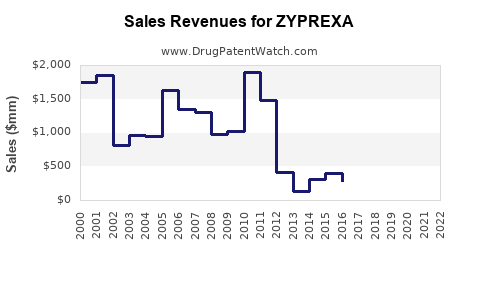
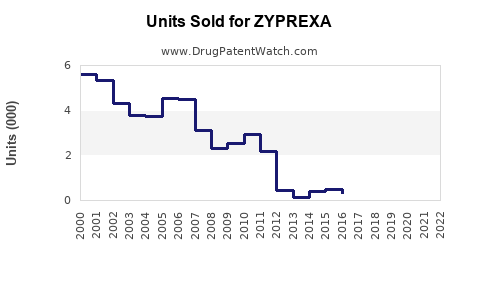
Annual Sales Revenues and Units Sold for ZYPREXA
| Drug Name | Revenues (USD) | Units | Year |
|---|---|---|---|
| ZYPREXA | ⤷ Start Trial | ⤷ Start Trial | 2022 |
| ZYPREXA | ⤷ Start Trial | ⤷ Start Trial | 2021 |
| ZYPREXA | ⤷ Start Trial | ⤷ Start Trial | 2020 |
| ZYPREXA | ⤷ Start Trial | ⤷ Start Trial | 2019 |
| ZYPREXA | ⤷ Start Trial | ⤷ Start Trial | 2018 |
| ZYPREXA | ⤷ Start Trial | ⤷ Start Trial | 2017 |
| ZYPREXA | ⤷ Start Trial | ⤷ Start Trial | 2016 |
| >Drug Name | >Revenues (USD) | >Units | >Year |
Zyprexa Market Analysis, Sales Projections, Patent Expiry, and Competitive Outlook
Zyprexa, Eli Lilly’s olanzapine brand, is a mature antipsychotic franchise with limited branded growth potential. The core oral product lost U.S. market exclusivity more than a decade ago, and generic olanzapine now controls most prescription volume. Commercial value remains in global generic sales, olanzapine pamoate long-acting injectable products, branded-market residual demand, and potential new delivery technologies.
A reasonable base-case forecast places the global olanzapine market at approximately $2.0 billion to $2.5 billion in 2024, rising to roughly $2.3 billion to $3.0 billion by 2030 at a 2% to 4% compound annual growth rate. Most growth should come from volume, emerging-market access, and long-acting formulations rather than price expansion. Eli Lilly’s direct Zyprexa revenue is expected to remain a small fraction of the historical peak.
What is Zyprexa and how large is the olanzapine market?
Zyprexa is the brand name for olanzapine, an atypical antipsychotic approved for schizophrenia and bipolar I disorder. The product is available in several formulations:
- Immediate-release oral tablets
- Orally disintegrating tablets marketed as Zyprexa Zydis
- Intramuscular olanzapine pamoate marketed as Zyprexa Relprevv in the United States
- Generic oral olanzapine tablets and orally disintegrating tablets
- Generic or locally branded long-acting injectable olanzapine products in selected markets
Olanzapine competes with risperidone, quetiapine, aripiprazole, lurasidone, ziprasidone, paliperidone, cariprazine, and clozapine. Its clinical use is supported by broad efficacy across schizophrenia and bipolar disorder, but its metabolic adverse-effect profile limits use in some patients.
The market has two distinct economic segments:
| Segment | Commercial status | Main value driver |
|---|---|---|
| Oral olanzapine | Predominantly generic | Prescription volume and low-cost access |
| Long-acting injectable olanzapine | Brand and specialty products | Adherence, administration services, and reimbursement |
| Orally disintegrating olanzapine | Generic and branded | Administration convenience |
| Combination use in bipolar disorder | Generic and branded | Treatment duration and diagnosis growth |
| Emerging delivery technologies | Early-stage | Longer dosing intervals and differentiated safety |
Global market estimates vary because some sources include only branded products while others include all generic olanzapine sales. The more useful commercial measure is total product value across oral and injectable formulations.
How much did Zyprexa generate, and what are the sales projections?
Zyprexa was one of Lilly’s largest products before loss of exclusivity. Global sales reached approximately $4.9 billion in 2010, according to Lilly’s annual reporting. U.S. generic entry began in late 2011, producing a rapid decline in branded revenue.[1]
The historical revenue trajectory was approximately:
| Period | Commercial event | Revenue impact |
|---|---|---|
| 1996-2007 | U.S. and international brand expansion | Rapid growth |
| 2007-2010 | Mature branded franchise | Revenue near historical peak |
| 2011 | U.S. patent expiry and generic entry | Sharp erosion |
| 2012-2015 | Broad generic substitution | Steep decline in branded sales |
| 2016 onward | Mature generic market | Residual branded and injectable demand |
| 2024-2030 | Stable to low-growth market | Volume-led expansion |
Lilly’s Zyprexa revenue is no longer comparable with the pre-2011 franchise peak. Public company reporting has increasingly grouped mature products, regional revenues, and alliance economics differently from the historical Zyprexa disclosures. As a result, total olanzapine market value is a more reliable forecasting basis than Lilly-branded revenue alone.
Base-case sales projection
The following forecast estimates total global olanzapine product sales, including generic oral products and long-acting injectable formulations:
| Year | Bear case | Base case | Bull case |
|---|---|---|---|
| 2024 | $1.8 billion | $2.2 billion | $2.5 billion |
| 2025 | $1.8 billion | $2.3 billion | $2.6 billion |
| 2026 | $1.9 billion | $2.4 billion | $2.7 billion |
| 2027 | $1.9 billion | $2.5 billion | $2.8 billion |
| 2028 | $2.0 billion | $2.6 billion | $2.9 billion |
| 2029 | $2.0 billion | $2.7 billion | $3.0 billion |
| 2030 | $2.1 billion | $2.8 billion | $3.1 billion |
The base case assumes 2.7% annual growth. The bear case reflects continued oral price deflation, weak branded injectable uptake, and increasing competition from aripiprazole and risperidone long-acting products. The bull case assumes greater use of long-acting injectable therapy, increased diagnosis and treatment in emerging markets, and stable reimbursement for specialty formulations.
These are market-level projections, not a forecast of Lilly’s reported Zyprexa revenue. Lilly’s direct branded share should remain substantially below the market’s total value because generic oral olanzapine dominates most mature markets.
When did Zyprexa lose exclusivity?
The principal U.S. compound patent covering olanzapine was U.S. Patent No. 5,229,382, assigned to Eli Lilly and Company. The patent was filed in 1990 and expired in 2011 after patent-term adjustment and pediatric exclusivity considerations.[2]
The key exclusivity milestones were:
| Milestone | Date or period |
|---|---|
| U.S. approval of Zyprexa | 1996 |
| Core U.S. compound patent expiration | 2011 |
| First broad U.S. generic entry | Late 2011 |
| Loss of practical oral-brand exclusivity | 2012 onward |
| Current status | Generic-dominated |
Patent expiry removed the principal barrier to generic immediate-release tablets. Later formulation and use patents did not restore broad exclusivity for the core oral product.
What patents protect Zyprexa and olanzapine formulations?
The core patent estate included compound protection for olanzapine and additional patents covering formulation, dosage forms, and manufacturing concepts. The commercially relevant U.S. patents are expired or no longer provide meaningful blocking protection for standard oral olanzapine.
Core compound patent
U.S. Patent No. 5,229,382 covered olanzapine and related chemical subject matter. It was the principal patent supporting Zyprexa’s original U.S. exclusivity. Its expiration enabled generic competition.
Orally disintegrating tablets
Zyprexa Zydis used an orally disintegrating dosage form designed to dissolve rapidly in the mouth. Product-specific formulation patents and regulatory exclusivities provided additional protection, but the commercial value of those protections has largely expired. Generic orally disintegrating olanzapine is available in the United States.
Long-acting injectable formulation
Zyprexa Relprevv contains olanzapine pamoate and is administered by intramuscular injection. The product has a different commercial and regulatory profile from oral olanzapine. The most important barriers are now:
- Clinical and regulatory requirements for long-acting injectable approval
- Post-injection delirium/sedation monitoring requirements
- Manufacturing scale and suspension stability
- Provider workflow and reimbursement
- Patient adherence and acceptance
- Competing long-acting antipsychotics
The long-acting injectable segment is protected more by formulation complexity, clinical infrastructure, and regulatory controls than by the expired patents covering oral olanzapine.
What is the FDA regulatory status of Zyprexa?
The FDA approved Zyprexa for schizophrenia in 1996 and later expanded its labeling to include bipolar I disorder and manic or mixed episodes. Zyprexa Zydis received approval as an orally disintegrating formulation. Zyprexa Relprevv was approved for the treatment of schizophrenia in adults.[3]
The principal regulatory issue for Zyprexa Relprevv is post-injection delirium/sedation syndrome, a rare but serious adverse event associated with inadvertent intravascular entry or rapid systemic exposure. The FDA requires a risk-management program involving:
- Administration by a registered healthcare professional
- Observation in a certified facility
- Post-injection monitoring
- Patient release procedures
- Reporting and management of suspected adverse events
This requirement raises the cost of care and limits adoption relative to simpler long-acting injectable products.
What is the Orange Book status of Zyprexa?
The FDA Orange Book historically listed Zyprexa patents covering olanzapine and certain dosage forms. The core listed patents have expired, and generic olanzapine products have been approved through abbreviated new drug applications.
For standard oral olanzapine, the Orange Book no longer creates a meaningful barrier to generic entry. A company seeking to launch a competing oral product generally faces established generic competition rather than a new Paragraph IV patent dispute against the original compound patent.
For injectable or specialized products, Orange Book-listed patents and regulatory exclusivities may differ by product, strength, formulation, and sponsor. A patent review must therefore be performed at the individual product level rather than by relying on Zyprexa’s historical compound patent.
Which companies are challenging Zyprexa, and what is the Paragraph IV risk?
The principal generic challengers entered through abbreviated new drug applications rather than through a current, commercially significant patent campaign. Early generic manufacturers included Teva, Dr. Reddy’s Laboratories, Sandoz, Mylan, and other generic companies, depending on dosage form and jurisdiction.
The major Paragraph IV risk occurred before the 2011 loss of exclusivity. After expiration of the principal compound patent, the litigation value of challenging Zyprexa patents declined sharply.
Current competitive risk is different:
- Generic companies compete on price and supply reliability.
- Specialty companies compete in long-acting injectable formulations.
- Branded antipsychotic manufacturers compete for prescriber preference.
- Developers of once-monthly and longer-interval injectables compete for adherence-focused treatment.
- Biosimilar competition is not relevant to olanzapine because Zyprexa is a small-molecule drug, not a biologic.
What patent litigation affects Zyprexa?
The most important historical litigation involved Lilly’s efforts to protect Zyprexa from generic entry. In 2005, the U.S. Court of Appeals for the Federal Circuit upheld the validity of Lilly’s olanzapine patent in litigation involving generic challengers.[4] That ruling delayed generic competition until the patent expired.
After generic entry, litigation shifted from the core compound patent to commercial disputes involving labeling, formulation claims, and product-specific patents. These disputes did not preserve broad exclusivity for oral Zyprexa.
There is no current litigation structure comparable to a newly launched branded medicine with unexpired composition-of-matter protection. The commercial question is generic pricing and injectable differentiation, not preservation of the original oral franchise.
How strong is the Zyprexa patent estate?
The patent estate is weak for standard oral olanzapine and stronger for complex delivery systems.
| Area | Patent strength | Commercial assessment |
|---|---|---|
| Oral olanzapine tablets | Low | Broad generic competition |
| Orally disintegrating tablets | Low to moderate | Formulation differentiation largely eroded |
| Olanzapine pamoate injection | Moderate | Technical and regulatory barriers remain |
| New depot formulations | Potentially strong | Depends on new formulation claims |
| Manufacturing processes | Moderate | May create supplier or process advantages |
| Method-of-use claims | Low to moderate | Narrow scope and difficult enforcement |
Method-of-use patents may cover treatment populations, dosing schedules, or combination therapy. Their value is limited when physicians can prescribe generic olanzapine for the same underlying disease under broad treatment indications.
What generic entry risks exist for Zyprexa?
Generic entry risk is already realized for the oral product. The remaining commercial risks are erosion of residual branded demand and substitution within the injectable segment.
The principal risks are:
- Continued price compression in oral tablets.
- Additional generic entrants that reduce supply-constrained pricing.
- Competitive long-acting products with easier administration.
- Hospital and payer preference for lower-cost alternatives.
- Increased use of aripiprazole, paliperidone, and risperidone injectables.
- Safety-driven prescribing shifts away from metabolically burdensome antipsychotics.
- Reduced use of branded Zydis where generic orally disintegrating products are available.
The main upside is patient adherence. Long-acting treatment can reduce missed doses in selected patients, but the Relprevv monitoring burden constrains widespread use.
How does Zyprexa compare with competing antipsychotics?
| Drug | Company or major sponsors | Formulation advantage | Main commercial issue |
|---|---|---|---|
| Olanzapine | Eli Lilly originator; generics | Broad efficacy and oral plus injectable forms | Metabolic risk and generic pricing |
| Risperidone | Janssen originator; generics | Established long-acting injectable use | Mature competition |
| Paliperidone | Johnson & Johnson | Monthly and longer-interval injections | Higher branded cost |
| Aripiprazole | Otsuka, Lundbeck, generics | Favorable metabolic profile and long-acting options | Strong competitive positioning |
| Quetiapine | AstraZeneca originator; generics | Broad oral use, sedation in some settings | Heavy generic erosion |
| Lurasidone | Sumitomo Pharma and generics | Bipolar depression positioning | Generic competition in several markets |
| Cariprazine | AbbVie and partners | Bipolar and schizophrenia positioning | Higher branded price |
| Clozapine | Multiple manufacturers | Treatment-resistant schizophrenia | Monitoring burden and safety risks |
Olanzapine retains clinical demand because of efficacy and familiarity. Its commercial disadvantage is the metabolic adverse-effect profile, including weight gain, dyslipidemia, and hyperglycemia. Aripiprazole and newer agents can gain share when prescribers prioritize lower metabolic risk.
What licensing deals affect Zyprexa?
The original Zyprexa franchise was developed and commercialized by Eli Lilly. No current licensing arrangement is required to explain the mature oral olanzapine market. Regional commercialization, generic supply agreements, and distribution arrangements may exist, but they generally do not create a material barrier to competition.
Licensing value is more relevant to new olanzapine delivery technologies. A differentiated formulation could attract a partner if it demonstrates:
- Longer dosing intervals
- Reduced post-injection monitoring
- Lower peak-related adverse events
- Improved adherence
- Better reimbursement economics
- Patent protection extending beyond the legacy compound
What are the revenue exposure and launch scenarios?
For Eli Lilly, Zyprexa is no longer a major growth driver. The brand’s financial exposure is concentrated in residual international sales, specific formulations, and any remaining commercial value from long-acting injectable products.
Generic launch scenario
A new oral generic entrant would face a low-value market with established competitors. The likely outcome would be:
- Rapid pharmacy substitution
- Declining net prices
- Low market share without supply or contracting advantages
- Limited opportunity for meaningful long-term profit
Specialty injectable scenario
A differentiated long-acting injectable could produce a more attractive launch profile. A successful product would need to overcome the operational disadvantages of Zyprexa Relprevv and demonstrate an advantage over paliperidone and aripiprazole injectables.
Market growth scenario
The strongest market expansion case depends on increased diagnosis and treatment of schizophrenia and bipolar disorder, broader access in emerging economies, and greater use of long-acting treatment. These factors can increase total olanzapine volume even while oral pricing declines.
What is the geographic outlook for olanzapine?
North America and Western Europe are mature, generic-dominated markets. Revenue growth is more likely in Asia-Pacific, Latin America, the Middle East, and parts of Eastern Europe, where treatment access and diagnosed populations can expand.
| Region | Outlook |
|---|---|
| United States | Mature generic market; injectable specialty opportunity |
| Western Europe | Strong generic penetration; payer price pressure |
| Japan | Mature market with regulated pricing |
| China | Volume growth potential and intense local competition |
| India | Large generic supply base and low pricing |
| Latin America | Access expansion with variable reimbursement |
| Middle East and Africa | Low current penetration but access-driven growth potential |
Key Takeaways
- Zyprexa is olanzapine, an atypical antipsychotic developed by Eli Lilly.
- The core U.S. olanzapine patent, U.S. Patent No. 5,229,382, expired in 2011.
- Oral Zyprexa has no meaningful remaining exclusivity against generic competition.
- Total global olanzapine market value is estimated at approximately $2.0 billion to $2.5 billion in 2024.
- A base-case forecast reaches approximately $2.8 billion by 2030.
- Growth should come from volume, emerging markets, and long-acting injectable products.
- Lilly’s branded Zyprexa revenue is materially below its approximately $4.9 billion historical peak.
- Biosimilar risk does not apply because olanzapine is a small-molecule drug.
- The strongest remaining commercial barriers are formulation complexity, manufacturing, monitoring, reimbursement, and provider workflow.
- Aripiprazole, paliperidone, and risperidone long-acting products are the most important competitive threats.
- The oral generic market offers limited launch economics; differentiated injectable products offer the stronger strategic opportunity.
Frequently Asked Questions
Is Zyprexa still under patent protection?
The principal compound patent covering olanzapine expired in 2011. Standard oral olanzapine is now broadly generic.
What is the difference between Zyprexa and olanzapine?
Zyprexa is Eli Lilly’s brand name. Olanzapine is the active pharmaceutical ingredient used in Zyprexa and generic products.
Is Zyprexa Relprevv a biosimilar product?
No. Zyprexa Relprevv is a small-molecule long-acting injectable formulation of olanzapine pamoate. It is not a biologic and is not regulated through the biosimilar pathway.
Which antipsychotic competes most directly with Zyprexa?
Aripiprazole is a major direct competitor because it has oral and long-acting injectable formulations and is often viewed as having a more favorable metabolic profile. Paliperidone and risperidone are also important injectable competitors.
Can a new olanzapine formulation obtain patent protection?
Yes. A new formulation, delivery system, manufacturing process, or dosing regimen may qualify for patent protection if it meets novelty, non-obviousness, and written-description requirements. Such protection would generally be narrower than the expired compound patent.
References
- Eli Lilly and Company. (2011). 2011 annual report. Eli Lilly and Company.
- U.S. Patent and Trademark Office. (1993). U.S. Patent No. 5,229,382: Thienobenzodiazepine derivatives.
- U.S. Food and Drug Administration. (2024). Zyprexa prescribing information.
- Eli Lilly & Co. v. Teva Parenteral Medicines, Inc., 465 F.3d 1331 (Fed. Cir. 2006).
More… ↓
