Share This Page
Drug Sales Trends for XYZAL
✉ Email this page to a colleague
Payment Methods and Pharmacy Types for XYZAL (2010)
Revenues by Pharmacy Type
Units Sold by Pharmacy Type
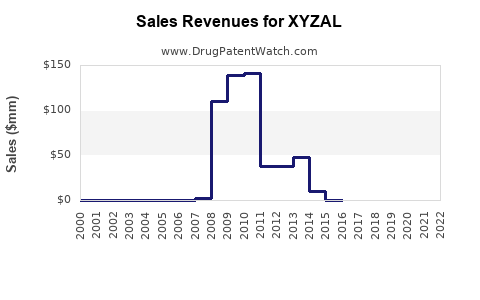
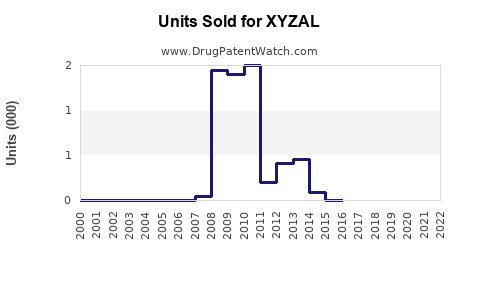
Annual Sales Revenues and Units Sold for XYZAL
| Drug Name | Revenues (USD) | Units | Year |
|---|---|---|---|
| XYZAL | ⤷ Start Trial | ⤷ Start Trial | 2022 |
| XYZAL | ⤷ Start Trial | ⤷ Start Trial | 2021 |
| XYZAL | ⤷ Start Trial | ⤷ Start Trial | 2020 |
| XYZAL | ⤷ Start Trial | ⤷ Start Trial | 2019 |
| XYZAL | ⤷ Start Trial | ⤷ Start Trial | 2018 |
| >Drug Name | >Revenues (USD) | >Units | >Year |
XYZAL (Levocetirizine) Market Analysis, Patent Position and Sales Projections
XYZAL is the branded version of levocetirizine, a second-generation oral antihistamine used for allergic rhinitis and chronic urticaria. Its commercial profile is mature and largely driven by over-the-counter demand, retailer distribution, seasonal allergy intensity, advertising, and price positioning rather than regulatory exclusivity.
The base-case outlook is for low-single-digit annual decline in U.S. branded sales, offset partly by international growth and expanded generic levocetirizine consumption. A reasonable modeled range for global XYZAL-branded manufacturer sales is approximately $180 million to $250 million in 2025, declining to $145 million to $215 million by 2029. These are analytical estimates, not reported company guidance. Sanofi does not separately disclose XYZAL revenue in its public financial reporting.[1]
What is XYZAL and how does it compete?
XYZAL contains levocetirizine dihydrochloride, the active R-enantiomer of cetirizine. It is marketed as a once-daily antihistamine for relief of symptoms associated with hay fever and indoor or outdoor allergies.
| Attribute | XYZAL |
|---|---|
| Active ingredient | Levocetirizine dihydrochloride |
| Drug class | Second-generation H1 antihistamine |
| Primary indications | Allergic rhinitis; chronic idiopathic urticaria |
| Typical adult dose | 5 mg once daily |
| U.S. regulatory status | Over-the-counter |
| U.S. prescription approval | 2007 |
| U.S. OTC switch | 2017 |
| Main competitors | Zyrtec, Claritin, Allegra, generic cetirizine, generic loratadine, generic fexofenadine |
| Primary dosage forms | Tablets, oral solution, children’s formulations |
| Biosimilar exposure | None |
| Current commercial risk | Generic substitution and brand-price competition |
The product competes on 24-hour symptom relief, perceived effectiveness, and brand recognition. Its pharmacological relationship with cetirizine creates a major commercial advantage for consumer awareness but also limits differentiation. Consumers can generally substitute among levocetirizine, cetirizine, loratadine, and fexofenadine products.
How large is the XYZAL market?
The relevant market is the broader oral allergy-relief category, not levocetirizine alone. The category includes branded and generic antihistamines sold through pharmacies, mass retailers, grocery stores, club stores, e-commerce platforms, and health-care providers.
U.S. allergy medicine demand has several structural characteristics:
- Demand is seasonal, with a major spring and early-summer peak.
- Indoor allergy products support a second demand cycle during fall and winter.
- OTC conversion increased consumer access but reduced prescription-channel pricing.
- Private-label products exert sustained price pressure.
- Retail media and search advertising influence product selection.
- Product availability and shelf placement are major volume drivers.
XYZAL occupies a middle position between premium brands and low-priced store brands. Zyrtec has stronger direct association with cetirizine-based allergy relief, while Claritin and Allegra maintain broad household recognition. XYZAL’s position depends on maintaining awareness of levocetirizine as a distinct active ingredient despite its relationship to cetirizine.
Estimated 2025 U.S. oral antihistamine market
| Segment | Estimated 2025 U.S. retail sales | Market characteristics |
|---|---|---|
| Branded oral antihistamines | $1.5 billion-$2.0 billion | Higher prices, advertising-led |
| Store-brand and generic oral antihistamines | $1.5 billion-$2.3 billion | High unit volume, low price |
| Total oral antihistamine category | $3.0 billion-$4.3 billion | Highly mature market |
| Branded XYZAL | $80 million-$125 million | Seasonal, price-sensitive |
| Generic levocetirizine | $100 million-$180 million | Fragmented across manufacturers |
These figures are modeled from category structure, brand maturity, generic penetration, and public-company disclosure patterns. They should not be treated as audited market-share measurements.
What are the XYZAL sales projections through 2029?
The base case assumes stable allergy prevalence, modest volume growth in international markets, continued U.S. generic substitution, and limited price increases. The projection covers branded XYZAL manufacturer sales, excluding generic levocetirizine and retailer private-label products.
Global XYZAL branded sales projection
| Year | Bear case | Base case | Bull case |
|---|---|---|---|
| 2024A estimated | $175 million | $215 million | $255 million |
| 2025E | $165 million | $210 million | $260 million |
| 2026E | $157 million | $206 million | $266 million |
| 2027E | $150 million | $202 million | $272 million |
| 2028E | $143 million | $198 million | $279 million |
| 2029E | $137 million | $194 million | $287 million |
| 2025-2029 CAGR | -4.5% | -1.9% | 2.5% |
The base case reflects a mature product with limited ability to expand U.S. penetration. The bull case requires sustained international growth, stronger e-commerce execution, effective consumer advertising, and limited erosion from store brands. The bear case assumes accelerated private-label conversion and weaker brand support.
Regional sales outlook
| Region | 2025 outlook | 2025-2029 expectation |
|---|---|---|
| United States | Largest single market; mature OTC demand | Low-single-digit decline |
| Western Europe | Established prescription and OTC markets | Flat to low-single-digit growth |
| Central and Eastern Europe | Broader pharmacy access and price sensitivity | Low- to mid-single-digit growth |
| Asia-Pacific | Variable regulatory and distribution conditions | Mid-single-digit growth from smaller base |
| Latin America | Brand and pharmacy-driven demand | Low- to mid-single-digit growth |
| Middle East and Africa | Smaller, distributor-dependent markets | Uneven growth |
The U.S. remains strategically important but is unlikely to be the main source of long-term volume growth. International performance depends on local brand ownership, OTC classification, reimbursement, pharmacy access, and local generic competition.
When did XYZAL lose prescription exclusivity?
XYZAL no longer has meaningful U.S. prescription exclusivity. The FDA approved levocetirizine for prescription use in 2007, and generic versions became available after the relevant patent and regulatory barriers expired.[2]
The 2017 OTC switch materially changed the product economics. Sanofi’s consumer-health business obtained authorization to market XYZAL directly to consumers without a prescription. OTC status increased addressable demand but placed the product in a more competitive, lower-priced environment.[3]
| Milestone | Approximate date | Commercial effect |
|---|---|---|
| Levocetirizine developed for allergy treatment | 1990s | Established active ingredient |
| U.S. FDA prescription approval | 2007 | Initial prescription commercialization |
| Generic levocetirizine entry | Post-exclusivity period | Increased substitution |
| U.S. OTC switch | 2017 | Expanded consumer access |
| Current status | 2025 | Mature OTC brand with generic competition |
What patents protect XYZAL?
The core active-ingredient patent estate is expired or commercially exhausted in the United States. Levocetirizine is a small molecule, so the product does not have biologic exclusivity or biosimilar protection.
Historical U.S. intellectual-property coverage centered on levocetirizine and related cetirizine chemistry. Patent protection for the active ingredient did not create a durable barrier after generic entry. Any remaining commercial protection is more likely to arise from trademarks, packaging, formulation differentiation, manufacturing know-how, and distribution contracts than from an enforceable core-molecule patent.
Does XYZAL have active Orange Book protection?
XYZAL’s current OTC status limits the practical importance of the prescription Orange Book. The product is not commercially protected in the same manner as a new prescription drug with active listed patents and regulatory exclusivity.
Generic levocetirizine products have competed in the United States, and the relevant market is governed primarily by abbreviated new drug approval, OTC distribution, pricing, and substitution. The principal commercial defense is brand equity rather than an active Orange Book patent barrier.
Are formulation patents important for XYZAL?
Formulation patents are not expected to create a substantial barrier for standard 5 mg levocetirizine tablets. The product has a conventional oral dosage form and no highly specialized delivery technology.
Potentially differentiated products include:
- Children’s oral solutions.
- Sugar-free liquids.
- Rapid-dissolve or orally disintegrating tablets.
- Combination allergy products.
- Packaging designed for seasonal or family use.
These features may support product segmentation but generally do not prevent substitution with generic tablets or other oral antihistamines. The commercial value of a formulation depends on consumer preference, retailer placement, and regulatory approval rather than on the presence of a complex delivery platform.
Which companies challenge XYZAL commercially?
XYZAL competes with both branded manufacturers and generic drug companies.
| Competitor | Company or supplier group | Competitive strength |
|---|---|---|
| Zyrtec | Haleon | Strong cetirizine recognition and retail distribution |
| Claritin | Bayer | Broad household awareness and long OTC history |
| Allegra | Opella/Sanofi in relevant markets | Non-drowsy positioning and strong brand recognition |
| Generic cetirizine | Multiple manufacturers | Low price and broad availability |
| Generic loratadine | Multiple manufacturers | Established substitution option |
| Generic fexofenadine | Multiple manufacturers | Non-drowsy positioning |
| Store brands | CVS, Walgreens, Walmart, Amazon and others | Lowest-price positioning |
The most direct product-level competition comes from generic levocetirizine and cetirizine. The broader competitive threat comes from products marketed as non-drowsy or long-lasting allergy treatments.
What generic entry risks exist for XYZAL?
Generic entry risk is high because:
- The active ingredient is well established.
- The principal tablet dosage form is relatively simple.
- Prescribers and consumers recognize therapeutic alternatives.
- OTC shoppers are highly price-sensitive.
- Retailers can shift shelf space toward private-label products.
- The active ingredient has no biologic manufacturing complexity.
Generic substitution is more damaging to volume and pricing than to overall category demand. Patients who switch from XYZAL to generic levocetirizine usually remain in the antihistamine category.
The largest risk is not a sudden loss of all demand. It is gradual deterioration in branded unit volume, promotional efficiency, and retailer willingness to carry premium-priced SKUs.
What is the FDA regulatory status of XYZAL?
XYZAL is an FDA-authorized OTC allergy medicine in the United States. The OTC switch allows consumers to purchase the product without a prescription, subject to applicable labeling and dosage requirements.[3]
The regulatory profile is favorable because:
- The active ingredient has extensive clinical use.
- The indication is well established.
- The product is not dependent on a narrow specialty indication.
- Manufacturing does not require biologic controls.
- No biosimilar pathway is relevant.
- Regulatory risk is concentrated in labeling, quality, manufacturing, and post-market compliance.
Potential regulatory risks include advertising claims, pediatric dosing presentation, manufacturing deviations, supply interruptions, and changes to OTC labeling requirements.
How strong is the XYZAL patent and commercial estate?
The patent estate is weak as a standalone barrier. The commercial estate is moderate because the brand has consumer recognition, established distribution, and a differentiated product identity.
| Estate component | Strength | Assessment |
|---|---|---|
| Core molecule patent | Low | Expired or no longer commercially exclusionary |
| Prescription exclusivity | None material | Product is mature and OTC |
| Formulation protection | Low to moderate | Limited relevance for standard tablets |
| Trademark | Moderate to strong | Supports premium positioning |
| Retail distribution | Moderate | Depends on shelf space and retailer terms |
| Consumer awareness | Moderate | Below or comparable with major category brands depending on market |
| Manufacturing barrier | Low | Conventional small-molecule production |
| International rights | Variable | Depends on country-level registrations and ownership |
| Litigation leverage | Low | No obvious high-value patent dispute driver |
What revenue exposure does XYZAL create?
For the brand owner, XYZAL is a mature consumer-health asset rather than a high-growth prescription product. Revenue exposure is concentrated in:
- Spring and summer allergy seasons.
- U.S. mass retail and pharmacy channels.
- Consumer advertising efficiency.
- Retailer inventory decisions.
- Raw-material and finished-product availability.
- Price gaps versus generic levocetirizine and cetirizine.
The product can generate dependable cash flow, but it is unlikely to produce significant revenue expansion without line extensions, geographic expansion, or a stronger premium proposition.
A 10% decline in branded XYZAL sales would have limited effect on a diversified multinational consumer-health portfolio, but could materially affect a brand-level licensing valuation. The more relevant valuation metrics are gross margin, advertising spending, repeat purchase, retailer concentration, and international rights.
What generic launch scenarios are most likely?
Base-case scenario
Generic levocetirizine gains incremental share, while XYZAL retains a premium segment through brand recognition and advertising. Branded sales decline approximately 1% to 3% annually.
Downside scenario
Retailers expand private-label shelf space, consumer advertising weakens, and the price gap exceeds 30% to 40%. Branded sales decline approximately 4% to 6% annually.
Upside scenario
The brand owner expands e-commerce distribution, improves family and pediatric offerings, and grows in markets where levocetirizine remains less commoditized. Sales are flat to modestly positive.
How does XYZAL compare with Zyrtec, Claritin and Allegra?
| Factor | XYZAL | Zyrtec | Claritin | Allegra |
|---|---|---|---|---|
| Active ingredient | Levocetirizine | Cetirizine | Loratadine | Fexofenadine |
| Brand maturity | Mature | Very mature | Very mature | Mature |
| Generic pressure | High | High | High | High |
| Consumer positioning | 24-hour allergy relief | Strong cetirizine efficacy recognition | Non-drowsy, broad household awareness | Non-drowsy positioning |
| Main advantage | Levocetirizine brand identity | Category leadership | Brand reach | Differentiated consumer perception |
| Main weakness | Limited differentiation from alternatives | Generic substitution | Intense category competition | Premium-price pressure |
XYZAL’s commercial challenge is that its clinical proposition is credible but not difficult to replicate. Its future depends on execution in branding, distribution, pricing, and product formats.
Key Takeaways
- XYZAL is a mature OTC levocetirizine brand with high generic exposure.
- U.S. prescription exclusivity is no longer a meaningful commercial barrier.
- The product has no biosimilar risk because levocetirizine is a small molecule.
- Core patent protection is expired or commercially exhausted.
- Branded global sales are modeled at approximately $180 million to $250 million in 2025.
- Base-case branded sales decline approximately 2% annually through 2029.
- Generic levocetirizine and private-label products are the main threats.
- Trademark strength, retail distribution, and consumer advertising matter more than patent protection.
- International markets offer the clearest path to growth.
- Standard tablets have limited formulation-based defensibility.
Frequently Asked Questions
Is XYZAL still a profitable product?
Yes. XYZAL can remain profitable as a mature OTC brand because manufacturing costs are relatively low and consumer demand is recurring. Profitability depends on advertising, retailer pricing, and the spread between branded and generic products.
Is levocetirizine the same as cetirizine?
No. Levocetirizine is the R-enantiomer of cetirizine. The two products are closely related pharmacologically, but they are separate active ingredients and are marketed under different generic names.
Can a company launch a generic version of XYZAL?
Yes. Companies can market generic levocetirizine after satisfying applicable FDA approval and quality requirements. Generic competition already limits XYZAL’s pricing power.
Does XYZAL have biosimilar competition?
No. Biosimilar regulation applies to biologic products. XYZAL is a conventional small-molecule drug and faces generic, not biosimilar, competition.
What would increase XYZAL’s sales?
The strongest growth levers are international expansion, improved e-commerce conversion, children’s and liquid formulations, retail distribution, targeted seasonal advertising, and a controlled premium over generic levocetirizine.
References
- Sanofi. (2024). Universal registration document and annual financial report 2023. Sanofi.
- U.S. Food and Drug Administration. (2007). FDA approves Xyzal for treatment of seasonal and perennial allergic rhinitis. FDA.
- U.S. Food and Drug Administration. (2017). Drug products containing levocetirizine: Prescription-to-over-the-counter switch materials. FDA.
- U.S. Food and Drug Administration. (2024). Drugs@FDA: FDA-approved drugs database. FDA.
- IQVIA. (2024). The global use of medicines and consumer health products: Market outlook through 2028. IQVIA Institute for Human Data Science.
More… ↓
