Drug Sales Trends for Trileptal
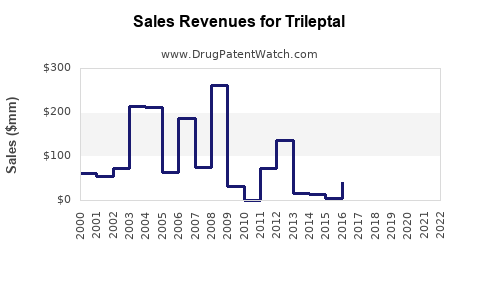
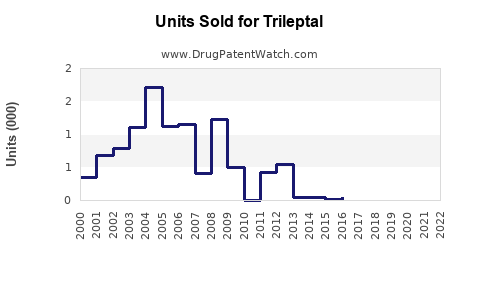
Annual Sales Revenues and Units Sold for Trileptal
| Drug Name | Revenues (USD) | Units | Year |
|---|---|---|---|
| TRILEPTAL | ⤷ Start Trial | ⤷ Start Trial | 2022 |
| TRILEPTAL | ⤷ Start Trial | ⤷ Start Trial | 2021 |
| TRILEPTAL | ⤷ Start Trial | ⤷ Start Trial | 2020 |
| TRILEPTAL | ⤷ Start Trial | ⤷ Start Trial | 2019 |
| TRILEPTAL | ⤷ Start Trial | ⤷ Start Trial | 2018 |
| TRILEPTAL | ⤷ Start Trial | ⤷ Start Trial | 2017 |
| TRILEPTAL | ⤷ Start Trial | ⤷ Start Trial | 2016 |
| >Drug Name | >Revenues (USD) | >Units | >Year |
Trileptal Market Analysis, Sales Forecast, Patent Status, and Generic Competition
Trileptal (oxcarbazepine) is a mature antiepileptic drug with limited branded revenue potential and a large, price-sensitive generic market. The U.S. product has no meaningful remaining regulatory exclusivity, its core patent protection has expired, and generic oxcarbazepine has been available for more than 15 years. Future market value will come primarily from generic volume, chronic epilepsy treatment demand, and use in oral suspension and extended-release formulations rather than from Novartis-branded Trileptal.
A reasonable base-case projection is for global oxcarbazepine drug spending to remain broadly stable to modestly higher through 2030, while average selling prices decline. The market is likely to grow at approximately 1% to 3% annually in nominal terms, with unit demand growing faster than revenue in lower-price generic markets.
What is Trileptal and how large is its addressable market?
Trileptal is the branded formulation of oxcarbazepine, an oral sodium-channel antiepileptic used mainly for partial-onset seizures. The FDA approved Trileptal in 2000 for adults and children with partial seizures. It is marketed in immediate-release tablets and oral suspension. Oxcarbazepine extended-release tablets are marketed separately in the U.S. under Oxtellar XR, originally developed by Supernus Pharmaceuticals.
The principal market segments are:
| Segment | Commercial position | Outlook |
|---|---|---|
| Trileptal brand | Mature, low-share product | Continued decline or limited residual sales |
| Generic oxcarbazepine tablets | Main U.S. volume segment | Stable to modest volume growth |
| Generic oral suspension | Smaller, higher-value niche | Positive growth from pediatric and adherence use |
| Oxcarbazepine extended release | Separate branded/generic segment | More defensible pricing than immediate release |
| Hospital and institutional supply | Low-price channel | Stable demand, competitive tenders |
Oxcarbazepine competes with carbamazepine, levetiracetam, lamotrigine, lacosamide, topiramate, and other antiseizure medicines. Newer agents have captured prescribing share because of dosing convenience, interaction profiles, and broader physician familiarity. Oxcarbazepine remains relevant where clinicians seek an established sodium-channel mechanism and where generic pricing is important.
How much did Trileptal historically sell?
Trileptal generated meaningful sales for Novartis before generic entry. Its commercial peak occurred before 2007, when the product faced limited generic competition and held a stronger position in partial-onset epilepsy.
After U.S. generic entry, the brand experienced the standard mature-product pattern:
- Rapid erosion in prescriptions.
- Lower reimbursement and formulary preference.
- Reduced physician and pharmacy substitution resistance.
- Concentration of remaining sales in patients or markets where brand continuity is preserved.
Novartis does not consistently disclose Trileptal as a separately reported major product in recent annual reports. This prevents a reliable current worldwide brand-sales figure from public company reporting. The commercial conclusion is clear: Trileptal is no longer a material growth product for Novartis, while oxcarbazepine remains an active generic pharmaceutical market.
What are the current Trileptal sales projections through 2030?
The following projection separates branded Trileptal from the total oxcarbazepine market. It is a scenario model based on product maturity, generic availability, stable epilepsy prevalence, price erosion, and the absence of a new exclusivity event.
Base-case market projection
| Year | Branded Trileptal revenue trend | Total oxcarbazepine market trend | Main driver |
|---|---|---|---|
| 2024 | Low and declining | Baseline | Generic-dominated market |
| 2025 | -5% to -10% | 0% to 2% | Continued brand substitution |
| 2026 | -5% to -10% | 0% to 2% | Stable patient volume |
| 2027 | -3% to -8% | 1% to 3% | Growth in chronic treatment demand |
| 2028 | -3% to -8% | 1% to 3% | Suspension and emerging-market volume |
| 2029 | -2% to -7% | 1% to 3% | Mature generic market |
| 2030 | -2% to -7% | 1% to 3% | Volume offsets price erosion |
The forecast assumes no major product withdrawal, no material safety action, and continued availability of multiple generic suppliers. In nominal revenue terms, generic price competition will restrain growth. In unit terms, demand is more likely to be stable or modestly positive.
Bull and bear cases
| Scenario | 2030 market result | Key assumptions |
|---|---|---|
| Bull case | 3% to 5% annual market growth | Higher diagnosis rates, improved access, growth in pediatric suspension use |
| Base case | 1% to 3% annual growth | Stable prevalence and modest volume expansion |
| Bear case | -2% to 0% annual change | Greater substitution to levetiracetam and lamotrigine, aggressive price cuts |
Branded Trileptal revenue would remain negative in all three scenarios unless a company repositions the product through a new formulation, specialty distribution strategy, or geographic licensing transaction.
What patents protect Trileptal and when did exclusivity expire?
The principal U.S. composition and product protection for oxcarbazepine expired before the current generic market was established. The core U.S. patent associated with oxcarbazepine was U.S. Patent No. 5,216,164, which had an expiration date around 2010 after applicable patent-term adjustments and extensions. Generic approval occurred earlier through patent certifications and litigation resolution.
| IP or regulatory category | Trileptal position |
|---|---|
| Active ingredient patent | Expired |
| Original product patent | Expired |
| U.S. market exclusivity | Expired |
| Pediatric exclusivity | Expired |
| Immediate-release tablet protection | Expired or commercially ineffective |
| Oral suspension protection | No material blocking exclusivity identified |
| Method-of-use patents | No current blocking position evident for approved seizure use |
| Biosimilar exclusivity | Not applicable |
The relevant commercial question is not whether historical patents existed. It is whether an enforceable patent currently prevents generic oxcarbazepine competition. For immediate-release Trileptal, the answer is no.
What is the Orange Book status of Trileptal?
Trileptal is associated with FDA New Drug Application 020235. FDA Orange Book records distinguish the reference product from approved generic oxcarbazepine products. The core branded product does not have a current market-exclusivity position capable of preventing routine ANDA competition.
Generic manufacturers have used the abbreviated new drug application pathway to market oxcarbazepine tablets and oral suspension. Generic applicants generally rely on Paragraph III certifications for expired patents or Paragraph IV certifications where a listed patent is asserted to be invalid, unenforceable, or not infringed.
The practical Orange Book conclusion is:
- Trileptal remains the reference product.
- Generic oxcarbazepine is approved.
- Core patent barriers have expired.
- Brand-only pricing power is minimal.
- Any residual patent activity would likely concern a formulation or delivery modification rather than the original Trileptal product.
Which companies compete with Trileptal and generic oxcarbazepine?
The competitive landscape has two levels: direct oxcarbazepine suppliers and therapeutic substitutes.
Direct competitors
Generic oxcarbazepine has been supplied by multiple U.S. and international manufacturers, including large generic companies such as Apotex, Aurobindo, Glenmark, Lupin, Sandoz, Teva, and other FDA-approved applicants at different times. Supplier participation changes because of manufacturing economics, shortages, contract arrangements, and portfolio rationalization.
The branded extended-release competitor is Oxtellar XR, marketed by Supernus Pharmaceuticals. Oxtellar XR has a different release profile and may preserve higher net pricing than immediate-release oxcarbazepine, although it competes against both generic immediate-release products and other extended-release antiepileptics.
Therapeutic substitutes
| Drug | Competitive advantage over oxcarbazepine |
|---|---|
| Levetiracetam | Broad use, simple dosing, limited drug interactions |
| Lamotrigine | Broad epilepsy use and established maintenance role |
| Lacosamide | Newer mechanism and branded or specialty positioning |
| Carbamazepine | Low cost and long clinical history |
| Topiramate | Multiple indications and established generic supply |
| Valproate | Broad seizure activity, although safety restrictions affect use |
Oxcarbazepine retains an advantage in low-cost prescribing and in patients for whom sodium-channel therapy is clinically appropriate. It is less competitive where clinicians prioritize minimal interactions, psychiatric tolerability, or once-daily convenience.
What formulations are protected and where are the commercial opportunities?
Immediate-release tablets are the least defensible segment because they are commoditized and supplied by multiple generic manufacturers. The oral suspension is more attractive because manufacturing, stability, packaging, and pediatric dosing requirements create greater operational complexity.
Oral suspension
The suspension has a smaller market but can support better pricing than standard tablets. Demand comes from:
- Pediatric epilepsy treatment.
- Patients unable to swallow tablets.
- Dose titration.
- Long-term care and institutional use.
The main barriers are manufacturing consistency, suspension stability, dosing-device accuracy, and pharmacy substitution practices. These are commercial barriers rather than strong patent barriers.
Extended release
Extended-release oxcarbazepine has stronger product differentiation than immediate-release Trileptal. Release technology, tablet design, dissolution performance, and clinical dosing claims can support formulation patents. Oxtellar XR therefore has a more defensible commercial position than generic immediate-release oxcarbazepine, although its market remains exposed to therapeutic substitution and payer controls.
What generic entry risks exist for Trileptal?
Generic entry risk is already realized rather than prospective. The remaining risk is continued erosion of residual brand sales.
| Risk | Probability | Impact |
|---|---|---|
| Additional generic price competition | High | Lower supplier margins |
| Brand-to-generic substitution | High | Further Trileptal volume loss |
| Generic manufacturing disruption | Medium | Temporary price increases or shortages |
| Shift to levetiracetam or lamotrigine | Medium | Long-term unit erosion |
| New patent blocking immediate-release products | Low | Limited |
| Growth in oral suspension demand | Medium | Offsets some tablet decline |
The principal risk for generic manufacturers is margin compression. The principal risk for the brand is continued reimbursement exclusion and loss of pharmacy availability.
What licensing deals and litigation affect Trileptal?
No current high-value licensing transaction is central to the Trileptal market. The original product was developed and commercialized by Novartis, while later commercial activity has focused on generic supply and differentiated extended-release oxcarbazepine.
Historical patent disputes around generic entry were commercially important because they determined the timing of market opening. Those disputes no longer create a meaningful barrier to routine immediate-release generic supply. Current litigation risk is more likely to involve:
- Product liability.
- Manufacturing and quality claims.
- Generic labeling disputes.
- Formulation patents associated with extended-release products.
- Commercial disputes between suppliers and distributors.
No active patent litigation should be assumed to delay generic access without a current docket or Orange Book listing confirming that position.
How strong is the Trileptal patent estate?
The patent estate is weak for the original product and stronger only for differentiated delivery systems.
| Patent category | Strength assessment |
|---|---|
| Oxcarbazepine molecule | None of practical commercial value |
| Immediate-release tablets | Very weak |
| Oral suspension | Moderate operational protection, limited exclusivity |
| Extended-release formulation | Stronger, depending on claim scope and expiration |
| New method of use | Potentially relevant only if separately patented and enforceable |
| Manufacturing process | Possible supplier-specific value, but unlikely to block the market |
The estate cannot support a conventional branded-product lifecycle strategy for Trileptal. Any investment thesis must focus on supply reliability, formulation differentiation, regulatory execution, or geographic arbitrage rather than the original molecule.
What is the FDA regulatory status of Trileptal?
Trileptal is FDA-approved for partial seizures. Generic oxcarbazepine tablets and oral suspension are approved through the ANDA pathway. The drug is not a biologic, so biosimilar regulation does not apply. Regulatory competition is governed by small-molecule generic rules, including bioequivalence, chemistry and manufacturing controls, labeling, and facility compliance.
Regulatory risk is concentrated in manufacturing quality and supply continuity. A product can lose commercial share quickly if it experiences recurring recalls, warning letters, or distribution interruptions.
Key Takeaways
- Trileptal is a mature, genericized antiepileptic with limited residual brand value.
- Core oxcarbazepine patent protection has expired.
- U.S. regulatory exclusivity is no longer a commercial barrier.
- The total oxcarbazepine market should remain stable to modestly growing through 2030.
- Generic unit demand may increase while revenue growth remains limited by price erosion.
- Oral suspension and extended-release products offer the strongest commercial differentiation.
- Levetiracetam, lamotrigine, lacosamide, and carbamazepine are the main therapeutic competitors.
- The most important business risks are generic margin compression, therapeutic substitution, manufacturing interruptions, and payer pressure.
- Biosimilar risk is irrelevant because oxcarbazepine is a small-molecule drug.
FAQs About Trileptal Sales and Market Competition
Is Trileptal still a profitable branded drug?
Trileptal is unlikely to be a major branded growth product. Its commercial value is concentrated in residual prescriptions, selected international markets, and supply arrangements where brand continuity remains relevant.
What is the difference between Trileptal and generic oxcarbazepine?
They contain the same active ingredient and are approved for comparable seizure indications. Generic products are generally sold at lower prices and are substituted through pharmacy and payer policies.
Does Trileptal have biosimilar competition?
No. Biosimilars apply to biologic products. Trileptal is a small-molecule drug, so its competitors enter through the ANDA generic pathway.
Can a new oxcarbazepine formulation obtain patent protection?
Yes. A new extended-release system, suspension technology, device, or clinically distinct formulation may support patents. Such patents would protect the formulation, not restore exclusivity for the original immediate-release Trileptal product.
What would cause oxcarbazepine sales to grow faster than projected?
Faster growth could result from expanded diagnosis and treatment access, supply disruptions affecting competing antiseizure drugs, increased pediatric suspension use, or broader adoption of extended-release oxcarbazepine.
References
-
U.S. Food and Drug Administration. (2000). Trileptal (oxcarbazepine) prescribing information. FDA.
-
U.S. Food and Drug Administration. (2024). Approved drug products with therapeutic equivalence evaluations: Orange Book. FDA.
-
U.S. Food and Drug Administration. (2024). Drugs@FDA: Trileptal, NDA 020235. FDA.
-
Novartis AG. (2007). Annual report 2007. Novartis.
-
Novartis AG. (2023). Annual report 2023. Novartis.
-
U.S. Patent No. 5,216,164. (1993). 10,11-dihydro-10-oxo-5H-dibenz[b,f]azepine-5-carboxamide derivatives. U.S. Patent and Trademark Office.
More… ↓