Drug Sales Trends for RALOXIFENE
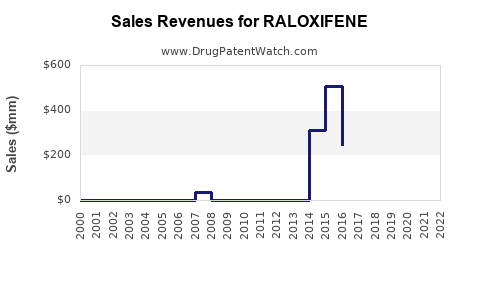
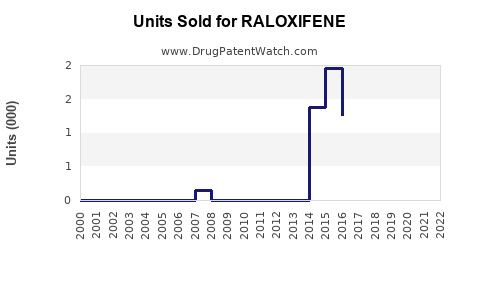
Annual Sales Revenues and Units Sold for RALOXIFENE
| Drug Name | Revenues (USD) | Units | Year |
|---|---|---|---|
| RALOXIFENE | ⤷ Start Trial | ⤷ Start Trial | 2022 |
| RALOXIFENE | ⤷ Start Trial | ⤷ Start Trial | 2021 |
| RALOXIFENE | ⤷ Start Trial | ⤷ Start Trial | 2020 |
| RALOXIFENE | ⤷ Start Trial | ⤷ Start Trial | 2019 |
| RALOXIFENE | ⤷ Start Trial | ⤷ Start Trial | 2018 |
| RALOXIFENE | ⤷ Start Trial | ⤷ Start Trial | 2017 |
| RALOXIFENE | ⤷ Start Trial | ⤷ Start Trial | 2016 |
| >Drug Name | >Revenues (USD) | >Units | >Year |
Raloxifene Market Analysis and Sales Projections
Raloxifene is a mature, genericized selective estrogen receptor modulator with declining branded revenue and stable but price-sensitive prescription demand. The commercial market is driven by postmenopausal osteoporosis treatment and prevention, with secondary demand from breast-cancer risk reduction. Eli Lilly’s Evista franchise no longer has meaningful U.S. exclusivity, and future market value depends on generic volume, reimbursement, guideline use, and patient persistence rather than patent protection.
A reasonable base case is a declining global market by value through 2030, with volume broadly stable in osteoporosis and risk-reduction niches. The principal commercial opportunity is low-cost generic supply, differentiated packaging, regional registration, and distribution rather than a new branded product.
What is raloxifene approved to treat?
Raloxifene hydrochloride is an oral selective estrogen receptor modulator, or SERM. It has estrogen-agonist effects in bone and estrogen-antagonist effects in breast tissue.
The U.S. Food and Drug Administration approved Evista in 1997 for:
- Prevention and treatment of postmenopausal osteoporosis.
- Reduction in the risk of invasive breast cancer in postmenopausal women with osteoporosis.
- Reduction in the risk of invasive breast cancer in postmenopausal women at high risk of invasive breast cancer.
Raloxifene is not approved to treat breast cancer, reduce cardiovascular events, or treat menopausal vasomotor symptoms. Its label includes clinically important risks, including venous thromboembolism and fatal stroke risk in certain high-risk populations.[1]
Raloxifene commercial profile
| Attribute | Raloxifene position |
|---|---|
| Active ingredient | Raloxifene hydrochloride |
| Drug class | Selective estrogen receptor modulator |
| Primary dosage form | Oral tablet |
| Common strength | 60 mg |
| Originator brand | Evista |
| Original sponsor | Eli Lilly and Company |
| Initial U.S. approval | 1997 |
| Main markets | United States, Europe, Japan, China and other regulated markets |
| Primary demand driver | Postmenopausal osteoporosis |
| Secondary demand driver | Breast-cancer risk reduction |
| Current U.S. competitive status | Genericized small-molecule market |
| Biosimilar exposure | None |
| Principal commercial risk | Generic price erosion and competition from alternative osteoporosis therapies |
How large is the raloxifene market?
No single public source provides a definitive, audited global raloxifene market total. Public market-research estimates vary because some reports include only active pharmaceutical ingredient sales, while others include branded and generic tablets, hospital channels, or broader SERM categories.
The market is best analyzed in three layers:
- Raloxifene tablets sold through retail and institutional channels.
- Raloxifene active pharmaceutical ingredient supplied to generic manufacturers.
- Broader SERM or osteoporosis markets, where raloxifene represents only a small segment.
The branded market is no longer an appropriate proxy for total demand. Evista sales reflected Lilly’s price, promotion, and distribution before generic erosion. Current market value is distributed among generic manufacturers and wholesalers.
Demand segmentation
| Segment | Commercial outlook | Key factors |
|---|---|---|
| Osteoporosis treatment | Largest recurring segment | Guideline positioning, fracture-risk profile, tolerability and adherence |
| Osteoporosis prevention | Moderate | Screening rates and physician preference |
| Breast-cancer risk reduction | Smaller but strategically important | Uptake of chemoprevention and risk assessment |
| Hospital use | Limited | Formularies and specialist prescribing |
| Emerging markets | Volume opportunity | Generic affordability and regulatory access |
Raloxifene competes with bisphosphonates, denosumab, teriparatide, abaloparatide, romosozumab, hormone therapy, and other osteoporosis medicines. In breast-cancer risk reduction, tamoxifen is the principal pharmacologic comparator, although the populations and risk-benefit profiles differ.
What are the main drivers of raloxifene sales?
Osteoporosis prevalence
The aging female population supports continued prescription demand. The addressable population is large, but treatment rates are constrained by underdiagnosis, adherence problems, competing therapies, and concerns about thromboembolic risk.
Raloxifene is most commercially relevant for postmenopausal women who require vertebral-fracture protection and may value breast-cancer risk reduction. Its positioning is weaker where broad nonvertebral or hip-fracture protection is the primary treatment objective.
Generic affordability
Generic entry materially reduced the average selling price. Lower prices expand access in price-sensitive markets but compress manufacturer revenue. This dynamic favors high-volume suppliers with efficient manufacturing and broad pharmacy distribution.
Breast-cancer risk reduction
The breast-cancer prevention indication gives raloxifene a differentiated position within osteoporosis therapy. The National Surgical Adjuvant Breast and Bowel Project’s STAR trial supported raloxifene as an alternative to tamoxifen for certain postmenopausal high-risk women, with a different adverse-event profile.[2]
Commercial uptake remains limited by:
- Low rates of formal breast-cancer risk assessment.
- Limited preventive prescribing outside specialist settings.
- Patient concern about thromboembolism.
- Competition from surveillance, surgery, and tamoxifen.
- Lack of a direct treatment indication for established breast cancer.
Safety and treatment persistence
Venous thromboembolism risk restricts use in patients with prior or active thrombotic disease and during prolonged immobilization. This safety profile reduces the addressable market relative to therapies without the same boxed-warning concerns.[1]
Persistence is another constraint. Osteoporosis medicines commonly experience discontinuation, which limits cumulative annual prescription volume even where initial prescribing remains stable.
What are the raloxifene sales projections through 2030?
The most defensible approach is an indexed scenario model rather than a single unsupported dollar forecast. Set estimated 2024 global raloxifene sales equal to 100. The projections below reflect value, not prescription volume.
| Scenario | 2025 | 2026 | 2027 | 2028 | 2029 | 2030 |
|---|---|---|---|---|---|---|
| Downside | 92 | 84 | 76 | 69 | 63 | 57 |
| Base case | 96 | 92 | 88 | 84 | 80 | 76 |
| Upside | 101 | 103 | 105 | 107 | 109 | 111 |
Base-case interpretation
The base case assumes:
- Generic price erosion continues but slows as the product matures.
- Prescription volume remains relatively stable in osteoporosis.
- Breast-cancer risk-reduction use grows modestly from a low base.
- No major new branded formulation gains broad regulatory adoption.
- No major supply disruption affects the market.
- Competing osteoporosis therapies continue to capture treatment share.
Under this case, raloxifene market value declines approximately 24% from the 2024 index by 2030. Volume could remain flat or decline less sharply because lower prices offset some loss in value.
Downside case
The downside scenario reflects accelerated substitution by denosumab, anabolic agents, bisphosphonates, and newer osteoporosis products; reduced use because of thromboembolic warnings; and further generic price compression.
This scenario produces a 43% value decline by 2030 from the 2024 index.
Upside case
The upside case requires several favorable developments:
- Greater use of raloxifene in breast-cancer prevention.
- Improved adherence through patient-support programs.
- Expansion in China, Latin America, India, and other price-sensitive markets.
- Stable guideline support for selected postmenopausal women.
- Limited additional price erosion because the supplier base consolidates.
Even this scenario indicates a low-growth mature product, not a return to originator-era revenue.
How should raloxifene revenue be modeled?
A practical revenue model is:
Revenue = treated patients × annual treatment persistence × net annual price
For generic raloxifene, the most sensitive variables are net price and treatment persistence.
| Variable | Downside | Base case | Upside |
|---|---|---|---|
| Patient volume trend through 2030 | -20% | -5% | +10% |
| Net price trend through 2030 | -30% | -20% | -5% |
| Persistence trend | -10% | Flat | +5% |
| Implied value trend | Approximately -50% | Approximately -24% | Approximately +10% |
These are analytical assumptions, not reported market totals. They are suitable for portfolio screening, manufacturing planning, or licensing analysis when validated against country-level prescription and price data.
What is the patent and exclusivity status of raloxifene?
Raloxifene is a small molecule, so biosimilar competition does not apply. The relevant competition is generic drug competition under abbreviated new drug application pathways.
The original U.S. product and use-related patent protection has expired. The Orange Book should be used for a current, product-specific review of any listed patents or exclusivity entries.[3] Raloxifene does not have a current U.S. market profile consistent with active originator exclusivity.
Exclusivity timeline
| Event | Approximate timing |
|---|---|
| Evista U.S. approval | 1997 |
| Originator commercial period | Late 1990s through mid-2000s |
| Generic competition | Established in the U.S. market |
| Current regulatory protection | No material broad U.S. exclusivity expected |
| Commercial consequence | Price competition dominates market access |
The product’s primary IP barriers were composition, formulation, and method-of-use rights associated with the originator development program. Those rights no longer provide a reliable barrier to generic entry in the core U.S. tablet market.
What generic entry risks exist for raloxifene?
Generic entry risk is already realized rather than prospective. The key issue is not whether generics can enter, but whether additional manufacturers can profitably enter or whether existing suppliers will exit.
Generic market risks
- Price erosion from multiple approved suppliers.
- Pharmacy and wholesaler substitution.
- Low differentiation between manufacturers.
- Exposure to API supply concentration.
- Tender-driven price reductions outside the United States.
- Manufacturing-site observations or recalls that disrupt supply.
- Limited ability to raise prices after capacity exits.
A generic manufacturer can improve its position through reliable supply, regulatory registrations in multiple countries, tablet-cost control, and private-label or institutional contracts.
What formulations are protected by raloxifene patents?
The commercially dominant formulation is the immediate-release 60 mg oral tablet. The core market does not depend on a high-value delivery platform.
Potential formulation opportunities include:
- Lower-dose tablets.
- Modified-release formulations.
- Combination products.
- Improved packaging for adherence.
- Fixed-dose combinations with osteoporosis therapies.
- Alternative oral delivery systems.
These opportunities face practical limitations. New formulations would need to demonstrate bioequivalence, clinical benefit, or a meaningful adherence advantage. A reformulation without differentiated outcomes would face rapid generic substitution and limited reimbursement support.
The most credible formulation strategy is therefore a targeted product for a defined patient segment rather than a broad replacement for generic 60 mg tablets.
What method-of-use opportunities exist for raloxifene?
Method-of-use opportunities are more commercially relevant than broad composition claims, but their value depends on regulatory adoption and prescribing behavior.
Potential areas include:
- Breast-cancer risk reduction in genetically or clinically defined populations.
- Use in women with osteoporosis and elevated breast-cancer risk.
- Treatment sequencing after intolerance to other osteoporosis medicines.
- Use in patients requiring vertebral-fracture protection with a specific breast-risk profile.
- Combination or sequential treatment protocols.
A method-of-use product would face several barriers:
- Physicians may use generic raloxifene based on existing knowledge without adopting a branded version.
- Payers may reject premium reimbursement where the active ingredient is available generically.
- Clinical guidelines would need to recognize the specific population.
- The sponsor would need evidence of improved outcomes, adherence, or risk stratification.
Which companies compete in the raloxifene market?
Competition operates at two levels: raloxifene suppliers and alternative osteoporosis or breast-cancer-prevention therapies.
Raloxifene suppliers
The U.S. generic market has historically included manufacturers such as Teva, Watson/Actavis, Mylan, Sandoz and other approved suppliers, depending on the period and product listing. Supplier participation changes over time as companies discontinue products, transfer approvals, or consolidate portfolios.[3]
Therapeutic competitors
| Competitor | Category | Competitive effect |
|---|---|---|
| Alendronate and other bisphosphonates | Generic antiresorptives | Strong price and guideline competition |
| Denosumab | Biologic antiresorptive | Competes for patients needing potent fracture-risk reduction |
| Teriparatide and abaloparatide | Anabolic agents | Used in higher-risk osteoporosis |
| Romosozumab | Sclerostin inhibitor | Competes in severe fracture-risk populations |
| Tamoxifen | SERM | Main comparator in breast-cancer risk reduction |
| Menopausal hormone therapy | Hormonal therapy | Alternative in selected postmenopausal patients |
Denosumab is a biologic but does not create biosimilar risk for raloxifene. Its relevance is competitive, not regulatory.
What is the FDA and Orange Book status of raloxifene?
Raloxifene tablets are an FDA-approved small-molecule product category with generic versions approved through abbreviated new drug applications. Generic applicants must demonstrate pharmaceutical equivalence and bioequivalence to the reference product.
Key FDA considerations include:
- Reference listed drug status for Evista.
- Generic tablet approvals.
- Label consistency for osteoporosis and breast-cancer risk-reduction indications.
- Manufacturing compliance and product-quality controls.
- Orange Book patent and exclusivity entries.
The Orange Book is the controlling source for current U.S. listed patents, exclusivity, therapeutic equivalence codes, and reference-product information. Historical patent expiration dates should not be treated as evidence of current blocking rights.[3]
What licensing and partnership opportunities exist?
Raloxifene has limited licensing value as an unprotected active ingredient. Potential transactions are more likely to involve:
- Regional commercialization rights.
- Generic supply agreements.
- API sourcing and technology transfer.
- Contract manufacturing.
- Private-label distribution.
- Combination-product development.
- Lifecycle products for defined patient populations.
An outright acquisition of broad raloxifene rights would have weak strategic logic unless the buyer has a low-cost manufacturing platform or a strong presence in markets where osteoporosis treatment remains underpenetrated.
The strongest transaction case is a regional supply or distribution agreement with minimum-volume commitments. A branded reformulation would require evidence that the product can preserve a premium despite generic availability.
How strong is the raloxifene patent estate?
The core patent estate is commercially weak because the product has been genericized for many years and broad originator exclusivity has expired. Remaining value is more likely to reside in:
- Manufacturing know-how.
- API process control.
- Regulatory approvals.
- Country-specific registrations.
- Supply reliability.
- Trademark recognition for Evista in markets where it remains commercially relevant.
- New clinical data supporting a narrow method of use.
Patent strength should be assessed separately from commercial strength. Raloxifene has low blocking-patent strength but can retain moderate market value where regulatory barriers, physician familiarity, or distribution capability limit effective competition.
What generic launch scenarios should investors consider?
Scenario 1: Continued mature generic erosion
Multiple suppliers retain approval. Prices decline gradually, prescription volume remains stable, and the market becomes increasingly concentrated among low-cost manufacturers.
Scenario 2: Supplier consolidation
Several manufacturers exit because of low margins or manufacturing costs. Prices stabilize, and reliable suppliers gain market share. This is the most favorable scenario for an efficient generic producer.
Scenario 3: Demand contraction
Guideline preference shifts toward alternative osteoporosis therapies, or safety concerns reduce use in prevention. Volume and value decline faster than expected.
Scenario 4: Niche lifecycle expansion
A sponsor obtains evidence and regulatory support for a defined breast-cancer-risk or osteoporosis population. Revenue improves, but the product remains exposed to generic substitution unless the new formulation or indication receives enforceable market protection.
What is the revenue exposure for manufacturers and investors?
Raloxifene is unlikely to be a material growth driver for a diversified pharmaceutical company. It can be strategically relevant for:
- Generic manufacturers with excess oral-solid capacity.
- API producers seeking stable, mature products.
- Regional pharmaceutical companies in underpenetrated osteoporosis markets.
- Distributors with institutional or government tender access.
- Specialty companies developing women’s-health products.
Revenue quality is generally low to moderate. The product has established clinical demand, but pricing power is limited and regulatory exclusivity is weak. Margin performance depends on manufacturing scale, procurement, market concentration, and supply reliability.
Key Takeaways
- Raloxifene is a mature generic SERM approved for postmenopausal osteoporosis and invasive breast-cancer risk reduction.
- Eli Lilly’s Evista franchise no longer has meaningful broad U.S. exclusivity.
- The market is driven by generic volume, low pricing, osteoporosis prevalence, and selected breast-cancer-prevention use.
- Base-case market value is likely to decline through 2030, with prescription volume declining more slowly than revenue.
- Biosimilar risk does not apply because raloxifene is a small molecule.
- The strongest commercial opportunities are low-cost manufacturing, regional expansion, supply reliability, and narrowly defined lifecycle products.
- Broad patent-based licensing value is limited.
- Generic competition from bisphosphonates and therapeutic competition from denosumab and newer osteoporosis therapies will constrain growth.
FAQs
Is raloxifene still commercially profitable?
It can be profitable for efficient generic manufacturers, but the product has limited pricing power. Profitability depends on manufacturing cost, supplier concentration, and regional reimbursement.
Does raloxifene have biosimilars?
No. Raloxifene is a chemically synthesized small molecule. Competing products are approved as generic drugs, not biosimilars.
Can a company launch a branded raloxifene product?
Yes, but commercial success would require a differentiated formulation, new clinical evidence, a narrow high-value indication, or strong regional distribution. A standard branded 60 mg tablet would face generic substitution.
Is raloxifene stronger than tamoxifen for breast-cancer prevention?
Raloxifene and tamoxifen have different benefit-risk profiles. Raloxifene is used in selected postmenopausal women, while tamoxifen has broader preventive relevance but a different adverse-event profile. Product choice depends on patient characteristics and clinical assessment.[2]
Does raloxifene have future growth potential in emerging markets?
Yes, mainly through low-cost generic access and distribution expansion. Emerging-market growth would likely increase volume more than global revenue because local prices are generally lower than historical branded prices.
References
-
U.S. Food and Drug Administration. (2023). Evista (raloxifene hydrochloride) tablets: Prescribing information. FDA.
-
Vogel, V. G., Costantino, J. P., Wickerham, D. L., Cronin, W. M., Cecchini, R. S., Atkins, J. N., Bevers, T. B., Fehrenbacher, L., Pajon, E. R., Wade, J. L., III, Robidoux, A., Margolese, R. G., James, J., Lippman, M. E., Runowicz, C. D., Ganz, P. A., Reis, S. E., McCaskill-Stevens, W., Ford, L. G., Jordan, V. C., & Wolmark, N. (2006). Effects of tamoxifen vs raloxifene on the risk of developing invasive breast cancer and other disease outcomes. JAMA, 295(23), 2727-2741.
-
U.S. Food and Drug Administration. (2024). Approved drug products with therapeutic equivalence evaluations: Orange Book. FDA.
-
Eli Lilly and Company. (2014). Annual report 2013. Eli Lilly and Company.
-
U.S. Food and Drug Administration. (1997). FDA approves Evista for osteoporosis. FDA.
More… ↓
