Share This Page
Drug Sales Trends for PRAMOSONE
✉ Email this page to a colleague
Payment Methods and Pharmacy Types for PRAMOSONE (2010)
Revenues by Pharmacy Type
Units Sold by Pharmacy Type
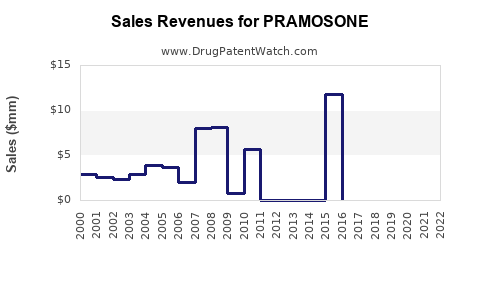
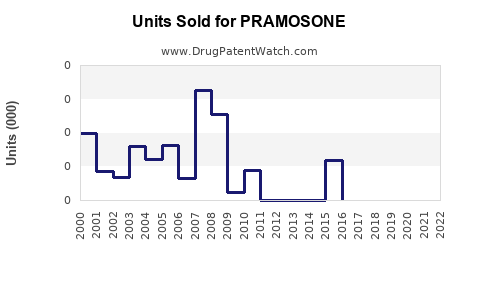
Annual Sales Revenues and Units Sold for PRAMOSONE
| Drug Name | Revenues (USD) | Units | Year |
|---|---|---|---|
| PRAMOSONE | ⤷ Start Trial | ⤷ Start Trial | 2022 |
| PRAMOSONE | ⤷ Start Trial | ⤷ Start Trial | 2021 |
| PRAMOSONE | ⤷ Start Trial | ⤷ Start Trial | 2020 |
| >Drug Name | >Revenues (USD) | >Units | >Year |
Pramosone Market Analysis and Sales Projections: Hydrocortisone-Pramoxine Topical Drug
Pramosone is a prescription topical combination of hydrocortisone acetate and pramoxine hydrochloride used to reduce inflammation and itching associated with corticosteroid-responsive dermatoses. The product competes in a mature, low-growth market dominated by generic corticosteroids, topical anesthetics, and lower-cost combination products. Public sources do not disclose standalone Pramosone revenue. A reasonable U.S. base-case estimate places current annual manufacturer net sales at approximately $3 million to $6 million, with limited growth potential and material substitution risk from generic and compounded alternatives.
What is Pramosone and who markets it?
Pramosone combines a topical corticosteroid with a local anesthetic:
| Attribute | Pramosone profile |
|---|---|
| Active ingredients | Hydrocortisone acetate and pramoxine hydrochloride |
| Therapeutic class | Low- to moderate-potency topical corticosteroid plus topical antipruritic |
| Dosage forms | Cream, ointment, and lotion presentations have been marketed under the Pramosone name |
| Route | Topical |
| Prescription status | Prescription product in the United States |
| Primary use | Temporary relief of itching and inflammation associated with responsive dermatoses |
| Main commercial sponsor | Taro Pharmaceuticals U.S.A., Inc. has marketed Pramosone-branded products |
| Principal competitors | Generic hydrocortisone-pramoxine products, hydrocortisone products, pramoxine products, and other antipruritic corticosteroid combinations |
The commercial rationale is convenience. Hydrocortisone reduces inflammation, while pramoxine provides local symptomatic relief from itching. The combination has a narrow differentiation profile because both ingredients are long-established and available separately at low prices.
FDA labeling for hydrocortisone acetate and pramoxine hydrochloride products limits use to affected areas and warns against prolonged use, extensive application, occlusion, and use on certain infected or ulcerated skin conditions.[1]
How large is the Pramosone market?
The directly addressable U.S. market is small relative to major dermatology products. Pramosone operates in a fragmented prescription topical market that includes:
- Generic hydrocortisone-pramoxine combinations.
- Prescription hydrocortisone and other low-potency corticosteroids.
- Pramoxine-only creams, lotions, and foams.
- Topical products for hemorrhoids, anal itching, eczema, dermatitis, and insect-bite symptoms.
- Physician-compounded corticosteroid and anesthetic combinations.
- Over-the-counter hydrocortisone, pramoxine, and anti-itch products.
A reasonable market-sizing framework is:
| Market layer | Estimated U.S. annual value | Relevance to Pramosone |
|---|---|---|
| Prescription hydrocortisone-pramoxine combinations | $8 million-$20 million | Direct market |
| Prescription low-potency topical corticosteroids | $150 million-$300 million | Partial substitute |
| Prescription topical antipruritics | $50 million-$150 million | Partial substitute |
| Broader topical dermatitis and itch treatments | More than $1 billion | Indirect competitive market |
These ranges are analytical estimates rather than reported manufacturer sales. Public FDA databases identify regulatory status and labeling but do not report product-level commercial revenue. Commercial prescription datasets such as IQVIA and Symphony Health are generally required to establish audited prescription volume and net sales.
Pramosone's realistic serviceable market is the first category, not the entire dermatology market. Its low price, mature ingredients, and narrow clinical positioning constrain pricing power.
What are Pramosone sales today?
No public filing separately reports Pramosone revenue. Taro reports at the company or broader product-category level rather than disclosing sales for each legacy topical brand.[2]
A triangulated estimate is:
| Metric | Low case | Base case | High case |
|---|---|---|---|
| Annual U.S. prescriptions | 40,000 | 70,000 | 110,000 |
| Average manufacturer net revenue per prescription | $55 | $70 | $90 |
| Estimated annual U.S. net sales | $2.2 million | $4.9 million | $9.9 million |
| Estimated gross product sales before discounts | $3 million | $6 million | $12 million |
The base case assumes a niche branded-prescription product with modest physician familiarity, limited formulary leverage, and continuing generic substitution. The estimate excludes non-U.S. sales, wholesaler inventory changes, and any revenue from unrelated hydrocortisone-pramoxine products.
The most likely current revenue band is $3 million to $6 million in U.S. manufacturer net sales. The high case requires stronger brand retention, broad pharmacy availability, and less aggressive substitution than is typical for mature topical combinations.
What are the Pramosone sales projections through 2029?
The base-case forecast assumes continued U.S. availability, no major new indication, no material supply interruption, and annual prescription erosion of approximately 4% to 6%. Price increases partly offset volume decline.
Base-case U.S. net sales forecast
| Year | Estimated prescriptions | Net revenue per prescription | Projected net sales |
|---|---|---|---|
| 2025 | 70,000 | $70 | $4.9 million |
| 2026 | 67,000 | $72 | $4.8 million |
| 2027 | 64,000 | $74 | $4.7 million |
| 2028 | 61,000 | $76 | $4.6 million |
| 2029 | 58,000 | $78 | $4.5 million |
Scenario range
| Year | Downside case | Base case | Upside case |
|---|---|---|---|
| 2025 | $2.5 million | $4.9 million | $8.5 million |
| 2026 | $2.2 million | $4.8 million | $8.3 million |
| 2027 | $1.9 million | $4.7 million | $8.2 million |
| 2028 | $1.7 million | $4.6 million | $8.0 million |
| 2029 | $1.5 million | $4.5 million | $7.8 million |
The downside case reflects formulary exclusion, pharmacy substitution, product discontinuation, or loss of commercial support. The upside case assumes stable branded prescribing, favorable reimbursement, and stronger demand for combination therapy. A sustained revenue increase above $10 million annually would require a significant commercial change, such as a new indication, a new delivery system, expanded payer coverage, or acquisition by a dermatology-focused company with an active sales force.
When does Pramosone lose exclusivity?
Pramosone is a mature small-molecule topical product. Its principal commercial protection is unlikely to come from a long-lived composition-of-matter patent.
For a product with old active ingredients, exclusivity is generally shaped by:
- Expired or weak composition patents.
- Available generic or therapeutically substitutable products.
- Formulation or vehicle patents, if any remain enforceable.
- Trademark rights in the Pramosone name.
- Manufacturing, supply, distribution, and prescriber familiarity.
The FDA Orange Book lists patents and regulatory exclusivity for approved drug products when applicable.[3] A brand's absence of meaningful Orange Book patent protection does not prevent sales, but it makes the product more vulnerable to ANDA competition and pharmacy-level substitution.
Pramosone should therefore be analyzed as a post-exclusivity or near-post-exclusivity product unless a currently enforceable formulation or method-of-use patent can be verified in the applicable FDA and USPTO records.
What patents protect Pramosone?
The commercial patent estate is likely limited.
| Protection category | Expected relevance |
|---|---|
| Hydrocortisone acetate composition patent | Expired; active ingredient is longstanding |
| Pramoxine hydrochloride composition patent | Expired or commercially immaterial |
| Combination-composition patent | Limited likelihood of meaningful remaining term |
| Cream, lotion, or ointment formulation patents | Possible, but likely narrow and vulnerable to design-around |
| Method-of-use patents | Possible for specific dermatologic uses, but difficult to enforce against routine prescribing |
| Trademark protection | Relevant to brand retention, not generic blocking |
| Trade secrets | Potentially relevant to manufacturing process, but unlikely to prevent generic entry |
A topical formulation patent can have practical value if it claims a specific vehicle, stability profile, delivery system, particle size, or manufacturing process. It does not necessarily prevent a competitor from selling a different cream, lotion, or ointment containing the same active ingredients.
The strength of the Pramosone estate is best characterized as low to moderate from an exclusivity perspective and moderate from a brand-retention perspective. The brand may retain prescriptions even when it lacks a blocking patent, but the product cannot depend on patent enforcement to support premium pricing.
Are there Paragraph IV challenges to Pramosone?
Paragraph IV litigation is generally relevant when an ANDA applicant certifies that an Orange Book-listed patent is invalid, unenforceable, or not infringed. The FDA's Orange Book and federal court dockets are the primary sources for determining listed patents and litigation.[3,4]
No major, publicly prominent Paragraph IV dispute is associated with Pramosone in the available public record. That does not establish that no ANDA certification has ever occurred. Legacy topical products can have generic applications, patent certifications, or commercial disputes that receive limited public attention.
The more important risk is ordinary generic substitution rather than a high-value patent challenge. Generic entrants can erode revenue through:
- Lower acquisition cost.
- Pharmacy substitution.
- Preferred formulary placement.
- Reduced physician sensitivity to the branded name.
- Multiple suppliers competing on price.
What formulations are protected by Pramosone?
Pramosone's formulations are commercially relevant because topical performance depends on vehicle characteristics, spreadability, absorption, residue, stability, and patient tolerability.
| Formulation | Commercial role | Competitive risk |
|---|---|---|
| Cream | Broadest dermatology use; familiar dosage form | High |
| Ointment | Greater occlusion and emollience; useful for dry lesions | Moderate to high |
| Lotion | Easier application over larger or hair-bearing areas | Moderate |
| Alternative vehicle or foam | Potential differentiation if clinically meaningful | Lower initially, but design-around risk remains |
A formulation could command a premium if it has measurable advantages in absorption, cosmetic acceptability, reduced irritation, or ease of application. Pramosone has no widely established premium delivery platform comparable to branded foam, spray, liposomal, or proprietary emulsion products.
A generic does not need to duplicate every sensory attribute to compete. Regulatory approval generally turns on pharmaceutical equivalence and applicable bioequivalence or comparative requirements, not exact consumer perception.
What is the FDA regulatory status of Pramosone?
Pramosone is a prescription topical drug regulated under FDA requirements for drug approval, labeling, manufacturing, and post-market safety. Its active ingredients are established drug substances, which reduces clinical-development risk but also limits differentiation.
Relevant FDA regulatory issues include:
- Whether each strength and dosage form has an approved NDA or ANDA.
- Whether the product remains listed as active in FDA databases.
- Whether the formulation is currently marketed.
- Whether an equivalent generic is available.
- Whether labeling includes restrictions on duration and treated body area.
- Whether product listing and labeling are current in Drugs@FDA and DailyMed.
FDA resources should be used to verify current approval status, active listing, label revisions, and any discontinued presentations.[1,5] A product may remain approved while having limited or intermittent commercial availability.
How does Pramosone compare with competing drugs?
| Product category | Clinical positioning | Price pressure | Commercial threat |
|---|---|---|---|
| Generic hydrocortisone-pramoxine | Closest substitute | High | Very high |
| Hydrocortisone alone | Anti-inflammatory treatment without anesthetic | Very high | High |
| Pramoxine alone | Itch relief without corticosteroid | High | Moderate |
| Prescription-strength corticosteroids | Greater anti-inflammatory potency | Moderate | Moderate |
| Branded eczema therapies | Higher-value differentiated treatment | Lower direct substitution | Low to moderate |
| OTC anti-itch products | Consumer self-care alternative | Very high | Moderate |
Pramosone is positioned between low-cost generic products and higher-priced branded dermatology therapies. It is unlikely to capture patients requiring potent anti-inflammatory treatment, advanced nonsteroidal therapy, biologics, or specialty dermatology management.
What generic entry risks exist for Pramosone?
Generic entry risk is high because the product has:
- Long-established active ingredients.
- Limited clinical differentiation.
- Multiple alternative dosage forms.
- Low development risk for generic manufacturers.
- Straightforward physician substitution logic.
- Low switching costs for pharmacies and patients.
The principal barriers are formulation reproducibility, topical equivalence requirements, manufacturing scale, and commercial access to wholesalers and payers. These barriers may slow entry but are unlikely to provide durable protection if market demand is sufficient.
The most probable launch pattern is gradual erosion rather than an abrupt collapse. A single generic entrant can pressure reimbursement and pharmacy purchasing. Additional entrants typically accelerate price erosion and reduce branded prescription volume.
Does Pramosone have biosimilar risk?
No. Pramosone is a small-molecule topical drug, not a biologic. Biosimilar approval under the Public Health Service Act does not apply. The relevant competitive pathways are abbreviated new drug applications, generic substitution, therapeutic alternatives, and compounded products.
What licensing deals or partnerships affect Pramosone?
No major publicly disclosed licensing transaction is associated with Pramosone in the principal public sources reviewed for this analysis. The product's commercial value is more likely to arise from:
- Acquisition of a legacy dermatology portfolio.
- In-licensing by a specialty-generic company.
- Co-promotion with a dermatology sales organization.
- Regional distribution agreements.
- Private-label or authorized-generic arrangements.
Because standalone revenue is small, a transaction would likely be evaluated on portfolio fit, manufacturing economics, channel access, and contribution margin rather than headline sales growth.
What is the investment outlook for Pramosone?
Pramosone is a cash-generating niche asset only if manufacturing cost is low and distribution remains efficient. Its investment profile is defensive rather than growth-oriented.
| Factor | Assessment |
|---|---|
| Revenue growth | Low or negative |
| Gross-margin potential | Moderate if production is efficient |
| Pricing power | Low |
| Patent strength | Low |
| Generic risk | High |
| Regulatory risk | Low to moderate |
| Manufacturing risk | Moderate |
| Commercial upside | Limited without reformulation or new indication |
| Acquisition rationale | Portfolio scale, channel fit, or manufacturing synergies |
The strongest value-creation strategy would be cost reduction, reliable supply, optimized payer access, and selective line extension. A premium-price strategy is unlikely to succeed without a differentiated vehicle or evidence of superior patient adherence.
Key Takeaways
- Pramosone is a mature hydrocortisone-pramoxine topical prescription product.
- Public filings do not disclose standalone Pramosone sales.
- Estimated U.S. net sales are approximately $3 million to $6 million annually, with a base-case estimate of $4.9 million in 2025.
- Base-case sales decline modestly to approximately $4.5 million by 2029.
- Generic substitution is the primary commercial threat.
- Biosimilar risk is not applicable because Pramosone is a small-molecule topical drug.
- The active ingredients provide little meaningful patent protection today.
- Formulation and manufacturing rights may have value but are unlikely to create a durable market barrier.
- Commercial upside depends on a new delivery system, expanded indication, improved payer access, or portfolio integration.
- Pramosone is better viewed as a niche cash-flow product than as a growth asset.
FAQs About Pramosone Sales and Market Risk
Is Pramosone still commercially available?
Pramosone has been marketed as a prescription topical product, but availability can vary by dosage form, strength, distributor inventory, and pharmacy ordering status. FDA approval status and commercial availability should be distinguished.
Is Pramosone the same as hydrocortisone-pramoxine?
Pramosone is a brand associated with hydrocortisone-pramoxine topical formulations. Generic products may contain the same active ingredients but can differ in manufacturer, vehicle, strength, labeling, and availability.
Can a generic manufacturer launch Pramosone without copying the brand?
Yes. A generic applicant can seek approval for a pharmaceutically equivalent product under the applicable abbreviated approval pathway. It cannot use the Pramosone trademark or copy protected brand trade dress.
Does Pramosone have orphan-drug or pediatric exclusivity?
There is no widely recognized orphan-drug or pediatric exclusivity period associated with the mature hydrocortisone-pramoxine product. Any product-specific exclusivity must be verified in current FDA records.
What would increase Pramosone's commercial value?
The most credible value drivers are a differentiated vehicle, improved cosmetic acceptability, a new delivery system, expanded payer coverage, evidence of better adherence, or inclusion in a broader dermatology portfolio with shared commercial infrastructure.
References
- U.S. Food and Drug Administration. (n.d.). Drugs@FDA: FDA-approved drugs. https://www.accessdata.fda.gov/scripts/cder/daf/
- Taro Pharmaceutical Industries Ltd. (2024). Annual report. https://www.taro.com
- U.S. Food and Drug Administration. (n.d.). Approved drug products with therapeutic equivalence evaluations, Orange Book. https://www.fda.gov/drugs/drug-approvals-and-databases/approved-drug-products-therapeutic-equivalence-evaluations-orange-book
- U.S. Courts. (n.d.). PACER case locator. https://pcl.uscourts.gov
- National Library of Medicine. (n.d.). DailyMed: Current medication information. https://dailymed.nlm.nih.gov/dailymed/
More… ↓
