Share This Page
Drug Sales Trends for PRADAXA
✉ Email this page to a colleague
Payment Methods and Pharmacy Types for PRADAXA (2010)
Revenues by Pharmacy Type
Units Sold by Pharmacy Type
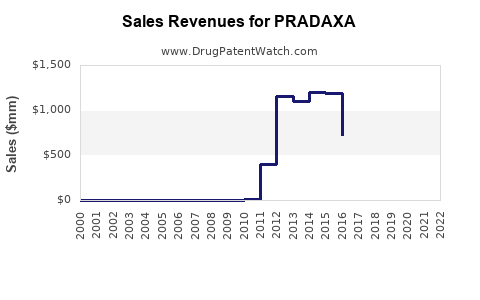
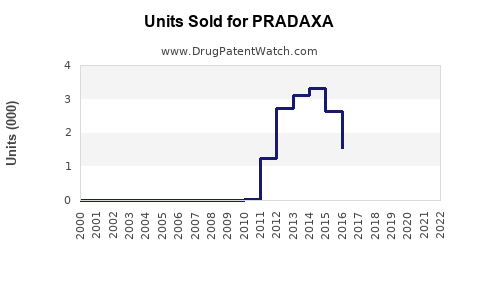
Annual Sales Revenues and Units Sold for PRADAXA
| Drug Name | Revenues (USD) | Units | Year |
|---|---|---|---|
| PRADAXA | ⤷ Start Trial | ⤷ Start Trial | 2022 |
| PRADAXA | ⤷ Start Trial | ⤷ Start Trial | 2021 |
| PRADAXA | ⤷ Start Trial | ⤷ Start Trial | 2020 |
| PRADAXA | ⤷ Start Trial | ⤷ Start Trial | 2019 |
| >Drug Name | >Revenues (USD) | >Units | >Year |
Pradaxa Market Analysis, Sales Projections, Patent Expiration and Generic Competition
Pradaxa, Boehringer Ingelheim’s dabigatran etexilate anticoagulant, is a mature direct oral anticoagulant facing sustained pressure from Eliquis, Xarelto and generic competition. Global sales have declined from peak levels, but the product retains revenue through atrial fibrillation, venous thromboembolism and pediatric indications. Base-case sales are projected to fall from approximately €1.3 billion in 2023 to €650 million-€850 million by 2030 as U.S. generic penetration expands.
The principal commercial variables are generic launch timing, pricing erosion, continued use in patients requiring an approved reversal agent, and Pradaxa’s position in markets where reimbursement favors low-cost oral anticoagulants.
What is Pradaxa and how does dabigatran work?
Pradaxa contains dabigatran etexilate mesylate, an oral prodrug converted to dabigatran. Dabigatran directly inhibits thrombin, reducing fibrin formation and clot development.
The product is available primarily as capsules in 75 mg, 110 mg and 150 mg strengths, with regional variations. U.S. prescribing is concentrated in the 150 mg twice-daily dose for stroke and systemic embolism prevention in patients with nonvalvular atrial fibrillation.
| Product attribute | Pradaxa |
|---|---|
| Active ingredient | Dabigatran etexilate mesylate |
| Drug class | Direct oral anticoagulant, or DOAC |
| Mechanism | Direct thrombin inhibition |
| Primary manufacturer | Boehringer Ingelheim |
| U.S. approval | October 2010 |
| U.S. application | NDA 022512 |
| Main indications | Nonvalvular atrial fibrillation, DVT and PE treatment, recurrence reduction, pediatric VTE treatment |
| Reversal agent | Idarucizumab, marketed as Praxbind |
| Administration | Oral capsules, generally twice daily |
The FDA approved Pradaxa for stroke and systemic embolism risk reduction in nonvalvular atrial fibrillation in 2010. The label later expanded to venous thromboembolism treatment and pediatric use. [1]
How large is the Pradaxa market?
Pradaxa competes in the global anticoagulant market, where Eliquis and Xarelto have the strongest commercial positions. The broader DOAC market is substantially larger than Pradaxa’s current franchise because apixaban and rivaroxaban have captured a greater share of prescriptions in atrial fibrillation and venous thromboembolism.
Public company reporting indicates that Pradaxa generated approximately €1.4 billion to €1.5 billion in annual revenue in the early 2020s. Sales were materially below the product’s peak after stronger uptake of competing DOACs and the emergence of generic anticoagulant alternatives in several jurisdictions. [2]
Competitive market comparison
| Drug | Active ingredient | Company | Mechanism | Key commercial strength |
|---|---|---|---|---|
| Pradaxa | Dabigatran | Boehringer Ingelheim | Direct thrombin inhibitor | Specific reversal agent and established clinical history |
| Eliquis | Apixaban | Bristol Myers Squibb and Pfizer | Factor Xa inhibitor | Strong efficacy, safety perception and broad physician adoption |
| Xarelto | Rivaroxaban | Johnson & Johnson and Bayer | Factor Xa inhibitor | Once-daily dosing and broad indication base |
| Savaysa/Lixiana | Edoxaban | Daiichi Sankyo | Factor Xa inhibitor | Regional presence and once-daily dosing |
| Warfarin | Warfarin | Multiple manufacturers | Vitamin K antagonist | Low price and long clinical experience |
Eliquis has become the leading branded DOAC by revenue. Xarelto remains a major competitor, particularly outside the United States. Pradaxa’s twice-daily administration and renal clearance requirements limit its use in some patient segments.
What are Pradaxa’s sales and revenue trends?
Pradaxa sales peaked before the broader DOAC class matured. The product lost share as physicians adopted factor Xa inhibitors, especially apixaban and rivaroxaban.
A representative historical trajectory is:
| Fiscal period | Estimated global Pradaxa revenue | Market interpretation |
|---|---|---|
| 2015-2016 peak period | Approximately €1.8 billion-€2.0 billion | Strong branded DOAC growth |
| 2019 | Approximately €1.4 billion-€1.6 billion | Competitive pressure increased |
| 2021 | Approximately €1.3 billion-€1.5 billion | Mature product with stable residual demand |
| 2022 | Approximately €1.4 billion | Continued international contribution |
| 2023 | Approximately €1.3 billion-€1.5 billion | U.S. generic risk became more material |
Reported figures can differ by accounting period, currency conversion and whether regional sales are presented on a gross or net basis. Boehringer Ingelheim’s annual reporting remains the principal source for company-level revenue data. [2]
Revenue exposure by geography
The United States remains strategically important because it has high anticoagulant spending and a large atrial fibrillation population. Europe and Japan provide meaningful revenue but have more aggressive price controls and earlier generic substitution in some markets.
The commercial exposure is therefore uneven:
- The United States has the greatest unit-price risk after generic entry.
- Europe has lower price realization but broader generic availability.
- Japan and other Asian markets provide longer-tail branded and reimbursed demand.
- Emerging markets have lower revenue per patient and greater dependence on hospital and public-sector procurement.
What are the Pradaxa sales projections through 2030?
The following projection is a base-case market model, not Boehringer Ingelheim guidance. It assumes continuing class growth, declining Pradaxa share, gradual generic substitution, and no major new indication.
| Year | Base-case Pradaxa revenue | Annual change | Primary assumption |
|---|---|---|---|
| 2023 | €1.3 billion-€1.5 billion | Baseline | Mature branded product |
| 2024 | €1.2 billion-€1.4 billion | Down 5%-10% | Early generic and formulary pressure |
| 2025 | €1.1 billion-€1.3 billion | Down 6%-9% | U.S. substitution expands |
| 2026 | €950 million-€1.15 billion | Down 8%-12% | Generic price competition broadens |
| 2027 | €850 million-€1.05 billion | Down 7%-11% | Brand retains complex and physician-directed use |
| 2028 | €750 million-€950 million | Down 6%-10% | International erosion accelerates |
| 2029 | €680 million-€875 million | Down 5%-9% | Residual branded demand |
| 2030 | €650 million-€850 million | Down 3%-8% | Mature genericized market |
The model implies a 2030 revenue decline of roughly 40% to 55% from the 2023 base.
Upside and downside scenarios
| Scenario | 2030 revenue | Conditions |
|---|---|---|
| Upside | €900 million-€1.1 billion | Slow generic substitution, strong Praxbind linkage, stable reimbursement |
| Base case | €650 million-€850 million | Progressive generic erosion and continued Eliquis/Xarelto competition |
| Downside | €400 million-€600 million | Rapid U.S. substitution, aggressive tender pricing and loss of preferred formulary status |
The most important factor is not growth in the total anticoagulant market. It is Pradaxa’s ability to retain share after pharmacy-level substitution becomes routine.
When does Pradaxa lose exclusivity and patent protection?
Pradaxa’s core U.S. exclusivity period has ended. The FDA approved generic dabigatran etexilate products, creating a direct substitution pathway in the United States. [3]
The core composition patent commonly associated with Pradaxa is U.S. Patent No. 6,087,380. Public patent records and Orange Book history associate the patent with dabigatran-related protection and an expiration period extending into 2021 after applicable patent-term adjustments or extensions. [4]
The effective commercial protection has been shaped by several layers:
| Protection type | Pradaxa status |
|---|---|
| U.S. regulatory approval | Approved in 2010 |
| Core compound protection | Expired or no longer sufficient to block generic entry |
| Orange Book-listed protections | Subject to expiration, litigation and generic certification |
| Pediatric exclusivity | Relevant to the pediatric label but not a durable block against all adult generic competition |
| Formulation and manufacturing patents | Potentially relevant to specific products or processes |
| Data exclusivity | Expired for the original U.S. approval |
Patent expiry does not guarantee immediate generic market penetration. Launch depends on ANDA approval, Paragraph IV litigation, settlement terms, manufacturing capacity, state substitution rules and payer behavior.
What is the Orange Book status of Pradaxa?
Pradaxa is listed in the FDA Orange Book under NDA 022512. The Orange Book identifies patents and exclusivity information submitted by the sponsor for approved drug products. [4]
The commercial importance of an Orange Book listing depends on whether:
- The patent remains unexpired.
- The patent is listed against the relevant strength or dosage form.
- A generic applicant certifies against the patent.
- The sponsor files a timely infringement action.
- A settlement restricts the generic launch date.
For Pradaxa, the central patent barrier has weakened substantially because generic dabigatran products have reached the U.S. approval stage. Remaining formulation or process claims may affect particular generic products, but they do not restore the original branded monopoly.
Which companies are challenging Pradaxa patents?
Generic pharmaceutical companies have pursued dabigatran etexilate through the abbreviated new drug application pathway. Publicly visible generic activity has included FDA approvals for manufacturers seeking to market dabigatran etexilate capsules.
The relevant challengers are likely to compete through:
- Paragraph IV patent certifications.
- Paragraph III certifications for patents that have expired.
- Section viii statements carving out protected indications.
- Product launches after settlements or patent expiry.
- Authorized or semi-authorized distribution arrangements.
The generic competitive field is more important than any individual challenger. Once multiple suppliers receive approval, price erosion generally increases and the branded product loses pharmacy preference.
What patent litigation affects Pradaxa?
Pradaxa’s principal litigation risk has been generic patent litigation involving dabigatran etexilate capsules and related intellectual property. The litigation framework is governed by the Hatch-Waxman Act.
A Paragraph IV certification can trigger a 30-month stay if the NDA holder files an infringement action within the statutory period. That stay can delay approval or launch, but it does not necessarily prevent a later generic launch if the patent is invalidated, found not infringed or expires.
Current commercial analysis should distinguish among:
- Core compound patent litigation.
- Dosage-form and formulation disputes.
- Method-of-use claims.
- Manufacturing-process claims.
- Patent settlements that establish an agreed entry date.
The core patent expiry and FDA approval of generic products mean that litigation is now a secondary issue compared with substitution and payer contracting.
What formulations and methods of use are protected?
Pradaxa’s commercial product is a capsule containing dabigatran etexilate mesylate. Relevant intellectual property categories include:
Formulation patents
Formulation claims may cover:
- The active pharmaceutical ingredient in capsule form.
- Excipients and absorption-enhancing components.
- Stability and storage characteristics.
- Particle size or salt form.
- Manufacturing processes that improve bioavailability.
Formulation protection tends to be narrower than composition claims. It may block a particular generic design without blocking all dabigatran products.
Method-of-use patents
Method-of-use protection may cover treatment or prevention of:
- Stroke and systemic embolism in nonvalvular atrial fibrillation.
- Deep vein thrombosis.
- Pulmonary embolism.
- Recurrent VTE.
- Pediatric venous thromboembolism.
A generic applicant can attempt a section viii carve-out for a patented indication. That approach allows marketing for unprotected uses when the FDA-approved labeling and promotional conduct comply with the carve-out.
Does Pradaxa face biosimilar risk?
No. Pradaxa is a chemically synthesized small-molecule drug, not a biologic. It faces generic competition under the ANDA pathway rather than biosimilar competition under the Public Health Service Act.
The commercial effect is important. Approved generics can often be substituted at the pharmacy level, subject to state law and payer rules. Biosimilar substitution usually requires more complex interchangeability and contracting analysis.
How strong is the Pradaxa patent estate?
Pradaxa’s patent estate is commercially weak relative to a newly launched branded medicine but retains limited value in product-specific formulation, manufacturing and indication claims.
| Patent estate factor | Assessment |
|---|---|
| Core compound protection | Expired or commercially exhausted |
| Formulation protection | Potentially relevant to selected products |
| Method-of-use protection | Limited by indication carve-outs and label design |
| Manufacturing protection | Can create technical barriers but rarely preserves full exclusivity |
| Regulatory exclusivity | Expired for the original approval |
| Generic substitution risk | High |
| Litigation leverage | Moderate for specific patents, low for the franchise overall |
The estate can support lifecycle management but is unlikely to reverse the long-term revenue decline.
What is Pradaxa’s commercial outlook compared with Eliquis and Xarelto?
Pradaxa has a smaller and more vulnerable revenue base than Eliquis and Xarelto. Eliquis benefits from broad adoption, strong clinical positioning and a large installed patient base. Xarelto has extensive indications and once-daily dosing.
Pradaxa retains several commercial advantages:
- A dedicated reversal agent, Praxbind.
- Long clinical experience in atrial fibrillation.
- Use in patients for whom direct thrombin inhibition is preferred.
- Established pediatric and VTE labeling.
- Potentially lower prices after generic entry.
Its disadvantages include twice-daily dosing, renal clearance concerns, dyspepsia in some patients, and lower physician preference than leading factor Xa inhibitors.
What licensing deals affect Pradaxa?
Pradaxa was developed and commercialized by Boehringer Ingelheim. The product does not have the same prominent co-commercialization structure as Eliquis, which is marketed through the Bristol Myers Squibb-Pfizer alliance.
No major recent licensing transaction is required to explain Pradaxa’s sales trajectory. The main commercial issue is internal lifecycle management, including the relationship between Pradaxa and Praxbind, rather than external licensing.
What generic launch scenarios exist for Pradaxa?
Scenario 1: Gradual generic penetration
Generic suppliers enter with limited capacity. Brand revenue declines 5% to 10% annually, while Boehringer retains hospital, specialist and selected international business.
Scenario 2: Rapid pharmacy substitution
Multiple approved generics receive preferred formulary status. U.S. net sales decline sharply over two to three years, with price reductions and loss of prescription volume.
Scenario 3: Branded residual market
Pradaxa remains available for patients who benefit from its indication profile or reversal-agent ecosystem. Revenue stabilizes at several hundred million euros globally by 2030.
The base case is between the first and third scenarios, with rapid U.S. erosion and slower international decline.
Key Takeaways
- Pradaxa is a mature direct thrombin inhibitor with global revenue of approximately €1.3 billion to €1.5 billion in 2023.
- Eliquis and Xarelto remain the principal branded competitors.
- Core U.S. patent protection has expired or no longer blocks generic entry.
- FDA-approved generic dabigatran products create high U.S. substitution risk.
- Pradaxa is exposed to generic competition, not biosimilar competition.
- Base-case revenue is projected at €650 million to €850 million by 2030.
- Praxbind, pediatric labeling and specialist use can slow, but not reverse, erosion.
- The strongest remaining IP value is likely to reside in formulation, process and indication-specific claims.
FAQs
Is Pradaxa still under patent protection?
The core patent protection that supported Pradaxa’s original U.S. exclusivity has expired or is no longer sufficient to prevent approved generic competition. Narrower formulation, manufacturing or use claims may remain relevant for particular products.
Has a generic version of Pradaxa been approved?
Yes. The FDA has approved generic dabigatran etexilate capsule products under the ANDA pathway. The commercial impact depends on launch, litigation and pharmacy substitution.
Will Pradaxa sales continue after generic launch?
Yes. Branded revenue can persist through physician preference, hospital protocols, specialist prescribing, international markets and patients who remain on Pradaxa because of its clinical history or access to idarucizumab.
Is Pradaxa safer than Eliquis or Xarelto?
The answer depends on patient characteristics, indication, renal function, bleeding risk and clinical guidance. Pradaxa has a specific reversal agent, while factor Xa inhibitors have different efficacy, dosing and safety profiles.
What is the biggest risk to Pradaxa revenue?
The largest risk is rapid U.S. generic substitution combined with continued market-share losses to Eliquis and Xarelto. Lower reimbursement and international tender pricing are secondary risks.
References
-
U.S. Food and Drug Administration. (2024). Pradaxa prescribing information. FDA.
-
Boehringer Ingelheim. (2024). Annual report 2023. Boehringer Ingelheim.
-
U.S. Food and Drug Administration. (2023-2024). Drugs@FDA: Pradaxa and approved generic dabigatran etexilate products. FDA.
-
U.S. Food and Drug Administration. (2024). Orange Book: Approved drug products with therapeutic equivalence evaluations, NDA 022512. FDA.
More… ↓
