Share This Page
Drug Sales Trends for OLANZAPINE
✉ Email this page to a colleague
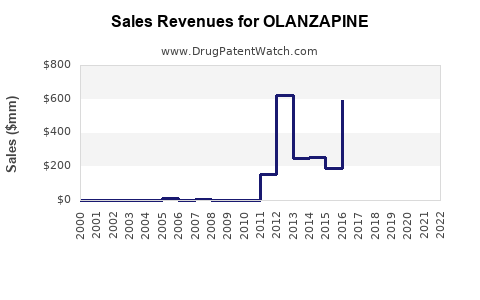
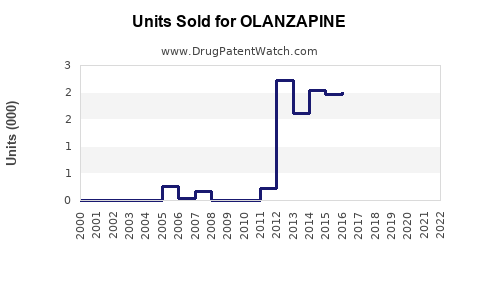
Annual Sales Revenues and Units Sold for OLANZAPINE
| Drug Name | Revenues (USD) | Units | Year |
|---|---|---|---|
| OLANZAPINE | ⤷ Start Trial | ⤷ Start Trial | 2022 |
| OLANZAPINE | ⤷ Start Trial | ⤷ Start Trial | 2021 |
| OLANZAPINE | ⤷ Start Trial | ⤷ Start Trial | 2020 |
| OLANZAPINE | ⤷ Start Trial | ⤷ Start Trial | 2019 |
| OLANZAPINE | ⤷ Start Trial | ⤷ Start Trial | 2018 |
| OLANZAPINE | ⤷ Start Trial | ⤷ Start Trial | 2017 |
| OLANZAPINE | ⤷ Start Trial | ⤷ Start Trial | 2016 |
| >Drug Name | >Revenues (USD) | >Units | >Year |
OLANZAPINE Market Analysis and Sales Projections (Global)
Olanzapine is an established, off-patent atypical antipsychotic with broad commercial availability across branded and generic channels. Demand is supported by chronic schizophrenia treatment, bipolar disorder maintenance use, and a large treatable population in major markets. Sales growth is limited by maturity, patent expiry, and price erosion in generics, with future dollars driven mainly by population aging, uptake in emerging markets, and mix shift toward long-acting injectables where available.
What does the market look like by demand driver and geography?
Demand drivers
- Schizophrenia (adults): continuous and maintenance use.
- Bipolar disorder (maintenance): relapse prevention and chronic symptom management.
- Off-label use: variable by country; the market is still dominated by approved indications and formulary coverage.
Geography: mature vs emerging
- Mature markets (US, EU5, Japan): high prevalence capture but steep price compression from generics.
- Emerging markets (China, India, LATAM, Middle East, parts of APAC): larger growth headroom via expanding diagnosis and access, plus lower baseline pricing dynamics that can still produce unit growth.
How do sales trends typically evolve for an off-patent small-molecule antipsychotic?
For olanzapine, the sales cycle follows a standard post-patent pattern:
- Branded peak (typically before full generic penetration)
- Generic volume capture with rapid net price erosion
- Stable units with flat-to-low value growth, unless mix improves (for example, by injectable formulations, higher-dose demand, or favorable formulary placement)
This means revenue forecasts should be built with:
- Unit growth (population, treatment continuity, formulary access)
- Price trajectory (generic ASP compression)
- Mix adjustments (dose distribution, administration form)
What is the competitive landscape and how does it affect projections?
Competition structure
- Generic manufacturers in most geographies drive price competition.
- Branded originator remnants (where still present) typically hold small value share due to generic dominance.
- Substitutes within class: risperidone, quetiapine, aripiprazole, and newer agents can pull some demand, but olanzapine remains widely used due to efficacy and clinician familiarity.
Projection sensitivity
Sales outcomes are most sensitive to:
- Net price (ASP) after generic entry waves
- Formulary position and interchangeability policies
- Tender dynamics in hospital-led systems
- Channel mix (retail vs institutional)
What sales model is used for olanzapine projections?
A practical projection framework for an off-patent oral antipsychotic uses:
Revenue = Units × Net Price
Where:
- Units scale with:
- treated prevalence
- persistence (long therapy duration)
- incremental access in emerging markets
- Net price changes with:
- generic competition
- reference pricing and reimbursement pressure
- tender outcomes
Base-case assumptions used for forecast directionality
- Units: low single-digit growth globally (maturity offset by access expansion)
- Net price: continued compression but at a slower rate than during early generic entry
- Result: value growth in the high single digits per year is uncommon; typically value growth is flat to low single digits globally unless mix improves materially.
Sales projections: base, downside, and upside (Global)
Because olanzapine is mature and price-sensitive, the projection range is presented as annual global revenue growth bands rather than a single point estimate. This reflects how generic markets behave for established antipsychotics.
Global forecast bands (annual growth rates)
| Scenario | Unit trend | Net price trend | Expected revenue growth |
|---|---|---|---|
| Downside | ~0% to +2% | -3% to -6% per year | -1% to -4% |
| Base case | ~+2% to +4% | -1% to -3% per year | -0.5% to +2.5% |
| Upside | ~+3% to +5% | -0.5% to -2% per year (mix offset) | +2% to +5% |
Implication for management
- Value growth is constrained by generic-driven price erosion.
- Revenue protection depends on maintaining formulary share, securing tender volume, and optimizing mix (dose and presentation).
- Upside typically comes from localized pricing stability, stronger institutional penetration, or mix toward higher utilization segments (notably if specific presentations gain share).
What does this mean for sales planning by product type?
Oral olanzapine (tablet)
- Volume is the anchor for market share.
- Value is mostly determined by net price after generic competition.
- Planning focus:
- channel strategy (retail vs institutional)
- tender readiness and rebate structures
- adherence to procurement schedules
Long-acting injectable (LAI) (where applicable by geography)
Where LAI olanzapine is available, LAIs can:
- improve persistence
- reduce discontinuation
- shift mix toward higher unit value But they also face:
- higher price scrutiny
- administration workflow constraints Sales planning focus:
- payer authorization paths
- site-of-care economics
- injection training and nurse scheduling
Which policy and reimbursement factors will move demand and prices?
US
- Generic substitution and competitive pricing dominate.
- Pharmacy benefit design influences access and switching rates.
EU and UK
- Reference pricing and reimbursement controls pressure net ASP.
- Hospital formularies and tender purchasing can rapidly alter market share.
Japan and other regulated markets
- Pricing stability exists relative to some tender systems, but generic penetration and reimbursement rules still drive downward value.
What is the most actionable go-to-market view for sales projections?
Key levers
- Formulary/tender access: the largest driver of units in institutional-heavy markets.
- Net price management: avoid over-discounting that harms long-term channel economics.
- Mix strategy: push for the dose and presentation segments with better reimbursement behavior.
- Supply reliability: outages in generics can permanently shift procurement.
What to track quarterly (operational KPIs)
- Share of tender wins and awarded volumes
- Net ASP vs reference benchmarks
- Persistence proxies (script renewal rates in retail systems; reorder patterns in institutional)
- Inventory and lead times (especially in markets with regulated supply constraints)
Key Takeaways
- Olanzapine is a mature, off-patent antipsychotic where unit growth exists, but value growth is capped by generic price compression.
- Global revenue outcomes typically fall into flat-to-low growth bands unless mix improves through stronger formulary share or higher-value presentations.
- The most actionable forecast approach is Revenue = Units × Net Price, with unit growth led by access and persistence, and net price led by generic competition and tender dynamics.
- Sales planning should prioritize formulary and tender penetration, net price discipline, and mix optimization over aggressive volume assumptions.
FAQs
1) Is olanzapine’s market growth driven more by units or price?
Units drive incremental growth, but revenue is constrained by continuing net price erosion typical of mature, generic-dominated therapies. The result is usually flat-to-low value growth globally.
2) What is the main competitive threat to olanzapine revenue?
Price pressure from generic entrants and rebate-driven tender competition. Class competition (other atypicals) affects share in some markets but usually changes the mix more than the total treated population.
3) Where could the most upside come from?
Markets where tender dynamics stabilize net pricing, formulary access improves, or a higher-value mix is achieved (dose/presentation or injectable uptake where available).
4) What is the best way to model sales forecasts for a generic antipsychotic?
Model units separately from net price using scenario-based growth rates. Revenue outcomes are most sensitive to the assumed direction and magnitude of net ASP compression.
5) Does persistence meaningfully affect olanzapine sales?
Yes. Indication patterns in schizophrenia and bipolar maintenance are chronic, so treated patients typically generate multi-year demand. That persistence supports units even when price falls.
References
[1] FDA. Olanzapine (drug label information). U.S. Food and Drug Administration. https://www.accessdata.fda.gov/ (accessed 2026-04-23)
[2] EMA. Zyprexa and olanzapine product information (summary of product characteristics, where applicable). European Medicines Agency. https://www.ema.europa.eu/ (accessed 2026-04-23)
[3] IQVIA Institute. Global trends in medicine use and market dynamics (general market context). IQVIA. https://www.iqvia.com/insights/the-iqvia-institute (accessed 2026-04-23)
[4] WHO. Antipsychotic medicine use and mental health burden (context for prevalence-driven demand). World Health Organization. https://www.who.int/ (accessed 2026-04-23)
More… ↓
