Drug Sales Trends for NIKKI
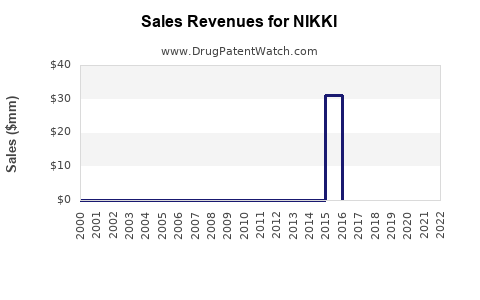
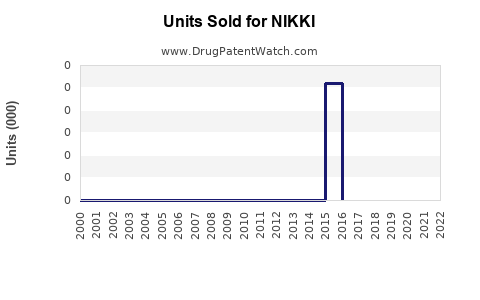
Annual Sales Revenues and Units Sold for NIKKI
| Drug Name | Revenues (USD) | Units | Year |
|---|---|---|---|
| NIKKI | ⤷ Start Trial | ⤷ Start Trial | 2022 |
| NIKKI | ⤷ Start Trial | ⤷ Start Trial | 2021 |
| NIKKI | ⤷ Start Trial | ⤷ Start Trial | 2020 |
| NIKKI | ⤷ Start Trial | ⤷ Start Trial | 2019 |
| NIKKI | ⤷ Start Trial | ⤷ Start Trial | 2018 |
| NIKKI | ⤷ Start Trial | ⤷ Start Trial | 2017 |
| NIKKI | ⤷ Start Trial | ⤷ Start Trial | 2016 |
| >Drug Name | >Revenues (USD) | >Units | >Year |
Nikki Drug Market Analysis, Patent Position, Competitive Landscape, and Sales Projections
Nikki is a U.S. prescription generic oral contraceptive containing drospirenone 3 mg and ethinyl estradiol 0.02 mg. It is therapeutically equivalent to Yaz and competes in a crowded, price-sensitive market dominated by generic substitution. Nikki has limited standalone pricing power, no meaningful biologic or new-drug exclusivity barrier, and low exposure to patent-driven generic-entry risk. Under a base-case U.S. model, Nikki could generate approximately $25 million to $40 million in annual manufacturer revenue, with upside toward $60 million to $90 million if prescription volume expands through payer coverage, pharmacy distribution, and brand recognition.
What is Nikki and how is it regulated by the FDA?
Nikki is a combined oral contraceptive tablet containing drospirenone and ethinyl estradiol. The standard package contains 28 tablets, including 24 active hormone tablets and four inert tablets. The product is used primarily for contraception. The underlying drospirenone/ethinyl estradiol formulation is also associated with treatment categories such as premenstrual dysphoric disorder and acne, although the precise approved indications depend on the product label and approved abbreviated new drug application.
| Product characteristic | Nikki |
|---|---|
| Active ingredients | Drospirenone 3 mg; ethinyl estradiol 0.02 mg |
| Dosage form | Oral tablet |
| Typical package | 28 tablets |
| Therapeutic class | Combined hormonal contraceptive |
| Reference product | Yaz |
| FDA pathway | Generic approval under an ANDA pathway |
| Primary market | U.S. prescription contraception |
| Commercial owner | Lupin Pharmaceuticals is associated with U.S. Nikki commercialization |
| Prescription status | Prescription-only |
| Biosimilar exposure | None |
The FDA evaluates generic oral contraceptives for pharmaceutical equivalence, bioequivalence, manufacturing quality, labeling requirements, and product performance. Generic approval does not provide the same market exclusivity available to a new chemical entity under the Hatch-Waxman framework. FDA generic-drug requirements are described in the agency’s generic-drug guidance and approval databases. [1]
What patents protect Nikki and when does Nikki lose exclusivity?
Nikki does not have the patent profile of a newly approved branded drug. Its commercial foundation is a generic version of the Yaz product family, whose core composition and original product patents have expired or become commercially ineffective for ordinary generic competition.
The key patent conclusions are:
- Nikki is not dependent on a current composition-of-matter patent for commercial protection.
- The principal commercial threat is competition from other approved generics.
- Method-of-use patents associated with the reference product are unlikely to prevent broad generic contraception competition.
- Formulation patent risk is limited because the product uses a conventional oral tablet rather than a novel delivery system.
- No separate biosimilar or biologic exclusivity period applies.
What is the Orange Book status of Nikki?
The Orange Book primarily lists reference listed drugs and patents submitted by approved new-drug applicants. Generic products such as Nikki generally rely on the Orange Book listing for the reference product rather than possessing a separate branded Orange Book patent estate equivalent to Yaz’s original estate. The relevant legal inquiry is therefore whether any listed Yaz patents remain enforceable and whether a generic ANDA applicant made the necessary patent certifications.
For Nikki, the commercial exclusivity period is best understood as having ended when generic drospirenone/ethinyl estradiol products entered the market. The product’s protection is distribution-based rather than patent-based.
When did Nikki lose exclusivity?
Nikki’s market exclusivity ended with the entry of generic versions of Yaz and related drospirenone/ethinyl estradiol products. Yaz was approved in the early 2000s, and generic competition developed after expiration or resolution of the relevant Hatch-Waxman protections.
| Exclusivity category | Nikki position |
|---|---|
| New chemical entity exclusivity | Not applicable to Nikki |
| New-drug product exclusivity | Not applicable as a generic product |
| Pediatric exclusivity | Not a material Nikki protection |
| Composition-of-matter patent | No current Nikki-specific barrier |
| Formulation patent | No material standalone barrier identified |
| Method-of-use exclusivity | Limited commercial relevance |
| Generic entry barrier | Low |
| Current commercial moat | Pharmacy access, payer placement, supply reliability, and price |
Nikki therefore has no conventional future “loss of exclusivity” event comparable to an innovator product facing its first generic entry. The relevant commercial cycle is a continuing erosion of price and share as additional manufacturers enter or expand distribution.
What is the competitive landscape for Nikki?
Nikki competes in two overlapping markets: drospirenone/ethinyl estradiol generics and the broader U.S. oral contraceptive market.
Which companies compete with Nikki?
Direct or near-direct competitors include generic products marketed under names such as Loryna, Gianvi, Vestura, Syeda, Zumandimine, and other drospirenone/ethinyl estradiol equivalents. Availability varies by manufacturer, distributor, pharmacy chain, and payer formulary.
The broader competitive set includes:
- Norgestimate/ethinyl estradiol products, including generic Ortho-Cyclen and related products.
- Desogestrel/ethinyl estradiol products.
- Levonorgestrel/ethinyl estradiol products.
- Norethindrone-based oral contraceptives.
- Slynd, a progestin-only drospirenone product.
- Nextstellis, a newer combined oral contraceptive.
- Long-acting reversible contraceptives, including intrauterine systems and implants.
- Depot injections, patches, rings, and emergency contraceptive products.
Nikki’s direct advantage is ingredient familiarity and broad generic availability. Its disadvantages are interchangeable substitution, weak differentiation, and limited ability to sustain premium pricing.
How does Nikki compare with Slynd and Nextstellis?
| Factor | Nikki | Slynd | Nextstellis |
|---|---|---|---|
| Hormonal type | Combined estrogen/progestin | Progestin-only | Combined estrogen/progestin |
| Main commercial position | Low-cost generic | Branded differentiated oral contraceptive | Branded newer oral contraceptive |
| Estrogen exposure | Yes | No | Yes |
| Patent protection | Limited generic protection | Branded patent estate | Branded patent estate |
| Price power | Low | Higher | Higher |
| Payer sensitivity | High | High | High |
| Main growth driver | Generic access and low cost | Estrogen-free positioning | Product differentiation and physician adoption |
Nikki is more likely to win on price than on clinical differentiation. Slynd and Nextstellis have greater potential to sustain branded pricing if their manufacturers maintain formulary coverage and physician demand.
What are the sales projections for Nikki?
Public company disclosures generally do not report Nikki revenue as a separate product line. A bottom-up projection is therefore more useful than a historical brand-revenue series. The model below uses U.S. packs sold, net manufacturer revenue per 28-day pack, and annual volume growth.
Base-case projection
| Year | Packs sold | Net revenue per pack | Estimated revenue |
|---|---|---|---|
| 2025 | 2.8 million | $9.00 | $25.2 million |
| 2026 | 3.1 million | $8.90 | $27.6 million |
| 2027 | 3.4 million | $8.80 | $29.9 million |
| 2028 | 3.7 million | $8.70 | $32.2 million |
| 2029 | 4.0 million | $8.60 | $34.4 million |
The base case assumes volume growth of roughly 8% to 11% annually, offset by modest net-price erosion. Growth would come from broader pharmacy availability, conversion from higher-cost branded alternatives, and continued demand for drospirenone-containing contraceptives.
Scenario analysis
| Scenario | 2029 packs | 2029 net revenue per pack | 2029 revenue |
|---|---|---|---|
| Downside | 1.8 million | $7.50 | $13.5 million |
| Base case | 4.0 million | $8.60 | $34.4 million |
| Upside | 7.0 million | $9.00 | $63.0 million |
An aggressive upside case could exceed $75 million if Nikki gains preferred status with large pharmacy benefit managers, captures substantial volume from discontinued competitors, or benefits from manufacturing shortages affecting other suppliers. That outcome would require stronger distribution and supply performance than is typical for an interchangeable generic.
What drives Nikki revenue and market share?
Nikki revenue depends on five commercial variables.
Prescription volume
The U.S. oral contraceptive market includes millions of users and a high degree of generic substitution. Nikki’s prescription growth depends on whether prescribers specify the product, pharmacies stock it, and payers place it on a favorable generic tier.
Net price
Retail prices can vary significantly by pharmacy, insurance status, dispensing channel, and discount program. Manufacturer revenue is materially below the patient-facing retail price after wholesaler discounts, rebates, chargebacks, and pharmacy arrangements.
Formulary position
Preferred generic placement can move volume quickly. A non-preferred position may reduce the product to residual demand even when the active ingredients are clinically interchangeable.
Supply reliability
Generic contraception markets are vulnerable to manufacturing interruptions because pharmacies can switch quickly between suppliers. A manufacturer with reliable active pharmaceutical ingredient sourcing, finished-dose capacity, and packaging availability can gain share during shortages.
Product reputation
Nikki has limited brand equity compared with a novel therapy, but consistent availability and low out-of-pocket cost can create repeat demand. The product’s commercial identity matters most in mail-order, specialty pharmacy, telehealth, and cash-pay channels.
What manufacturing and intellectual property barriers affect Nikki?
Nikki’s primary barriers are operational rather than patent-related. The main requirements are:
- Reliable drospirenone and ethinyl estradiol sourcing.
- Validated manufacturing and content-uniformity controls.
- Stability performance across the labeled shelf life.
- Packaging capacity for 28-tablet packs.
- Compliance with FDA current good manufacturing practice requirements.
- Control of impurities, dissolution, assay, and batch release.
- Distribution agreements with wholesalers and national pharmacy chains.
Drospirenone is a potent active ingredient, so process control and content uniformity remain important. These requirements can delay or disrupt supply but do not create durable exclusivity if another manufacturer can qualify an equivalent product.
What Paragraph IV challenges and patent litigation affect Nikki?
The relevant Paragraph IV activity involved generic entry against Yaz and related reference products, not a continuing Nikki-specific litigation franchise. Paragraph IV certification permits an ANDA applicant to assert that listed patents are invalid, unenforceable, or not infringed. Once the relevant reference-product patents no longer block approval, multiple generic manufacturers can compete.
No major current litigation should be assumed to provide Nikki with meaningful market protection. The product’s principal legal exposure is ordinary generic competition, including:
- ANDA approvals for competing drospirenone/ethinyl estradiol products.
- Patent challenges involving future delivery or formulation variants.
- Manufacturing and regulatory enforcement actions.
- Supply or distribution disputes.
- Product-liability claims applicable to combined hormonal contraceptives.
Settlement agreements involving historical Yaz generic entry may have affected launch timing for specific manufacturers, but those agreements do not create a durable Nikki monopoly after broad generic entry.
What is the biosimilar risk for Nikki?
Nikki has no biosimilar risk because it is a chemically synthesized small-molecule drug, not a biologic. Its competitive risk is generic substitution. Biosimilar market dynamics, interchangeable biologic designation, and biologic reference-product exclusivity do not apply.
What geographic markets does Nikki cover?
Nikki’s principal commercial market is the United States. The product’s value depends on U.S. FDA approval, national wholesaler access, and domestic payer contracting. International sales should not be assumed to contribute materially unless the product is separately registered and marketed under equivalent or different trade names.
Geographic expansion would require country-specific regulatory filings, pricing approvals, pharmacovigilance systems, and local distribution. Because drospirenone/ethinyl estradiol products are widely available internationally, overseas expansion would likely add volume without creating substantial pricing power.
How strong is the patent estate for Nikki?
Nikki’s patent estate is weak from an investment perspective. Its strengths are regulatory approval, an established active-ingredient combination, and an existing market for generic oral contraception. Its weaknesses are the absence of meaningful exclusivity, numerous interchangeable competitors, low switching costs, and limited ability to raise price.
| Patent-estate factor | Assessment |
|---|---|
| Composition patent | Weak or expired |
| Novel formulation protection | Limited |
| Method-of-use protection | Limited commercial impact |
| Orange Book leverage | Low |
| Paragraph IV defense value | Low |
| Manufacturing know-how | Moderate operational value |
| Supply-chain moat | Potentially moderate |
| Long-term pricing power | Low |
Key Takeaways
- Nikki is a generic drospirenone 3 mg/ethinyl estradiol 0.02 mg oral contraceptive associated with Lupin’s U.S. portfolio.
- Its reference product is Yaz, and the core market is already exposed to generic competition.
- Nikki has no meaningful new-drug, biologic, or formulation exclusivity.
- Patent risk is less important than payer access, supply reliability, and net pricing.
- Estimated U.S. manufacturer revenue is approximately $25 million to $40 million annually under a base-case scenario.
- A downside case produces approximately $13 million to $15 million in 2029 revenue.
- An upside case could reach approximately $60 million to $75 million if Nikki captures preferred formulary placement or competitor supply disruptions.
- The main commercial threat is substitution by other generic drospirenone/ethinyl estradiol products, not biosimilars.
- Nikki is unlikely to sustain premium pricing without a differentiated formulation, distribution advantage, or supply shortage.
FAQs About Nikki Sales, Patents, and Market Entry
Is Nikki the same as Yaz?
Nikki contains the same active ingredients and strengths as Yaz, although inactive ingredients, labeling details, manufacturer, packaging, and approved indications can differ. FDA therapeutic-equivalence designations determine whether pharmacies may substitute the generic product.
Can a new generic manufacturer still enter the Nikki market?
Yes. A manufacturer that obtains FDA approval for an equivalent drospirenone/ethinyl estradiol product can compete, subject to applicable patents, regulatory requirements, manufacturing capacity, and commercial distribution.
Does Nikki have a branded-drug exclusivity period?
No. Nikki is a generic product and does not receive the new chemical entity exclusivity available to an innovator drug.
What would most increase Nikki’s sales?
Preferred payer placement, dependable national supply, competitive acquisition cost, pharmacy-chain contracts, and telehealth distribution would have the greatest effect on volume.
Is Nikki exposed to contraceptive patent litigation?
Its exposure is primarily indirect. Historical litigation concerned the reference-product patent estate and generic entry. Future litigation could involve manufacturing, labeling, product liability, or any new formulation, but the standard Nikki tablet has limited patent leverage.
More… ↓
