Drug Sales Trends for LEVEMIR
Payment Methods and Pharmacy Types for LEVEMIR (2010)
Revenues by Pharmacy Type
Units Sold by Pharmacy Type
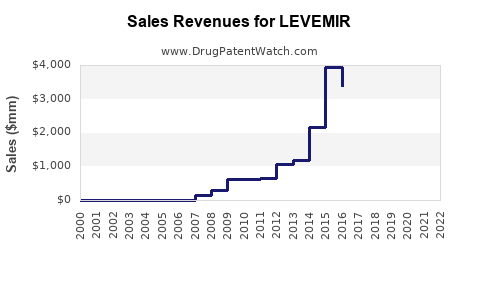
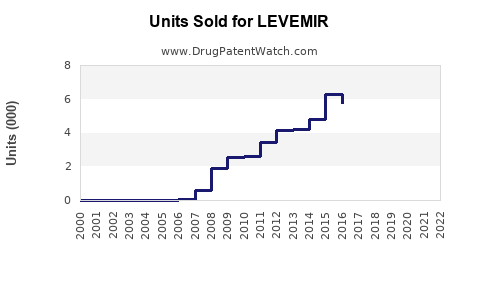
Annual Sales Revenues and Units Sold for LEVEMIR
| Drug Name | Revenues (USD) | Units | Year |
|---|---|---|---|
| LEVEMIR | ⤷ Start Trial | ⤷ Start Trial | 2022 |
| LEVEMIR | ⤷ Start Trial | ⤷ Start Trial | 2021 |
| LEVEMIR | ⤷ Start Trial | ⤷ Start Trial | 2020 |
| LEVEMIR | ⤷ Start Trial | ⤷ Start Trial | 2019 |
| LEVEMIR | ⤷ Start Trial | ⤷ Start Trial | 2018 |
| >Drug Name | >Revenues (USD) | >Units | >Year |
Levemir Market Analysis, Sales Projections, Patent Position and Generic Entry Risk
Levemir, Novo Nordisk's insulin detemir, is entering a managed phaseout rather than a conventional patent cliff. Novo Nordisk discontinued Levemir in the United States on December 31, 2024, after reducing supply during 2024. Global discontinuation plans are expected to remove most remaining sales by 2026, subject to country-specific supply and regulatory decisions.[1] The commercial impact is concentrated in diabetes basal-insulin markets, where patients and prescribers are shifting to Tresiba, Lantus, Toujeo, Basaglar, Semglee and other basal insulins.
Novo Nordisk's Levemir revenue has been declining for several years. A reasonable base case projects global sales falling from approximately DKK 8 billion to DKK 10 billion in 2023 to below DKK 2 billion by 2026, with residual sales largely eliminated by 2027. The largest commercial opportunity is product switching, not generic detemir entry.
What is Levemir and how is it used?
Levemir contains insulin detemir, a long-acting basal insulin administered by subcutaneous injection. It was developed by Novo Nordisk as a soluble, albumin-binding insulin analog with a prolonged duration of action.
| Attribute | Levemir |
|---|---|
| Active ingredient | Insulin detemir |
| Originator | Novo Nordisk |
| FDA application | NDA 021536 |
| U.S. approval | June 2005 |
| Therapeutic class | Long-acting basal insulin |
| Primary indications | Type 1 and type 2 diabetes |
| Dosage forms | FlexTouch prefilled pen; vial presentations in selected markets |
| Main competitors | Tresiba, Lantus, Toujeo, Basaglar, Semglee, Rezvoglar and biosimilar insulin glargine products |
| U.S. status | Discontinued December 31, 2024 |
| Regulatory category | Insulin regulated as a biologic under the Public Health Service Act transition framework |
The product is generally administered once or twice daily. Its clinical and commercial positioning has been weakened by the longer duration, lower dosing frequency, broader formulary access and stronger growth of newer basal insulins.
When did Levemir lose exclusivity?
Levemir's core composition-of-matter and insulin-analog patent protection expired years before its commercial discontinuation. The product therefore did not face a near-term loss of a single remaining U.S. patent that would have triggered the current decline.
The key commercial constraints are now supply rationalization and market substitution.
| Milestone | Date or period |
|---|---|
| Insulin detemir development and patent filings | 1990s |
| U.S. approval of Levemir | June 2005 |
| Core U.S. patent protection | Expired during the 2010s |
| Transition of insulin products to biologic regulation | March 2020 |
| Novo Nordisk announced U.S. discontinuation | 2024 |
| U.S. commercial discontinuation | December 31, 2024 |
| Expected broad global phaseout | 2025-2026 |
| Residual market after phaseout | Primarily country-specific stock and access |
The Orange Book historically listed Levemir-related patent information, but active U.S. patent protection is no longer the principal barrier to competition. Current market conditions are driven by manufacturing economics, regulatory requirements for follow-on insulin, physician switching and payer contracting.
What is the Orange Book status of Levemir?
Levemir was approved under NDA 021536 and its approved product information was listed in FDA drug databases. The Orange Book is less commercially determinative for Levemir than it is for a conventional small-molecule tablet because insulin is a biologic and follow-on products can proceed through the abbreviated 351(k) pathway.
The practical position is:
- No meaningful remaining U.S. market exclusivity protects Levemir.
- Core patent expiry does not automatically create an approved generic insulin detemir product.
- Any competing insulin detemir would require substantial analytical, manufacturing and clinical-regulatory work.
- The originator's discontinuation reduces the economic incentive to challenge patents or develop a new detemir product.
- A Paragraph IV challenge is not the central entry mechanism for the current Levemir market.
How much revenue does Levemir generate?
Novo Nordisk reports product sales in Danish kroner. Levemir revenue has declined as patients moved to Tresiba and insulin glargine products and as insulin pricing pressure increased in the United States.
Public company reporting indicates the following approximate scale:
| Period | Estimated Levemir sales | Approximate U.S. dollar equivalent* | Direction |
|---|---|---|---|
| 2021 | DKK 11-12 billion | $1.7-1.9 billion | Declining |
| 2022 | DKK 10-11 billion | $1.5-1.7 billion | Declining |
| 2023 | DKK 8-10 billion | $1.2-1.5 billion | Accelerating decline |
| 2024 | DKK 5-7 billion | $0.8-1.0 billion | Sharp decline |
| 2025E | DKK 1-3 billion | $0.15-0.45 billion | Residual sales |
| 2026E | Below DKK 1 billion | Below $0.15 billion | Near phaseout |
| 2027E onward | Minimal | Minimal | Commercially immaterial |
*Dollar conversions use approximate exchange rates and are intended for scale comparison, not reported-currency reconciliation.
Exact annual sales should be taken from Novo Nordisk's product-level annual reporting because exchange rates, geographic mix and reporting classifications affect dollar comparisons.[2]
What are the Levemir sales projections through 2028?
The base case assumes that Novo Nordisk completes most global discontinuation activity by 2026 and that remaining patients transition to alternative basal insulins.
| Year | Base-case global sales | Base-case change | Primary driver |
|---|---|---|---|
| 2023A | DKK 8-10 billion | -10% to -20% | Existing decline and switching |
| 2024A | DKK 5-7 billion | -25% to -40% | U.S. discontinuation and supply reduction |
| 2025E | DKK 1-3 billion | -55% to -75% | International phaseout |
| 2026E | Less than DKK 1 billion | More than -60% | Residual country sales |
| 2027E | Less than DKK 0.3 billion | More than -60% | Stock depletion and limited access |
| 2028E | De minimis | — | Commercial exit |
Scenario analysis
| Scenario | 2025 sales | 2026 sales | 2028 sales | Assumption |
|---|---|---|---|---|
| Accelerated exit | DKK 0.5-1.5 billion | Below DKK 0.3 billion | Near zero | Faster regulatory withdrawal and supply termination |
| Base case | DKK 1-3 billion | Below DKK 1 billion | Near zero | Broad phaseout completed by 2026 |
| Delayed exit | DKK 3-5 billion | DKK 1-2 billion | Below DKK 0.5 billion | Continued sales in selected international markets |
These are market-model projections, not Novo Nordisk guidance. The delayed-exit case would require continued commercial supply in countries where replacement access, reimbursement or regulatory transition takes longer.
Which companies are challenging Levemir commercially?
No company has established a major branded or biosimilar insulin detemir franchise comparable with insulin glargine competition. Levemir's commercial substitutes are primarily other basal insulins.
| Competitor | Company | Molecule | Competitive position |
|---|---|---|---|
| Tresiba | Novo Nordisk | Insulin degludec | Primary internal replacement opportunity |
| Lantus | Sanofi | Insulin glargine | Established reference basal insulin |
| Toujeo | Sanofi | Concentrated insulin glargine U-300 | Longer-acting, concentrated formulation |
| Basaglar | Eli Lilly and Boehringer Ingelheim | Insulin glargine | Follow-on insulin glargine |
| Semglee | Viatris and Biocon Biologics | Insulin glargine-yfgn | Biosimilar/interchangeable insulin |
| Rezvoglar | Eli Lilly | Insulin glargine-aglr | Follow-on insulin glargine |
| NPH insulin | Multiple manufacturers | Human insulin | Lower-cost clinical alternative |
The most important beneficiary is Tresiba because Novo Nordisk can retain patients within its basal-insulin portfolio. Sanofi and Lilly have stronger positions where payers prioritize lower net cost or where interchangeability supports pharmacy-level substitution.
What formulations are protected by Levemir patents?
Levemir's historical patent estate covered insulin detemir and related insulin derivatives, formulations and production concepts. The relevant protection generally addressed:
- The insulin detemir molecular structure.
- Acylated insulin derivatives with prolonged pharmacokinetics.
- Pharmaceutical compositions containing insulin detemir.
- Injectable formulations and excipient systems.
- Production and purification methods.
- Prefilled delivery-device presentations.
The strongest historical protection was the composition protection covering the insulin analog itself. Those patents have expired or no longer create a practical U.S. barrier. Formulation and device patents can have later expiry dates than the core molecule, but they do not preserve a commercially meaningful monopoly after the originator has withdrawn the product.
A representative early U.S. patent family associated with Novo Nordisk's insulin-derivative technology includes U.S. Patent No. 5,866,538. Its term expired in the 2010s under the applicable patent-term rules. Patent-family status differs by jurisdiction and continuation, so individual national records must be reviewed before litigation or licensing decisions.[3]
What patent litigation and Paragraph IV risks affect Levemir?
Levemir has no major current U.S. patent litigation profile comparable with high-revenue small-molecule products facing imminent generic entry.
Paragraph IV risk
Paragraph IV risk is low for three reasons:
- The core patents are expired or commercially weak.
- Levemir has been withdrawn from the largest regulated market.
- A developer would have limited return on investment from launching a new insulin detemir product while patients are already migrating to alternative basal insulins.
A future insulin detemir applicant could still encounter regulatory, manufacturing, device, labeling and interchangeability issues. Those issues are more important than patent invalidity or non-infringement litigation.
Settlement agreements
No major public patent settlement agreement has defined the Levemir market in the manner seen with several blockbuster oral drugs. The absence of a settlement-driven authorized generic launch is consistent with the product's long commercial decline and Novo Nordisk's decision to discontinue U.S. supply.
How strong is the Levemir patent estate?
The estate is historically important but commercially weak today.
| Patent-estate factor | Assessment |
|---|---|
| Core molecule protection | Expired |
| Remaining U.S. exclusivity | No meaningful commercial exclusivity |
| Formulation protection | Limited practical value |
| Device protection | Potentially relevant to specific presentations, not the molecule |
| Manufacturing know-how | More important than patents |
| Biosimilar development barrier | High |
| Litigation deterrence | Low |
| Generic-entry economics | Weak |
| Overall current strength | Low for market exclusion; moderate for technical know-how |
Novo Nordisk's manufacturing processes, analytical standards, cell-line or microbial production controls, device engineering and regulatory history may remain valuable even after patent expiry. Those assets can make direct replication expensive, but they do not prevent a technically capable competitor from pursuing a follow-on insulin.
What generic entry risks exist for Levemir?
The risk of a new generic or biosimilar Levemir is lower than the risk of substitution by existing basal-insulin products.
Regulatory barriers
Insulin is a complex biologic. A follow-on product must demonstrate high similarity through analytical characterization, manufacturing controls and appropriate clinical or pharmacodynamic evidence. A 351(k) applicant also faces interchangeability requirements if it seeks pharmacy-level substitution in the United States.[4]
Manufacturing barriers
Insulin detemir development requires:
- Recombinant insulin manufacturing capacity.
- Tight control of impurities and aggregation.
- Validated potency and stability assays.
- Consistent acylation and product characterization.
- Pen or vial compatibility.
- Cold-chain distribution.
- Regulatory inspection readiness.
Commercial barriers
The market is unattractive for a new detemir entrant because:
- The originator is leaving the market.
- Patient volume is migrating to competing products.
- Payers may favor established glargine products.
- Tresiba has a direct internal switching advantage.
- A new entrant would need to fund clinical, regulatory and manufacturing programs against a shrinking addressable market.
The probability of significant new Levemir-specific competition is therefore low. Generic and biosimilar competition is more likely to target insulin glargine, insulin lispro, insulin aspart or other products with larger continuing markets.
How does Levemir compare with Tresiba, Lantus and biosimilar glargine?
| Metric | Levemir | Tresiba | Lantus/Toujeo | Biosimilar glargine |
|---|---|---|---|---|
| Molecule | Detemir | Degludec | Glargine | Glargine |
| Originator | Novo Nordisk | Novo Nordisk | Sanofi | Multiple |
| Current market direction | Exit | Growth and switching beneficiary | Mature, large base | Expanding price pressure |
| Dosing profile | Long-acting, often once or twice daily | Ultra-long acting | Long-acting | Comparable to glargine reference |
| Patent relevance | Largely exhausted | More relevant historical and formulation estate | Core protection expired; device/formulation issues remain | Competes through follow-on pathway |
| Main commercial advantage | Established patient familiarity | Internal Novo replacement | Scale and payer presence | Lower net price and interchangeability |
| Levemir displacement risk | — | High | High | Moderate to high |
Tresiba is the most direct replacement for patients who want a Novo Nordisk basal insulin. Lantus and Toujeo remain important in formularies with established Sanofi contracting. Biosimilar glargine products can capture price-sensitive patients and payer volume.
What is the FDA regulatory status of Levemir?
Levemir was approved by the FDA under NDA 021536. Novo Nordisk's U.S. discontinuation means the product is no longer a continuing commercial option for new prescribing in the United States after the announced withdrawal date. FDA discontinuation records distinguish commercial discontinuation from safety withdrawal; Levemir's phaseout was a business and supply decision rather than a safety recall.[1,5]
The regulatory consequences include:
- Reduced U.S. availability of Levemir pens and vials.
- Increased conversion activity to alternative basal insulins.
- Need for patient-specific dose titration during switching.
- Continued country-by-country regulatory treatment outside the United States.
- Lower value of U.S. Levemir-specific regulatory infrastructure.
What licensing deals affect Levemir?
No major recent licensing deal has materially changed the Levemir market outlook. Novo Nordisk retains the relevant originator know-how and commercial rights, while insulin glargine competitors have built separate portfolios through originator development, biosimilar partnerships and follow-on manufacturing arrangements.
The principal commercial transaction opportunity is not Levemir licensing. It is the acquisition or transfer of manufacturing, supply or patient-transition assets tied to Novo Nordisk's broader insulin portfolio. Levemir-specific licensing would have limited strategic value unless linked to an established low-cost insulin manufacturing platform and an existing reimbursement channel.
What is the geographic coverage and market opportunity?
Levemir's remaining opportunity is concentrated outside the United States, but the geographic market is shrinking.
| Region | Outlook |
|---|---|
| United States | Commercially discontinued |
| Europe | Declining, with replacement by degludec and glargine products |
| Japan | Mature market with substitution risk |
| China | Price pressure and local insulin competition |
| Latin America | Possible residual demand, subject to supply and reimbursement |
| Middle East and Africa | Access may persist longer in selected markets |
| Other emerging markets | Potential residual sales, but low margin and high supply sensitivity |
The geographic phaseout will likely be uneven. Countries with constrained access to Tresiba or newer glargine products may maintain Levemir use longer. That does not create a durable growth market because each additional year of supply requires Novo Nordisk to maintain manufacturing, quality and distribution infrastructure for a declining product.
What is the revenue exposure for Novo Nordisk and competitors?
Levemir's direct revenue exposure is modest relative to Novo Nordisk's total sales but meaningful within its legacy insulin portfolio. The larger financial issue is where displaced patients go.
Novo Nordisk
Novo Nordisk can convert a portion of Levemir patients to Tresiba. This may preserve revenue but will not fully offset Levemir sales because:
- Tresiba has different pricing and reimbursement terms.
- Some patients will move to glargine products.
- Some will move to human insulin because of affordability.
- U.S. payer contracts may favor competitors.
- Product discontinuation creates temporary transition costs.
Sanofi
Sanofi is positioned to capture patients through Lantus and Toujeo, especially in plans with established Sanofi insulin contracting. Toujeo can appeal to patients needing concentrated basal insulin.
Eli Lilly and Viatris/Biocon
Lilly's Basaglar and Rezvoglar and Viatris/Biocon's Semglee can benefit from payer-led substitution. Their opportunity is strongest where reimbursement favors lower-cost follow-on insulin glargine.
Key Takeaways
- Levemir is in commercial phaseout, not at the start of a conventional generic cliff.
- U.S. discontinuation occurred on December 31, 2024.
- Global sales are likely to fall below DKK 1 billion by 2026 and become immaterial by 2027-2028.
- Core insulin detemir patent protection has expired; patents are not the main current market barrier.
- New generic or biosimilar detemir entry is commercially unlikely because the addressable market is shrinking.
- Tresiba is Novo Nordisk's leading internal replacement product.
- Lantus, Toujeo, Basaglar, Semglee and Rezvoglar are the principal external beneficiaries.
- The main value lies in patient conversion, payer contracting and manufacturing know-how rather than Levemir-specific licensing.
- The largest risks are supply disruption, patient switching, reimbursement friction and loss of physician familiarity.
FAQs
Is Levemir still available in the United States?
No. Novo Nordisk discontinued U.S. Levemir supply on December 31, 2024. Patients generally require conversion to another basal insulin under prescriber supervision.
Is there a generic version of Levemir?
There is no widely commercialized generic or biosimilar insulin detemir product that has replaced Levemir at scale. The market is shifting toward insulin glargine and insulin degludec rather than a new detemir entrant.
What drug is most similar to Levemir?
Tresiba is the closest Novo Nordisk replacement because it is also a long-acting basal insulin. Lantus, Toujeo and follow-on insulin glargine products are the main competitive alternatives.
Will Levemir sales reach zero?
Global sales may persist temporarily in countries with remaining inventory, regulatory transition periods or limited access to replacement products. Commercially meaningful revenue is unlikely after 2026.
Can a company still develop insulin detemir?
A company could pursue a follow-on insulin detemir through applicable biologic pathways, but the shrinking market, manufacturing complexity and established alternatives make the investment case weak.
References
- Novo Nordisk A/S. (2024). Annual report 2024 and Levemir discontinuation communications. Novo Nordisk.
- Novo Nordisk A/S. (2024). Annual report 2023. Novo Nordisk.
- United States Patent and Trademark Office. (1999). U.S. Patent No. 5,866,538, Insulin derivatives. U.S. Department of Commerce.
- U.S. Food and Drug Administration. (2024). Questions and answers on biosimilar and interchangeable insulin products. U.S. Department of Health and Human Services.
- U.S. Food and Drug Administration. (2024). Drugs@FDA: Levemir, NDA 021536. U.S. Department of Health and Human Services.
More… ↓
