Drug Sales Trends for CHOLESTYRAM
Payment Methods and Pharmacy Types for CHOLESTYRAM (2010)
Revenues by Pharmacy Type
Units Sold by Pharmacy Type
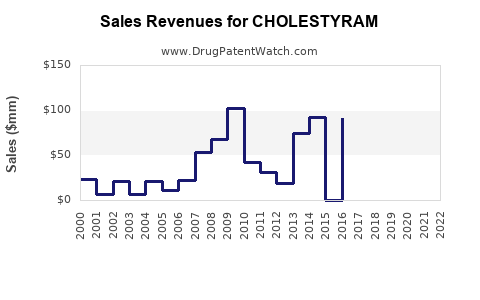
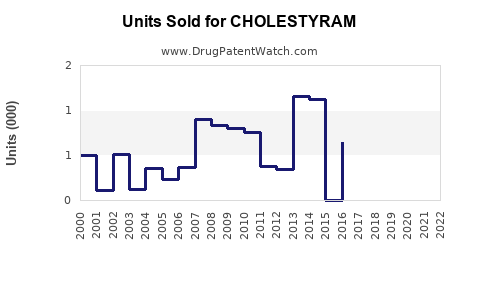
Annual Sales Revenues and Units Sold for CHOLESTYRAM
| Drug Name | Revenues (USD) | Units | Year |
|---|---|---|---|
| CHOLESTYRAM | ⤷ Start Trial | ⤷ Start Trial | 2022 |
| CHOLESTYRAM | ⤷ Start Trial | ⤷ Start Trial | 2021 |
| CHOLESTYRAM | ⤷ Start Trial | ⤷ Start Trial | 2020 |
| CHOLESTYRAM | ⤷ Start Trial | ⤷ Start Trial | 2019 |
| CHOLESTYRAM | ⤷ Start Trial | ⤷ Start Trial | 2018 |
| >Drug Name | >Revenues (USD) | >Units | >Year |
Cholestyramine Market Analysis and Sales Projections
Cholestyramine is a mature, generic bile acid sequestrant with low unit pricing, limited patent barriers, and stable but declining demand. The addressable market is concentrated in hypercholesterolemia, bile-acid diarrhea, and pruritus associated with cholestatic liver disease. U.S. commercial opportunity is modest, with most value captured through high-volume generic prescriptions rather than premium pricing.
The base-case estimate places the global cholestyramine market at approximately $140 million to $180 million in 2025, with the U.S. accounting for about $75 million to $105 million. Global market revenue is projected to decline at roughly 2% to 4% annually through 2030 unless a manufacturer obtains meaningful share in bile-acid diarrhea or develops a differentiated formulation.
What is cholestyramine and how is it used?
Cholestyramine is a nonabsorbed anion-exchange resin that binds bile acids in the gastrointestinal tract and promotes their excretion. The FDA-approved indication is reduction of elevated low-density lipoprotein cholesterol in patients with primary hypercholesterolemia when diet alone is inadequate. The drug is also widely used off-label for bile-acid diarrhea and cholestatic pruritus. [1]
Primary therapeutic uses
| Use | Regulatory status | Commercial relevance |
|---|---|---|
| Primary hypercholesterolemia | FDA-approved | Declining because of statins, ezetimibe and PCSK9 therapies |
| Bile-acid diarrhea | Common off-label use | Important source of persistent demand |
| Cholestatic pruritus | Common off-label use | Smaller but clinically durable segment |
| Digoxin, thyroid hormone and drug-binding applications | Drug-interaction management | Not a primary revenue driver |
Cholestyramine is supplied as an oral powder that must be mixed with liquid or soft food. Typical adult dosing is 4 grams once or twice daily, with titration up to 24 grams daily depending on the indication and tolerability. [1]
How large is the cholestyramine market?
The market is fragmented among generic manufacturers and does not have the transparent branded-sales profile seen with newer specialty drugs. Companies generally report cholestyramine revenue within broader generic pharmaceutical portfolios.
Estimated 2025 market size
| Market | Estimated revenue | Market characteristics |
|---|---|---|
| United States | $75 million-$105 million | Generic-dominated; powder sachets and cans |
| Europe | $25 million-$35 million | Country-specific reimbursement and availability |
| Asia-Pacific | $20 million-$30 million | Higher volume, lower average price |
| Latin America and other markets | $15 million-$25 million | Variable access and local manufacturing |
| Global total | $135 million-$195 million | Low growth and limited pricing power |
These estimates represent manufacturer and distributor revenue rather than total patient spending. Actual retail spending is higher because of wholesaler, pharmacy and reimbursement markups.
Why the market remains commercially relevant
Cholestyramine remains inexpensive, orally administered and clinically familiar. It is also one of the few readily available bile-acid sequestrants used for bile-acid diarrhea, particularly when newer agents are unavailable, poorly tolerated or not reimbursed.
Demand is supported by:
- Persistent use in patients with bile-acid malabsorption.
- Use after ileal resection, cholecystectomy or gastrointestinal surgery.
- Continued use in cholestatic liver disease.
- Low-cost treatment of hypercholesterolemia in price-sensitive markets.
- Product substitution among Questran-type, Prevalite-type and unbranded formulations.
Demand is constrained by gastrointestinal adverse effects, poor palatability, inconvenient administration and extensive drug-binding interactions. Statins have displaced cholestyramine in most first-line lipid-lowering treatment.
What are the leading cholestyramine products and manufacturers?
The principal U.S. product families are Questran, Questran Light, Prevalite and generic cholestyramine powder.
| Product | Active ingredient | Form | Commercial status |
|---|---|---|---|
| Questran | Cholestyramine resin | Oral powder | Legacy branded product |
| Questran Light | Cholestyramine resin | Oral powder | Lower-sugar formulation |
| Prevalite | Cholestyramine light | Oral powder | Branded/generic-market product |
| Generic cholestyramine | Cholestyramine resin | Oral powder | Main U.S. volume source |
Historical Questran products were associated with Bristol-Myers Squibb. Current distribution and manufacturing have shifted among generic and specialty pharmaceutical companies. The U.S. market has included manufacturers and labelers such as ANI Pharmaceuticals, Upsher-Smith and other contract or generic suppliers, depending on product availability and manufacturing arrangements. NDC ownership and active marketing status can change over time.
A company’s economic position depends more on supply continuity, wholesaler access, reimbursement status and product presentation than on active-ingredient exclusivity.
What is the FDA regulatory status of cholestyramine?
Cholestyramine is an FDA-approved prescription drug with a long commercial history. The reference product, Questran, was approved under NDA 017666. Current generic products are generally approved through ANDA pathways referencing the relevant listed drug. [2]
FDA regulatory characteristics
| Factor | Assessment |
|---|---|
| Approval pathway | Legacy NDA and subsequent ANDA approvals |
| Prescription status | Prescription drug |
| Dosage form | Oral powder for suspension |
| Active ingredient | Cholestyramine resin |
| FDA exclusivity | Expired |
| New chemical entity exclusivity | Not available |
| Orphan exclusivity | None identified |
| Pediatric exclusivity | None relevant to the current market |
| Biosimilar pathway | Not applicable |
The product has no biologic component and does not present biosimilar risk. Competitive entry occurs through generic drug approval, manufacturing capacity and commercial distribution.
What patents protect cholestyramine?
The core composition and use patents for cholestyramine are expired. No active patent estate is expected to block ordinary generic production of the established resin and powder dosage form.
Patent position
| Patent category | Current position |
|---|---|
| Core active ingredient | Expired |
| Original composition patents | Expired |
| Hypercholesterolemia method-of-use patents | Expired |
| Oral powder formulation patents | Expired or commercially nonblocking |
| Manufacturing-process patents | Any surviving rights would be narrow and product-specific |
| Device or delivery patents | Not material for standard powder products |
| Orange Book patent protection | No meaningful current barrier expected |
The relevant intellectual-property risk is not the active ingredient. It is more likely to involve a proprietary flavor system, low-sugar formulation, packaging configuration, manufacturing process or combination product. Such rights would need to be assessed at the individual product level.
What is the Orange Book status of cholestyramine?
The FDA Orange Book historically listed Questran and related products with drug-specific patent and exclusivity information. Core patent protection has expired, and cholestyramine is now treated as a mature multisource product. Orange Book status should be reviewed by NDA and product presentation because listed patents, delistings and marketing-status designations can differ among legacy products. [2]
No current Orange Book listing is expected to provide broad exclusivity over cholestyramine powder as a chemical entity or standard dosage form.
When did cholestyramine lose exclusivity?
Cholestyramine lost meaningful market exclusivity decades ago. The original Questran approval dates to the 1970s, and generic competition has existed for many years. Any remaining commercial protection is product-specific rather than molecule-wide.
Exclusivity timeline
| Period | Event |
|---|---|
| 1970s | Original Questran approval and commercialization |
| 1980s-1990s | Expansion of generic and alternative bile-acid sequestrant competition |
| 2000s | Statins and newer lipid therapies reduce cholesterol-market relevance |
| 2010s | Continued use in bile-acid diarrhea and cholestatic pruritus |
| 2020s | Mature generic market with intermittent supply and pricing variation |
Which companies are challenging cholestyramine exclusivity?
No meaningful current Paragraph IV campaign is expected against the core cholestyramine product. The drug is already genericized, and the principal commercial competition is among existing ANDA holders.
Paragraph IV risk would become relevant only if a company introduced a new formulation, a differentiated low-sugar product, a novel flavor system or a new approved indication supported by patent claims. For standard cholestyramine powder, the more relevant risks are:
- ANDA approval delays.
- Drug-shortage events.
- Manufacturing-site changes.
- Raw-material constraints.
- Labeling or bioequivalence disputes.
- Product discontinuation by a major supplier.
What formulation patents protect cholestyramine?
Standard cholestyramine products are oral powders. Formulation differentiation can focus on palatability, sugar content, particle size, dispersibility, dosing convenience and packaging.
Commercially relevant formulation features
| Formulation feature | Potential commercial value |
|---|---|
| Lower sugar content | Supports diabetic and calorie-sensitive patients |
| Improved flavor | May improve persistence and adherence |
| Single-dose packets | Increases convenience and institutional use |
| Canister packaging | Reduces packaging cost for chronic users |
| Better dispersion | Reduces clumping and administration difficulty |
| Lower excipient burden | May improve tolerability |
| Sachet portability | Supports adherence outside the home |
Formulation patents could create limited differentiation, but they are unlikely to support major pricing power unless paired with clinical evidence, payer coverage or a new indication.
What is the competitive landscape for cholestyramine?
Cholestyramine competes in two separate markets: lipid lowering and bile-acid sequestration for gastrointestinal or hepatic conditions.
Comparison with competing bile-acid sequestrants
| Product | Active ingredient | Main advantages | Main disadvantages |
|---|---|---|---|
| Cholestyramine | Cholestyramine resin | Low cost; established use in bile-acid diarrhea | Poor palatability; constipation; drug interactions |
| Colestipol | Colestipol hydrochloride | Similar bile-acid mechanism | Similar tolerability and administration issues |
| Welchol | Colesevelam hydrochloride | Tablet option; fewer drug interactions | Higher cost; tablet burden; less accessible in some markets |
| Statins | Various statins | Strong LDL reduction; convenient dosing | Systemic exposure; intolerance in some patients |
| Ezetimibe | Ezetimibe | Oral tablet; low interaction burden | Less useful for bile-acid diarrhea |
| PCSK9 inhibitors | Evolocumab, alirocumab | High LDL reduction | High cost; injectable administration |
For LDL reduction, cholestyramine has largely become a niche or adjunctive therapy. For bile-acid diarrhea, its substitutes are less direct. Colesevelam may be better tolerated but is usually more expensive and may not be covered for off-label use.
What are the sales projections for cholestyramine?
The forecast below estimates manufacturer-level global revenue. It assumes no major new indication, no sustained shortage and no premium reformulation gaining broad reimbursement.
Base-case global sales forecast
| Year | Estimated global sales | Annual growth |
|---|---|---|
| 2024 | $145 million-$190 million | Baseline |
| 2025 | $135 million-$195 million | -3% to 3% |
| 2026 | $132 million-$188 million | -3% to -2% |
| 2027 | $128 million-$182 million | -3% to -2% |
| 2028 | $124 million-$177 million | -3% to -2% |
| 2029 | $121 million-$172 million | -3% to -2% |
| 2030 | $117 million-$167 million | -3% to -2% |
The midpoint base case is approximately $165 million in 2025 and $142 million in 2030, implying a compound annual decline of about 3%.
U.S. sales forecast
| Year | Estimated U.S. sales |
|---|---|
| 2025 | $75 million-$105 million |
| 2026 | $73 million-$103 million |
| 2027 | $71 million-$100 million |
| 2028 | $69 million-$97 million |
| 2029 | $67 million-$94 million |
| 2030 | $65 million-$91 million |
The U.S. market should remain the highest-value geography because of higher reimbursement and prescription pricing, although competition among generic suppliers will limit net revenue.
What are the upside and downside scenarios?
Downside case
The downside case assumes continued substitution by colesevelam, reduced use in lipid management, lower generic reimbursement and no supply disruption that creates temporary pricing opportunity.
| Year | Downside global sales |
|---|---|
| 2025 | $120 million |
| 2027 | $105 million |
| 2030 | $85 million |
This scenario implies an annual decline of approximately 6% to 8%.
Base case
The base case assumes stable off-label use in bile-acid diarrhea, modest volume erosion and continued low-price generic competition.
| Year | Base-case global sales |
|---|---|
| 2025 | $165 million |
| 2027 | $155 million |
| 2030 | $142 million |
Upside case
The upside case assumes a manufacturer improves palatability, secures reliable payer coverage and captures share in bile-acid diarrhea without materially increasing regulatory complexity.
| Year | Upside global sales |
|---|---|
| 2025 | $195 million |
| 2027 | $205 million |
| 2030 | $215 million |
The upside scenario requires product-level differentiation. A conventional generic launch alone is unlikely to produce this trajectory.
What generic entry risks exist for cholestyramine?
Generic entry risk is already fully realized for the core product. The issue for a new entrant is commercial execution rather than patent clearance.
Key entry risks
- Low average selling price and limited gross-margin headroom.
- Established generic suppliers with wholesaler relationships.
- Difficult-to-manage powder formulation and flavor requirements.
- Off-label demand that may not be fully captured in claims data.
- Payer substitution toward the lowest-cost supplier.
- Potential supply interruptions caused by limited manufacturing redundancy.
- Low prescriber switching because clinicians often select products based on availability.
A new entrant may achieve volume if it offers reliable supply, a competitively priced sachet or a formulation that improves tolerability.
What manufacturing and intellectual-property barriers affect cholestyramine?
Manufacturing barriers are more important than patent barriers. Cholestyramine requires consistent resin quality, particle-size control, moisture management, flavor masking and uniform dose delivery. Production must also address powder flow, packaging stability and dispersion in liquid.
Potential manufacturing advantages include:
- A qualified and redundant resin supply chain.
- Low-cost high-throughput powder filling.
- Sachet production capacity.
- Validated flavor and excipient systems.
- Stable supply during competitor shortages.
- Regulatory experience with legacy ANDA products.
These capabilities can support market share but do not create durable exclusivity unless protected by enforceable formulation or process claims.
What patent litigation or settlement agreements affect cholestyramine?
There is no major current patent-litigation pattern comparable to markets involving high-value small molecules or biologics. Core cholestyramine litigation risk is low because the original composition and method-of-use rights have expired.
Settlement agreements would be most relevant to a new branded formulation or a reformulated product with a separate patent estate. For ordinary generic cholestyramine, litigation exposure is more likely to involve product liability, manufacturing quality, labeling or supply disputes than patent infringement.
What is the revenue exposure for manufacturers?
Cholestyramine is unlikely to materially affect a large diversified pharmaceutical company. It can be material for a small generic manufacturer if the product represents a meaningful share of portfolio revenue.
Manufacturer economics
| Metric | Mature-market expectation |
|---|---|
| Price growth | Low or negative |
| Volume growth | Flat to declining |
| Gross margin | Highly supplier-dependent |
| Regulatory exclusivity | None for standard product |
| Switching costs | Low |
| Supply disruption value | Potentially high but temporary |
| Long-term pricing power | Low |
| Strategic value | Portfolio breadth and niche gastrointestinal demand |
A company acquiring a cholestyramine product should value supply reliability, regulatory status and net pricing rather than assume patent-driven cash flows.
How does cholestyramine compare with newer lipid drugs?
Cholestyramine has a substantially weaker commercial position in hypercholesterolemia than statins, ezetimibe, PCSK9 inhibitors and inclisiran. Its advantage is low cost and absence of systemic absorption. Its disadvantages are administration burden, gastrointestinal intolerance and drug-binding interactions.
The product remains more defensible in bile-acid diarrhea than in LDL reduction because competing drugs do not offer the same combination of mechanism, price and historical clinical use.
Key Takeaways
- Cholestyramine is a mature generic drug with no meaningful core patent barrier.
- Estimated global manufacturer revenue is approximately $135 million to $195 million in 2025.
- U.S. revenue is estimated at $75 million to $105 million.
- Base-case global sales are projected to decline from about $165 million in 2025 to $142 million in 2030.
- Hypercholesterolemia is no longer the primary growth market; bile-acid diarrhea and cholestatic pruritus support residual demand.
- Standard powder products have limited pricing power and low exclusivity value.
- Formulation improvements, reliable supply and better palatability are the main commercial opportunities.
- Biosimilar risk is irrelevant because cholestyramine is a nonbiologic small-molecule drug.
- Paragraph IV activity and patent litigation are not major current risks for the standard product.
- Manufacturing execution and channel access matter more than intellectual property.
FAQs
Is cholestyramine still a profitable drug?
It can be profitable for a low-cost manufacturer with efficient production and reliable distribution, but it is unlikely to support high margins without supply scarcity or a differentiated formulation.
Does cholestyramine have a generic equivalent?
Yes. Multiple generic cholestyramine products have been marketed in the United States and other jurisdictions, generally as oral powder for suspension.
Can a new cholestyramine product obtain market exclusivity?
A new product could potentially obtain limited protection for a novel formulation, delivery system or approved indication. The active ingredient and conventional powder formulation do not provide meaningful new exclusivity.
Is cholestyramine used for bile-acid malabsorption?
Yes. It is commonly used off label for bile-acid diarrhea associated with ileal disease, gastrointestinal surgery, cholecystectomy and other causes of bile-acid malabsorption.
Will cholestyramine sales increase through 2030?
The base case is a gradual decline. Sales could increase if a manufacturer wins share through an improved-tolerability formulation, expands access in bile-acid diarrhea or benefits from sustained shortages affecting competing suppliers.
References
- U.S. Food and Drug Administration. (2018). Questran (cholestyramine) prescribing information.
- U.S. Food and Drug Administration. (2024). Approved drug products with therapeutic equivalence evaluations: Orange Book.
- National Library of Medicine. (2024). DailyMed: Cholestyramine powder for suspension prescribing information.
- U.S. Food and Drug Administration. (2023). Drugs@FDA: FDA-approved drugs database.
More… ↓
