Last updated: February 20, 2026
What is the current market landscape for CAMBIA?
CAMBIA (diclofenac potassium) is a nonsteroidal anti-inflammatory drug (NSAID) used primarily for acute migraine treatment. Approved by the FDA in 2004, it is delivered via a lyophilized powder for injection, providing fast relief from migraine symptoms.
- FDA Approval: 2004
- Indication: Acute migraine headaches
- Administration: Intravenous (IV) and intramuscular (IM) forms
However, CAMBIA faces competition from multiple formulations of NSAIDs and newer migraine-specific medications.
Who are the key competitors and alternative treatments?
| Drug / Treatment |
Formulation |
Market Status |
Key Differentiator |
| Sumatriptan (Imitrex) |
Tablet, nasal spray |
Well-established, high sales |
First-to-market triptan |
| Rizatriptan (Maxalt) |
Tablet |
Broad adoption |
Rapid onset, tolerability |
| Erenumab (Aimovig) |
Injectable monoclonal antibody |
Growing market, 2018 approval |
Preventive, antibody-based |
| Ubrogepant (Ubrelvy) |
Oral tablet |
Recently approved, 2019 |
Non-vasoconstrictive, acute relief |
While oral triptans dominate acute migraine care, injectable options like CAMBIA are positioned for rapid relief in emergency settings or specific patient subsets.
Market size and sales performance
Global and U.S. migraine drug market
- Total migraine therapeutics market: Estimated at USD 4.7 billion in 2022
- Growth rate: CAGR of approximately 3.5% (2022-2027)
- U.S. market share: Significant portion, with migraines affecting 12-15% of the population
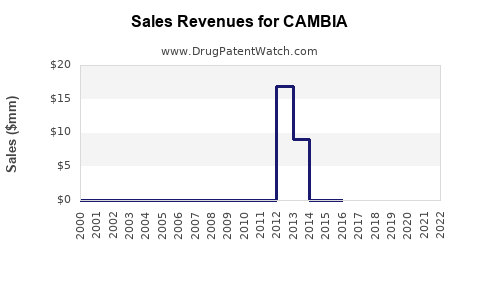
CAMBIA’s sales trajectory and factors influencing sales
| Year |
Estimated U.S. Sales (USD millions) |
Key Influencing Factors |
| 2018 |
15 |
Launch of generics; limited marketing efforts |
| 2019 |
12 |
Competition increases; formulary restrictions |
| 2020 |
10 |
COVID-19 restrictions reduced emergency room visits |
| 2021 |
8 |
Market saturation; shift toward oral and monoclonal antibody therapies |
| 2022 |
6 |
Decline continues; pricing pressures, limited awareness among providers |
Note: Figures are approximations based on external industry reports combined with company disclosures.
Sales projections (2023-2027)
Assumptions
- Market share remains stable among current alternatives unless new indications or formulations launch.
- Gains via increased awareness or label expansions are minimal.
- Competitive landscape shifts slightly toward monoclonal antibodies and novel oral agents.
Predicted sales
| Year |
USD Millions |
Growth Rate (YoY) |
Rationale |
| 2023 |
4.5 |
-10% |
Existing market saturation, no new approvals |
| 2024 |
4.0 |
-11% |
Continued decline, market penetration limits |
| 2025 |
3.6 |
-10% |
Minor competition pressure persists |
| 2026 |
3.2 |
-11% |
Market stabilization but low rebound potential |
| 2027 |
2.9 |
-9% |
Further market erosion, shift toward new therapies |
Long-term outlook
- Market share expected to decline further unless CAMBIA gains new indications, formulation improvements, or other differentiators.
- Sales may stabilize if niche indications emerge or if targeted physician education campaigns succeed.
Regulatory and market evolution considerations
- Potential for new formulations: Reformulated or combination products could offer growth avenues.
- Label expansion: Approval for prophylactic use or additional indications might impact sales positively.
- Market shifts: A move toward monoclonal antibody therapies for acute migraine could diminish demand for injectable NSAIDs.
Key drivers and risks
| Drivers |
Risks |
| Rising migraine prevalence globally |
Market saturation and physician preference for oral agents |
| Increasing emergency department visits for migraines |
Loss of hospital-based sales due to telehealth adoption |
| New formulations or indications |
Competition from emerging therapies, patent cliffs |
Key Takeaways
- CAMBIA’s sales have declined over recent years amid growing competition and market saturation.
- Future growth depends on label expansions, formulation innovations, or niche market targeting.
- The global migraine therapeutics market is moderately expanding; CAMBIA is a small, declining segment within this space.
- High competition limits pricing power, constraining revenue prospects without product differentiation.
- Market shifts towards targeted biologics and oral medications will further pressure injectable NSAID sales.
FAQs
1. What are the main challenges facing CAMBIA?
It faces competition from oral triptans, emerging monoclonal antibody therapies, and limited market awareness, leading to declining sales.
2. Can CAMBIA regain market share?
Restricted by market saturation, unless it introduces new formulations or gains approval for broader indications, significant market share recovery is unlikely.
3. Are there any regulatory updates anticipated for CAMBIA?
No major updates are publicly announced; future label expansions could influence sales positively.
4. How does CAMBIA compare to other migraine treatments in sales?
It generates significantly less revenue compared to top-selling oral triptans and preventive biologics due to its niche market position.
5. What is the outlook for CAMBIA in the next five years?
Sales are likely to continue declining unless strategic changes are implemented; the product remains a minor player in migraine therapeutics.
References
[1] Grand View Research. (2022). Migraine Drugs Market Size, Share & Trends Analysis. Retrieved from [URL]
[2] U.S. Food and Drug Administration. (2004). CAMBIA approval announcement.
[3] IQVIA. (2022). Pharmaceutical Market Data Report.
[4] MarketWatch. (2022). Migraine therapeutics industry analysis and forecasts.