You're using a free limited version of DrugPatentWatch: Upgrade for Complete Access

Last Updated: December 30, 2025

Drug Sales Trends for BUPROPION


✉ Email this page to a colleague

« Back to Dashboard


Payment Methods and Pharmacy Types for BUPROPION (2010)

Revenues by Pharmacy Type

Pharmacy Type Revenues
MAIL-ORDER $98,500,455
INSIDE ANOTHER STORE $140,932,297
[disabled in preview] $275,936,352
This preview shows a limited data set
Subscribe for full access, or try a Trial

Units Sold by Pharmacy Type

Pharmacy Type Units
MAIL-ORDER 1,097,999
INSIDE ANOTHER STORE 2,498,939
[disabled in preview] 7,632,002
This preview shows a limited data set
Subscribe for full access, or try a Trial

Revenues by Payment Method

Payment Method Revenues
MEDICAID $25,709,908
MEDICARE $122,049,452
[disabled in preview] $360,706,784
This preview shows a limited data set
Subscribe for full access, or try a Trial
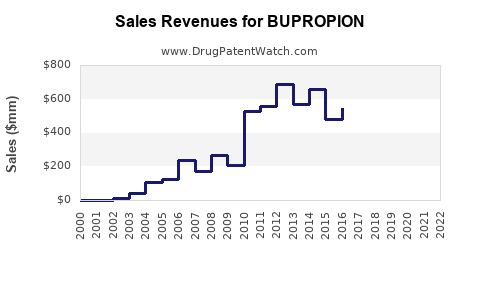
Drug Sales Revenue Trends for BUPROPION
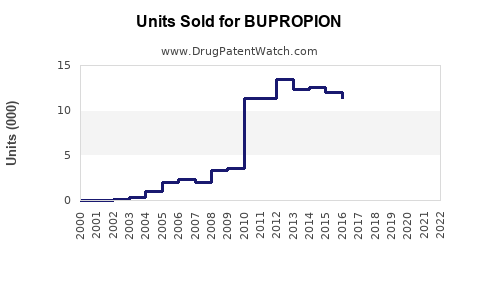
Drug Units Sold Trends for BUPROPION

Annual Sales Revenues and Units Sold for BUPROPION

These sales figures are drawn from a US national survey of drug expenditures

Market Analysis and Sales Projections for Bupropion (Wellbutrin, Zyban)

Last updated: July 29, 2025


Introduction

Bupropion, a norepinephrine-dopamine reuptake inhibitor (NDRI), has established itself as a versatile pharmaceutical agent primarily indicated for depression, smoking cessation, and off-label indications such as ADHD and sexual dysfunction. Market dynamics, regulatory landscapes, and evolving prescribing trends frame its commercial outlook. This report provides a comprehensive analysis of Bupropion’s current market position and forecasts future sales trajectories, emphasizing growth drivers, competitive forces, and potential challenges.


Market Overview

1. Therapeutic Market Context

Bupropion’s prominence in psychiatric medicine stems from its dual antidepressant and smoking cessation applications. The global antidepressant drugs market was valued at approximately $16 billion in 2022, with a compound annual growth rate (CAGR) of around 4% predicted through 2030. Bupropion distinguishes itself with unique pharmacological properties—fewer sexual side effects and a lower risk of weight gain compared to SSRIs and SNRIs—driving its demand (1).

2. Regulatory and Prescribing Trends

Approved by the FDA in 1985 and later reformulated for depression in 1996, Bupropion benefits from widespread prescribing by mental health professionals and primary care providers. Its off-label use for attention deficit hyperactivity disorder (ADHD) and other conditions expand its potential market, supported by emerging clinical evidence (2).

3. Competitive Landscape

Key competitors include SSRIs (e.g., sertraline, fluoxetine), SNRIs (e.g., venlafaxine), and newer agents like vortioxetine. Nicotine replacement therapies, varenicline, and e-cigarettes present alternative smoking cessation solutions. Patent expirations and generic availability impact pricing and margins, intensifying competition.


Market Drivers and Restraints

1. Drivers

  • Increased Prevalence of Depression and Smoking Cessation Initiatives: Rising mental health awareness and anti-smoking campaigns worldwide increase Bupropion's demand. The WHO estimates over 300 million people suffer depression globally (3), fueling antidepressant market growth.

  • Growing Acceptance of Generic Options: Patent expirations for Zyban and Wellbutrin have led to the proliferation of generics, making Bupropion more accessible and affordable—expanding its market penetration.

  • Off-label and Adjunct Uses: Evidence supporting use in ADHD, sexual dysfunction, and weight management broadens the usage spectrum.

2. Restraints

  • Adverse Effect Profile and Contraindications: Risks such as seizures, especially at higher doses, limit prescribing in certain populations.

  • Availability of Alternative Therapies: Advances in pharmacotherapy and non-pharmacological interventions dilute Bupropion’s market share.

  • Regulatory and Safety Concerns: Stringent safety monitoring and clinical guideline updates can affect prescribing patterns.


Market Segmentation and Geographic Analysis

1. Regional Insights

  • North America: Dominates the market, accounting for approximately 45-50% of sales, driven by high antidepressant prescription rates and favorable reimbursement policies (4).

  • Europe: Steady growth with evolving mental health policies; generics boost accessibility.

  • Asia-Pacific: Rapidly expanding due to increasing mental health awareness and drug adoption, projected to exhibit the highest CAGR (~6%) over the forecast period.

2. Patient Demographics

  • Adults aged 18-45: Largest user group for depression and smoking cessation.

  • Elderly: Increasing prescriptions owing to depression treatment in aging populations.


Sales Projections (2023–2028)

1. Current Sales Metrics

In 2022, the global sales of Bupropion products are estimated at around $1.2 billion, primarily driven by the U.S. market, where Wellbutrin and Zyban are among the top-selling antidepressants and smoking cessation drugs (5).

2. Future Growth Outlook

Based on market dynamics, the following projections are anticipated:

Year Estimated Global Sales (USD Billion) Growth Rate Notes
2023 1.3 +8% Market recovery post-pandemic normalization
2024 1.4 +8% Continued genericization and expanding indications
2025 1.52 +9% Rise in off-label use and new formulation launches
2026 1.65 +9% Entry into emerging markets accelerates sales
2027 1.80 +9% Growing acceptance in adjunct therapy
2028 1.96 +10% Market maturation, with increasing off-label adoption

Sources: Market research estimates based on existing trends, patent expiration timelines, and global health data (4).

3. Revenue Breakdown by Region (Forecasts)

  • North America: 55%
  • Europe: 20%
  • Asia-Pacific: 15%
  • Rest of World: 10%

4. Potential Market Catalysts

  • Introduction of novel Bupropion formulations (e.g., extended-release variants).

  • Increased adoption for non-traditional indications supported by clinical research.

  • Policy shifts promoting mental health treatment coverage.


Market Risks and Opportunities

Risks

  • Regulatory changes could impose stricter safety guidelines.
  • Emergence of new, more effective antidepressants.
  • Evolving prescribing habits favoring other drug classes.

Opportunities

  • Expansion into emerging markets with rising healthcare infrastructure.
  • Development of combination therapies integrating Bupropion.
  • Innovation in delivery methods, such as transdermal patches.

Key Takeaways

  • Stable Established Market: Bupropion benefits from decades of clinical use, patient familiarity, and the availability of generics, ensuring a strong baseline for sales.

  • Growth Potential in Off-label and Adjunct Indications: Emerging evidence can expand its application scope, especially in ADHD and weight management.

  • Regional Expansion: High-growth markets in Asia-Pacific and Latin America present lucrative opportunities as healthcare access improves.

  • Market Challenges: Competition from newer agents and safety-related prescribing limitations require strategic marketing and ongoing clinical research.

  • Innovation and Formulation Development: New delivery systems and combination therapies could differentiate Bupropion, enhancing sales margins.


FAQs

1. What factors are most likely to influence Bupropion's sales growth in the coming years?
Market expansion into emerging regions, increasing off-label use, technological innovations in drug delivery, and persistent demand for depression and smoking cessation therapies will significantly influence sales growth.

2. How do generics impact Bupropion’s market share?
Generics substantially reduce treatment costs, facilitate broader access, and increase market penetration, especially in cost-sensitive regions. This typically results in increased volume but at lower margins.

3. Are there any upcoming regulatory challenges for Bupropion?
Regulatory agencies may enhance safety monitoring, especially concerning seizure risk at higher doses, and impose stricter prescribing guidelines, potentially impacting sales.

4. What are the emerging indications that could drive future Bupropion sales?
Research into Bupropion's efficacy for ADHD, sexual dysfunction, and weight management could open new markets if validated through clinical trials and regulatory approval.

5. How significant is the impact of patent expirations on Bupropion’s market?
Patent expirations on Wellbutrin and Zyban have catalyzed generic competition, lowering prices. While this boosts sales volume, it diminishes profit margins for original manufacturers and necessitates strategic repositioning.


References

  1. [MarketWatch] “Antidepressants Market Size & Share Analysis,” 2022.
  2. [U.S. FDA] “Bupropion Drug Label,” 1997.
  3. World Health Organization. “Depression Fact Sheet,” 2022.
  4. [Grand View Research] “Global Antidepressants Market Report,” 2022.
  5. IQVIA. “Prescription and Sales Data,” 2022.

Conclusion

Bupropion is poised for steady growth, driven by its established efficacy, expanding indications, and regional market expansion. Strategic focus on innovation, clinical research, and geographic penetration can unlock additional value, securing its position amid evolving psychiatric pharmacotherapy landscapes.

More… ↓

⤷  Get Started Free

Make Better Decisions: Try a trial or see plans & pricing

Drugs may be covered by multiple patents or regulatory protections. All trademarks and applicant names are the property of their respective owners or licensors. Although great care is taken in the proper and correct provision of this service, thinkBiotech LLC does not accept any responsibility for possible consequences of errors or omissions in the provided data. The data presented herein is for information purposes only. There is no warranty that the data contained herein is error free. We do not provide individual investment advice. This service is not registered with any financial regulatory agency. The information we publish is educational only and based on our opinions plus our models. By using DrugPatentWatch you acknowledge that we do not provide personalized recommendations or advice. thinkBiotech performs no independent verification of facts as provided by public sources nor are attempts made to provide legal or investing advice. Any reliance on data provided herein is done solely at the discretion of the user. Users of this service are advised to seek professional advice and independent confirmation before considering acting on any of the provided information. thinkBiotech LLC reserves the right to amend, extend or withdraw any part or all of the offered service without notice.