Share This Page
Drug Sales Trends for sildenafil
✉ Email this page to a colleague
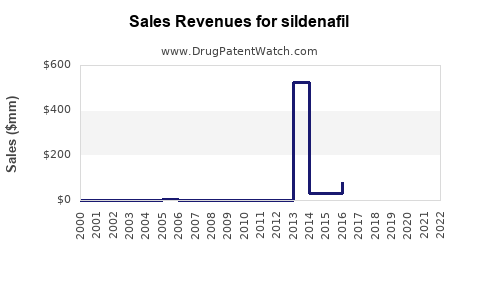
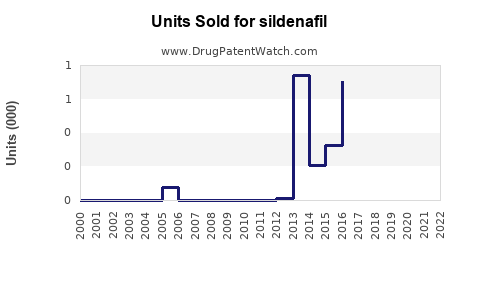
Annual Sales Revenues and Units Sold for sildenafil
| Drug Name | Revenues (USD) | Units | Year |
|---|---|---|---|
| SILDENAFIL | ⤷ Start Trial | ⤷ Start Trial | 2022 |
| SILDENAFIL | ⤷ Start Trial | ⤷ Start Trial | 2021 |
| SILDENAFIL | ⤷ Start Trial | ⤷ Start Trial | 2020 |
| >Drug Name | >Revenues (USD) | >Units | >Year |
Sildenafil Market Analysis, Sales Projections, Patent Status, and Generic Competition
Sildenafil is a mature, largely generic pharmaceutical with two principal markets: erectile dysfunction (ED), sold originally as Viagra, and pulmonary arterial hypertension (PAH), sold as Revatio. Global sildenafil sales are estimated at approximately $1.9 billion to $2.3 billion in 2024, with generic products accounting for most unit volume and branded Viagra retaining a smaller premium segment. The market should grow at a low-to-mid single-digit rate through 2029, driven by increased diagnosis, online prescribing, broader geographic access, and demand for lower-cost generic treatment.
Sildenafil has no meaningful biosimilar risk because it is a chemically synthesized small molecule. The primary commercial risks are price erosion, regulatory enforcement against unauthorized online sellers, substitution by tadalafil and newer ED products, and declining branded sales.
What is sildenafil and how is it used?
Sildenafil citrate is a phosphodiesterase-5 inhibitor. It increases blood flow by inhibiting PDE5 and is approved in different dosage forms for ED and PAH.
| Product | Active ingredient | FDA indication | Typical strengths | Original sponsor |
|---|---|---|---|---|
| Viagra | Sildenafil citrate | Erectile dysfunction | 25 mg, 50 mg, 100 mg tablets | Pfizer |
| Revatio | Sildenafil citrate | Pulmonary arterial hypertension | 20 mg tablets; oral suspension; injection | Pfizer |
| Generic sildenafil | Sildenafil citrate | ED and, where approved, PAH | Multiple strengths and dosage forms | Multiple manufacturers |
Viagra was approved by the FDA in March 1998 as the first oral PDE5 inhibitor for ED. Revatio was approved in June 2005 for PAH.[1][2] Sildenafil is also used off-label in some settings, but off-label use does not create the same commercial or regulatory protection as an approved indication.
How large is the sildenafil market?
Public market estimates vary because analysts count different combinations of branded Viagra, generic sildenafil, Revatio, hospital products, online sales, and international markets. A practical 2024 estimate is:
| Segment | Estimated 2024 global sales | 2024-2029 expected growth | Commercial profile |
|---|---|---|---|
| Sildenafil ED, all brands and generics | $1.5B-$1.8B | 2%-4% CAGR | Large, price-sensitive, highly fragmented |
| Viagra brand | $300M-$450M | -3% to -7% CAGR | Premium pricing, declining share |
| Sildenafil PAH products | $350M-$500M | 2%-5% CAGR | Smaller volume, higher clinical value |
| Total sildenafil market | $1.9B-$2.3B | 2%-4% CAGR | Mature generic market |
These figures are analyst estimates rather than a single audited market total. Pfizer reports product-level results within broader categories and does not consistently disclose a standalone global sildenafil revenue line.[3]
What drives sildenafil demand?
Demand is supported by several structural factors:
- High prevalence of ED, particularly among older men and patients with diabetes, cardiovascular disease, obesity, and prostate disease.
- Increased use of telehealth and direct-to-consumer prescribing.
- Availability of low-cost generic tablets.
- Greater diagnosis and treatment of PAH.
- Expansion of pharmacy distribution in emerging markets.
- Physician familiarity with sildenafil and extensive clinical experience.
Demand is constrained by generic price competition, the availability of tadalafil, counterfeit products, contraindications with nitrates, and patient preference for longer-acting therapies.
What are the sildenafil sales projections through 2029?
The base-case forecast assumes continued generic volume growth, annual price erosion of approximately 3%-6% in mature markets, modest growth in PAH treatment, and continued decline in branded Viagra.
| Year | Global sildenafil market estimate | Growth versus prior year | Viagra brand estimate | Generic and other sildenafil |
|---|---|---|---|---|
| 2024 | $1.9B-$2.3B | Base year | $300M-$450M | $1.5B-$1.8B |
| 2025 | $2.0B-$2.4B | 2%-4% | $285M-$425M | $1.6B-$1.9B |
| 2026 | $2.0B-$2.5B | 2%-4% | $270M-$405M | $1.7B-$2.0B |
| 2027 | $2.1B-$2.6B | 2%-4% | $255M-$390M | $1.8B-$2.1B |
| 2028 | $2.2B-$2.7B | 2%-4% | $240M-$375M | $1.9B-$2.2B |
| 2029 | $2.2B-$2.8B | 2%-4% | $225M-$360M | $2.0B-$2.4B |
What are the upside and downside scenarios?
| Scenario | 2029 global sales | Key assumptions |
|---|---|---|
| Downside | $1.9B-$2.2B | Faster price erosion, tadalafil substitution, online enforcement, weak branded demand |
| Base case | $2.2B-$2.8B | Low-single-digit volume growth offsets generic price declines |
| Upside | $2.8B-$3.3B | Strong telehealth adoption, increased diagnosis, emerging-market expansion, stable PAH pricing |
The market is likely to grow in units faster than in revenue. Generic competition means that a 5% increase in prescriptions may produce little revenue growth if average selling prices decline at a similar rate.
When did sildenafil lose patent exclusivity?
Sildenafil lost meaningful U.S. compound-patent protection in 2012. Pfizer’s key U.S. sildenafil compound patent was U.S. Patent No. 5,250,534, which covered sildenafil and related compounds. The patent expired in 2012 after applicable patent-term adjustments and pediatric exclusivity considerations.[4]
The loss of compound protection enabled generic entry. Pfizer later faced additional commercial pressure from authorized and independent generic products.
| Milestone | Date | Commercial effect |
|---|---|---|
| Viagra FDA approval | March 1998 | Market launch |
| Revatio FDA approval | June 2005 | PAH market expansion |
| Core sildenafil patent expiration | 2012 | Generic entry pathway opened |
| Pfizer authorized-generic agreement with Teva | 2017 | Broader low-cost competition |
| Generic Viagra availability | 2017 onward | Accelerated branded price and volume pressure |
What is the FDA and Orange Book status of sildenafil?
Viagra and Revatio are FDA-approved products. Generic sildenafil products are approved through abbreviated new drug applications when they demonstrate pharmaceutical equivalence and bioequivalence to a reference product.
The Orange Book historically listed patents associated with Viagra and Revatio, including compound and method-of-use patents. The principal commercial patent barrier has expired. Current generic competition is therefore primarily governed by ANDA approvals, formulation equivalence, manufacturing capacity, state substitution rules, and channel access rather than by a live composition-of-matter patent.
Sildenafil products remain prescription drugs in the United States. FDA-approved formulations include tablets, oral suspension, and injectable products for specific indications. A generic company cannot market sildenafil for an unapproved use merely because physicians prescribe it off-label.
What patents protect Viagra, Revatio, and generic sildenafil?
The strongest historical patent was the sildenafil compound patent:
| Patent | Subject matter | Historical holder | Status |
|---|---|---|---|
| U.S. Patent No. 5,250,534 | Sildenafil compounds and pharmaceutical use | Pfizer-related entities | Expired |
| U.S. Patent No. 6,469,012 | Sildenafil-related PAH use | Pfizer-related entities | Expired |
| Viagra and Revatio formulation and use patents | Dosage forms, indications, and administration | Pfizer-related entities | Commercially expired or no longer a material barrier in the U.S. |
The patent estate is now weak from an exclusivity perspective. Some jurisdiction-specific patents, formulation claims, process claims, or later-filed patents may have existed outside the United States, but none has preserved broad global exclusivity for sildenafil as an active ingredient.
How strong is the sildenafil patent estate?
| Patent-estate factor | Assessment |
|---|---|
| Composition-of-matter protection | Expired |
| Broad ED method-of-use protection | Expired |
| PAH protection | Expired or commercially ineffective against established generic entry |
| Formulation protection | Limited and product-specific |
| Manufacturing-process protection | Potentially relevant to individual suppliers |
| U.S. generic-entry barrier | Low |
| International variability | Moderate |
| Litigation leverage | Low for broad market exclusion |
Residual intellectual-property value may remain in novel delivery systems, combination products, pediatric formulations, manufacturing processes, or digital adherence programs. These rights would protect a specific product configuration rather than the sildenafil market as a whole.
Which companies manufacture or challenge sildenafil?
Sildenafil is supplied by a broad group of generic manufacturers, contract manufacturers, and branded-product companies. The competitive field includes:
- Teva Pharmaceutical Industries
- Viatris, including legacy Mylan products
- Dr. Reddy’s Laboratories
- Zydus Lifesciences
- Torrent Pharmaceuticals
- Cipla
- Sun Pharmaceutical Industries
- Apotex
- Hikma Pharmaceuticals
- Endo and legacy Par Pharmaceutical operations
- Pfizer, through Viagra, Revatio, and authorized-generic arrangements
The relevant competitive distinction is not usually the molecule. It is price, tablet quality, pharmacy coverage, dosage-form availability, regulatory track record, supply reliability, and digital or telehealth distribution.
What generic-entry risks exist for branded Viagra and Revatio?
Branded Viagra faces permanent generic substitution risk. The main commercial outcomes are:
- Lower average selling prices.
- Reduced pharmacy preference for the branded product.
- Increased insurer and pharmacy benefit manager substitution.
- Greater consumer movement to online and telehealth channels.
- Continued erosion of brand equity when prescribers view generic sildenafil as clinically interchangeable.
Revatio has a more complex commercial profile. PAH treatment is specialist-driven, and products may compete on clinical familiarity, reimbursement, hospital contracts, formulation availability, and supply continuity. Generic substitution still creates substantial risk, but PAH products can maintain higher revenue per patient than ED tablets.
Is there biosimilar risk for sildenafil?
No. Sildenafil is a small-molecule drug, not a biologic. Biosimilar regulation under the Biologics Price Competition and Innovation Act does not apply. Competition occurs through the generic drug pathway under section 505(j) of the Federal Food, Drug, and Cosmetic Act.
The practical risks are ordinary generic risks:
- ANDA approvals
- Paragraph IV certifications
- Paragraph III certifications after patent expiry
- manufacturing inspections
- product recalls
- supply shortages
- pharmacy substitution
- state-level generic substitution rules
What Paragraph IV litigation affected sildenafil?
Sildenafil generated significant patent-certification and litigation activity before generic entry. Generic applicants challenged Pfizer’s patent rights through Paragraph IV certifications, while Pfizer pursued patent litigation and negotiated commercial arrangements.
The key commercial result was delayed but ultimately broad generic entry after expiration of the core patent estate. By the time generic sildenafil became widely available, the relevant patent protections had little remaining economic life. Teva announced in 2017 that it would launch a generic version of Viagra in the United States under an agreement with Pfizer.[5]
Current Paragraph IV risk is less important for the established sildenafil market than it is for new entrants seeking approval for differentiated formulations, combination products, or alternative delivery systems.
What licensing and settlement agreements affect sildenafil?
The most commercially important arrangement was Pfizer’s agreement with Teva involving an authorized generic version of Viagra. The arrangement gave Teva access to sildenafil tablets under a commercial framework while allowing Pfizer to participate in the post-exclusivity market.[5]
Pfizer also used authorized-generic and product-distribution strategies to manage the transition from branded Viagra to generic competition. These arrangements reduced the value of independent patent challenges while preserving some revenue after loss of exclusivity.
No current license appears capable of restoring broad exclusivity for sildenafil in the United States.
How does sildenafil compare with tadalafil and other ED drugs?
| Drug | Duration | Main commercial advantage | Main weakness |
|---|---|---|---|
| Sildenafil | Approximately 4 hours | Low cost, extensive clinical familiarity | Food effects, shorter duration |
| Tadalafil | Up to 36 hours | Long duration and daily-use option | Higher branded and generic competition |
| Vardenafil | Approximately 4-5 hours | Similar efficacy profile | Smaller market presence |
| Avanafil | Rapid onset in some patients | Newer profile and tolerability positioning | Limited market penetration |
Tadalafil is the strongest direct competitor in ED because its longer duration supports both planned and spontaneous use. Sildenafil remains the volume leader in many lower-cost markets because of price, prescriber familiarity, and generic availability.
In PAH, sildenafil competes with tadalafil and multiple drug classes, including endothelin-receptor antagonists, prostacyclin-pathway agents, and soluble guanylate cyclase stimulators. Treatment decisions depend more heavily on disease severity, combination therapy, payer policy, and specialist practice than on consumer brand preference.
What revenue exposure does sildenafil create for Pfizer?
Pfizer’s historical Viagra revenue exposure was material but has declined sharply since generic entry. Sildenafil is no longer a principal growth asset for Pfizer. The product still contributes through branded sales, authorized-generic economics, Revatio, and international channels, but its strategic value is limited relative to Pfizer’s newer oncology, immunology, vaccine, and hospital products.
For generic manufacturers, the opportunity is larger in aggregate but less profitable per unit. Scale, procurement, regulatory compliance, and reliable supply are more important than patent ownership.
What generic launch scenarios are most likely?
The base-case launch pattern is continued market fragmentation rather than a single disruptive entrant.
| Launch scenario | Probability assessment | Expected effect |
|---|---|---|
| Additional low-cost tablet suppliers | High | Further price pressure |
| New PAH generic suppliers | Moderate | Gradual hospital and specialist substitution |
| Premium branded Viagra recovery | Low | Limited due to generic equivalence |
| Novel sildenafil formulation | Moderate | Niche pricing opportunity |
| Major patent-based market withdrawal | Very low | Core patents have expired |
| Online-channel expansion | High | More prescriptions but greater regulatory scrutiny |
The best commercial opportunities are likely to involve differentiated dosage forms, dependable supply, specialty-pharmacy access, or international markets with less mature generic penetration.
Key Takeaways
- Sildenafil is a mature generic market with estimated 2024 global sales of $1.9 billion to $2.3 billion.
- The market is projected to reach approximately $2.2 billion to $2.8 billion by 2029 under the base case.
- Viagra’s core U.S. patent protection expired in 2012.
- Generic products control most unit volume and are likely to capture nearly all incremental demand.
- Viagra brand sales should continue to decline at approximately 3%-7% annually.
- Revatio and generic sildenafil for PAH retain higher-value specialist demand but face ongoing substitution.
- Sildenafil has no biosimilar risk.
- The patent estate is commercially weak for broad market exclusion.
- Teva’s authorized-generic arrangement with Pfizer was the most important post-exclusivity commercial agreement.
- Tadalafil is the strongest direct ED competitor because of its longer duration.
- Future value is more likely to come from formulation, channel, manufacturing, or geographic advantages than from core-molecule patents.
FAQs About Sildenafil Market Size, Patents, and Sales
What is the global market size for generic sildenafil?
The global generic sildenafil market is estimated at approximately $1.5 billion to $1.8 billion in 2024, excluding some hospital products and unreported online-market sales.
Does Viagra still have patent protection?
Broad U.S. patent protection for sildenafil has expired. Any remaining rights are product-specific and do not prevent widespread generic competition.
Can a generic company launch sildenafil for both ED and PAH?
A generic company must obtain approval for each indication or rely on permitted labeling and regulatory pathways. Approval for sildenafil tablets does not automatically authorize every indication or dosage form.
Is sildenafil a high-growth pharmaceutical market?
No. It is a mature market. Unit demand may grow modestly, but revenue growth is constrained by generic price erosion.
Which drug is the biggest threat to sildenafil?
Tadalafil is the strongest direct ED competitor. In PAH, competition comes from tadalafil and multiple non-PDE5 therapies, particularly combination treatment regimens.
References
- U.S. Food and Drug Administration. (1998). Viagra sildenafil citrate prescribing information. FDA.
- U.S. Food and Drug Administration. (2005). Revatio sildenafil prescribing information. FDA.
- Pfizer Inc. (2024). Annual report 2023. Pfizer.
- U.S. Patent and Trademark Office. (1993). U.S. Patent No. 5,250,534: Pyrazolo[4,3-d]pyrimidin-7-ones for the treatment of impotence. U.S. Department of Commerce.
- Teva Pharmaceutical Industries Ltd. (2017). Teva launches generic Viagra in the United States. Teva Pharmaceuticals.
More… ↓
