Share This Page
Drug Sales Trends for diazepam
✉ Email this page to a colleague
Payment Methods and Pharmacy Types for diazepam (2009)
Revenues by Pharmacy Type
Units Sold by Pharmacy Type
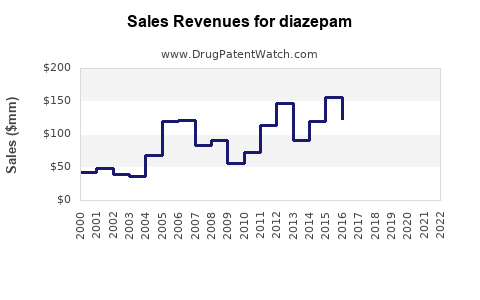
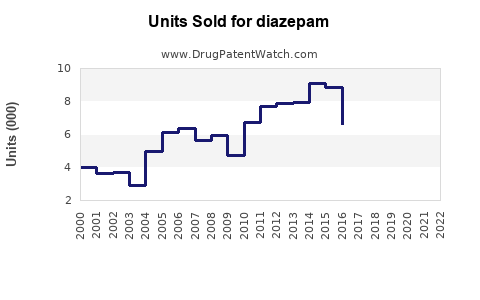
Annual Sales Revenues and Units Sold for diazepam
| Drug Name | Revenues (USD) | Units | Year |
|---|---|---|---|
| DIAZEPAM | ⤷ Start Trial | ⤷ Start Trial | 2022 |
| DIAZEPAM | ⤷ Start Trial | ⤷ Start Trial | 2021 |
| DIAZEPAM | ⤷ Start Trial | ⤷ Start Trial | 2020 |
| DIAZEPAM | ⤷ Start Trial | ⤷ Start Trial | 2019 |
| DIAZEPAM | ⤷ Start Trial | ⤷ Start Trial | 2018 |
| >Drug Name | >Revenues (USD) | >Units | >Year |
Diazepam Market Analysis and Sales Projections: Generic, Valtoco and Libervant
Diazepam is a mature, low-cost benzodiazepine with declining generic pricing but durable demand across seizure emergencies, anxiety, muscle spasm, alcohol withdrawal and procedural sedation. The commercial opportunity has shifted from conventional tablets and injectable products to patented rescue-delivery systems, including Valtoco nasal spray and Libervant buccal film.
A reasonable 2024 global diazepam market estimate is approximately $550 million to $850 million in manufacturer and distributor revenue, with the generic segment accounting for most volume and branded rescue products generating most of the market's growth. Under a base-case model, global revenue is likely to remain broadly stable to 2029 as generic erosion offsets growth in seizure-rescue formulations.
What is the current diazepam market size?
Publicly available market estimates vary because they combine different products, geographies and revenue bases. Diazepam is sold through multiple generic manufacturers, hospital suppliers and branded specialty products, so there is no single consolidated public sales figure.
Estimated 2024 market by segment
| Segment | Estimated 2024 global revenue | Market characteristics |
|---|---|---|
| Generic tablets and oral solutions | $180 million-$280 million | High volume, low price, fragmented suppliers |
| Injectable diazepam | $100 million-$170 million | Hospital and emergency use; supply reliability is important |
| Rectal gel products | $70 million-$120 million | Established seizure-rescue segment; limited growth |
| Valtoco nasal spray | $120 million-$200 million | Branded, patent-protected rescue product |
| Libervant buccal film | Less than $25 million | Newly commercialized product with early market penetration |
| Other formulations and regional products | $80 million-$120 million | Includes suppositories, compounded products and local brands |
| Total | $550 million-$850 million | Directional estimate, not audited industry revenue |
The generic market is larger by unit volume. Branded rescue products have higher revenue per treated patient because they are sold as proprietary delivery systems rather than as low-cost diazepam equivalents.
What are the diazepam sales projections through 2029?
The base case assumes modest contraction in conventional generic revenue, stable demand for injectable diazepam and continued expansion of nasal and buccal rescue products.
Global diazepam revenue forecast
| Year | Bear case | Base case | Bull case |
|---|---|---|---|
| 2024 | $550 million | $700 million | $850 million |
| 2025 | $530 million | $715 million | $895 million |
| 2026 | $510 million | $735 million | $945 million |
| 2027 | $490 million | $755 million | $995 million |
| 2028 | $470 million | $775 million | $1.05 billion |
| 2029 | $450 million | $795 million | $1.11 billion |
| 2024-2029 CAGR | -3.9% | 2.6% | 5.5% |
The base case implies a shift in revenue mix rather than broad volume expansion.
| Segment | 2024 base case | 2029 base case | Expected trend |
|---|---|---|---|
| Conventional generics | $290 million | $245 million | Declining prices and substitution |
| Injectable products | $125 million | $130 million | Stable hospital demand |
| Rectal gel | $90 million | $80 million | Mature and gradually declining |
| Nasal spray | $165 million | $275 million | Primary growth engine |
| Buccal film | $10 million | $65 million | Early commercial ramp |
| Other products | $20 million | $0 million-$20 million | Regional variability |
The forecast is most sensitive to branded rescue-product uptake, payer coverage and whether competing generic nasal or buccal products reach the U.S. market.
Which products drive diazepam commercial growth?
Valtoco diazepam nasal spray
Valtoco is a proprietary intranasal diazepam product developed by Neurelis and approved by the FDA in January 2020 for the acute treatment of intermittent, stereotypic episodes of frequent seizure activity in patients six years of age and older.[1]
The product competes primarily with Diastat rectal gel and off-label or emergency-use oral formulations. Its commercial advantages include:
- Nonrectal administration
- Use outside a hospital
- Greater acceptability for caregivers and adolescents
- Premeasured, ready-to-use delivery
- Expansion of the seizure-rescue market beyond patients who reliably tolerate rectal administration
Valtoco's main market risks are price sensitivity, payer restrictions and the availability of alternative rescue products, particularly midazolam nasal spray. It also faces competition from newer intranasal seizure therapies, although diazepam has a long clinical history and a relatively familiar safety profile.
A base-case revenue range for Valtoco is $150 million-$180 million in 2024, rising to approximately $250 million-$300 million by 2029 if prescription growth continues and reimbursement remains adequate. The product's growth is likely to be driven by new patient starts rather than higher treatment frequency.
Libervant diazepam buccal film
Libervant is a buccal film formulation of diazepam developed by Aquestive Therapeutics. The FDA approved Libervant in 2024 for the acute treatment of intermittent, stereotypic episodes of frequent seizure activity in patients ages two through five years.[2]
The product's commercial position is differentiated from Valtoco because it uses buccal administration and initially targets a younger pediatric population. The product can expand access where caregivers or clinicians prefer an oral-mucosal dosage form.
Libervant's early sales are likely to be constrained by:
- Limited initial labeled age range
- New-product formulary adoption
- Competition from existing rectal and nasal rescue products
- Need for caregiver education
- Pediatric prescribing and reimbursement procedures
A reasonable base-case projection is $5 million-$15 million in first full-year revenue, increasing to $50 million-$80 million by 2029 if the labeled population expands and the product secures broad payer coverage.
How does diazepam compare with midazolam and other seizure-rescue drugs?
Diazepam remains commercially relevant because it is available in multiple dosage forms, while its active ingredient has extensive clinical familiarity. Midazolam has stronger positioning in rapid intranasal rescue and is available in branded products such as Nayzilam.
| Product | Active ingredient | Primary delivery | Commercial position |
|---|---|---|---|
| Valtoco | Diazepam | Nasal spray | Branded seizure-rescue product |
| Libervant | Diazepam | Buccal film | Pediatric buccal rescue product |
| Diastat | Diazepam | Rectal gel | Older seizure-rescue product |
| Nayzilam | Midazolam | Nasal spray | Direct branded nasal competitor |
| Generic diazepam | Diazepam | Oral, injectable, other forms | Low-cost broad-use product |
| Generic midazolam | Midazolam | Injectable and other forms | Hospital and procedural use |
Valtoco benefits from longer-acting diazepam pharmacology and caregiver familiarity. Nayzilam benefits from a simple intranasal route and an established emergency-medicine profile. Libervant competes through pediatric buccal administration rather than through price.
When does diazepam lose exclusivity?
The diazepam active ingredient lost meaningful exclusivity decades ago. U.S. patents covering the original Valium product and conventional diazepam compositions have expired. Generic tablets, solutions and injectable products are therefore subject to ordinary abbreviated new drug application competition.
Exclusivity timeline
| Milestone | Status |
|---|---|
| Original Valium approval | 1960s |
| Conventional composition and product patents | Expired |
| Generic diazepam tablets and injection | Widely approved |
| U.S. chemical exclusivity | Expired |
| Current market protection | Primarily formulation, device and method patents |
| Biologic exclusivity | Not applicable |
The commercial protection for Valtoco and Libervant does not arise from new chemical entity exclusivity. It arises from patents covering delivery systems, formulations, dosing and methods of treating seizure clusters.
What patents protect Valtoco and Libervant?
Valtoco patent estate
Valtoco is protected by formulation and nasal-delivery patents rather than by a patent on diazepam itself. U.S. Patent No. 10,292,926 is associated with intranasal diazepam formulations and was issued in 2019.[3] The relevant Orange Book listings and related patent records should be reviewed together because patent scope and expiration can differ across dosage strengths and claims.
Key protected features may include:
- Intranasal diazepam compositions
- Solubility and concentration characteristics
- Device-dose combinations
- Administration methods for seizure clusters
- Pediatric and weight-based dosing protocols
The practical loss-of-exclusivity risk is later than for generic oral diazepam because a competing applicant must develop a comparable nasal product, demonstrate bioequivalence or otherwise satisfy the applicable FDA pathway, and address listed patents.
Libervant patent estate
Libervant relies on patents covering buccal film compositions, drug loading, film manufacture, mucosal delivery and seizure-rescue use. Aquestive's broader intellectual-property portfolio includes oral-film technologies used across several products.[4]
The primary barriers are technical as well as legal:
- Uniform diazepam loading in a small film
- Stability during storage
- Rapid and reproducible mucosal absorption
- Film adhesion and administration
- Pediatric dose flexibility
- Manufacturing scale-up
Patent protection for Libervant may therefore create a more substantial development barrier than conventional tablet patents, even if a generic applicant ultimately challenges selected claims.
What is the Orange Book status of diazepam products?
Conventional generic diazepam products are generally listed as approved abbreviated new drug applications and do not carry meaningful innovator exclusivity. The Orange Book is more commercially relevant for branded delivery systems such as Valtoco and Libervant.
| Product category | Orange Book relevance | Generic risk |
|---|---|---|
| Diazepam tablets | Multiple generic listings | High |
| Diazepam oral solution | Generic competition | High |
| Diazepam injection | Generic competition, supply-sensitive | Moderate |
| Diastat rectal gel | Formulation and product patents may matter | Moderate |
| Valtoco nasal spray | Listed patents and formulation claims | Low near-term, rising after patent expiry |
| Libervant buccal film | Product-specific patent and exclusivity review | Low near-term |
FDA approval does not guarantee commercial interchangeability. For rescue products, device performance, administration training and payer policy can affect substitution even where a competing product is legally approved.
Are there Paragraph IV challenges to diazepam patents?
Generic Paragraph IV activity is most relevant to Valtoco and Libervant, not to ordinary diazepam tablets. A Paragraph IV applicant would certify that one or more listed patents are invalid, unenforceable or will not be infringed.
Publicly visible commercial risk should be evaluated through:
- FDA Orange Book patent listings.
- Abbreviated new drug application filings.
- Patent certification notices.
- District court complaints under the Hatch-Waxman Act.
- Settlement terms and launch dates.
No broad Paragraph IV challenge is necessary to enter the conventional diazepam market because the principal active-ingredient and tablet patents are expired. The higher-value dispute would involve an intranasal or buccal formulation.
A successful Paragraph IV challenge could move entry forward by several years. A settlement could allow a licensed or authorized generic launch before full patent expiry while preserving branded revenue until the negotiated date.
What patent litigation affects diazepam products?
The most important litigation risk is formulation litigation involving branded rescue products. Potential disputes include:
- Whether a generic nasal device uses the same formulation characteristics
- Whether a buccal film reproduces protected film structure or drug-loading claims
- Whether seizure-cluster method claims are valid
- Whether pediatric dosing claims are enforceable
- Whether manufacturing-process claims can be detected through the finished product
Conventional diazepam tablet and injection litigation is unlikely to create material market protection because those products have long been genericized.
For investors and licensees, the key distinction is between a patent that protects a commercial product and a patent that merely covers a narrow manufacturing parameter. Device and formulation claims usually have greater practical value than broad method-of-use claims when the active ingredient is old and widely used.
How strong is the diazepam patent estate?
The diazepam patent estate is weak for the active ingredient and conventional dosage forms but stronger for proprietary delivery systems.
| Patent category | Strength | Commercial implication |
|---|---|---|
| Original diazepam composition | Very low | Expired |
| Conventional tablets | Very low | Broad generic competition |
| Injectable diazepam | Very low | Generic supply competition |
| Rectal gel | Moderate | Product-specific barriers, mature market |
| Nasal spray | Moderate to strong | Higher technical and patent barriers |
| Buccal film | Moderate to strong | Manufacturing and formulation barriers |
| Treatment-method claims | Variable | Vulnerable to validity and design-around arguments |
The strongest defenses are likely to combine patent claims with manufacturing know-how, device controls, caregiver familiarity and payer positioning.
What generic entry risks exist for diazepam?
Conventional products
Generic entry is already established. The main risks are:
- Continued price compression
- Contract manufacturing concentration
- Shortages of injectable presentations
- Hospital purchasing consolidation
- Substitution by lorazepam, midazolam or clonazepam where clinically appropriate
- Regulatory scrutiny of controlled-substance manufacturing and distribution
Valtoco
Near-term generic risk is limited by formulation and device patents. The larger risks before patent expiry are branded competition, payer step edits and lower-cost off-label alternatives.
After patent challenges or expiry, entry could produce a rapid price decline because diazepam itself is inexpensive and the main premium resides in the delivery system.
Libervant
Libervant faces lower immediate generic risk because it is newly approved and technically complex. Its commercial risk is more likely to come from slow uptake, limited coverage or competing products than from immediate generic substitution.
What is the FDA regulatory status of diazepam?
Diazepam is FDA-approved in several dosage forms and indications, including anxiety disorders, acute alcohol withdrawal, skeletal muscle spasm, seizure disorders and procedural sedation, depending on the product label.[5]
Diazepam is a Schedule IV controlled substance under the federal Controlled Substances Act.[6] The regulatory environment affects distribution, prescribing, inventory controls and abuse-deterrence practices.
The FDA labeling for benzodiazepines includes warnings concerning abuse, misuse, addiction, dependence and withdrawal. Concomitant use with opioids can produce profound sedation, respiratory depression, coma and death.[5] These warnings can constrain prescribing even where diazepam has clinical utility.
What licensing deals and commercial partnerships affect diazepam?
The commercial market is shaped by licensing and distribution rather than by active-ingredient discovery.
Relevant structures include:
- Neurelis commercialization of Valtoco
- Aquestive commercialization of Libervant
- Contract manufacturing for generic tablets and injectables
- Specialty-pharmacy distribution for seizure-rescue products
- Hospital purchasing agreements for injectable diazepam
- Potential regional licenses for branded rescue products
Because diazepam is generic, the value of a licensing deal depends on protected delivery technology, regulatory status, reimbursement and geographic rights. A license covering ordinary diazepam tablets has limited strategic value unless it includes distribution scale or a differentiated market.
What is the geographic market opportunity?
The United States is the most commercially important market for patented diazepam rescue products because it supports higher branded pricing and has established specialty-pharmacy infrastructure.
Regional outlook
| Region | Generic opportunity | Branded rescue opportunity |
|---|---|---|
| United States | Mature, price competitive | Highest value and strongest patent focus |
| Western Europe | Mature and reimbursement controlled | Moderate, country-specific access |
| Japan | Mature, tightly regulated | Selective opportunity |
| China | Large volume, local competition | Limited near-term branded penetration |
| Latin America | Growing access, low pricing | Selective private-market demand |
| Middle East and Africa | Uneven supply | Hospital and emergency-use demand |
Geographic patent coverage is most important for Valtoco and Libervant. Generic diazepam sales depend more on local registration, controlled-substance rules, procurement and supply reliability than on patent rights.
What revenue exposure exists for manufacturers?
For generic manufacturers, diazepam is generally a portfolio product rather than a major standalone growth asset. Revenue exposure is highest for suppliers with:
- Injectable capacity
- Government and hospital contracts
- Broad controlled-substance distribution
- Reliable active pharmaceutical ingredient sourcing
- Multiple strengths and dosage forms
For branded manufacturers, value is concentrated in seizure-rescue products. A successful nasal or buccal product can produce substantially higher revenue per patient than oral diazepam, but it also carries greater regulatory, reimbursement and litigation exposure.
What are the most likely diazepam launch scenarios?
Base case
Generic oral and injectable products remain widely available. Valtoco grows steadily, while Libervant builds a smaller pediatric franchise. Total market revenue rises modestly because branded rescue growth offsets generic price erosion.
Downside case
Payer restrictions limit branded rescue adoption. Generic or authorized-generic nasal products enter earlier than expected. Valtoco revenue declines after initial growth, and Libervant remains a niche product.
Upside case
Intranasal and buccal rescue products gain broad caregiver and clinician acceptance. Label expansions increase eligible populations. Patent litigation delays generic entry, allowing branded products to retain premium pricing through the late 2020s.
Key Takeaways
- Diazepam is a mature generic market with no meaningful active-ingredient exclusivity.
- Conventional tablets, oral solutions and injections face established generic competition.
- The global market is estimated at $550 million-$850 million in 2024.
- Base-case revenue is projected to reach approximately $795 million by 2029.
- Valtoco is the principal current growth product and could reach $250 million-$300 million in annual revenue by 2029.
- Libervant is an emerging buccal-film product with a smaller but differentiated pediatric opportunity.
- Patent risk is concentrated in nasal, buccal and rectal delivery systems, not in diazepam itself.
- Paragraph IV risk is most relevant to Valtoco and Libervant.
- Generic launch risk is already fully realized for conventional diazepam presentations.
- Biosimilar risk is not applicable because diazepam is a small-molecule drug.
- The strongest commercial barriers are proprietary delivery technology, manufacturing know-how, payer access and caregiver adoption.
FAQs
Is diazepam still a profitable drug?
Generic diazepam is profitable mainly through manufacturing scale, injectable supply contracts and portfolio distribution. Higher margins are available in patented rescue formulations such as nasal spray and buccal film.
Which company owns the main branded diazepam nasal product?
Neurelis developed and commercializes Valtoco, an FDA-approved diazepam nasal spray for seizure clusters.
Can a generic company launch diazepam nasal spray?
Yes, but it must satisfy FDA requirements for the product and address applicable formulation, device, method-of-use and manufacturing patents.
Is Libervant a generic diazepam product?
No. Libervant is a proprietary buccal-film formulation of diazepam developed by Aquestive Therapeutics.
Does diazepam have biosimilar competition?
No. Diazepam is a synthetic small-molecule drug. Competition proceeds through generic drug and formulation-specific pathways rather than the biosimilar pathway.
References
-
U.S. Food and Drug Administration. (2020). Valtoco (diazepam nasal spray) prescribing information. FDA.
-
U.S. Food and Drug Administration. (2024). Libervant (diazepam buccal film) prescribing information. FDA.
-
United States Patent and Trademark Office. (2019). U.S. Patent No. 10,292,926. Washington, DC: U.S. Department of Commerce.
-
Aquestive Therapeutics, Inc. (2024). Annual report and filings. U.S. Securities and Exchange Commission.
-
U.S. Food and Drug Administration. (2023). Diazepam prescribing information and boxed warning. FDA.
-
U.S. Drug Enforcement Administration. (2024). Controlled substance schedules. U.S. Department of Justice.
More… ↓
