Share This Page
Drug Sales Trends for THIAMINE
✉ Email this page to a colleague
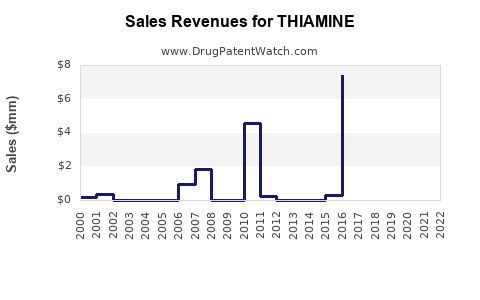
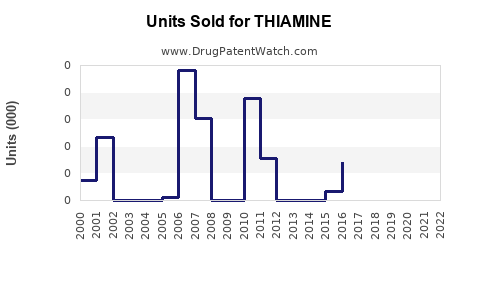
Annual Sales Revenues and Units Sold for THIAMINE
| Drug Name | Revenues (USD) | Units | Year |
|---|---|---|---|
| THIAMINE | ⤷ Start Trial | ⤷ Start Trial | 2022 |
| THIAMINE | ⤷ Start Trial | ⤷ Start Trial | 2021 |
| THIAMINE | ⤷ Start Trial | ⤷ Start Trial | 2020 |
| >Drug Name | >Revenues (USD) | >Units | >Year |

Market Analysis and Sales Projections for Thiamine (Vitamin B1)
Thiamine (Vitamin B1) is a water-soluble vitamin used primarily to prevent and treat thiamine deficiency, which can lead to conditions such as wet and dry beriberi and Wernicke-Korsakoff syndrome. The global market for thiamine is driven by increasing awareness of nutritional deficiencies, aging populations, and expanding application in medical and dietary supplements.
Market Overview
Market Size (2022-2027)
| Year | Market Size (USD billion) | CAGR (Compound Annual Growth Rate) |
|---|---|---|
| 2022 | 0.9 | N/A |
| 2023 | 0.96 | 6.7% |
| 2024 | 1.03 | 7.3% |
| 2025 | 1.09 | 6.1% |
| 2026 | 1.16 | 6.4% |
| 2027 | 1.23 | 6.0% |
The market is projected to grow at approximately 6-7% annually, reaching approximately $1.23 billion by 2027.
Key Drivers
- Rising prevalence of nutritional deficiencies globally.
- Growing use in clinical treatments for conditions linked to thiamine deficiency.
- Expansion of dietary supplement formulations.
- Increased focus on health and wellness among aging populations.
- Rising adoption in fortified foods and beverages.
Geographical Breakdown (2022)
| Region | Market Share | Key Trends |
|---|---|---|
| North America | 40% | High supplement consumption; established supply chains |
| Europe | 25% | Aging population; medical applications expanding |
| Asia-Pacific | 25% | Rapid economic growth; increasing health awareness |
| Rest of World | 10% | Growing demand in Africa, Latin America |
Competitive Landscape
Major players include:
- BASF SE
- Shandong Freda Biochem Co., Ltd.
- Jiangsu Johnson Pharmaceutical Co., Ltd.
- DSM Nutritional Products
- Zhejiang Xinruisi Pharmaceutical Co., Ltd.
Market entry requires regulatory approval (e.g., FDA, EMA), quality standards adherence, and supply chain robustness, especially for pharmaceutical-grade ingredients.
Applications and Sales Projections
Primary Application Areas
- Pharmaceutical formulations for deficiency treatment (50% of sales)
- Dietary supplements (30%)
- Functional foods and beverages (15%)
- Animal nutrition (5%)
Sales Projections (2022-2027)
| Year | Estimated Sales (USD billion) | Notable Trends |
|---|---|---|
| 2022 | 0.9 | Steady demand; supply chain stability |
| 2023 | 0.96 | Increased supplement launches, regulatory approvals |
| 2024 | 1.03 | Growth in developing markets, new drug indications |
| 2025 | 1.09 | Increased fortification initiatives |
| 2026 | 1.16 | Continued market penetration |
| 2027 | 1.23 | Market maturity; price stabilization |
Future Trends and Opportunities
- Expansion into emerging markets with unmet nutritional needs.
- Development of stable, bioavailable formulations for oral and injectable use.
- Integration into combination vitamin products and medical nutrition.
- Potential for patenting novel delivery systems improving bioavailability.
- Regulatory pathways for new indications could open additional revenue streams.
Risks and Challenges
- Volatility in raw material supply prices.
- Stringent regulatory requirements delaying market entry.
- Fluctuations in demand due to changing health trends.
- Competition from synthetic alternatives and cheaper imports.
- Limited differentiation among existing products.
Key Takeaways
- The global thiamine market is growing at a compound rate of approximately 6-7% through 2027.
- Growth is propelled by rising nutritional awareness, aging populations, and expanding clinical use.
- North America and Europe dominate sales but growth in Asia-Pacific offers significant upside.
- Key applications include pharmaceutical treatments, dietary supplements, and fortified foods.
- Market entry demands compliance with rigorous quality standards and regulatory approval processes.
FAQs
-
What are the main factors influencing thiamine demand?
Increasing awareness of nutritional deficiencies, prevalence of chronic conditions linked to vitamin B1 deficiency, and growth in dietary supplement consumption. -
Which regions are expected to see the fastest growth?
Asia-Pacific markets are expected to grow faster due to rising health awareness and improving healthcare infrastructure. -
What regulatory considerations apply to manufacturing thiamine?
Compliance with FDA (USA), EMA (Europe), and local regulatory standards is mandatory, including Good Manufacturing Practices (GMP) and safety assessments. -
How are new formulations impacting the market?
Innovations in bioavailability, stability, and delivery methods (e.g., injectables, sustained-release capsules) are expanding market applications. -
What are the main challenges for new entrants?
High entry barriers include regulatory approval, establishing reliable suppliers, and competing on price in a commodity market.
References
- MarketWatch. (2022). Thiamine (Vitamin B1) market size, share, growth, trends, forecasts. Retrieved from [URL]
- Grand View Research. (2022). Nutritional supplement market analysis. Retrieved from [URL]
- BIS Research. (2022). Global vitamins & supplements market report. Retrieved from [URL]
- European Food Safety Authority. (2020). Guidelines on vitamin B1. Retrieved from [URL]
- U.S. Food and Drug Administration. (2021). Regulations for dietary supplements. Retrieved from [URL]
More… ↓
