Drug Sales Trends for STRATTERA
Payment Methods and Pharmacy Types for STRATTERA (2009)
Revenues by Pharmacy Type
Units Sold by Pharmacy Type
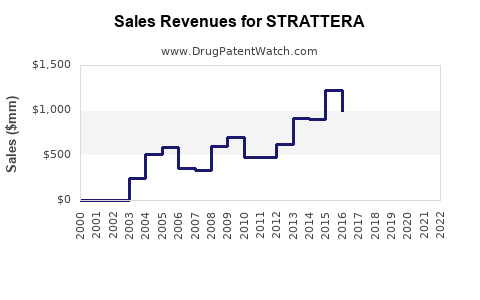
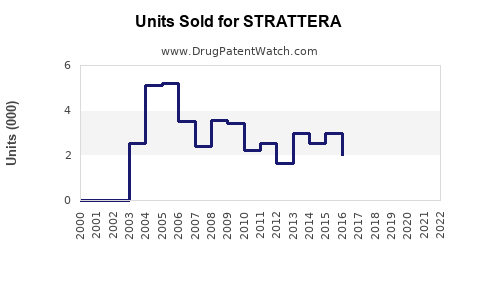
Annual Sales Revenues and Units Sold for STRATTERA
| Drug Name | Revenues (USD) | Units | Year |
|---|---|---|---|
| STRATTERA | ⤷ Start Trial | ⤷ Start Trial | 2022 |
| STRATTERA | ⤷ Start Trial | ⤷ Start Trial | 2021 |
| STRATTERA | ⤷ Start Trial | ⤷ Start Trial | 2020 |
| STRATTERA | ⤷ Start Trial | ⤷ Start Trial | 2019 |
| STRATTERA | ⤷ Start Trial | ⤷ Start Trial | 2018 |
| STRATTERA | ⤷ Start Trial | ⤷ Start Trial | 2017 |
| >Drug Name | >Revenues (USD) | >Units | >Year |
Strattera Market Analysis, Sales Projections, Patent Expiration, and Generic Competition
Strattera, the brand name for atomoxetine hydrochloride, is a mature nonstimulant ADHD medicine marketed originally by Eli Lilly. Its U.S. composition patent expired in 2017, pediatric exclusivity ended around the same period, and multiple generic manufacturers entered the market. The commercial opportunity is now concentrated in generic atomoxetine, selected international markets, and patients who cannot use stimulant medicines.
The base-case global atomoxetine market is estimated at approximately $160 million to $220 million in annual manufacturer revenue through 2029. Strattera-branded revenue is likely a small share of that total, generally below $30 million annually in the United States. Volume should remain relatively stable, while pricing continues to decline because of generic competition.
What is Strattera and how is atomoxetine used?
Strattera contains atomoxetine hydrochloride, a selective norepinephrine reuptake inhibitor. The FDA approved it for the treatment of attention-deficit/hyperactivity disorder in children, adolescents, and adults. Unlike amphetamine and methylphenidate products, atomoxetine is not a controlled substance under the U.S. Controlled Substances Act.
The product is available in oral capsules with strengths of 10 mg, 18 mg, 25 mg, 40 mg, 60 mg, 80 mg, and 100 mg. Dosing is generally weight-based in children and adolescents and titrated in adults. The product label identifies liver injury, suicidal ideation risk in pediatric patients, cardiovascular effects, and interactions involving CYP2D6 metabolism as key safety considerations. (U.S. Food and Drug Administration, 2024a)
Atomoxetine occupies a distinct position in ADHD treatment because it:
- Is nonstimulant.
- Does not have the same diversion profile as amphetamine or methylphenidate.
- Can be used in patients with stimulant misuse concerns.
- Has a slower onset of therapeutic benefit than many stimulant medicines.
- Is available as a low-cost generic in the United States.
How large is the Strattera and atomoxetine market?
The market has two different economic segments:
- The branded Strattera market, which has contracted sharply since generic entry.
- The broader atomoxetine market, which includes generic capsules and remains commercially relevant because of continued ADHD diagnosis and treatment demand.
Eli Lilly reported peak annual Strattera revenue of several hundred million dollars before patent expiry. Company-reported revenue declined as the product aged and generic competition approached. The historical trajectory was approximately as follows:
| Period | Estimated Strattera global revenue | Market condition |
|---|---|---|
| 2008-2010 | $700 million-$800 million annually | Mature branded product |
| 2011-2013 | $530 million-$650 million annually | Aging product and competitive pressure |
| 2014-2016 | $300 million-$470 million annually | Pre-generic erosion |
| 2017 onward | Steep decline | U.S. generic entry |
| 2024 estimate | Less than $50 million globally | Residual branded demand and selected markets |
The historical figures reflect company reporting and rounded annual-report data rather than a single standardized market-data source. Eli Lilly’s reporting categories and geographic disclosures changed over time. (Eli Lilly and Company, 2011, 2014, 2016)
In the United States, total atomoxetine prescription volume remains materially larger than branded Strattera revenue would suggest because generic products carry most prescriptions at sharply lower prices.
What are the Strattera sales projections through 2029?
The following forecast separates the total atomoxetine market from branded Strattera. It is a market scenario based on generic penetration, ADHD treatment growth, price erosion, and the absence of meaningful U.S. patent protection.
Base-case forecast
| Year | Global atomoxetine market | Strattera-branded revenue | Main driver |
|---|---|---|---|
| 2024 | $180 million-$220 million | $20 million-$40 million | Generic-dominated market |
| 2025 | $175 million-$215 million | $18 million-$35 million | Continued price pressure |
| 2026 | $170 million-$210 million | $16 million-$32 million | Brand substitution |
| 2027 | $165 million-$205 million | $14 million-$29 million | Stable volume, lower net prices |
| 2028 | $160 million-$200 million | $12 million-$26 million | Mature generic market |
| 2029 | $155 million-$195 million | $10 million-$24 million | Residual brand demand |
The forecast implies a low-single-digit annual decline in total market revenue and a mid-single-digit to low-double-digit decline in branded revenue. Unit demand may grow modestly, but this growth is unlikely to offset generic price compression.
Scenario analysis
| Scenario | 2029 total atomoxetine revenue | 2029 Strattera revenue | Assumptions |
|---|---|---|---|
| Downside | $120 million-$155 million | $5 million-$12 million | Higher generic substitution and lower reimbursement |
| Base case | $155 million-$195 million | $10 million-$24 million | Stable patient volume and continued price erosion |
| Upside | $210 million-$275 million | $25 million-$45 million | Stronger ADHD diagnosis, nonstimulant demand, and supply constraints affecting alternatives |
The upside scenario depends more on growth in the underlying ADHD-treatment population than on any renewed competitive advantage for Strattera. No major product innovation or patent extension supports a large branded rebound.
When did Strattera lose U.S. exclusivity?
Strattera lost effective U.S. market exclusivity in 2017.
| Event | Timing | Commercial effect |
|---|---|---|
| FDA approval of Strattera | 2002 | Launch of atomoxetine in the U.S. |
| Core U.S. patent expiration | 2017 | Removal of the primary patent barrier |
| Pediatric exclusivity | Around 2017 | Six-month extension associated with pediatric studies |
| First generic approvals | 2017 | Rapid erosion of branded U.S. sales |
| Current status | Generic-dominated | Limited commercial role for brand |
The central U.S. patent was U.S. Patent No. 5,658,590, covering atomoxetine-related chemical matter and associated pharmaceutical use. The patent expired in 2017 after the applicable patent term and pediatric extension. The exact market-entry date varied by generic applicant and regulatory approval. (U.S. Patent and Trademark Office, 1997; U.S. Food and Drug Administration, 2017)
What patents protect Strattera and atomoxetine?
The commercially important U.S. patent estate is largely expired.
| Patent or protection | Subject matter | Status |
|---|---|---|
| U.S. Patent No. 5,658,590 | Atomoxetine chemical matter and pharmaceutical applications | Expired in 2017 |
| Pediatric exclusivity | FDA regulatory protection tied to pediatric studies | Expired around 2017 |
| Product labeling | Approved ADHD indications and safety information | Continues as regulatory labeling, not exclusivity |
| Formulation protection | No commercially meaningful current U.S. barrier identified | Does not block standard generic capsules |
The patent estate does not present the type of layered protection found in newer drugs with separate patents covering composition, crystalline form, long-acting delivery, devices, or manufacturing intermediates. Generic atomoxetine capsules do not face a meaningful U.S. patent barrier from the original Strattera estate.
Are there formulation patents for Strattera?
The commercial product is an immediate-release oral capsule. There is no widely recognized active U.S. formulation patent that materially delays generic atomoxetine capsule competition.
This limits the ability of the brand owner to use lifecycle management strategies such as:
- Extended-release reformulation.
- Transdermal delivery.
- Long-acting injectable delivery.
- Pediatric liquid formulation with new patent protection.
- Combination therapy protected by a separate patent family.
The absence of a commercially important protected formulation is a major reason why the product transitioned rapidly to generic competition.
What is the Orange Book status of Strattera?
The FDA Orange Book historically listed Strattera-related patent information, but the relevant U.S. patent protection expired. Generic applicants could therefore enter after satisfying the applicable abbreviated new drug application requirements and resolving any certification obligations.
Current commercial conditions are consistent with an off-patent, multi-source product:
- Atomoxetine capsules are approved through the ANDA pathway.
- Multiple generic manufacturers compete on price.
- No active Orange Book patent is known to block standard atomoxetine capsules.
- The brand does not retain a meaningful regulatory exclusivity advantage.
- Prescribers and payers generally treat generic atomoxetine as the default product.
The Orange Book remains important for confirming formal listing and expiration data, but the commercial conclusion is straightforward: U.S. atomoxetine is no longer protected by a live core patent. (U.S. Food and Drug Administration, 2024b)
Which companies compete with Strattera and generic atomoxetine?
Competition operates at two levels: direct atomoxetine competition and alternative ADHD therapies.
Direct generic competitors
Generic atomoxetine has been marketed or approved by companies including:
- Teva Pharmaceuticals
- Apotex
- Aurobindo Pharma
- Glenmark Pharmaceuticals
- Dr. Reddy’s Laboratories
- Amneal Pharmaceuticals
- Rising Pharmaceuticals
- Other regional and contract manufacturers
The active manufacturer set varies by strength, supplier status, and pharmacy purchasing arrangements. Market share can change rapidly because wholesalers and payers favor suppliers offering the lowest reliable net price.
Branded ADHD competitors
| Product | Ingredient | Class | Competitive position |
|---|---|---|---|
| Strattera | Atomoxetine | Nonstimulant | Mature, generic-dominated |
| Qelbree | Viloxazine extended release | Nonstimulant | Branded nonstimulant alternative |
| Intuniv | Guanfacine extended release | Alpha-2A agonist | Nonstimulant alternative |
| Kapvay | Clonidine extended release | Alpha-2 agonist | Adjunct and alternative therapy |
| Concerta and generics | Methylphenidate | Stimulant | Large established segment |
| Adderall and generics | Mixed amphetamine salts | Stimulant | Large established segment |
| Vyvanse and generics | Lisdexamfetamine | Stimulant prodrug | Strong branded and generic competition |
Stimulants remain the dominant ADHD drug class. Atomoxetine’s principal commercial advantage is patient suitability rather than superior efficacy across the entire ADHD population.
What is the FDA regulatory status of Strattera?
Strattera is FDA-approved for ADHD in pediatric and adult populations. The drug is not a controlled substance, which affects prescribing, refill management, and diversion concerns. Its noncontrolled status can support use in patients for whom stimulant treatment is clinically or operationally difficult.
The regulatory risks are well established:
- Suicidal ideation monitoring in children and adolescents.
- Rare but serious liver injury.
- Increases in heart rate and blood pressure.
- Potential effects on growth and weight.
- Drug interactions involving CYP2D6 inhibitors and poor metabolizer status.
These warnings can restrict use in certain patient groups but do not create a patent or regulatory barrier for generic manufacturers. The FDA-approved label applies to the generic products through their abbreviated approval pathway. (U.S. Food and Drug Administration, 2024a)
Are Paragraph IV challenges or patent lawsuits affecting Strattera?
Paragraph IV challenges were commercially relevant before generic atomoxetine entry because applicants needed to address the listed Strattera patent. After expiration of the core patent and pediatric exclusivity, those challenges ceased to be a meaningful barrier to market access.
No current patent litigation appears to materially affect U.S. atomoxetine sales. The litigation risk is therefore low compared with newer branded ADHD products that retain active patents or have pending exclusivity disputes.
Settlement agreements
There is no widely reported current settlement agreement that restricts generic atomoxetine access. Any historical Hatch-Waxman settlements would have been superseded economically by patent expiration and broad generic availability.
How strong is the Strattera patent estate?
The current patent estate is weak from a commercial protection perspective.
| Factor | Assessment |
|---|---|
| Core composition patent | Expired |
| Pediatric exclusivity | Expired |
| Active U.S. formulation barrier | Not material |
| Method-of-use exclusivity | Not material for standard ADHD treatment |
| Manufacturing barriers | Low to moderate |
| Generic substitution risk | High |
| Biosimilar risk | Not applicable |
| Brand pricing power | Very low |
Manufacturing still requires validated synthesis, impurity control, capsule production, quality testing, and FDA compliance. Those requirements create operational barriers but do not protect the brand from competition. Atomoxetine is a small molecule, so biosimilar regulation is irrelevant. Generic applicants use the ANDA pathway rather than the biologics license application pathway.
What generic launch scenarios exist for atomoxetine?
The most likely market structure is a stable multi-source generic market with periodic supply disruptions. Three scenarios matter commercially.
Price-led generic market
Several manufacturers maintain supply across common strengths. Pharmacy benefit managers and wholesalers prioritize low-cost suppliers. Brand revenue continues to decline, while generic manufacturer margins compress.
Concentrated supplier market
Only a smaller number of manufacturers consistently supply all strengths. A manufacturing interruption can produce temporary shortages and modest price increases. This scenario can support short-term revenue gains for reliable suppliers but does not restore durable brand protection.
Nonstimulant demand expansion
Growth in ADHD diagnosis, treatment persistence, and stimulant-avoidant prescribing increases atomoxetine volume. The benefit accrues primarily to generic manufacturers because the product is off patent.
What licensing deals affect Strattera?
Strattera was developed and commercialized by Eli Lilly. No current licensing transaction appears to materially change its market outlook. The principal value transfer now occurs through generic supply arrangements, authorized distribution, and procurement contracts rather than a strategic brand licensing deal.
A new license involving atomoxetine would likely be commercially modest unless it introduced a differentiated delivery system, a new combination product, or a market-specific regulatory advantage. Standard immediate-release capsules have limited licensing value because of low pricing and broad generic competition.
What geographic markets remain attractive?
The United States is the largest reference market for regulatory and clinical adoption, but it is also heavily genericized. Commercial opportunities are more dependent on procurement scale and supply reliability than on brand recognition.
Potentially attractive markets include:
- Countries where atomoxetine generic competition remains less intense.
- Markets with growing ADHD diagnosis and specialist treatment.
- Regions where stimulant prescribing is restricted or culturally limited.
- Countries where noncontrolled prescribing provides an operational advantage.
- Public procurement markets favoring low-cost, reliable supply.
European and other international markets have different patent histories, reimbursement rules, and generic-entry dates. Geographic patent status must be checked country by country. The U.S. expiration does not automatically establish freedom to launch in every jurisdiction.
What revenue exposure does Strattera create for Eli Lilly?
Strattera is no longer a material revenue driver for Eli Lilly relative to the company’s major growth products. Its contribution is small compared with newer medicines in diabetes, obesity, oncology, immunology, and neuroscience.
The principal financial exposure is downside rather than upside:
- Brand revenue continues to erode.
- Generic competition limits price increases.
- No major patent cliff remains because the cliff occurred in 2017.
- Supply or manufacturing problems could reduce residual brand revenue.
- A branded reformulation would require new clinical, regulatory, and commercial investment.
For investors, Strattera should be modeled as a residual mature-product revenue stream rather than a pipeline or lifecycle-growth asset.
How does Strattera compare with newer nonstimulant ADHD medicines?
| Attribute | Strattera | Qelbree | Intuniv |
|---|---|---|---|
| Active ingredient | Atomoxetine | Viloxazine ER | Guanfacine ER |
| FDA category | Nonstimulant | Nonstimulant | Nonstimulant |
| U.S. status | Generic-dominated | Branded | Generic and branded competition |
| Controlled substance | No | No | No |
| Patent strength | Weak or expired | Stronger active-product protection historically | Mature |
| Price | Low generic price | Higher branded price | Low to moderate |
| Commercial growth potential | Limited | Greater, subject to access | Limited to moderate |
Strattera has a cost advantage and extensive clinical familiarity. Newer branded nonstimulants can compete through tolerability, dosing convenience, commercial support, and payer positioning, but they face their own access and patent risks.
Key Takeaways
- Strattera is the original branded formulation of atomoxetine, an FDA-approved nonstimulant ADHD medicine.
- The U.S. core patent and pediatric exclusivity expired around 2017.
- Generic atomoxetine dominates the U.S. market.
- Strattera-branded revenue is likely below $50 million globally and should continue declining.
- The total atomoxetine market is estimated at roughly $155 million to $195 million in 2029 under the base case.
- Generic manufacturers face low patent risk but must manage price pressure, FDA compliance, and supply reliability.
- Biosimilar risk does not apply because atomoxetine is a small molecule.
- No current litigation or settlement appears likely to restrict U.S. generic entry.
- Commercial upside depends on growth in ADHD treatment and nonstimulant prescribing, not on renewed Strattera exclusivity.
- Eli Lilly’s residual Strattera revenue is not material to its overall investment profile.
FAQs About Strattera Market Size and Patent Risk
Is Strattera still under patent in the United States?
No. The primary U.S. patent protection associated with atomoxetine expired in 2017, followed by broad generic entry.
Is atomoxetine more commercially valuable than Strattera?
Yes. The broader atomoxetine market includes all generic manufacturers and is economically larger than the remaining Strattera brand market.
Can a company launch a generic Strattera capsule?
A company can seek approval for generic atomoxetine capsules through the FDA ANDA pathway, subject to manufacturing, bioequivalence, labeling, and regulatory requirements.
Does Strattera have biosimilar competition?
No. Atomoxetine is a chemically synthesized small molecule. Its competitors are generic drugs, not biosimilars.
What could increase atomoxetine sales through 2029?
Higher ADHD diagnosis rates, increased treatment persistence, stimulant shortages, greater use of noncontrolled medicines, and improved access for patients who cannot use stimulants could increase volume. These factors would primarily benefit generic suppliers.
References
- Eli Lilly and Company. (2011). Annual report 2011.
- Eli Lilly and Company. (2014). Annual report 2014.
- Eli Lilly and Company. (2016). Annual report 2016.
- U.S. Food and Drug Administration. (2017). FDA approves first generic versions of Strattera to treat ADHD.
- U.S. Food and Drug Administration. (2024a). Strattera (atomoxetine hydrochloride) prescribing information.
- U.S. Food and Drug Administration. (2024b). Approved drug products with therapeutic equivalence evaluations: Orange Book.
- U.S. Patent and Trademark Office. (1997). U.S. Patent No. 5,658,590: Treatment of attention-deficit/hyperactivity disorder with atomoxetine.
More… ↓
