Share This Page
Drug Sales Trends for PIROXICAM
✉ Email this page to a colleague
Payment Methods and Pharmacy Types for PIROXICAM (2009)
Revenues by Pharmacy Type
Units Sold by Pharmacy Type
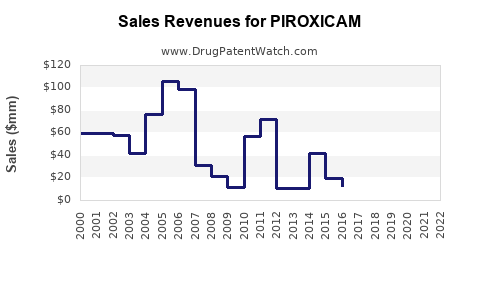
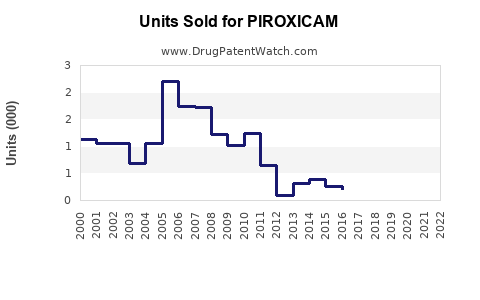
Annual Sales Revenues and Units Sold for PIROXICAM
| Drug Name | Revenues (USD) | Units | Year |
|---|---|---|---|
| PIROXICAM | ⤷ Start Trial | ⤷ Start Trial | 2022 |
| PIROXICAM | ⤷ Start Trial | ⤷ Start Trial | 2021 |
| PIROXICAM | ⤷ Start Trial | ⤷ Start Trial | 2020 |
| PIROXICAM | ⤷ Start Trial | ⤷ Start Trial | 2019 |
| PIROXICAM | ⤷ Start Trial | ⤷ Start Trial | 2018 |
| PIROXICAM | ⤷ Start Trial | ⤷ Start Trial | 2017 |
| >Drug Name | >Revenues (USD) | >Units | >Year |
Piroxicam Market Analysis and Sales Projections: Generic NSAID Outlook Through 2030
Piroxicam is a mature, low-cost nonsteroidal anti-inflammatory drug used primarily for osteoarthritis and rheumatoid arthritis. Its commercial market is fragmented across generic manufacturers and national brands. The drug has no meaningful remaining composition-of-matter exclusivity in the United States, no biologic or biosimilar risk, and limited ability to support premium pricing.
The base-case outlook is for stable-to-declining global revenue through 2030. Growth in emerging markets and continued use of once-daily oral therapy should offset part of the decline caused by substitution with meloxicam, celecoxib, diclofenac, naproxen and topical NSAIDs.
Public sources do not disclose audited global piroxicam sales by active ingredient. The projections below are scenario estimates based on generic-drug pricing, prescription demand, competitive substitution and geographic availability.
What is piroxicam and how is it used?
Piroxicam is an oxicam-class NSAID marketed historically under the Feldene brand and now supplied mainly by generic manufacturers. It inhibits cyclooxygenase-mediated prostaglandin production and has a long elimination half-life, generally reported at approximately 50 hours. This supports once-daily dosing but also prolongs exposure when adverse effects occur.
The principal approved uses are:
- Osteoarthritis
- Rheumatoid arthritis
- Short-term treatment of inflammatory pain in selected markets
- Topical treatment of musculoskeletal pain in certain jurisdictions
The FDA-approved oral product carries boxed warnings for increased risk of serious cardiovascular thrombotic events and gastrointestinal bleeding, ulceration and perforation. The FDA label recommends the lowest effective dose for the shortest duration consistent with treatment objectives.[1]
What dosage forms are sold?
| Dosage form | Typical market position | Commercial assessment |
|---|---|---|
| 10 mg and 20 mg capsules or tablets | Primary global form | Main source of volume |
| Injectable formulations | Available in selected countries | Small, hospital-oriented segment |
| Topical gel or cream | Marketed in some jurisdictions | Competes with diclofenac and ketoprofen topicals |
| Combination products | Available in selected emerging markets | Regulatory and reimbursement treatment varies |
The oral 20 mg strength is generally the most commercially important presentation. Product availability, prescription status and approved indications differ substantially by country.
How large is the piroxicam market?
The piroxicam market is a mature generic market rather than a branded specialty-pharmaceutical market. Revenue is spread among manufacturers of finished-dose tablets, capsules, injections and topical products. Pfizer's historical Feldene franchise no longer determines market pricing or access.
A reasonable commercial segmentation is:
| Segment | Relative importance | Demand characteristics |
|---|---|---|
| Oral tablets and capsules | High | Chronic arthritis use and low-cost generic prescribing |
| Topical products | Moderate in selected markets | Acute and localized musculoskeletal pain |
| Injectable products | Low | Institutional and short-term use |
| Combination products | Low to moderate | More relevant in price-sensitive markets |
The largest demand pools are likely to be countries with:
- High prevalence of osteoarthritis and rheumatoid arthritis.
- Broad generic substitution.
- Established use of older NSAIDs.
- Lower access to newer COX-2 selective agents.
- Reimbursement systems that favor low-cost oral medicines.
The United States is unlikely to be the principal growth market. Piroxicam competes against multiple inexpensive NSAIDs, and prescribers often favor agents with shorter half-lives or more familiar cardiovascular and gastrointestinal risk profiles.
What are the main growth drivers for piroxicam sales?
Piroxicam retains several commercial advantages despite its age.
Once-daily dosing
The long half-life allows once-daily administration. This can support adherence in chronic inflammatory conditions, particularly where patients and prescribers value dosing simplicity.
Low generic cost
Piroxicam is generally inexpensive compared with branded anti-inflammatory products. In lower-income and middle-income countries, price remains a major determinant of NSAID selection.
Broad international availability
Piroxicam is registered in numerous jurisdictions through legacy national approvals and generic applications. Some markets have long-established local brands, which can preserve demand even after originator patent expiry.
Established clinical familiarity
Physicians in several markets have decades of experience with piroxicam. Familiarity can maintain prescriptions even as treatment guidelines increasingly favor other NSAIDs for selected patients.
Growth in musculoskeletal disease
Population aging and rising prevalence of osteoarthritis support underlying demand for anti-inflammatory therapy. Piroxicam will capture only a small portion of that growth because it competes within a large and highly substitutable NSAID class.
What factors are limiting piroxicam revenue?
Piroxicam faces structural commercial pressure.
Safety profile
The FDA labeling identifies serious gastrointestinal, cardiovascular and renal risks associated with NSAIDs. Piroxicam's long half-life can make adverse-event management more difficult than with shorter-acting products.[1]
Substitution by other NSAIDs
Meloxicam, celecoxib, diclofenac, naproxen and ibuprofen compete directly with piroxicam. Meloxicam is particularly important because it provides once-daily dosing with a newer market position and broad generic availability.
Topical competition
Topical diclofenac products compete for patients with localized pain while reducing systemic exposure. This is a significant competitive factor in osteoarthritis and soft-tissue pain markets.
Low pricing power
Most piroxicam products are generic. Manufacturers generally compete through tender pricing, distribution coverage, local branding and regulatory access rather than clinical differentiation.
Guideline and prescribing trends
Risk-based prescribing increasingly favors lower doses, shorter treatment duration and patient-specific selection based on gastrointestinal, cardiovascular and renal risk. These trends can reduce routine use of long-acting NSAIDs.
What is the FDA regulatory status of piroxicam?
Piroxicam is an established FDA-approved active ingredient. The U.S. product is associated with Pfizer's historical Feldene approval and multiple generic abbreviated new drug applications.
The key U.S. regulatory characteristics are:
| Regulatory issue | Status |
|---|---|
| FDA approval | Established oral NSAID product |
| Generic availability | Yes |
| Orange Book exclusivity | No current commercial exclusivity expected for the active ingredient |
| New chemical entity exclusivity | Expired |
| Pediatric exclusivity | Not a current market driver |
| Orphan exclusivity | Not applicable |
| Biosimilar pathway | Not applicable |
| ANDA pathway | Primary route for generic entry |
FDA's Orange Book records approved drug products, patent information and exclusivity data. Piroxicam's commercial status is consistent with a fully genericized product rather than a product protected by an active U.S. patent estate.[2]
What patents protect piroxicam?
The original composition-of-matter and product patents for piroxicam expired many years ago. Current commercial protection is generally based on manufacturing know-how, trademarks, regulatory approvals, formulation development and local market registrations rather than enforceable core-molecule patents.
Formulation patents
Potential formulation protection may exist for:
- Modified-release dosage forms
- Topical delivery systems
- Combination products
- Specific excipient systems
- Injectable formulations
- Particle-size or solubility enhancements
These rights are jurisdiction-specific and do not create broad exclusivity for conventional piroxicam tablets or capsules. A formulation patent would need to claim a commercially relevant dosage form and withstand validity and infringement challenges.
Method-of-use patents
New method-of-use patents are commercially difficult to sustain for a long-established NSAID. Possible claim areas could include:
- A specific inflammatory condition
- A defined dosing regimen
- Use in a selected patient population
- Combination treatment
- A topical application or delivery method
Any such patent would face substantial prior-art risk because piroxicam has been used clinically for decades.
Manufacturing and process protection
Manufacturing know-how may still have value. It can cover:
- Crystallization and polymorph control
- Impurity reduction
- Yield improvement
- Stability enhancement
- Scale-up procedures
- Cost-efficient API production
These protections are typically trade secrets or narrow process patents. They can affect cost and supply reliability but do not prevent generic competition broadly.
Are there Paragraph IV challenges or piroxicam patent lawsuits?
Piroxicam has no major current U.S. patent litigation profile comparable to active branded drugs. Any historical Paragraph IV activity would have related to generic entry against patents listed for the originator product. Because the core product is long genericized, current U.S. market entry is primarily an ANDA approval and manufacturing issue.
| Litigation issue | Current commercial relevance |
|---|---|
| Core-molecule patent dispute | Low |
| Active Orange Book patent litigation | Low |
| Paragraph IV launch risk | Low for conventional products |
| Formulation patent disputes | Possible but narrow |
| Trade-secret disputes | Possible at API or manufacturing level |
| Trademark disputes | Possible between local brands |
No significant settlement agreement currently controls broad U.S. piroxicam generic entry. Local disputes may arise in individual countries over trademarks, registrations, distribution rights or formulation claims.
How does piroxicam compare with competing NSAIDs?
| Drug | Dosing profile | Generic status | Key commercial advantage | Key competitive weakness |
|---|---|---|---|---|
| Piroxicam | Usually once daily | Generic | Long duration and low cost | Long half-life and safety concerns |
| Meloxicam | Usually once daily | Generic | Stronger modern prescribing position | Directly substitutes for piroxicam |
| Celecoxib | Once or twice daily | Generic | COX-2 selectivity and lower GI injury in some patients | Cardiovascular and price concerns |
| Diclofenac | One or more daily doses | Generic | Broad oral and topical availability | Cardiovascular and hepatic concerns |
| Naproxen | One or two daily doses | Generic | Established efficacy and broad use | GI risk and dosing burden |
| Ibuprofen | Multiple daily doses | Generic and OTC | Very low price and consumer familiarity | Shorter duration and frequent dosing |
Piroxicam's strongest competitive attribute is dosing convenience. Its weakest attributes are safety perception and limited differentiation from other generic NSAIDs.
What are piroxicam sales projections through 2030?
The following model uses an indexed 2024 global revenue baseline of 100. It assumes that piroxicam remains available in major markets, with no new branded formulation producing substantial premium pricing.
| Year | Downside case | Base case | Upside case |
|---|---|---|---|
| 2024 | 100 | 100 | 100 |
| 2025 | 94 | 99 | 104 |
| 2026 | 88 | 98 | 108 |
| 2027 | 81 | 96 | 112 |
| 2028 | 75 | 95 | 116 |
| 2029 | 70 | 93 | 120 |
| 2030 | 65 | 91 | 124 |
| 2024-2030 CAGR | -6.7% | -1.5% | 3.7% |
Base case
The base case assumes:
- Mature demand in North America and Western Europe
- Low-single-digit volume growth in selected emerging markets
- Continued price erosion in tender-based channels
- Gradual substitution by meloxicam, celecoxib and topical NSAIDs
- Stable use of piroxicam in chronic arthritis and low-cost prescribing segments
Under this case, nominal global revenue declines approximately 9% from 2024 through 2030.
Upside case
The upside case requires:
- Increased use in price-sensitive markets
- Stable local-brand demand
- Expansion of topical or combination products
- Improved distribution by regional generic manufacturers
- Limited further erosion in average selling prices
This case represents market stabilization rather than a return to branded growth.
Downside case
The downside case assumes:
- Accelerated substitution by meloxicam and celecoxib
- Greater use of topical diclofenac
- Tighter NSAID prescribing controls
- Tender-driven price compression
- Manufacturing or registration withdrawals by smaller suppliers
The downside case would reduce revenue by approximately 35% from the 2024 index by 2030.
What is the commercial opportunity for generic manufacturers?
The opportunity is operational rather than patent-driven. A manufacturer can compete through:
- Low-cost API sourcing
- Reliable supply
- National registrations
- Government tenders
- Multiple dosage strengths
- Topical or injectable extensions
- Contract manufacturing
- Distribution in markets with established piroxicam prescribing
A conventional 20 mg capsule or tablet is unlikely to support meaningful premium pricing without a differentiated formulation, strong brand recognition or local reimbursement advantage.
The most attractive strategy is usually regional portfolio placement alongside other generic NSAIDs. Piroxicam can function as a low-cost product within a broader arthritis and pain portfolio, but it is unlikely to justify standalone commercial infrastructure in mature markets.
What generic launch scenarios exist for piroxicam?
Conventional oral generic
This is the lowest-risk entry route. The market is already genericized, regulatory requirements are well established and patent barriers are limited. The principal risks are price competition and limited market share.
Topical product
A topical piroxicam product could gain share in markets where topical NSAIDs are widely prescribed. It would compete directly with diclofenac and ketoprofen. Regulatory requirements and clinical evidence expectations vary by jurisdiction.
Combination product
A combination containing piroxicam and another analgesic or muscle relaxant may obtain local commercial traction, particularly in emerging markets. Combination products carry increased regulatory, pharmacovigilance and prescribing scrutiny.
Hospital injectable product
An injectable launch may access institutional demand but typically offers limited volume. Manufacturing controls, sterility requirements and hospital procurement pricing reduce the attractiveness of this segment.
What is the investment outlook for piroxicam?
Piroxicam is a low-growth, low-IP-risk generic asset. Its value depends on supply-chain economics, geographic registrations and portfolio fit rather than exclusivity.
The investment profile is:
| Factor | Assessment |
|---|---|
| Market growth | Flat to modest decline |
| Patent protection | Weak or absent for conventional products |
| Regulatory risk | Low for established oral generics |
| Pricing power | Low |
| Manufacturing opportunity | Moderate |
| Litigation exposure | Low |
| Biosimilar exposure | None |
| Revenue durability | Moderate where local brands are established |
| Premium-product potential | Limited |
| Best commercial route | Regional generic portfolio |
Key Takeaways
- Piroxicam is a mature generic NSAID with no meaningful remaining core patent protection in the United States.
- The commercial market is fragmented and lacks transparent audited global sales data.
- Oral tablets and capsules generate most revenue, with topical and injectable products representing smaller regional opportunities.
- Once-daily dosing and low cost support continued use.
- Long half-life, gastrointestinal risk and cardiovascular warnings limit growth.
- Meloxicam, celecoxib, diclofenac, naproxen and ibuprofen are the principal competitive alternatives.
- The base-case forecast is a gradual global revenue decline of about 1.5% annually through 2030.
- Generic manufacturers should focus on supply reliability, local registrations and portfolio distribution rather than patent exclusivity.
- Biosimilar competition is irrelevant because piroxicam is a small-molecule drug.
- A differentiated formulation could improve economics, but conventional piroxicam products have limited pricing power.
FAQs About Piroxicam Market Size and Sales Forecasts
Is piroxicam still commercially relevant?
Yes. It remains relevant in countries where low-cost oral NSAIDs and established local brands dominate treatment. Its relevance is greater in price-sensitive markets than in the United States or Western Europe.
Does Pfizer still control the piroxicam market?
No. Pfizer developed and marketed Feldene, but the active ingredient is now supplied primarily by generic manufacturers. Pfizer does not control broad commercial access to conventional piroxicam products.
Can a company obtain new patent protection for piroxicam?
A company may seek patents for a specific formulation, delivery system, manufacturing process or narrow method of use. Such patents would not normally restore exclusivity for standard piroxicam tablets or capsules.
Is piroxicam available over the counter?
Regulatory status varies by country. It is prescription-only in many jurisdictions, while certain topical or low-dose products may have different classifications elsewhere.
What is the most attractive piroxicam product opportunity?
A regional generic oral product with efficient manufacturing is the lowest-risk opportunity. Topical formulations may offer more differentiation, but they face strong competition from established topical diclofenac products.
References
- U.S. Food and Drug Administration. (2019). Feldene (piroxicam) prescribing information. FDA.
- U.S. Food and Drug Administration. (2024). Approved drug products with therapeutic equivalence evaluations: Orange Book. FDA.
- U.S. National Library of Medicine. (2024). Piroxicam drug label information. DailyMed.
- World Health Organization Collaborating Centre for Drug Statistics Methodology. (2024). ATC/DDD index: M01AC01 piroxicam. WHO.
More… ↓
