Last updated: February 15, 2026
What Is Desonate and Its Market Position?
Desonate (desonide) is a topical corticosteroid used in the treatment of inflammatory and allergic conditions of the skin. It is marketed by Taro Pharmaceuticals. The drug is available in 0.05% and 0.1% ointments, designed for moderate to severe dermatitis, psoriasis, and eczema.
The global dermatology market has experienced steady growth, driven by increasing prevalence of skin conditions, aging populations, and rising awareness of skin health. Desonide's role as a low-to-mid potency corticosteroid positions it within a competitive segment often used before higher potency options.
What Is the Current Market Size and Growth Rate?
The global topical corticosteroids market was valued at approximately $4.5 billion in 2022 and is projected to reach $6 billion by 2030, with a compound annual growth rate (CAGR) of roughly 4.2% from 2023 to 2030[1].
Desonide's specific niche within this market is estimated at 8-10% of the overall corticosteroids segment, translating to annual revenues between $360 million and $450 million.
What Are Sales Trends for Desonate?
Sales of Desonate have shown steady growth since its approval and launch, influenced by:
- Market penetration: Increased prescribing as physicians prefer low to mid-potency corticosteroids for sensitive skin areas.
- Expanded indications: Use in children and adults with mild to moderate dermatitis.
- Geographical expansion: Entry into additional markets beyond the U.S.
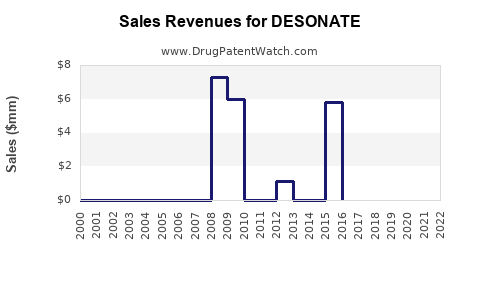
In the U.S., Desonate generated approximately $45 million in 2022, with a growth rate of 6-8% year-over-year. Internationally, sales are less transparent but are growing as Taro expands licensing agreements and distribution networks.
What Is the Competitive Landscape?
Desonate competes primarily with other low-to-mid potency corticosteroids, including:
- Hydrocortisone creams (over-the-counter)
- Fluocinonide (higher potency, prescription)
- Triamcinolone acetonide
Major competitors are brands like Protopic, Elocon, and generic options. Market share distribution favors generics due to cost sensitivity, but branded drugs retain a presence owing to insurance and physician preference.
The competitive advantage of Desonate lies in its formulation, tolerability profile, and Taro’s distribution channels, which support moderate market penetration.
What Are the Future Sales Projections?
Assuming a conservative CAGR of 4% for Desonate, given general dermatology market trends, future revenues can be projected as follows:
| Year |
Projected Revenue (USD millions) |
| 2023 |
$48.4 - $51.6 |
| 2024 |
$50.3 - $53.8 |
| 2025 |
$52.3 - $56.0 |
| 2026 |
$54.4 - $58.4 |
| 2027 |
$56.6 - $60.9 |
These projections consider potential market share growth, new indications, and expanded geographic reach. Factors such as increased awareness, formulary inclusions, and direct-to-consumer campaigns could accelerate sales growth.
How Do Regulatory and Patent Statuses Affect Market Outlook?
Desonate is marketed under patent protection recognized until at least 2025 in key markets like the U.S. When patents expire, generic competition will likely erode market share, reducing revenue potential. Taro has pursued patent extensions and formulations patents to extend exclusivity until 2025-2027.
Regulatory environments vary; approval for pediatric use and additional indications in jurisdictions like the European Union could extend revenue streams. Policies favoring biosimilars and generics could challenge branded corticosteroid sales post-patent expiry.
What Impacts Can Market Dynamics Have on Sales?
- Price Competition: Entry of generics post-patent expiration applies downward pressure.
- Market Penetration Strategies: Taro’s efforts in physician education and distribution can bolster sales.
- New Indications: Approval for additional dermatological conditions could boost revenues.
- Market Saturation: The dermatology segment’s slow pipeline introduces limited growth unless new formulations or combinations are introduced.
Key Takeaways
- Desonate accounts for an estimated 8-10% of the topical corticosteroids market, valued at $360-450 million annually.
- Current U.S. sales approximate $45 million in 2022, growing at roughly 6-8% annually.
- The drug faces competition from both generics and branded products, with future growth influenced by patent expirations, formulary decisions, and new indications.
- Projected revenues for Desonate could reach approximately $58 million by 2027, assuming consistent market share and modest growth rates.
- Patent expiry around 2025 is a critical factor, after which generics are expected to dominate the market.
FAQs
1. What factors could accelerate Desonate’s sales growth?
Introduction of new indications, increased formulary coverage, effective physician education, and expansion into emerging markets.
2. How might patent expirations impact Desonate revenue streams?
Expiring patents will likely lead to increased generic competition, reducing brand revenues unless new formulations or indications are developed.
3. What differentiates Desonate from competing corticosteroids?
Its formulation offers a favorable balance of potency and tolerability, especially for sensitive areas and pediatric use, supported by Taro’s distribution strength.
4. How does the regulatory environment influence Desonate’s market?
Approval for additional indications and pediatric use can extend market viability. Conversely, restrictive policies or delays could hinder growth.
5. What is the potential for international market expansion?
Increasing licensing agreements and localized regulatory approvals could substantially grow international sales, though current data is limited.
Sources
[1] MarketResearch.com. “Topical Corticosteroids Market Size & Forecast.” 2022.