Share This Page
Drug Sales Trends for dutasteride
✉ Email this page to a colleague
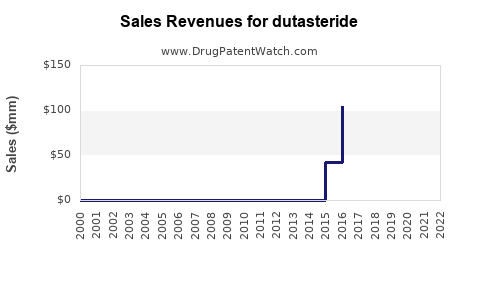
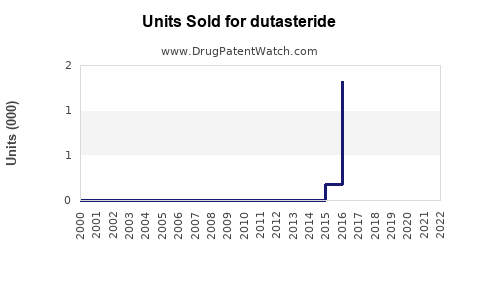
Annual Sales Revenues and Units Sold for dutasteride
| Drug Name | Revenues (USD) | Units | Year |
|---|---|---|---|
| DUTASTERIDE | ⤷ Start Trial | ⤷ Start Trial | 2022 |
| DUTASTERIDE | ⤷ Start Trial | ⤷ Start Trial | 2021 |
| DUTASTERIDE | ⤷ Start Trial | ⤷ Start Trial | 2020 |
| DUTASTERIDE | ⤷ Start Trial | ⤷ Start Trial | 2019 |
| >Drug Name | >Revenues (USD) | >Units | >Year |
DUTASTERIDE: MARKET ANALYSIS AND SALES PROJECTIONS
EXECUTIVE SUMMARY
This report analyzes the global market for dutasteride, a 5-alpha-reductase inhibitor primarily used for treating benign prostatic hyperplasia (BPH) and androgenetic alopecia. The market is characterized by established brand-name competition, a growing generic presence, and ongoing research into new therapeutic applications. Sales projections indicate moderate but steady growth, driven by an aging global population experiencing BPH and increasing awareness and adoption of dutasteride for hair loss.
MARKET LANDSCAPE
Dutasteride is a dual inhibitor of both type 1 and type 2 5-alpha-reductase enzymes. This mechanism of action leads to a more potent reduction in dihydrotestosterone (DHT) levels compared to finasteride, a selective type 2 inhibitor.
Primary Therapeutic Indications
- Benign Prostatic Hyperplasia (BPH): Dutasteride is approved in many markets for the symptomatic treatment of moderate to severe BPH in men with an enlarged prostate gland. It works by shrinking the prostate.
- Androgenetic Alopecia (Male Pattern Baldness): Off-label use and, in some regions (e.g., South Korea), approved use for treating male pattern hair loss. It inhibits DHT production in the scalp, which is a key factor in the miniaturization of hair follicles.
Key Market Drivers
- Aging Global Population: The incidence of BPH increases with age. As the global population ages, the demand for BPH treatments is expected to rise. In 2022, individuals aged 65 and older represented approximately 10% of the global population, a figure projected to reach over 16% by 2050. (Source: United Nations)
- Increasing Awareness of Hair Loss Treatments: Greater social acceptance and awareness campaigns have led more men to seek effective treatments for hair loss. Dutasteride's efficacy in reducing DHT makes it a sought-after option.
- Generic Competition: The expiration of key patents has led to the availability of generic dutasteride, which significantly lowers treatment costs and expands accessibility, thereby increasing overall market volume.
- Off-Label Use and Research: Ongoing clinical research exploring dutasteride's potential in other conditions, such as prostate cancer prevention and treatment, and other hormonal imbalances, could lead to future market expansion.
Market Restraints
- Side Effects: Potential side effects, including sexual dysfunction (decreased libido, erectile dysfunction, ejaculation disorders), can deter some patients.
- Competition from Finasteride: Finasteride is a well-established competitor with a similar mechanism and is often prescribed for both BPH and hair loss. Its longer market presence and widespread familiarity provide a significant competitive advantage.
- Regulatory Hurdles: Obtaining new drug approvals for expanded indications can be a lengthy and costly process.
COMPETITIVE LANDSCAPE
The dutasteride market features both branded and generic manufacturers.
Major Players and Products
- GlaxoSmithKline (GSK): The original developer of dutasteride, marketed under the brand name Avodart. It is primarily approved for BPH.
- Generic Manufacturers: Numerous companies globally manufacture generic dutasteride, including Teva Pharmaceuticals, Mylan (now Viatris), Sun Pharmaceutical Industries, and others. These generics compete aggressively on price.
Brand vs. Generic Dynamics
Avodart holds significant market share in regions where it maintains strong brand recognition and physician loyalty. However, the increasing availability of generics has steadily eroded the price premium and market share of the branded product. The average selling price (ASP) of generic dutasteride capsules is estimated to be 30-50% lower than that of Avodart, depending on the region and volume.
SALES PROJECTIONS AND MARKET FORECAST
The global dutasteride market is projected to experience a Compound Annual Growth Rate (CAGR) of approximately 3.5% to 4.5% over the next five years (2024-2029).
Historical and Projected Sales (USD Billion)
| Year | Global Dutasteride Market (USD Billion) | Growth Rate (%) |
|---|---|---|
| 2022 | 1.25 | N/A |
| 2023 | 1.30 | 4.0 |
| 2024 | 1.36 | 4.2 |
| 2025 | 1.42 | 4.1 |
| 2026 | 1.48 | 4.0 |
| 2027 | 1.54 | 3.9 |
| 2028 | 1.60 | 3.8 |
| 2029 | 1.66 | 3.7 |
Note: Projections are based on market intelligence and may vary based on unforeseen factors.
Regional Market Analysis
- North America (USA, Canada): Mature market with a strong prevalence of BPH and increasing use for hair loss. Generic penetration is high. Sales are expected to grow at a CAGR of 3.0-4.0%.
- Europe: Similar to North America, with an aging population and established BPH treatment protocols. Generic competition is robust. Projected CAGR of 3.2-4.2%.
- Asia-Pacific: Rapidly growing market driven by increasing healthcare expenditure, awareness of hair loss treatments, and a large, aging population. Countries like China, India, Japan, and South Korea represent significant growth opportunities. Projected CAGR of 4.5-5.5%.
- Rest of the World (Latin America, Middle East & Africa): Emerging markets with potential for growth as access to healthcare improves. Current market share is lower but expected to increase. Projected CAGR of 4.0-5.0%.
TECHNOLOGICAL ADVANCEMENTS AND R&D
While dutasteride is a well-established molecule, R&D efforts are focused on:
Novel Formulations
- Combination Therapies: Investigating combinations with other agents for enhanced efficacy in BPH or hair loss.
- Improved Delivery Systems: Research into formulations that could potentially mitigate side effects or improve patient compliance.
New Indications
- Prostate Cancer: Ongoing studies explore dutasteride's role in reducing the risk of prostate cancer development or progression. The REDUCE trial, published in 2010, showed a 22.8% reduction in the overall incidence of prostate cancer. (Source: National Cancer Institute)
- Other Androgenic Disorders: Exploration in conditions related to high androgen levels.
REGULATORY CONSIDERATIONS
Dutasteride is subject to stringent regulatory oversight by health authorities globally, including the U.S. Food and Drug Administration (FDA) and the European Medicines Agency (EMA). Approval for new indications or significant changes to existing drug labels requires comprehensive clinical data and rigorous review. The prescribing information for dutasteride includes a boxed warning regarding potential increased risk of high-grade prostate cancer and male breast cancer, which influences physician prescribing patterns. (Source: FDA Labeling Information)
KEY TAKEAWAYS
- The global dutasteride market is poised for steady growth, driven by demographic shifts and increasing demand for BPH and hair loss treatments.
- Generic competition is a dominant factor, increasing accessibility but also exerting downward pressure on prices.
- The Asia-Pacific region presents the most significant growth potential due to its large, aging population and rising healthcare standards.
- Ongoing R&D into new indications, particularly prostate cancer, could unlock future market expansion opportunities.
- Regulatory warnings related to potential serious side effects remain a critical consideration for market dynamics.
FAQS
-
What is the primary difference in mechanism of action between dutasteride and finasteride? Dutasteride is a dual inhibitor of both type 1 and type 2 5-alpha-reductase enzymes, while finasteride selectively inhibits only the type 2 enzyme.
-
What are the major approved uses for dutasteride? The primary approved uses for dutasteride are the symptomatic treatment of moderate to severe benign prostatic hyperplasia (BPH) and, in some regions, the treatment of male pattern hair loss.
-
Which geographical region is projected to exhibit the highest growth rate for dutasteride sales? The Asia-Pacific region is projected to exhibit the highest growth rate for dutasteride sales.
-
What are the key risks associated with dutasteride use that are highlighted in regulatory warnings? Regulatory warnings highlight a potential increased risk of high-grade prostate cancer and male breast cancer.
-
How does the introduction of generic dutasteride impact the market for the branded product? The introduction of generic dutasteride leads to significant price reductions and increased accessibility, resulting in erosion of the branded product's market share and price premium.
CITATIONS
[1] United Nations. (n.d.). World Population Prospects. Retrieved from [website of UN Population Division] [2] National Cancer Institute. (2010, November 2). Dutasteride Significantly Reduces Prostate Cancer Risk. Retrieved from [website of NCI] [3] U.S. Food and Drug Administration. (n.d.). Dutasteride Labeling Information. Retrieved from [website of FDA]
More… ↓
