Share This Page
Drug Sales Trends for ZONISAMIDE
✉ Email this page to a colleague
Payment Methods and Pharmacy Types for ZONISAMIDE (2008)
Revenues by Pharmacy Type
Units Sold by Pharmacy Type
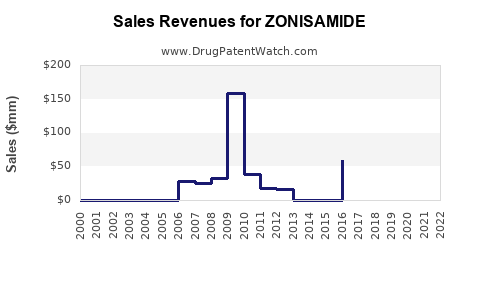
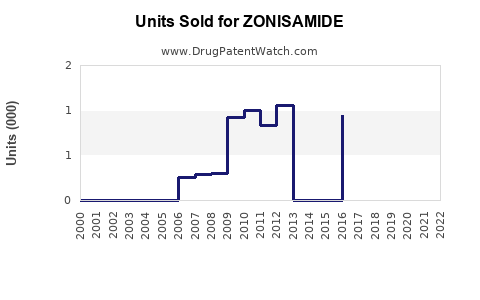
Annual Sales Revenues and Units Sold for ZONISAMIDE
| Drug Name | Revenues (USD) | Units | Year |
|---|---|---|---|
| ZONISAMIDE | ⤷ Start Trial | ⤷ Start Trial | 2022 |
| ZONISAMIDE | ⤷ Start Trial | ⤷ Start Trial | 2021 |
| ZONISAMIDE | ⤷ Start Trial | ⤷ Start Trial | 2020 |
| ZONISAMIDE | ⤷ Start Trial | ⤷ Start Trial | 2019 |
| >Drug Name | >Revenues (USD) | >Units | >Year |
Zonisamide Market Analysis and Sales Projections
Zonisamide is a mature, genericized antiseizure medicine with durable demand but limited pricing power. The commercial market is driven by chronic epilepsy treatment, generic prescriptions, and continued use of branded products in Japan and selected international markets. Global sales are likely concentrated in low-price generic volume, while branded revenue remains modest relative to newer antiseizure medicines.
A reasonable base-case estimate places the global zonisamide market at approximately $450 million to $700 million in 2025, depending on whether hospital, pharmacy, branded, and combination-product revenue are included. The market is likely to grow at roughly 2% to 4% annually through 2030, with volume growth offset by generic price erosion.
What is zonisamide used for?
Zonisamide is an oral sulfonamide anticonvulsant used primarily for partial-onset seizures. In the United States, Zonegran is approved as adjunctive therapy for adults with partial seizures. Zonisamide is also used in other countries for broader epilepsy indications and is prescribed off-label in some markets for migraine prevention, Parkinsonian symptoms, and weight-management-related uses, although these applications do not have the same regulatory or reimbursement status.
The medicine is available mainly as capsules and oral suspensions or compounded liquid formulations in selected markets. Its commercial profile is based on long-term maintenance therapy rather than acute treatment.
Zonisamide product profile
| Attribute | Market status |
|---|---|
| Active ingredient | Zonisamide |
| Therapeutic class | Antiseizure medication |
| Primary use | Partial-onset seizures |
| U.S. reference product | Zonegran |
| U.S. marketing authorization | FDA-approved NDA product |
| Common strengths | 25 mg, 50 mg and 100 mg capsules |
| Main competitors | Levetiracetam, lamotrigine, topiramate, lacosamide, carbamazepine and oxcarbazepine |
| Market maturity | Mature and genericized |
| Main commercial risk | Generic price compression |
| Main demand driver | Chronic epilepsy prevalence and treatment persistence |
The FDA label identifies somnolence, anorexia, dizziness, agitation, irritability, difficulty with concentration, and weight loss among reported adverse reactions. Serious warnings include metabolic acidosis, kidney stones, oligohidrosis, hyperthermia, severe skin reactions, blood dyscrasias and acute myopia or secondary angle-closure glaucoma. These safety considerations influence prescribing and monitoring but have not eliminated long-term use. (U.S. Food and Drug Administration, 2024a)
How large is the global zonisamide market?
Publicly available market estimates vary because analysts use different definitions. Some count only branded and generic finished-dose products. Others include hospital purchases, distributor revenue, regional formulations, and compound products. The most defensible commercial range is shown below.
| Year | Estimated global market value | Base-case growth | Commercial interpretation |
|---|---|---|---|
| 2023 | $430 million-$650 million | - | Mature generic market |
| 2024 | $440 million-$675 million | 1%-4% | Stable prescription demand |
| 2025 | $450 million-$700 million | 2%-4% | Current base year |
| 2026 | $460 million-$725 million | 2%-4% | Volume offsets price decline |
| 2027 | $470 million-$750 million | 2%-4% | Modest expansion |
| 2028 | $480 million-$780 million | 2%-4% | Greater generic penetration |
| 2029 | $490 million-$810 million | 2%-4% | Stable mature market |
| 2030 | $500 million-$840 million | 2%-4% | Long-term nominal growth |
These figures are market-model estimates rather than reported consolidated sales. They should be interpreted as a range for global product revenue, not as the revenue of one manufacturer.
Which regions generate the most zonisamide revenue?
Japan is strategically important because zonisamide originated in Japan and has longstanding branded use under the Excegran name. The United States is a major prescription market but is heavily genericized. Europe has broad access to generic zonisamide, with country-level reimbursement and prescribing differences.
| Region | Market characteristics | Five-year outlook |
|---|---|---|
| Japan | Strong historical brand presence; established epilepsy use | Low-to-moderate growth |
| United States | Generic-heavy; high substitution and reimbursement pressure | Flat to low growth |
| Western Europe | Mature generic market; country-specific pricing controls | Flat to modest growth |
| China | Expanding epilepsy diagnosis and treatment access | Higher volume growth from a low base |
| Latin America | Uneven registration and reimbursement | Selective growth |
| Middle East and Africa | Access limited by diagnosis, procurement and affordability | Small but potentially expanding |
Japan and the United States are likely to account for a large share of regulated-market revenue, but emerging markets may contribute more prescription growth than revenue growth because of lower prices.
What are the leading zonisamide brands and manufacturers?
The principal branded products include Zonegran and Excegran. Generic zonisamide is supplied by multiple manufacturers, including regional generic companies and contract manufacturers. Product availability varies by country and dosage form.
| Product or supply category | Typical commercial position |
|---|---|
| Zonegran | Reference brand, established epilepsy product |
| Excegran | Japanese branded product associated with long-term local use |
| Generic capsules | Main source of U.S. and European prescription volume |
| Oral liquid or compounded products | Niche use, including pediatric and swallowing-challenged patients |
| Hospital and institutional supply | Price-sensitive, often tender-based |
Brand revenue is exposed to generic substitution, formulary controls and therapeutic interchange. Generic manufacturers compete primarily on supply reliability, regulatory status, manufacturing cost and procurement contracts.
When did zonisamide lose exclusivity?
Zonisamide lost practical U.S. market exclusivity many years ago. The original product is no longer protected by a commercially meaningful period of data or market exclusivity, and generic versions are widely available.
The relevant U.S. regulatory milestones are:
| Milestone | Date or status |
|---|---|
| Original U.S. approval of Zonegran | 2000 |
| Generic approvals | Multiple approvals over subsequent years |
| Current exclusivity | No material commercial exclusivity |
| Current U.S. market | Generic-dominated |
| Pediatric exclusivity | Historical exclusivity periods do not block current generic competition |
| Patent position | Original product patents are expired or commercially exhausted |
The FDA approved Zonegran under NDA 020789. The FDA’s Approved Drug Products with Therapeutic Equivalence Evaluations, commonly called the Orange Book, lists approved zonisamide products and therapeutic-equivalence information. Current competition is therefore based on generic approval, manufacturing economics and supply access rather than a remaining composition-of-matter monopoly. (U.S. Food and Drug Administration, 2024b, 2024c)
What patents protect zonisamide products?
The original chemical and product patent estate is no longer a material barrier to ordinary generic entry in the United States. The commercial patent risk is concentrated in jurisdiction-specific formulation, process, polymorph, packaging or method-of-use claims, if any remain enforceable.
Composition-of-matter patents
The original zonisamide compound patents were filed decades before the current market. Their ordinary 20-year terms have expired. Those patents do not prevent generic manufacturers from producing standard zonisamide capsules.
Formulation patents
Formulation protection is commercially relevant only if a later patent covers a product that differs materially from standard capsules, such as:
- Modified-release delivery
- Pediatric liquid formulations
- Taste-masked products
- Specific particle-size or dissolution profiles
- Combination products
- Device-based or specialty delivery systems
No such formulation category has displaced conventional zonisamide capsules as the core U.S. market product.
Method-of-use patents
Method-of-use claims could cover a disease indication, dosing regimen, patient subgroup or combination with another therapy. Their commercial value is limited when:
- The principal epilepsy indication is already established.
- Generic labels can omit patented uses under a section viii or skinny-label strategy.
- Physicians can prescribe the product for non-patented uses where legally permitted.
- Reimbursement systems favor lower-cost alternatives.
A method-of-use patent could still create litigation or labeling risk, but it is unlikely to restore broad product exclusivity for conventional zonisamide capsules.
What is the Orange Book status of zonisamide?
The Orange Book status is that of an established reference product with approved generic equivalents. The key commercial facts are:
- Zonegran is the historical reference product.
- Generic zonisamide capsules have been approved by the FDA.
- Therapeutic-equivalence ratings support substitution where state law and payer rules permit it.
- No current Orange Book exclusivity appears to support a broad period of protected U.S. sales.
- Any listed patent must be reviewed by product, dosage form and current FDA listing status rather than inferred from historical Zonegran patents.
Orange Book status does not eliminate all litigation risk. A generic applicant may still file a Paragraph IV certification against a listed patent, and a patent holder may sue within the statutory period. For standard zonisamide capsules, the principal commercial issue is the absence of durable blocking exclusivity rather than a major unresolved patent barrier.
Which companies are challenging zonisamide exclusivity?
Zonisamide has already undergone the main generic challenge cycle. Generic manufacturers have entered the U.S. market through abbreviated new drug applications rather than relying on a future launch event. The competitive field may include large generic companies, specialty suppliers and regional manufacturers.
The market does not currently depend on one anticipated Paragraph IV launch. Generic competition is already established, so additional applicants generally compete for share in an existing market.
Paragraph IV and litigation exposure
A Paragraph IV filing is more relevant to a later patent-protected formulation or method of use than to the original zonisamide molecule. For the standard product:
| Risk factor | Current assessment |
|---|---|
| Original molecule patent | Low |
| Standard capsule formulation | Low |
| New delivery technology | Potentially higher |
| Narrow method-of-use claim | Case-specific |
| Manufacturing-process patent | Supplier-specific |
| Paragraph IV launch event | Not the principal market catalyst |
| 180-day generic exclusivity impact | Limited to any specific qualifying applicant |
No major current U.S. litigation event is necessary to explain the commercial outlook. The market is mature, and pricing pressure is structural.
How strong is the zonisamide patent estate?
The patent estate is weak for standard immediate-release zonisamide capsules and potentially stronger for differentiated products or manufacturing technologies.
| Patent category | Strength for standard zonisamide market | Business impact |
|---|---|---|
| Original compound patent | Expired | No blocking value |
| Original capsule formulation | Expired or commercially exhausted | No meaningful protection |
| New formulation | Potentially moderate | Could support niche pricing |
| Method of use | Narrow to moderate | Depends on claim scope and label strategy |
| Manufacturing process | Moderate if difficult to design around | May affect selected suppliers |
| Pediatric dosage form | Potentially moderate | Small addressable market |
| Combination product | Potentially moderate | Requires clinical and regulatory investment |
A new entrant would not need to solve a major composition-of-matter patent problem. The primary barriers would be FDA approval, bioequivalence, manufacturing validation, product quality, supply continuity and payer access.
What is the FDA regulatory status of zonisamide?
Zonisamide is FDA-approved as an oral adjunctive treatment for partial seizures in adults. Generic products use the abbreviated new drug application pathway when they demonstrate pharmaceutical equivalence and bioequivalence to the reference listed drug.
The regulatory pathway is comparatively straightforward for immediate-release capsules, but applicants must address:
- Active pharmaceutical ingredient quality
- Impurity controls
- Dissolution and stability
- Bioequivalence
- Capsule strength and labeling
- Sulfonamide-related safety information
- Manufacturing-site compliance
- Drug shortage and supply-chain risk
A differentiated liquid, extended-release, pediatric or combination product could require additional clinical, pharmacokinetic or formulation work.
What is the competitive landscape for zonisamide?
Zonisamide competes in a crowded antiseizure market. Levetiracetam and lamotrigine have broad use and strong generic penetration. Topiramate competes in epilepsy and migraine. Lacosamide has a newer mechanism and historically supported higher branded pricing, although it too faces generic pressure. Carbamazepine and oxcarbazepine remain established alternatives.
| Drug | Competitive advantage | Competitive weakness versus zonisamide |
|---|---|---|
| Levetiracetam | Broad use, simple dosing, extensive generic supply | Behavioral adverse effects in some patients |
| Lamotrigine | Broad epilepsy use and mood-disorder familiarity | Slow titration and rash risk |
| Topiramate | Epilepsy and migraine indications | Cognitive and metabolic adverse effects |
| Lacosamide | Established focal-seizure use; newer product positioning | Higher historical cost |
| Carbamazepine | Long clinical history | Drug interactions and tolerability issues |
| Zonisamide | Once- or twice-daily use, long clinical experience, low generic cost | Sulfonamide warnings, renal and metabolic monitoring |
Zonisamide is most competitive where physicians value low cost, seizure-control experience and a differentiated pharmacologic profile. It is less competitive where prescribers prioritize broad label coverage, pediatric familiarity or simpler safety monitoring.
What are the sales projections for zonisamide through 2030?
The base case assumes stable epilepsy prevalence, low single-digit prescription growth in emerging markets, continued generic price erosion and no major new branded formulation.
| Scenario | 2025 market | 2030 market | 2025-2030 CAGR | Main assumptions |
|---|---|---|---|---|
| Downside | $450 million | $500 million | 2.1% | Faster price erosion and brand substitution |
| Base case | $575 million | $665 million | 3.0% | Stable volume and moderate generic pressure |
| Upside | $700 million | $840 million | 3.7% | Higher diagnosis rates and emerging-market expansion |
These are total market projections. They should not be treated as forecast revenue for Zonegran, Excegran or any single generic manufacturer.
Revenue split by product type
A plausible 2025 global mix is:
| Segment | Estimated share | Estimated 2025 revenue |
|---|---|---|
| Generic capsules | 70%-85% | $315 million-$595 million |
| Branded products | 10%-20% | $45 million-$140 million |
| Oral liquids and specialty formulations | 3%-8% | $15 million-$55 million |
| Other institutional or regional products | 2%-5% | $10 million-$35 million |
Branded revenue is likely to decline as a share of the market even if absolute demand remains stable. Generic manufacturers will capture most incremental volume, but unit revenue will remain constrained.
What generic launch scenarios exist for zonisamide?
The standard capsule market is already open. The most realistic future launch scenarios are therefore incremental rather than transformational.
Scenario 1: Additional standard capsule entrant
This would increase price competition and reduce incumbent generic share. The launch would have limited market-creation value because patients already have access to approved products.
Scenario 2: Pediatric liquid product
A liquid or taste-masked product could target children, patients with dysphagia and institutional settings. The addressable market would be smaller, but the product could support higher net pricing than standard capsules.
Scenario 3: Modified-release product
An extended-release formulation could compete on adherence and dosing convenience. Commercial success would require evidence that the convenience benefit justifies a premium over low-cost capsules.
Scenario 4: Combination product
A fixed-dose combination could create a differentiated niche but would face clinical development, payer and prescribing barriers. It would also require clear evidence of incremental benefit.
Scenario 5: Regional expansion
Registration in China, Latin America, Southeast Asia or selected Middle Eastern markets could generate volume growth. Revenue per prescription would likely remain below U.S., Japanese or Western European levels.
What manufacturing and intellectual-property barriers affect zonisamide?
The molecule itself does not create a high patent barrier, but manufacturing remains important. Zonisamide manufacturers must control impurity profiles, particle characteristics, dissolution and batch consistency. Sulfonamide-associated safety labeling increases the importance of quality systems and pharmacovigilance.
Potential barriers include:
- Reliable active pharmaceutical ingredient supply
- FDA-compliant manufacturing sites
- Validation of capsule filling and dissolution
- Stability in hot or humid markets
- Control of elemental impurities and residual solvents
- Quality agreements for contract manufacturers
- Regulatory inspection history
- Ability to maintain supply during price competition
The lowest-cost manufacturer is not always the strongest competitor. Buyers also value uninterrupted supply, regulatory reliability and multi-region registration.
What licensing deals affect zonisamide?
Zonisamide’s commercial history includes licensing and distribution arrangements around the original branded product, particularly between Japanese rights holders and international commercial partners. Those arrangements have less market significance today because generic products dominate many regions.
The most commercially relevant future licensing opportunities would involve:
- Pediatric formulations
- Modified-release delivery
- Specialty liquids
- Combination products
- Regional registrations
- Contract manufacturing and distribution
A conventional zonisamide capsule licensing deal would likely have limited strategic value unless it provides access to a high-volume tender market or a difficult-to-enter jurisdiction.
What is the revenue exposure for manufacturers?
For the reference-brand owner, zonisamide is unlikely to be a major growth asset in markets with mature generic substitution. Revenue exposure is more meaningful for companies with a concentrated epilepsy portfolio, strong Japanese brand presence or regional distribution rights.
For generic manufacturers, the product is attractive as a stable maintenance therapy but generally has limited pricing power. Profitability depends on manufacturing scale, API cost, regulatory overhead and portfolio efficiency.
| Stakeholder | Revenue opportunity | Principal risk |
|---|---|---|
| Reference-brand owner | Retained brand patients and selected markets | Generic substitution |
| Large generic company | Volume and portfolio breadth | Price compression |
| Specialty formulation developer | Premium niche product | Clinical and payer adoption |
| API supplier | Recurring demand from multiple finished-dose makers | Procurement consolidation |
| Regional distributor | Local registration and access | Tender pricing and supply disruption |
Key Takeaways
- Zonisamide is a mature, genericized antiseizure medicine with durable demand.
- The estimated global market is approximately $450 million to $700 million in 2025.
- Base-case global revenue is projected to reach about $665 million by 2030.
- Standard zonisamide capsules face low patent risk because original exclusivity has expired.
- Generic manufacturers control most volume and exert persistent price pressure.
- Japan remains strategically important for branded zonisamide.
- The United States is a large but highly genericized market.
- The strongest commercial opportunities are differentiated liquids, pediatric products, modified-release formulations and regional expansion.
- Standard capsule entry is unlikely to create substantial market growth because generic access already exists.
- The main barriers are manufacturing quality, supply continuity, registration and payer access rather than core-molecule patent protection.
FAQs
Is zonisamide still a profitable drug?
Zonisamide can be profitable as part of a broad generic portfolio, particularly where a manufacturer has scale and reliable supply. It is unlikely to support high standalone margins in the United States or Western Europe.
Does zonisamide have biosimilar risk?
No. Zonisamide is a small-molecule drug, not a biologic. It faces generic competition under abbreviated drug-approval pathways rather than biosimilar competition.
Can a new company obtain market exclusivity for a zonisamide product?
A new company could seek protection for a novel formulation, combination, delivery system or method of use. A conventional immediate-release capsule would not ordinarily support meaningful new exclusivity based on the old molecule.
Which zonisamide formulation has the greatest commercial potential?
A pediatric oral liquid or taste-masked formulation has a clearer niche than another standard capsule. A modified-release product could have greater revenue potential, but it would require stronger clinical and payer differentiation.
What is the main risk to a zonisamide sales forecast?
The main risk is faster-than-expected generic price erosion. Prescription volume is relatively stable, but net revenue can decline when additional manufacturers enter, payers increase substitution and branded patients switch to generic products.
References
-
U.S. Food and Drug Administration. (2024a). Zonegran (zonisamide) prescribing information. FDA.
-
U.S. Food and Drug Administration. (2024b). Drugs@FDA: FDA-approved drugs database, Zonegran NDA 020789. FDA.
-
U.S. Food and Drug Administration. (2024c). Approved drug products with therapeutic equivalence evaluations, Orange Book. FDA.
-
World Health Organization. (2023). Epilepsy: Key facts. WHO.
-
International League Against Epilepsy. (2022). Classification and terminology of seizures and epilepsy. ILAE.
More… ↓
