Share This Page
Drug Sales Trends for ZETIA
✉ Email this page to a colleague
Payment Methods and Pharmacy Types for ZETIA (2008)
Revenues by Pharmacy Type
Units Sold by Pharmacy Type
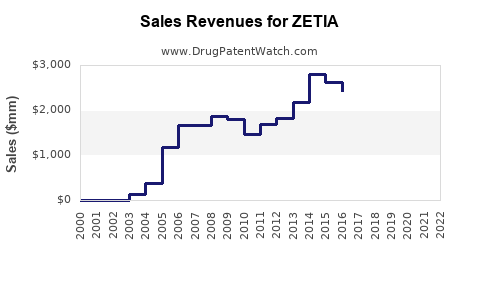
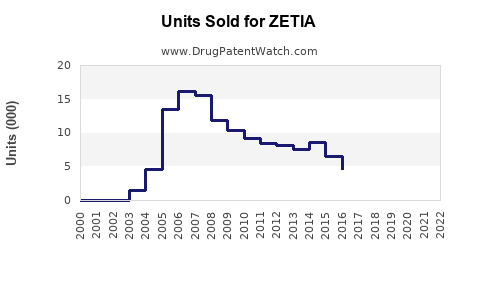
Annual Sales Revenues and Units Sold for ZETIA
| Drug Name | Revenues (USD) | Units | Year |
|---|---|---|---|
| ZETIA | ⤷ Start Trial | ⤷ Start Trial | 2022 |
| ZETIA | ⤷ Start Trial | ⤷ Start Trial | 2021 |
| ZETIA | ⤷ Start Trial | ⤷ Start Trial | 2020 |
| ZETIA | ⤷ Start Trial | ⤷ Start Trial | 2019 |
| ZETIA | ⤷ Start Trial | ⤷ Start Trial | 2018 |
| >Drug Name | >Revenues (USD) | >Units | >Year |
ZETIA Market Analysis and Sales Projections: Ezetimibe Revenue, Competition, Patents, and Generic Risk
ZETIA (ezetimibe) is a mature oral cholesterol-lowering product with broad clinical use, low manufacturing complexity, and substantial generic competition. The branded product lost U.S. composition-of-matter exclusivity in 2017, causing a sharp revenue decline. Its commercial value now depends on prescription volume, combination-product use, adherence, payer coverage, and international branded or authorized-generic sales.
The ezetimibe market remains resilient because the drug is inexpensive, guideline-supported, and commonly used with statins. Global annual sales of all ezetimibe products are likely to remain in the approximate range of $1.5 billion to $2.2 billion through 2028, with most value captured by generic manufacturers. Branded ZETIA revenue should continue to decline modestly in the United States, while combination products such as VYTORIN and ROSZET may support residual branded demand.
What is ZETIA and how large is the ezetimibe market?
ZETIA is the brand name for ezetimibe, an oral cholesterol-absorption inhibitor. It blocks the NPC1L1 transporter in the small intestine and lowers low-density lipoprotein cholesterol, or LDL-C. The FDA approved ZETIA as monotherapy in 2002 and later approved it with statins, including simvastatin in VYTORIN and atorvastatin in the ezetimibe/atorvastatin combination marketed in some jurisdictions.[1]
Ezetimibe is used in several patient groups:
- Patients who do not reach LDL-C targets on statin therapy.
- Patients who cannot tolerate high-intensity statins.
- Patients with familial hypercholesterolemia.
- Patients requiring additional LDL-C reduction before injectable therapies are considered.
- Patients for whom low-cost oral therapy is preferred.
Ezetimibe typically produces an additional LDL-C reduction of approximately 15% to 25% when added to statin therapy. It is less potent than PCSK9 inhibitors, inclisiran, or high-dose statins, but its oral administration and low generic price support high utilization.
Ezetimibe market structure
The market has four commercial segments:
| Segment | Examples | Commercial position |
|---|---|---|
| Generic ezetimibe | Teva, Sandoz, Dr. Reddy's, Accord, other manufacturers | Largest volume segment |
| Branded ZETIA | Organon in the United States and selected markets | Residual premium-priced demand |
| Statin combinations | VYTORIN, ezetimibe/atorvastatin, ezetimibe/rosuvastatin | Supports adherence and fixed-dose use |
| Non-ezetimibe alternatives | Repatha, Praluent, Leqvio, bempedoic acid | Higher-cost alternatives for selected patients |
Ezetimibe's volume base is larger than its revenue base because generic pricing has compressed substantially. Market-research estimates differ depending on whether they include combination products, hospital sales, and all geographic markets. Public company filings provide more reliable information for branded revenue than syndicated market reports.
What are the current ZETIA sales and revenue trends?
Merck historically reported ZETIA as part of its cardiovascular franchise. The product generated annual sales above $2 billion before generic entry, but revenue declined after the U.S. exclusivity period ended. Merck transferred ZETIA and other established products to Organon as part of the 2021 separation of its women's health, established brands, and biosimilars businesses.[2]
The commercial pattern was:
| Period | Market event | Revenue effect |
|---|---|---|
| 2002-2016 | U.S. branded exclusivity and broad physician adoption | High-margin branded sales |
| 2017 | Generic entry following loss of key U.S. patent protection | Rapid U.S. price and share erosion |
| 2018-2020 | Continued generic substitution | Lower branded revenue, persistent prescription volume |
| 2021 | Organon assumes the established-brands portfolio | Product becomes part of a mature-products strategy |
| 2022 onward | Stable demand with generic competition | Volume remains durable; price remains pressured |
Organon's established-brands portfolio includes products with long commercial histories and lower growth rates than its biosimilars or women's health products. ZETIA is strategically valuable as a cash-generating product, but it is no longer a high-growth pharmaceutical asset.[2]
How much revenue does branded ZETIA generate?
Exact current ZETIA revenue should be separated from total ezetimibe market sales. Organon reports product and portfolio information in its annual filings, but public disclosures may aggregate products or present sales by geographic region rather than provide a complete standalone global revenue series for every year.[2]
A reasonable market interpretation is:
- Pre-generic global ZETIA sales exceeded $2 billion annually.
- Post-2017 U.S. branded revenue declined sharply.
- Current branded ZETIA revenue is a fraction of the pre-generic peak.
- Total ezetimibe molecule revenue remains materially higher because generic prescriptions dominate unit volume.
- International branded sales may persist longer where generic substitution is slower or where local brands retain physician recognition.
What are the ZETIA sales projections through 2028?
The table below presents an analytical market forecast for total ezetimibe product revenue, including branded and generic products. It is not company guidance. It uses a scenario range because public companies do not disclose a single, comprehensive global forecast for all ezetimibe products.
| Year | Downside case | Base case | Upside case | Main driver |
|---|---|---|---|---|
| 2024 | $1.45B | $1.70B | $1.95B | Stable prescription volume |
| 2025 | $1.40B | $1.67B | $1.96B | Generic price erosion |
| 2026 | $1.34B | $1.64B | $1.98B | Combination-product adoption |
| 2027 | $1.28B | $1.61B | $2.00B | Cardiovascular treatment expansion |
| 2028 | $1.22B | $1.58B | $2.02B | Volume growth offsets price decline |
The base case assumes approximately flat to modestly declining total market revenue. Unit demand grows by roughly 1% to 3% annually, but average selling prices decline because of generic competition. The upside case assumes stronger use of combination therapy and continued expansion of LDL-C treatment among high-risk patients. The downside case assumes faster generic price compression and increased use of newer oral and injectable therapies.
Branded ZETIA revenue is expected to decline faster than the total molecule market. A base-case branded trajectory would be:
| Year | Estimated branded ZETIA direction |
|---|---|
| 2024 | Stable to down low single digits |
| 2025 | Down mid-single digits |
| 2026 | Down mid-single digits |
| 2027 | Down low to mid-single digits |
| 2028 | Down low single digits |
The largest risk is not volume displacement. It is the loss of branded price premium.
When does ZETIA lose exclusivity and patent protection?
ZETIA lost effective U.S. market exclusivity after the expiration of its principal compound patent. The key U.S. patent was U.S. Patent No. 5,767,115, covering ezetimibe-related composition matter. Public patent records identify an expiration date in 2017, subject to patent-term calculations and regulatory extensions.[3]
Key ZETIA exclusivity timeline
| Date | Event |
|---|---|
| 2002 | FDA approves ZETIA |
| 2004 | FDA approves ezetimibe/simvastatin, marketed as VYTORIN |
| 2016 | FDA approves multiple generic ezetimibe applications |
| April 2017 | Principal U.S. patent protection reaches its listed expiration period |
| 2017 | Generic ezetimibe launches in the United States |
| 2021 | Organon assumes the established-brands business from Merck |
The product's basic active-ingredient protection is therefore exhausted in the United States. Later patents may cover particular combinations, formulations, manufacturing processes, or methods of use, but these generally do not recreate broad exclusivity for standalone ezetimibe tablets.
What patents protect ZETIA, and how strong is the patent estate?
The strongest historical protection was the composition-of-matter patent covering ezetimibe. That protection supported the original branded franchise but is no longer a meaningful barrier to ordinary generic ezetimibe tablets.
The remaining patent estate is commercially weaker for several reasons:
- Generic manufacturers can market standalone ezetimibe after expiration of the core patent.
- Combination patents do not necessarily block generic monotherapy.
- Manufacturing patents may be designed around.
- Method-of-use claims face narrower infringement questions than composition claims.
- FDA approval of a generic product does not require the generic manufacturer to adopt every patented indication.
The patent estate is therefore weak against standard generic ezetimibe but may retain targeted value for specific combinations or delivery approaches.
What formulations are protected by ZETIA-related patents?
ZETIA is primarily an immediate-release oral tablet. Formulation protection may cover:
- Ezetimibe combined with simvastatin.
- Ezetimibe combined with atorvastatin or rosuvastatin.
- Specific excipient systems.
- Fixed-dose combinations intended to improve adherence.
- Manufacturing processes that improve purity, particle size, or stability.
These claims have less commercial reach than the original molecule patent. A generic manufacturer can often avoid a formulation claim by using a different excipient composition or manufacturing route, provided the resulting product meets FDA quality and bioequivalence requirements.
What is the FDA regulatory status and Orange Book position of ZETIA?
ZETIA was approved under a conventional new drug application, NDA 021445. It is an FDA-approved oral tablet for hypercholesterolemia and related lipid disorders. The FDA Orange Book historically listed patents associated with ZETIA and its approved indications, while generic applicants used abbreviated new drug applications, or ANDAs, to seek approval.[1,4]
The current regulatory profile is mature:
- FDA approval: established.
- Dosage form: oral tablet.
- Regulatory pathway for generics: ANDA.
- Bioequivalence requirement: required.
- Biosimilar pathway: not applicable.
- Pediatric exclusivity: historical extensions may have affected timing but do not restore current market exclusivity.
- Orange Book relevance: focused on listed patents and approved labeling, not on broad future protection.
ZETIA is a small-molecule drug. Biosimilar risk is therefore irrelevant. The competitive threat comes from generic drugs, authorized generics, and combination products.
Which companies are challenging ZETIA and competing in the market?
Generic competition includes major and regional manufacturers such as Teva, Sandoz, Dr. Reddy's, Accord Healthcare, Lupin, and other ANDA holders. The exact active supplier set changes by country and over time because manufacturers enter, exit, or sell portfolios.
Competition is based on:
- Contracting with wholesalers and pharmacy benefit managers.
- Reliable API supply.
- Manufacturing cost.
- Product availability.
- State substitution rules.
- Ability to supply multiple strengths and package sizes.
The main therapeutic competitors are not direct substitutes in every patient:
| Product class | Representative products | Competitive effect |
|---|---|---|
| High-intensity statins | Atorvastatin, rosuvastatin | Compete for first-line LDL-C lowering |
| PCSK9 antibodies | Repatha, Praluent | Compete in high-risk and refractory patients |
| siRNA therapy | Leqvio | Competes where long-interval dosing is preferred |
| ATP-citrate lyase inhibitor | Nexletol, Nexlizet | Competes in statin-intolerant patients |
| Ezetimibe combinations | VYTORIN and generic combinations | Strengthen adherence and combination use |
Ezetimibe remains advantaged on price and oral convenience. Injectable products have greater LDL-C potency but face access restrictions and higher payer scrutiny.
What generic entry risks exist for branded ZETIA?
The major generic-entry risk has already occurred. The remaining risks are commercial rather than legal:
- Continued substitution from branded ZETIA to generic ezetimibe.
- Wholesaler and payer pressure on net price.
- Loss of physician brand preference.
- Declining availability of branded product in formularies.
- Generic supply consolidation and price competition.
- Substitution toward ezetimibe-containing fixed-dose combinations.
The principal generic launch scenario is therefore a continuing erosion curve rather than a single future launch event. In the United States, additional generic entrants can reduce prices further, although the effect may be limited if the market already has multiple suppliers.
What patent litigation and Paragraph IV activity affect ZETIA?
ZETIA generic litigation was most relevant before the 2017 entry period. ANDA applicants commonly use Paragraph IV certifications to challenge listed patents, asserting that patents are invalid, unenforceable, or not infringed. Generic approvals and launches followed the expiration or resolution of key patent barriers.[4]
Current litigation risk is limited for standalone ZETIA because:
- The core composition patent has expired.
- Generic products have already entered the market.
- Remaining claims are narrower.
- Commercial damages from blocking a generic launch are lower than before patent expiry.
Potential disputes could still involve fixed-dose combinations, labeling, manufacturing processes, or specific formulation claims. Those disputes would not necessarily remove generic standalone ezetimibe from the market.
What licensing deals affect ZETIA commercialization?
The most important transaction was Merck's 2021 separation of established brands into Organon. This was a portfolio transfer rather than a conventional third-party licensing deal. Organon assumed commercial responsibility for a group of mature products, including ZETIA-related revenue streams in relevant markets.[2]
A separate licensing structure may exist in individual countries through local distributors or marketing partners. Those arrangements can affect reported revenue, but they do not materially change the global conclusion: ZETIA is a mature product whose value is driven by volume, supply reliability, and cost control.
How does ZETIA compare with newer LDL-lowering drugs?
ZETIA has lower potency than PCSK9 therapies but a substantially lower cost and simpler administration. Its clinical role is often incremental: it is added to a statin rather than replacing the entire lipid-lowering regimen.
| Metric | ZETIA/ezetimibe | PCSK9 therapy | Inclisiran | Bempedoic acid |
|---|---|---|---|---|
| Administration | Daily oral | Injection every 2-4 weeks | Infrequent injection | Daily oral |
| Price position | Very low after generic entry | High | High | Intermediate |
| LDL-C potency | Moderate | High | High | Moderate |
| Generic competition | Extensive | Limited or absent | Absent | Limited |
| Access | Broad | Prior authorization common | Prior authorization common | Expanding |
| Primary commercial role | Add-on or statin alternative | High-risk refractory disease | Durable dosing and adherence | Statin intolerance |
ZETIA's persistence reflects economics more than product novelty. It is often used before a patient qualifies for or receives a more expensive therapy.
What is the outlook for ZETIA revenue and commercial value?
ZETIA's commercial outlook is stable but defensive. Total ezetimibe volume should remain durable because cardiovascular disease prevalence is high, treatment guidelines support combination therapy, and generic pricing expands access. Branded revenue should continue to decline unless Organon or a partner obtains a meaningful price premium in markets with limited substitution.
The asset's value is strongest in:
- Low-cost chronic therapy portfolios.
- Emerging markets with growing cardiovascular treatment.
- Combination products that improve adherence.
- Distribution platforms with efficient generic and branded supply.
- Payer systems that prioritize oral low-cost treatment.
The asset's value is weakest in:
- U.S. branded sales dependent on formulary preference.
- Markets with aggressive automatic substitution.
- Strategies requiring new composition-of-matter exclusivity.
- Premium pricing without clinical differentiation.
Generic launch scenarios
The most probable scenario is continued generic dominance with low-single-digit volume growth and annual price erosion. A more favorable scenario would involve increased treatment of high-risk patients and greater use of ezetimibe in combination therapy. The downside scenario would involve faster adoption of newer oral therapies and broader payer access to injectable LDL-lowering drugs.
Key Takeaways
- ZETIA is a mature ezetimibe brand with broad clinical use and limited remaining U.S. patent leverage.
- The principal U.S. compound patent expired in 2017, enabling generic entry.
- Generic ezetimibe captures most market volume and an increasing share of total revenue.
- Branded ZETIA revenue is expected to decline gradually through 2028.
- Total global ezetimibe revenue is likely to remain broadly stable, with a base-case range near $1.6 billion to $1.7 billion annually through 2028.
- Generic competition, not biosimilar competition, is the central market risk.
- Combination products and adherence-focused prescribing are the main sources of commercial resilience.
- Organon's ZETIA exposure is strategically defensive: dependable volume, low growth, and continuing price pressure.
- Remaining formulation, method-of-use, and manufacturing patents are narrower than the expired composition protection.
- The strongest investment case is tied to molecule volume and portfolio efficiency, not branded price expansion.
FAQs About ZETIA Sales, Patents, and Market Competition
Is ZETIA still protected by patents?
The principal U.S. composition protection for ezetimibe expired in 2017. Narrower patents may cover selected combinations, formulations, or manufacturing methods, but they do not provide broad protection against standalone generic ezetimibe.
Is ZETIA a biologic or a biosimilar product?
No. ZETIA is a small-molecule drug. It is approved through an NDA, and competing products are approved as generic drugs through ANDAs rather than through the biosimilar pathway.
Who owns the ZETIA brand?
Organon assumed the relevant established-brands business from Merck in 2021. Ownership and commercialization rights can differ by country because local distribution and licensing arrangements may apply.
Will generic ezetimibe eliminate ZETIA sales?
Generic products have sharply reduced branded sales but have not eliminated them. Brand demand can persist among patients, physicians, and payers that prefer the branded product or in countries where substitution is less aggressive.
What is the biggest long-term threat to ezetimibe revenue?
The primary threat is cumulative price erosion from generic competition. Therapeutic substitution by bempedoic acid, PCSK9 inhibitors, inclisiran, and other LDL-lowering products is a secondary risk, particularly in high-risk or statin-intolerant populations.
References
- U.S. Food and Drug Administration. (2024). ZETIA (ezetimibe) prescribing information and regulatory history. https://www.fda.gov
- Organon & Co. (2024). 2023 annual report. https://www.organon.com/investors/financial-information/annual-reports/
- United States Patent and Trademark Office. (2024). Patent No. 5,767,115 patent records. https://patents.google.com/patent/US5767115
- U.S. Food and Drug Administration. (2024). Approved drug products with therapeutic equivalence evaluations, Orange Book. https://www.fda.gov/drugs/drug-approvals-and-databases/orange-book-data-files-agreement-disclaimer-and-copyright-notice
More… ↓
