Share This Page
Drug Sales Trends for PAMELOR
✉ Email this page to a colleague
Payment Methods and Pharmacy Types for PAMELOR (2008)
Revenues by Pharmacy Type
Units Sold by Pharmacy Type
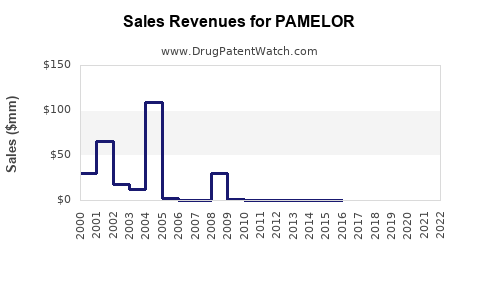
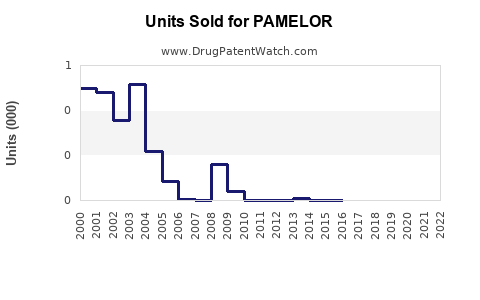
Annual Sales Revenues and Units Sold for PAMELOR
| Drug Name | Revenues (USD) | Units | Year |
|---|---|---|---|
| PAMELOR | ⤷ Start Trial | ⤷ Start Trial | 2022 |
| PAMELOR | ⤷ Start Trial | ⤷ Start Trial | 2021 |
| PAMELOR | ⤷ Start Trial | ⤷ Start Trial | 2020 |
| PAMELOR | ⤷ Start Trial | ⤷ Start Trial | 2019 |
| PAMELOR | ⤷ Start Trial | ⤷ Start Trial | 2018 |
| PAMELOR | ⤷ Start Trial | ⤷ Start Trial | 2017 |
| >Drug Name | >Revenues (USD) | >Units | >Year |
Pamelor Market Analysis, Patent Status, Competitive Landscape, and Sales Projections
Pamelor is the legacy brand of nortriptyline hydrochloride, a tricyclic antidepressant approved for depressive illness. Its commercial position is mature and largely generic. The brand has no meaningful patent moat, faces broad substitution from generic nortriptyline capsules and oral solution, and has limited public revenue disclosure. Future sales depend on residual brand prescribing, pharmacy substitution, supply reliability, and demand for low-cost antidepressants rather than on innovation or exclusivity.
A reasonable U.S. base-case projection places annual Pamelor-branded revenue below $5 million, with the broader nortriptyline market likely several times larger. Generic nortriptyline will capture almost all prescription volume.
What is Pamelor and how is it used?
Pamelor contains nortriptyline hydrochloride, a secondary-amine tricyclic antidepressant. The FDA labeling identifies depression as the approved indication. Clinicians also prescribe nortriptyline off label for neuropathic pain, migraine prevention, sleep-related conditions, and functional gastrointestinal disorders, although these uses do not create additional FDA exclusivity for Pamelor.[1]
| Attribute | Pamelor |
|---|---|
| Active ingredient | Nortriptyline hydrochloride |
| Chemical form | Nortriptyline hydrochloride |
| Drug class | Tricyclic antidepressant |
| FDA indication | Depression |
| Common dosage forms | 10 mg, 25 mg, 50 mg, and 75 mg capsules; oral solution products are also marketed generically |
| Administration | Oral |
| Prescription status | Prescription-only |
| Controlled-substance status | Not listed as a controlled substance under the federal Controlled Substances Act |
| Primary competitors | Generic nortriptyline, amitriptyline, desipramine, imipramine, duloxetine, venlafaxine, and other antidepressants |
| Regulatory pathway | Legacy NDA, with extensive generic competition |
Nortriptyline is prescribed less frequently than selective serotonin reuptake inhibitors and serotonin-norepinephrine reuptake inhibitors. Its use persists because of low generic cost, clinician familiarity, utility in selected patients, and a role in patients who do not tolerate newer antidepressants.
When did Pamelor lose exclusivity?
Pamelor’s core composition and product exclusivity expired decades ago. The product is not commercially protected by a current compound patent or meaningful regulatory exclusivity period.
The original nortriptyline approval predates the modern Hatch-Waxman patent system. Any original patent protection would have expired long before the current generic market developed. Current Orange Book analysis is therefore relevant mainly for identifying whether any enforceable, listed Pamelor patents remain, not for evaluating an impending loss of exclusivity.[2]
| Exclusivity category | Pamelor status |
|---|---|
| New chemical entity exclusivity | Expired |
| Core composition patent | Expired |
| Current Orange Book patent barrier | No material barrier identified |
| Pediatric exclusivity | Not commercially relevant |
| Orphan exclusivity | None |
| Reference-product exclusivity | Expired |
| Generic substitution | Widely available |
No upcoming Pamelor patent cliff is expected because the commercial product is already in the post-exclusivity phase.
What is the Orange Book status of Pamelor?
The Orange Book identifies FDA-approved products and associated patent or exclusivity information. For a legacy product such as Pamelor, the commercial issue is not whether a new generic entrant must wait for a patent expiration date. Generic nortriptyline products have been available for many years.
The principal Orange Book implications are:
- Pamelor is a legacy reference product.
- Generic nortriptyline products can compete through abbreviated new drug applications.
- There is no evident active formulation, method-of-use, or manufacturing patent that supports a premium branded position.
- Any current brand sales are exposed to pharmacy-level substitution and insurer preference for generic products.
The absence of a meaningful patent estate makes Paragraph IV litigation unlikely. Generic applicants have no commercial reason to challenge an expired patent portfolio when the product already has a long-established generic market.
How many patents protect Pamelor?
No meaningful active patent estate protects the core Pamelor product.
Composition patents
The composition protection for nortriptyline is expired. The molecule is an established active pharmaceutical ingredient with a long history of generic manufacture.
Formulation patents
No commercially important, enforceable formulation patent is associated with conventional Pamelor capsules. Generic products generally use standard immediate-release capsule formulations.
Method-of-use patents
No Pamelor-specific method-of-use patent is expected to restrict common generic use. Off-label prescribing does not create enforceable market protection for the brand.
Manufacturing patents
Nortriptyline manufacturing processes are unlikely to create a practical barrier. The active ingredient is a mature small molecule, and multiple manufacturers can source or produce it. Process patents, where present, would not ordinarily prevent generic supply of the finished product if alternative processes are available.
What is the competitive landscape for Pamelor?
Pamelor competes in two markets: the narrow nortriptyline market and the broader antidepressant market.
| Competitive segment | Key products | Competitive effect |
|---|---|---|
| Direct generic competition | Nortriptyline capsules and oral solution | Highest substitution risk |
| Older tricyclics | Amitriptyline, desipramine, imipramine | Compete on physician familiarity and indication |
| SNRIs | Duloxetine, venlafaxine, desvenlafaxine | Compete in depression and neuropathic pain |
| SSRIs | Sertraline, fluoxetine, escitalopram, citalopram | Dominate first-line depression treatment |
| Neuropathic-pain products | Gabapentin, pregabalin, duloxetine | Reduce nortriptyline use in pain |
| Migraine therapies | Topiramate, beta blockers, CGRP products | Reduce off-label use in migraine prevention |
Pamelor’s main advantage is cost and familiarity. Its principal disadvantages are anticholinergic effects, sedation, cardiovascular risk, overdose toxicity, and a less favorable tolerability profile than newer antidepressants. The FDA label warns about cardiac effects, orthostatic hypotension, seizures, and the risks associated with tricyclic overdose.[1]
What is the FDA regulatory status of Pamelor?
Pamelor is an FDA-approved legacy product. The active ingredient is established, and generic nortriptyline products are approved under the abbreviated new drug application pathway.
The regulatory profile is commercially unfavorable for the brand:
- No new clinical efficacy program is needed for generic entry.
- Generic applicants can rely on the reference product’s safety and efficacy findings.
- Bioequivalence, chemistry, manufacturing, and labeling requirements remain applicable.
- The product does not have biologic complexity.
- No biosimilar pathway is involved.
Does Pamelor face biosimilar risk?
No. Pamelor is a chemically synthesized small molecule, not a biologic. Biosimilar competition is irrelevant. The appropriate competitive framework is generic substitution under Hatch-Waxman.
Which companies are challenging Pamelor?
The market challenge comes primarily from generic manufacturers rather than from a single litigation campaign. Depending on market conditions and supply contracts, generic nortriptyline may be supplied by companies such as:
- Teva Pharmaceuticals
- Viatris
- Sun Pharmaceutical Industries
- Rising Pharmaceuticals
- Upsher-Smith Laboratories
- Hikma Pharmaceuticals
- Zydus Pharmaceuticals
- other approved U.S. generic suppliers
Supplier participation can change because of product discontinuations, manufacturing economics, shortage conditions, or portfolio rationalization. A company’s presence in historical FDA records does not establish current commercial supply.
No major active Paragraph IV dispute is central to Pamelor’s market position. The product’s commercial risk is substitution, not patent litigation.
What patent litigation affects Pamelor?
No material current patent litigation is associated with Pamelor’s core product. The absence of litigation is consistent with the product’s age, the expiration of foundational rights, and the availability of generic products.
| Litigation issue | Current commercial relevance |
|---|---|
| Paragraph IV challenge | Low |
| Hatch-Waxman litigation | No material active case identified |
| Formulation patent dispute | Low |
| Method-of-use litigation | Low |
| Manufacturing patent dispute | Low |
| Brand-generic settlement | No major current settlement appears to shape the market |
| Antitrust exposure | Low relative to protected branded drugs |
The lack of litigation does not indicate commercial strength. It indicates that the market is already open.
What are Pamelor sales and revenue exposure?
Standalone Pamelor sales are not generally reported in public filings by major pharmaceutical companies. The brand is a small legacy product, and any revenue is usually embedded within broader established-products or generic portfolios.
A useful commercial distinction is:
- Pamelor brand revenue: limited and declining or flat.
- Generic nortriptyline revenue: larger than branded revenue but still modest in the overall antidepressant market.
- Nortriptyline clinical value: higher than its direct sales value because it remains useful in selected patients.
- Strategic value: low for a conventional branded-drug investor; potentially relevant for a low-cost generic supplier with reliable manufacturing.
Revenue exposure by market
| Market | Exposure to Pamelor |
|---|---|
| U.S. branded Pamelor | Low |
| U.S. generic nortriptyline | Moderate within the molecule, low within antidepressants |
| International brand markets | Variable and generally limited |
| Hospital and institutional purchasing | Price-sensitive |
| Retail pharmacy | Highly substitution-driven |
| Specialty pharmacy | Minimal |
| Biologic or biosimilar market | None |
What are the sales projections for Pamelor?
The following projection is a scenario model rather than a reported company forecast. It separates branded Pamelor from the broader generic nortriptyline market.
U.S. Pamelor brand revenue projection
| Year | Bear case | Base case | Upside case |
|---|---|---|---|
| 2025 | $1.0 million | $2.5 million | $4.0 million |
| 2026 | $0.8 million | $2.3 million | $3.9 million |
| 2027 | $0.6 million | $2.1 million | $3.8 million |
| 2028 | $0.5 million | $1.9 million | $3.7 million |
| 2029 | $0.4 million | $1.7 million | $3.6 million |
The base case assumes continued generic substitution, limited active promotion, stable clinical use, and no meaningful brand relaunch. The upside case requires unusual conditions, such as generic supply disruption, a niche cash-pay strategy, or a new distributor willing to maintain brand availability.
U.S. nortriptyline market projection
| Year | Estimated market range |
|---|---|
| 2025 | $15 million-$35 million |
| 2026 | $15 million-$36 million |
| 2027 | $15 million-$37 million |
| 2028 | $15 million-$38 million |
| 2029 | $15 million-$39 million |
The broader market can remain stable even while Pamelor brand revenue falls. Generic prices are low, prescription volume is relatively mature, and selected off-label uses provide a floor. Inflation and supply constraints can raise market revenue without increasing patient volume.
What generic launch risks exist for Pamelor?
Generic launch risk is already realized rather than imminent. The relevant scenario is further generic entry or aggressive price competition.
Downside factors
- Additional suppliers can reduce average selling prices.
- Pharmacy benefit managers can increase substitution.
- Clinicians can choose newer antidepressants.
- Safety concerns can reduce use in older adults.
- Manufacturers may discontinue low-margin strengths.
- A shortage of one supplier can shift demand to another without benefiting the brand.
Stabilizing factors
- Low acquisition cost supports continued use.
- Nortriptyline remains clinically useful in selected patients.
- Generic entry does not eliminate prescription demand.
- Older products can retain stable institutional and specialist use.
- Several dosage strengths support titration and individualized treatment.
How strong is the Pamelor patent estate?
Pamelor has a weak patent estate for investment and licensing purposes.
| Patent-strength factor | Assessment |
|---|---|
| Remaining compound life | None of commercial significance |
| Formulation protection | Weak or absent |
| Method-of-use protection | Weak or absent |
| Manufacturing barriers | Low |
| Generic substitution resistance | Very low |
| Litigation leverage | Very low |
| Repricing potential | Low |
| Licensing value | Low unless tied to distribution or supply |
Any commercial opportunity would need to come from manufacturing efficiency, reliable supply, contract distribution, geographic access, or a differentiated delivery system. A conventional Pamelor relaunch would not have a defensible premium-price basis.
What licensing deals affect Pamelor?
No major recent licensing transaction is central to Pamelor’s market outlook. Legacy brands can move between pharmaceutical distributors or portfolio owners, but those transactions generally transfer an existing product rather than create new exclusivity.
A commercially rational licensing strategy would focus on:
- Regional distribution rights.
- Institutional supply contracts.
- Authorized generic arrangements.
- Multi-product CNS portfolios.
- Oral-solution manufacturing.
- Supply continuity for hard-to-source dosage strengths.
A license covering the conventional capsule product alone would have limited value unless the transaction included manufacturing scale or guaranteed distribution.
What is the geographic coverage of Pamelor?
Nortriptyline is available in multiple international markets, but the Pamelor brand name and supplier differ by jurisdiction. Generic availability is broad in developed markets. Brand economics are generally stronger in countries with limited generic substitution, while volume is more generic-driven in the United States and major European markets.
| Region | Commercial outlook |
|---|---|
| United States | Mature generic market; minimal brand leverage |
| Europe | Generic competition and national reimbursement controls |
| Canada | Generic substitution; limited brand premium |
| Japan | Established antidepressant market with local product dynamics |
| Latin America | Brand and generic coexistence varies by country |
| Asia-Pacific | Broad generic access; pricing and registration vary |
| Emerging markets | Potential volume, limited premium pricing |
Key Takeaways
- Pamelor is the legacy brand of nortriptyline hydrochloride.
- Core patent and regulatory exclusivity expired long ago.
- Generic nortriptyline is the primary commercial product.
- No material current patent litigation or Paragraph IV threat defines the market.
- Biosimilar risk is irrelevant because nortriptyline is a small molecule.
- U.S. Pamelor brand revenue is likely below $5 million annually.
- Base-case branded revenue declines from approximately $2.5 million in 2025 to $1.7 million in 2029.
- The broader U.S. nortriptyline market may remain in the $15 million-$39 million annual range through 2029.
- The product has low licensing value unless bundled with manufacturing, distribution, or supply rights.
- Investment exposure is driven by generic margins and supply reliability, not patent protection.
FAQs
Is Pamelor still available in the United States?
Generic nortriptyline is broadly available. Availability of the Pamelor-branded product can vary by manufacturer, distributor, dosage strength, and pharmacy inventory.
Can a generic manufacturer launch nortriptyline without a Paragraph IV challenge?
Yes. Because the relevant original exclusivity and patent barriers have expired, a generic manufacturer does not need to rely on a new Paragraph IV challenge to enter the established market.
Does Pamelor have pediatric exclusivity?
No commercially meaningful pediatric exclusivity period protects the legacy product.
Is nortriptyline a high-growth pharmaceutical market?
No. Nortriptyline is a mature, low-growth market. Revenue stability depends on prescription persistence and generic supply rather than expanding treatment adoption.
Could a new Pamelor formulation create market exclusivity?
A new formulation could potentially receive patent protection if it produced a novel, non-obvious and clinically differentiated product. That protection would apply to the new formulation, not automatically to conventional Pamelor capsules or generic nortriptyline.
References
-
U.S. Food and Drug Administration. (n.d.). Pamelor (nortriptyline hydrochloride) capsule prescribing information. DailyMed.
-
U.S. Food and Drug Administration. (2025). Approved drug products with therapeutic equivalence evaluations: Orange Book. FDA.
More… ↓
