Share This Page
Drug Sales Trends for MONTELUKAST
✉ Email this page to a colleague
Payment Methods and Pharmacy Types for MONTELUKAST (2008)
Revenues by Pharmacy Type
Units Sold by Pharmacy Type
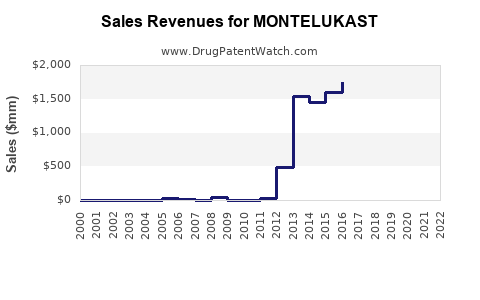
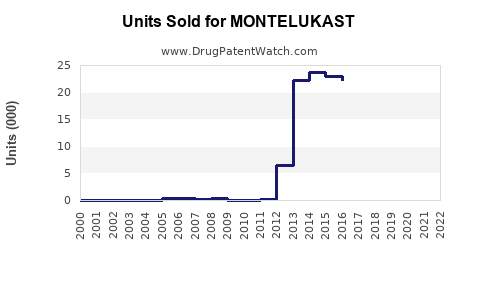
Annual Sales Revenues and Units Sold for MONTELUKAST
| Drug Name | Revenues (USD) | Units | Year |
|---|---|---|---|
| MONTELUKAST | ⤷ Start Trial | ⤷ Start Trial | 2022 |
| MONTELUKAST | ⤷ Start Trial | ⤷ Start Trial | 2021 |
| MONTELUKAST | ⤷ Start Trial | ⤷ Start Trial | 2020 |
| MONTELUKAST | ⤷ Start Trial | ⤷ Start Trial | 2019 |
| MONTELUKAST | ⤷ Start Trial | ⤷ Start Trial | 2018 |
| MONTELUKAST | ⤷ Start Trial | ⤷ Start Trial | 2017 |
| MONTELUKAST | ⤷ Start Trial | ⤷ Start Trial | 2016 |
| >Drug Name | >Revenues (USD) | >Units | >Year |
Montelukast Market Analysis, Sales Projections, Patent Expiry and Generic Competition
Montelukast is a mature, low-cost leukotriene receptor antagonist with substantial global volume but limited brand pricing power. The original Singulair franchise generated roughly $5 billion in annual sales before U.S. generic entry. Current commercial value is distributed across generic tablets, chewable tablets, oral granules and branded or private-label products. A base-case market model projects global montelukast sales rising from approximately $1.5 billion in 2024 to $1.9 billion by 2030, representing a compound annual growth rate of about 4%.
The principal growth drivers are asthma prevalence, pediatric use, expanded diagnosis in emerging markets and combination treatment with inhaled corticosteroids. Price erosion, generic substitution, safety-related prescribing restrictions in allergic rhinitis and competition from inhaled therapies limit revenue growth.
What is the current market size for montelukast?
Public market estimates vary because some reports count only finished-dose products while others include active pharmaceutical ingredient sales, hospital procurement and combination products. A practical global estimate for 2024 is approximately $1.4 billion to $1.6 billion in finished-dose montelukast revenue.
| Metric | 2024 estimate | 2030 base case | 2024-2030 CAGR |
|---|---|---|---|
| Global montelukast finished-dose market | $1.4-$1.6 billion | $1.8-$2.0 billion | 3.5%-5.0% |
| Base-case modeled market | $1.5 billion | $1.9 billion | 4.0% |
| U.S. market | $350-$450 million | $400-$500 million | 1%-3% |
| Europe | $300-$400 million | $330-$430 million | 1%-2% |
| Asia-Pacific | $500-$600 million | $750-$850 million | 6%-8% |
| Latin America, Middle East and Africa | $200-$300 million | $300-$350 million | 4%-6% |
These figures are market estimates rather than manufacturer guidance. The commercial market is fragmented across generic manufacturers, national pharmaceutical companies and distributors.
Which products generate montelukast revenue?
Montelukast is marketed primarily in four dosage forms:
- 10 mg tablets for adults and adolescents.
- 5 mg chewable tablets for children.
- 4 mg chewable tablets for younger children.
- 4 mg oral granules for pediatric patients.
Combination products containing montelukast and levocetirizine or other allergy medicines add volume in some markets, although they should not always be included in a pure montelukast market calculation.
Asthma remains the most defensible core indication. Allergic rhinitis contributes substantial demand, but the U.S. Food and Drug Administration requires a boxed warning for serious neuropsychiatric events and recommends reserving montelukast for allergic rhinitis patients who do not respond adequately to or cannot tolerate alternatives.[1]
How are montelukast sales expected to develop through 2030?
The base case assumes low-single-digit volume growth, continued generic price pressure and modest expansion in emerging markets.
| Year | Global market estimate | Growth assumption |
|---|---|---|
| 2024 | $1.50 billion | Base year |
| 2025 | $1.56 billion | 4.0% |
| 2026 | $1.62 billion | 4.0% |
| 2027 | $1.69 billion | 4.0% |
| 2028 | $1.76 billion | 4.0% |
| 2029 | $1.83 billion | 4.0% |
| 2030 | $1.90 billion | 4.0% |
What are the bull, base and bear projections?
| Scenario | 2030 market | Implied CAGR | Main assumptions |
|---|---|---|---|
| Bear | $1.55 billion | 0.5% | Faster substitution by inhaled therapies, sharper price erosion and weak emerging-market growth |
| Base | $1.90 billion | 4.0% | Stable asthma volume, moderate pediatric growth and continued Asia-Pacific expansion |
| Bull | $2.25 billion | 7.0% | Higher diagnosis rates, improved access in developing markets and sustained pediatric demand |
The most likely outcome is volume growth with flat or declining average selling prices in highly genericized markets. Revenue growth will depend more on geographic mix and dosage-form expansion than on price increases.
What were Singulair’s historical sales?
Singulair was developed and commercialized by Merck. It became one of the company’s largest products before patent expiration.
| Year | Approximate Singulair sales | Commercial event |
|---|---|---|
| 2010 | About $4.0 billion | Mature branded franchise |
| 2011 | About $4.5-$5.0 billion | Peak-period sales |
| 2012 | About $3.8-$4.0 billion | U.S. generic entry |
| 2013 | About $1.0-$1.3 billion | Broad erosion after loss of exclusivity |
| 2014 onward | Materially lower | Generic market established |
Merck reported that Singulair sales declined sharply after U.S. exclusivity ended. The fall illustrates the difference between the historic branded franchise and the current market: montelukast retains high patient demand, but the value has transferred from the originator to generic manufacturers and payers.[2]
When did montelukast lose patent exclusivity?
The core U.S. montelukast patent was U.S. Patent No. 5,565,473, assigned to Merck and directed to montelukast and related compounds. The patent expired in 2012 after applicable term adjustments and pediatric exclusivity were considered.
| Milestone | Timing |
|---|---|
| U.S. approval of Singulair | 1998 |
| Core compound patent | U.S. Patent No. 5,565,473 |
| First U.S. generic approvals | 2007 onward for selected dosage forms |
| Broad commercial generic impact | 2012 |
| Pediatric exclusivity period | Extended effective exclusivity into August 2012 |
| Current status | Generic market; no meaningful originator exclusivity |
The exact commercial date differed by dosage form and applicant. Generic launch timing also reflected court settlements, ANDA approvals and market-specific agreements.
What patents protect montelukast today?
The principal compound protection has expired. Remaining intellectual-property value is generally limited to:
- Formulation and dosage-form claims.
- Manufacturing processes and intermediates.
- Combination products.
- Country-specific secondary patents.
- Regulatory exclusivities or trademarks, where applicable.
These rights are materially weaker than the original compound patent. Generic manufacturers can usually compete through alternative formulations, independent manufacturing routes or non-infringing processes.
What is the Orange Book status of montelukast?
The FDA Orange Book historically listed Singulair-related patents covering the active ingredient and specific dosage forms. The core patent has expired, and montelukast is now widely available through approved ANDAs.
The practical Orange Book position is:
| Issue | Status |
|---|---|
| Listed reference drug | Singulair and related Merck products |
| Core compound patent | Expired |
| Generic ANDAs | Numerous approvals |
| Paragraph IV relevance | Primarily historical |
| Current blocking patent | None of broad commercial significance |
| Brand-generic substitution | Established in the U.S. |
Paragraph IV certifications were commercially important before generic entry. Applicants challenged listed patents or sought approval based on non-infringement, invalidity or expiration. The resulting generic competition eliminated the originator’s ability to preserve monopoly pricing.
Which companies compete in the montelukast market?
The competitive field includes multinational generic manufacturers, regional pharmaceutical companies and local distributors. Company participation differs by country, and market share is often dispersed.
Major competitive groups
- Teva Pharmaceutical Industries.
- Sandoz.
- Viatris and legacy Mylan operations.
- Dr. Reddy’s Laboratories.
- Cipla.
- Sun Pharmaceutical Industries.
- Lupin.
- Zydus Lifesciences.
- Torrent Pharmaceuticals.
- Hikma Pharmaceuticals.
- Regional manufacturers in China, India, Latin America and Southeast Asia.
- Merck, through residual Singulair and branded channel sales.
Competitive advantage is usually based on manufacturing cost, regulatory coverage, distribution access and tender participation. Brand recognition has less value than it had before 2012.
What formulations are protected by montelukast patents?
Montelukast formulation differentiation is concentrated in pediatric and adherence-oriented products.
Chewable tablets
Five-milligram and four-milligram chewable tablets are important in pediatric asthma and allergic rhinitis. Manufacturers compete on taste, excipient profile, tablet stability and procurement price.
Oral granules
Oral granules address younger children and patients who cannot swallow tablets. Granules may have higher manufacturing and packaging complexity than standard tablets, but they remain vulnerable to generic substitution once regulatory requirements are met.
Ten-milligram tablets
The 10 mg tablet is the most commoditized form. It has broad generic availability and limited scope for durable price premiums.
Combination products
Montelukast combinations can generate higher revenue per prescription than single-agent products, but their patent position depends on the specific combination, jurisdiction and formulation. Combination products also face clinical competition from inhaled corticosteroid and long-acting bronchodilator regimens.
What is the FDA regulatory status of montelukast?
Montelukast is FDA-approved for:
- Prophylaxis and chronic treatment of asthma.
- Prevention of exercise-induced bronchoconstriction.
- Relief of seasonal allergic rhinitis.
- Relief of perennial allergic rhinitis.
The 2020 FDA boxed warning addressed serious neuropsychiatric events, including agitation, depression, sleep disturbance and suicidal thoughts or actions. FDA advised against using montelukast for mild allergic rhinitis when alternative therapies are effective.[1]
The warning creates commercial pressure in allergy treatment but has less effect on patients who use montelukast for asthma control or exercise-induced bronchoconstriction.
How strong is the montelukast patent estate?
The current patent estate is weak from a market-exclusivity perspective.
| Patent factor | Assessment |
|---|---|
| Core compound protection | Expired |
| Formulation protection | Narrow and generally avoidable |
| Manufacturing protection | Potentially relevant at supplier level |
| Method-of-use protection | Limited commercial blocking power |
| Regulatory exclusivity | Expired |
| Generic substitution risk | Very high |
| Biosimilar risk | Not applicable |
Montelukast is a small-molecule drug, not a biologic. Biosimilar risk is therefore not relevant. The relevant competitive threat is conventional ANDA-based generic substitution.
What generic launch risks exist for montelukast?
Generic launch risk is already realized in the U.S. and other major markets. The remaining commercial risks concern further erosion and channel competition.
U.S. risks
The U.S. market has broad generic availability, high pharmacy substitution and payer pressure. Additional entrants may reduce prices further, although the impact is limited if the market is already near commodity pricing.
Europe
European markets rely heavily on national reimbursement systems, tendering and reference pricing. Prices are generally lower than historical U.S. brand pricing, while country-specific reimbursement can affect market access.
Asia-Pacific
Asia-Pacific offers the strongest growth potential because of population scale, improving diagnosis and expanding pharmaceutical access. It also has intense price competition and significant local-manufacturer participation.
Emerging markets
Local registration, distributor networks and public procurement are critical. Manufacturing costs and regulatory execution often matter more than patent ownership.
What licensing deals affect montelukast?
Montelukast’s principal historical commercial arrangement was Merck’s internal development and global commercialization of Singulair. The current generic market does not depend on a major active licensing structure. Regional licensing, distribution and contract manufacturing agreements may exist, but they are generally not material to the global market thesis.
The absence of a meaningful current licensing moat increases the importance of:
- Local marketing authorizations.
- Contract manufacturing capacity.
- API sourcing.
- Government tenders.
- Pharmacy and wholesaler relationships.
What litigation affects montelukast?
The main litigation cycle occurred before and around generic entry. Disputes focused on:
- Validity of the core montelukast patent.
- Non-infringement by generic applicants.
- Paragraph IV ANDA certifications.
- Launch timing.
- Pediatric exclusivity.
- Dosage-form and formulation claims.
There is no current litigation barrier comparable to the original compound patent. Future disputes are more likely to involve supply contracts, trademarks, manufacturing quality, regulatory compliance or narrower formulation rights than market-wide exclusivity.
How does montelukast compare with competing asthma drugs?
Montelukast is commercially positioned below inhaled corticosteroids and combination inhalers in many treatment guidelines, but it remains attractive because it is oral, familiar, inexpensive and easy to administer.
| Product class | Competitive position versus montelukast |
|---|---|
| Inhaled corticosteroids | Stronger guideline position for persistent asthma |
| ICS/LABA combinations | Higher clinical and commercial intensity; stronger control for many patients |
| Long-acting bronchodilators | Used in defined asthma and COPD regimens |
| Antihistamines | Important alternatives in allergic rhinitis |
| Biologics | Higher-cost options for severe asthma |
| Montelukast | Low-cost oral option with pediatric and exercise-induced use |
Montelukast’s durable commercial niche is convenience and low cost. Its weaker position is the availability of more effective inhaled therapies for many asthma patients and non-leukotriene treatments for allergic rhinitis.
What is the investment outlook for montelukast?
Montelukast is an attractive volume product but a weak branded investment opportunity. The market has:
- High prescription familiarity.
- Broad generic demand.
- Low development risk.
- Limited patent protection.
- Low pricing power.
- Moderate emerging-market growth.
- Minimal opportunity for a new originator franchise.
For generic manufacturers, the product can be commercially useful when combined with efficient API sourcing, pediatric dosage-form capability and broad geographic registration. For investors, revenue quality depends on supply-chain position and manufacturing scale rather than intellectual-property ownership.
Key Takeaways
- Global montelukast sales are estimated at approximately $1.5 billion in 2024.
- A base-case forecast reaches about $1.9 billion by 2030, with a 4% CAGR.
- Singulair generated roughly $5 billion in peak annual sales before U.S. generic erosion.
- The core U.S. patent, U.S. Patent No. 5,565,473, expired in 2012.
- Generic competition is established across major markets.
- The strongest growth opportunity is in Asia-Pacific and other emerging markets.
- The main commercial risks are price erosion, inhaled-therapy substitution and the FDA neuropsychiatric boxed warning.
- Biosimilar risk does not apply because montelukast is a small-molecule drug.
- Current value lies in manufacturing efficiency, regulatory reach and distribution rather than patent exclusivity.
FAQs
Is montelukast still commercially profitable for generic manufacturers?
Yes. Profitability depends on production scale, API cost, tender access and market concentration. U.S. margins are generally compressed, while selected emerging markets may offer better growth and pricing.
Will montelukast sales decline after the FDA boxed warning?
The warning is likely to reduce use in mild allergic rhinitis, but asthma, exercise-induced bronchoconstriction and pediatric demand support continued volume. The effect is more significant on prescribing mix than on complete market displacement.
Does montelukast have any remaining blocking patents?
No broad, market-blocking compound patent remains in force in the United States. Narrow formulation, process or combination patents may exist in specific jurisdictions.
Can a new montelukast formulation command premium pricing?
Only in limited circumstances. Pediatric granules, taste improvements, fixed-dose combinations or adherence-focused packaging can support differentiation, but generic substitution and reimbursement controls constrain sustained premiums.
What is the largest growth region for montelukast through 2030?
Asia-Pacific is the leading growth region because of population size, expanding diagnosis, rising healthcare access and continued use of oral asthma medicines. Price competition will limit the translation of volume growth into revenue growth.
References
-
U.S. Food and Drug Administration. (2020). FDA requires boxed warning about serious mental health side effects for asthma and allergy drug montelukast. https://www.fda.gov/
-
Merck & Co., Inc. (2013). 2012 annual report. Merck & Co., Inc.
-
U.S. Food and Drug Administration. (2024). Approved drug products with therapeutic equivalence evaluations. U.S. Department of Health and Human Services. https://www.fda.gov/
-
U.S. Food and Drug Administration. (2024). Orange Book: Approved drug products with therapeutic equivalence evaluations. U.S. Department of Health and Human Services. https://www.accessdata.fda.gov/
-
World Health Organization. (2023). World health statistics 2023: Monitoring health for the SDGs. World Health Organization. https://www.who.int/related-sites/world-health-statistics
-
Global Initiative for Asthma. (2024). Global strategy for asthma management and prevention. Global Initiative for Asthma. https://ginasthma.org/
More… ↓
