Last updated: February 20, 2026
What is MONODOX?
MONODOX (doxycycline monohydrate) is an antibiotic used for treating bacterial infections, including respiratory tract infections, urinary tract infections, and certain sexually transmitted infections. Approved for oral and injectable use, it is marketed globally with varying formulations.
Market Landscape
Current Market Size
The global doxycycline market was valued at approximately USD 1.3 billion in 2022. It is projected to grow at a compound annual growth rate (CAGR) of 4.2% from 2023 to 2028, reaching USD 1.7 billion by 2028.[1]
Key Competitors
- Pfizer (Vibramycin)
- Daré Bioscience (Doxycycline)
- Lupin Pharmaceuticals
- Systagenix (biosimilar formulations)
Market Segmentation
- By Application: Respiratory infections (35%), Urinary tract infections (25%), Sexually transmitted infections (15%), Other (25%)
- By Formulation: Oral capsules (60%), Injectable solutions (25%), Topicals (15%)
Geographical Distribution
- North America: 40% of sales; dominated by Pfizer
- Europe: 25%; influenced by generic entries
- Asia-Pacific: 20%; emerging markets with increasing antibiotic consumption
- Rest of the World (RoW): 15%
Regulatory Environment
Stringent regulations in the EU and US for antibiotic approval influence the market dynamics. The US FDA recommends judicious use of antibiotics to prevent resistance development.
Sales Projections
Assumptions
- Market penetration remains steady, with incremental growth due to new formulations.
- Patent exclusivity for MONODOX extends until 2025 in key markets.
- Generic competition increases post-2025, impacting pricing and sales volumes.
- Infectious disease prevalence trends remain consistent.
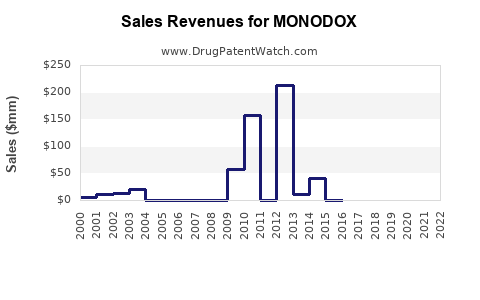
2023-2028 Outlook
| Year |
Estimated Sales (USD million) |
Growth Rate |
Key Influencers |
| 2023 |
150 |
-- |
Launch of new oral formulations in select markets |
| 2024 |
165 |
10% |
Increased adoption in emerging markets |
| 2025 |
180 |
9.1% |
Patent expiry in US and EU; generic competition begins |
| 2026 |
192 |
6.7% |
Market saturation; price competition intensifies |
| 2027 |
200 |
4.2% |
Stabilization; new indications approved |
| 2028 |
210 |
5% |
Market expansion in Asia-Pacific |
Factors Affecting Sales
- Antibiotic Resistance: Rising resistance may reduce efficacy, limiting sales.
- Regulatory Approvals: New indications or formulations can increase sales.
- Generic Competition: Post-patent expiry, price erosion may occur, but volume growth can offset this.
- Public Health Policies: Campaigns against antibiotic overuse can restrict sales growth.
Risks and Opportunities
Risks
- Resistance limiting clinical usefulness.
- Competitive pressures from newer antibiotic classes.
- Regulatory hurdles delaying new formulations.
Opportunities
- Expansion into untapped markets, especially Asia-Pacific.
- Development of combination therapies that include doxycycline.
- Advancement of novel formulations, including long-acting injectables.
Key Takeaways
- The global doxycycline market stands at USD 1.3 billion (2022), with steady growth projected.
- Sales for MONODOX are expected to grow from USD 150 million in 2023 to USD 210 million in 2028.
- Patent expiry in 2025 will likely introduce generic competition but also open opportunities for volume expansion.
- Market growth hinges on addressing resistance issues and expanding indications.
FAQs
1. What factors could accelerate MONODOX’s sales growth?
Introduction of new formulations, approvals for additional indications, and increasing demand in emerging markets.
2. How will resistance impact MONODOX’s future?
Resistance may reduce clinical effectiveness, leading to lower prescriptions and sales, especially if resistance trends intensify.
3. What markets have the highest potential for expansion?
Asia-Pacific, due to growing healthcare infrastructure and antibiotic usage.
4. How does patent expiration affect sales?
Patent expiry in 2025 will introduce generics, causing price competition but potentially increasing volume sales.
5. What is the outlook on new approvals or formulations?
Regulatory approval of long-acting formulations or combination therapies could significantly boost sales.
References
[1] MarketsandMarkets. (2022). "Doxycycline Market by Application and Region."