Drug Sales Trends for MIRAPEX
Payment Methods and Pharmacy Types for MIRAPEX (2008)
Revenues by Pharmacy Type
Units Sold by Pharmacy Type
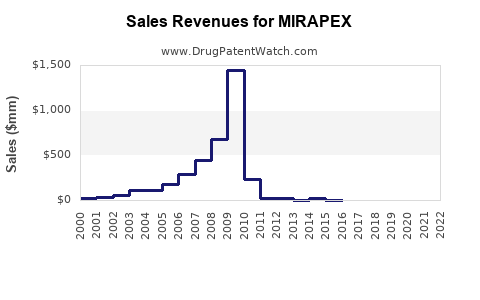
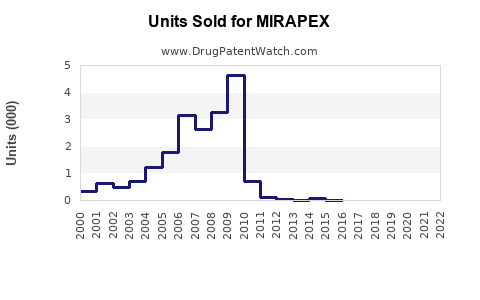
Annual Sales Revenues and Units Sold for MIRAPEX
| Drug Name | Revenues (USD) | Units | Year |
|---|---|---|---|
| MIRAPEX | ⤷ Start Trial | ⤷ Start Trial | 2022 |
| MIRAPEX | ⤷ Start Trial | ⤷ Start Trial | 2021 |
| MIRAPEX | ⤷ Start Trial | ⤷ Start Trial | 2020 |
| MIRAPEX | ⤷ Start Trial | ⤷ Start Trial | 2019 |
| >Drug Name | >Revenues (USD) | >Units | >Year |
Mirapex Market Analysis, Sales Projections, Patent Expiration, and Generic Risk
Mirapex, the branded form of pramipexole, is a mature dopamine agonist with limited commercial growth potential. The product is approved for Parkinson's disease and moderate-to-severe primary restless legs syndrome (RLS). Immediate-release pramipexole has faced generic competition for more than a decade, while extended-release Mirapex ER also has generic competition in the United States. Current revenue is concentrated in low-cost generic prescriptions rather than branded Mirapex sales.
A reasonable base-case estimate places the global pramipexole market at approximately $300 million to $450 million in 2025 sales, including branded and generic products. The market is likely to decline modestly through 2029 as dopamine agonists lose share to newer Parkinson's therapies and physicians reduce use because of impulse-control, sleep-attack, edema, and hallucination risks.
What is Mirapex and how is it used?
Mirapex contains pramipexole dihydrochloride, a non-ergoline dopamine agonist. The drug directly stimulates dopamine receptors, with high activity at the D2 subfamily and relative activity at D3 receptors.
| Product | Active ingredient | Main indications | Dosage form |
|---|---|---|---|
| Mirapex | Pramipexole | Parkinson's disease; primary RLS | Immediate-release tablets |
| Mirapex ER | Pramipexole extended release | Parkinson's disease | Extended-release tablets |
| Generic pramipexole | Pramipexole | Same approved indications, subject to product labeling | Immediate-release and extended-release tablets |
The FDA first approved Mirapex for Parkinson's disease in 1997 and later approved it for moderate-to-severe primary RLS. Mirapex ER was approved in 2010 for Parkinson's disease.[1,2]
The Parkinson's indication typically generates higher revenue per treated patient because treatment is chronic, doses are higher, and extended-release products can carry higher reimbursement than immediate-release generic tablets. The RLS market has a larger pool of potential patients but lower revenue per patient and greater substitution by generic products.
What is the current Mirapex market size?
Public companies do not generally disclose current Mirapex revenue as a separate line item. The product's commercial value is therefore best assessed through prescription volume, generic pricing, branded market share, and the broader pramipexole market.
Estimated 2025 market by segment
| Segment | Estimated 2025 global sales | Market position |
|---|---|---|
| Generic immediate-release pramipexole | $170 million-$250 million | Largest segment by volume |
| Generic extended-release pramipexole | $40 million-$75 million | Smaller, higher-value segment |
| Branded Mirapex and Mirapex ER | $20 million-$50 million | Residual branded business |
| Other international branded products | $70 million-$100 million | Primarily regional markets |
| Total pramipexole market | $300 million-$450 million | Mature and declining |
These estimates include product sales rather than patient spending across all reimbursement channels. They exclude sales of ropinirole, rotigotine, levodopa combinations, apomorphine, and newer Parkinson's disease treatments.
The market remains commercially relevant because pramipexole is inexpensive, widely available, orally administered, and familiar to neurologists. Its commercial ceiling is limited by generic pricing, treatment-switching, and the availability of levodopa and newer delivery systems.
What are the projected Mirapex sales through 2029?
The base-case forecast assumes continued generic dominance, stable Parkinson's disease prevalence, declining use in early disease, and no major branded relaunch.
Global pramipexole sales forecast
| Year | Low case | Base case | High case |
|---|---|---|---|
| 2025 | $300 million | $375 million | $450 million |
| 2026 | $285 million | $360 million | $445 million |
| 2027 | $270 million | $345 million | $440 million |
| 2028 | $255 million | $330 million | $430 million |
| 2029 | $240 million | $315 million | $420 million |
Under the base case, the market declines at approximately 4% annually. The low case reflects faster migration to levodopa-based regimens, lower reimbursement, and continued erosion of extended-release pricing. The high case assumes stable prescription volume in emerging markets and slower adoption of competing products.
Branded Mirapex forecast
| Year | Estimated branded sales |
|---|---|
| 2025 | $20 million-$50 million |
| 2026 | $18 million-$45 million |
| 2027 | $16 million-$42 million |
| 2028 | $14 million-$39 million |
| 2029 | $12 million-$36 million |
Branded Mirapex is unlikely to regain material market share without a new formulation, a differentiated adherence program, or a commercial agreement that targets markets with limited generic penetration.
When did Mirapex lose exclusivity?
Mirapex lost practical market exclusivity after generic immediate-release pramipexole entered the U.S. market. The core composition-of-matter protection for pramipexole is no longer a meaningful barrier to generic competition.
U.S. exclusivity timeline
| Event | Approximate timing | Commercial effect |
|---|---|---|
| FDA approval of Mirapex | 1997 | Launch in Parkinson's disease |
| RLS approval | 2006 | Expanded patient population |
| Generic immediate-release entry | 2010 era | Rapid erosion of branded share |
| FDA approval of Mirapex ER | 2010 | Extended-release product launch |
| Generic ER competition | 2020 era | Reduced remaining formulation protection |
| Current status | 2025 | Generic-dominated market |
The exact commercial erosion date varied by dosage strength, applicant, and settlement arrangements. Market exclusivity ended years ago for practical purposes, and residual patents do not create a credible block to generic immediate-release supply.
What patents protect Mirapex and Mirapex ER?
Mirapex's original patent estate covered pramipexole, pharmaceutical compositions, and use in Parkinson's disease. Those rights have expired or no longer provide commercially meaningful exclusivity in the United States.
Patent categories
| Patent category | Scope | Current commercial strength |
|---|---|---|
| Compound patents | Pramipexole molecule and salts | Expired |
| Basic formulation patents | Conventional oral tablets | Expired or commercially ineffective |
| Method-of-use patents | Treatment of Parkinson's disease or RLS | Limited, subject to labeling and claim scope |
| Extended-release formulation patents | Controlled-release tablet technology | Expired, invalidated, licensed, or bypassed in major markets |
| Manufacturing patents | Process and crystallization methods | Narrow; generally does not block finished-dose entry |
The key patent risk is no longer a blocking patent. The relevant issues are whether a generic applicant may use the same indication, whether an ANDA contains a Paragraph IV certification, and whether any remaining method-of-use claims are carved out of the generic label.
What is the Orange Book status of Mirapex?
Mirapex and Mirapex ER are FDA-approved prescription products listed in the Orange Book under pramipexole-related entries. The Orange Book records approved products, therapeutic-equivalence information, and patent or exclusivity data reported by the NDA holder.
The practical Orange Book assessment is:
- Immediate-release Mirapex has generic therapeutic alternatives.
- Mirapex ER has generic extended-release alternatives.
- There is no remaining new chemical entity exclusivity.
- Any listed patents must be evaluated by product strength, dosage form, and current listing status.
- Generic applicants can use Paragraph III certifications for expired patents or Paragraph IV certifications for patents they assert are invalid, unenforceable, or not infringed.
A generic company's commercial exposure is therefore governed more by manufacturing scale, payer contracts, and launch timing than by the original Mirapex patent estate.[3]
Which companies are challenging Mirapex?
Multiple generic manufacturers have supplied or sought approval for pramipexole products in the United States and other regulated markets. Suppliers have included major generic manufacturers such as Teva, Sandoz, Mylan/Viatris, Dr. Reddy's, Amneal, and other regional applicants, depending on dosage strength and formulation.
The competitive structure is fragmented:
| Competitor group | Product strategy | Competitive effect |
|---|---|---|
| Large generic companies | Multiple strengths and broad distribution | Lowest unit pricing |
| Specialty generics | Extended-release or niche strengths | Higher margin, smaller volume |
| Regional manufacturers | Local tenders and hospital channels | Geographic price pressure |
| Branded licensees | Residual Mirapex supply | Limited share and premium pricing |
No current biosimilar challenge applies because pramipexole is a chemically synthesized small molecule, not a biologic. The relevant regulatory pathway is an abbreviated new drug application (ANDA), not a biosimilar application under the Public Health Service Act.
How strong is the Mirapex patent estate?
The Mirapex patent estate is weak from an investment or litigation-blocking perspective.
Strength assessment
| Factor | Assessment |
|---|---|
| Core molecule protection | Very weak; expired |
| Immediate-release formulation | Weak |
| Extended-release formulation | Weak to moderate historically; weak currently |
| Method-of-use claims | Narrow and difficult to enforce broadly |
| Manufacturing know-how | Moderate operational value, low blocking value |
| International protection | Variable; generally expired in major markets |
| Generic entry risk | High |
| Litigation leverage | Low |
The remaining value is primarily operational. A manufacturer with reliable API sourcing, validated dissolution performance, and low-cost tablet production can compete effectively without acquiring meaningful Mirapex patent rights.
What formulation patents protect pramipexole?
Mirapex ER depends on controlled-release technology that delivers pramipexole over an extended period. Such products can face formulation barriers involving:
- Polymer matrices;
- Drug-release profiles;
- Tablet hardness and dissolution;
- Dose proportionality;
- Stability and moisture control;
- Bioequivalence across strengths.
These barriers can delay or complicate generic approval, but they do not necessarily support long-term exclusivity. Once an ANDA applicant demonstrates pharmaceutical equivalence and bioequivalence, the branded product loses most of its pricing power.
Generic applicants may also design around particular release mechanisms. A different polymer system or manufacturing process can avoid narrow formulation claims while achieving a therapeutically equivalent release profile.
What patent litigation and Paragraph IV risk affect Mirapex?
The principal historical litigation risk involved generic applicants challenging listed patents covering pramipexole or extended-release formulations. The current litigation risk is low because core protection has expired and generic supply is established.
Litigation risk by product
| Product | Paragraph IV risk | Current assessment |
|---|---|---|
| Immediate-release Mirapex | Historical and largely resolved | Low current risk |
| Mirapex ER | Higher historical risk due to formulation patents | Low current blocking risk |
| New pramipexole formulation | Potentially material | Depends on new patent filings |
| Combination product | Potentially material | Requires separate patent and regulatory analysis |
A new litigation event would most likely arise from a reformulated product, a fixed-dose combination, or a newly patented delivery system rather than conventional Mirapex tablets.
Settlement agreements, where used in the historical generic challenges, would have had commercial value only during the remaining life of the relevant patents. They do not restore exclusivity after patent expiration.
What FDA regulatory status does Mirapex have?
Mirapex is an FDA-approved small-molecule prescription drug. It is not a controlled substance and is not regulated as a biologic.
Important regulatory considerations include:
- Parkinson's disease approval;
- Primary RLS approval for immediate-release tablets;
- Extended-release approval for Parkinson's disease;
- Dose titration based on renal function;
- Warnings for somnolence and sudden sleep onset;
- Impulse-control disorders;
- Hallucinations and psychotic-like behavior;
- Orthostatic hypotension;
- Dyskinesia and augmentation concerns in RLS.
The RLS indication has faced market pressure from safety and treatment-guideline concerns. Dopamine agonists can produce augmentation, in which symptoms begin earlier, become more severe, or spread to other body areas. This has encouraged greater use of alpha-2-delta ligands such as gabapentin enacarbil and pregabalin in appropriate patients.
How does Mirapex compare with competing Parkinson's drugs?
Mirapex competes with levodopa, ropinirole, rotigotine, amantadine, and newer advanced-delivery therapies.
| Drug or class | Commercial advantage | Limitation versus pramipexole |
|---|---|---|
| Levodopa/carbidopa | Strongest symptomatic efficacy | Motor fluctuations and dyskinesia over time |
| Ropinirole | Similar dopamine-agonist profile | Same class safety concerns |
| Rotigotine patch | Continuous transdermal delivery | Higher cost and patch-related issues |
| Apomorphine | Rescue or infusion use | Administration complexity |
| Gabapentin enacarbil | RLS use without dopamine agonist augmentation | Sedation and broader tolerability concerns |
| Pramipexole | Low cost, oral dosing, long clinical history | Impulse-control and sleep-related risks |
Pramipexole's strongest competitive position is low-cost oral treatment. Its weakest position is branded differentiation. Generic pricing limits the ability to fund large promotional programs or new clinical development.
What generic launch scenarios exist for Mirapex?
Three commercial scenarios are relevant.
Continued low-price generic supply
This is the base case. Multiple suppliers maintain supply, reimbursement remains competitive, and average selling prices decline gradually. Revenue falls mainly through price erosion rather than a sharp volume collapse.
Consolidation among generic suppliers
Some manufacturers may exit low-margin strengths or reduce production. Consolidation could temporarily raise prices or create supply shortages, particularly for less frequently prescribed extended-release strengths. This would improve short-term manufacturer margins but would not recreate durable exclusivity.
Reformulated or combination products
A new once-daily combination, modified-release product, or adherence-oriented presentation could command higher pricing if supported by new clinical data and patent claims. The commercial potential would depend on differentiation from generic pramipexole and competing Parkinson's treatments.
What is the geographic outlook for Mirapex?
North America and Western Europe have the highest generic penetration. Emerging markets can retain branded or semi-branded pramipexole revenue because of local prescribing practices, fragmented distribution, and variable regulatory substitution policies.
| Region | Outlook |
|---|---|
| United States | Generic-dominated; low branded opportunity |
| Western Europe | Strong generic substitution; tender pricing |
| Japan | Mature market with local regulatory and reimbursement dynamics |
| China | Volume opportunity, price pressure, local competition |
| Latin America | Mixed branded and generic penetration |
| Middle East and Africa | Smaller volumes; distributor-driven markets |
Geographic growth is more likely to come from prescription expansion in aging populations than from premium pricing. The Parkinson's disease patient population is increasing, but pramipexole will capture only part of that growth because treatment patterns are shifting toward levodopa and non-dopaminergic options.
What is the revenue exposure for a Mirapex investor or licensee?
The product has low standalone revenue quality. Revenue is exposed to:
- Generic price compression;
- Loss of branded prescriptions;
- Reimbursement substitution;
- Manufacturing interruptions;
- Safety-related prescribing restrictions;
- Declining use of dopamine agonists in RLS;
- Competition from established low-cost alternatives.
A licensee should value Mirapex primarily as a cash-generating mature product, not as a growth asset. The strongest acquisition rationale would be manufacturing efficiency, geographic distribution, or a broader neurology portfolio.
Key Takeaways
- Mirapex is a mature pramipexole product with no meaningful remaining U.S. core patent protection.
- Generic immediate-release and extended-release products dominate the market.
- Estimated global pramipexole sales are approximately $300 million to $450 million in 2025.
- Base-case sales are projected to decline to approximately $315 million by 2029.
- Branded Mirapex sales are likely to remain below $50 million globally in 2025.
- Paragraph IV and patent-litigation risk is low for conventional Mirapex products.
- No biosimilar risk applies because pramipexole is a small molecule.
- The primary commercial opportunity is low-cost generic supply, not branded price expansion.
- RLS prescribing is vulnerable to dopamine-agonist augmentation and safety concerns.
- A new formulation or combination product would need meaningful clinical differentiation to support premium pricing.
FAQs
Is Mirapex still under patent in the United States?
The original pramipexole protection has expired, and generic immediate-release and extended-release products are available. Any remaining listed patents should be assessed at the specific dosage-form and strength level.
Is pramipexole a biologic or biosimilar product?
No. Pramipexole is a chemically synthesized small molecule. Generic versions are approved through the ANDA pathway rather than the biosimilar pathway.
Does Mirapex ER have stronger commercial protection than immediate-release Mirapex?
Historically, Mirapex ER had greater formulation complexity. That advantage has eroded because generic extended-release products are available and the relevant exclusivity period has passed.
Is pramipexole still widely used for restless legs syndrome?
Yes, but its use is under pressure. Concerns about augmentation, impulse-control disorders, and daytime sleepiness have increased use of non-dopaminergic alternatives in some patients.
Can a new pramipexole formulation command premium pricing?
Potentially, but only if it has enforceable patents and a clinically meaningful advantage such as improved adherence, reduced adverse effects, or a differentiated release profile.
References
- U.S. Food and Drug Administration. (1997). Mirapex approval letter and prescribing information. FDA.
- U.S. Food and Drug Administration. (2010). Mirapex ER prescribing information. FDA.
- U.S. Food and Drug Administration. (2025). Approved drug products with therapeutic equivalence evaluations: Orange Book. FDA.
- National Library of Medicine. (2025). DailyMed: Mirapex and pramipexole prescribing information. U.S. National Library of Medicine.
- International Parkinson and Movement Disorder Society. (2022). Evidence-based medicine review of treatments for Parkinson's disease. Movement Disorder Society.
- American Academy of Sleep Medicine. (2024). Clinical practice guideline for the treatment of restless legs syndrome and periodic limb movement disorder. Journal of Clinical Sleep Medicine.
More… ↓
