Share This Page
Drug Sales Trends for MICARDIS
✉ Email this page to a colleague
Payment Methods and Pharmacy Types for MICARDIS (2008)
Revenues by Pharmacy Type
Units Sold by Pharmacy Type
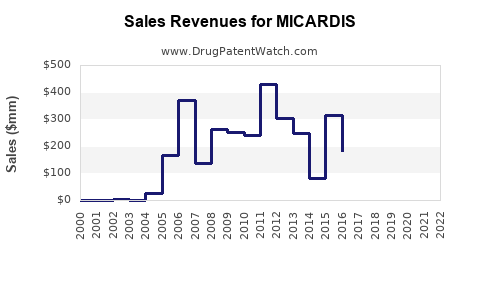
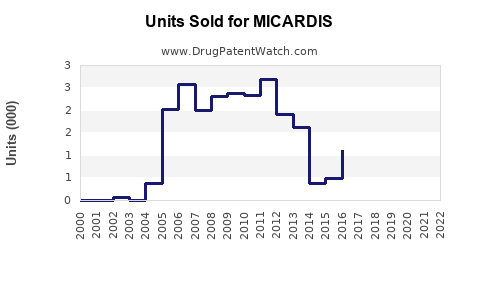
Annual Sales Revenues and Units Sold for MICARDIS
| Drug Name | Revenues (USD) | Units | Year |
|---|---|---|---|
| MICARDIS | ⤷ Start Trial | ⤷ Start Trial | 2022 |
| MICARDIS | ⤷ Start Trial | ⤷ Start Trial | 2021 |
| MICARDIS | ⤷ Start Trial | ⤷ Start Trial | 2020 |
| MICARDIS | ⤷ Start Trial | ⤷ Start Trial | 2019 |
| MICARDIS | ⤷ Start Trial | ⤷ Start Trial | 2018 |
| MICARDIS | ⤷ Start Trial | ⤷ Start Trial | 2017 |
| >Drug Name | >Revenues (USD) | >Units | >Year |
Micardis Market Analysis and Sales Projections
Micardis, the brand name for telmisartan, is a mature angiotensin II receptor blocker (ARB) with extensive generic competition. Its commercial value has shifted from branded telmisartan tablets to fixed-dose combinations, cardiovascular risk-reduction positioning, and emerging-market distribution. Global brand sales should continue declining through 2029, while the broader telmisartan market is likely to grow modestly in volume but remain highly price competitive.
What is Micardis and how is it used?
Micardis is an oral telmisartan product marketed by Boehringer Ingelheim. Telmisartan selectively blocks the angiotensin II type 1 receptor and is used primarily to treat hypertension. In the United States, the FDA label covers hypertension and cardiovascular-risk reduction in certain high-risk patients who cannot take angiotensin-converting enzyme inhibitors.[1]
Micardis is sold in several dosage forms:
| Product | Active ingredients | Primary use |
|---|---|---|
| Micardis | Telmisartan | Hypertension |
| Micardis HCT | Telmisartan and hydrochlorothiazide | Hypertension requiring combination treatment |
| Twynsta | Telmisartan and amlodipine | Hypertension requiring dual therapy |
| Generic telmisartan | Telmisartan | Hypertension |
| Generic telmisartan/hydrochlorothiazide | Telmisartan and hydrochlorothiazide | Hypertension |
Common telmisartan tablet strengths are 20 mg, 40 mg and 80 mg. Micardis HCT is available in multiple telmisartan/hydrochlorothiazide strengths, while Twynsta combines telmisartan with amlodipine.[1]
What is the market position of Micardis?
Micardis has a strong clinical and commercial position but a weak branded pricing position. The product benefits from a long-established safety record, once-daily dosing, broad physician familiarity and evidence from cardiovascular-outcomes studies. Its main commercial constraint is generic substitution.
The major competitive set includes:
- Losartan and losartan/hydrochlorothiazide
- Valsartan and valsartan/hydrochlorothiazide
- Olmesartan and olmesartan/hydrochlorothiazide
- Irbesartan and irbesartan/hydrochlorothiazide
- Candesartan
- Amlodipine-based combinations
- ACE inhibitors such as lisinopril and perindopril
Telmisartan has a longer half-life than several competing ARBs and is generally administered once daily. It also has a relatively large volume of distribution and a long terminal elimination half-life, characteristics that support adherence and sustained blood-pressure control.[1]
The product’s commercial differentiation is strongest in markets where physicians value its pharmacokinetic profile, cardiovascular-risk indication or combination products. It is weakest in markets governed by generic tendering, reference pricing and mandatory substitution.
How much revenue did Micardis generate before generic entry?
Micardis was one of Boehringer Ingelheim’s largest products before patent expiry. Public company reporting indicated annual sales above €1 billion during the peak commercial period, with Micardis and related products forming a major part of the company’s cardiovascular franchise.[2]
The principal patent covering telmisartan was U.S. Patent No. 5,591,762, assigned to Boehringer Ingelheim and directed to the compound and related pharmaceutical applications. The patent expired in 2014 after applicable patent-term adjustments and pediatric exclusivity considerations.[3]
Generic competition entered the U.S. market in 2014. The entry materially changed the revenue profile of Micardis, Micardis HCT and related products. Since then, telmisartan volume has remained substantial, but branded revenue has been pressured by lower generic prices and payer substitution.
When did Micardis lose exclusivity?
Micardis lost core U.S. small-molecule patent protection in 2014. FDA-approved generic telmisartan products subsequently entered the market, followed by generic telmisartan/hydrochlorothiazide products.[4]
| Milestone | Approximate timing | Commercial effect |
|---|---|---|
| U.S. FDA approval of Micardis | 1998 | Launch of branded telmisartan |
| Expansion into cardiovascular-risk reduction | 2000s | Broader clinical positioning |
| Core compound patent expiration | 2014 | Generic entry risk crystallized |
| U.S. generic telmisartan approvals | 2014 onward | Rapid price erosion |
| Generic combination competition | 2014 onward | Pressure on Micardis HCT |
| Mature generic market | 2018 onward | Volume growth with low unit economics |
Micardis does not have biologic exclusivity and is not exposed to biosimilar substitution. It is a conventional small molecule, so the principal threat is abbreviated new drug application competition under the Hatch-Waxman framework.
What is the Orange Book status of Micardis?
Micardis and Micardis HCT were listed in the FDA’s Orange Book as approved small-molecule products with associated patents and exclusivity information during their protected commercial period.[3] The core patent estate is now expired for U.S. market-exclusivity purposes.
The commercial significance of current Orange Book listings is limited compared with the pre-generic period. Any remaining listed patents would be more relevant to specific formulations, combinations, labeling claims or litigation strategy than to basic telmisartan compound protection.
The main patent barriers that previously protected Micardis included:
- The telmisartan compound patent
- Combination patents covering telmisartan and hydrochlorothiazide
- Formulation and manufacturing patents
- Method-of-use claims associated with hypertension and cardiovascular-risk reduction
These protections did not prevent long-term generic competition after expiration of the core compound patent.
What patents protect Micardis formulations and combinations?
Micardis HCT and Twynsta historically had greater patent complexity than plain Micardis because their protection could involve combinations, dosage forms and formulation characteristics.
Micardis HCT
Micardis HCT combines telmisartan with hydrochlorothiazide. The product’s patent strategy included combination and formulation claims. Generic entry depended on the expiration or resolution of relevant patents and regulatory certifications.
Twynsta
Twynsta combines telmisartan and amlodipine. The product competes directly with other ARB/calcium-channel-blocker combinations and is exposed to generic substitution in both components.
Combination-product patents may delay entry into a specific product category, but they generally do not preserve the commercial price of the underlying monotherapy once generic telmisartan is available.
Which companies challenge Micardis through generic competition?
Generic competition comes from multiple manufacturers rather than a single challenger. In the U.S., generic telmisartan and telmisartan/hydrochlorothiazide products have been approved for companies including Glenmark, Torrent, Lupin, Mylan/Viatris, Aurobindo, Teva and other suppliers, depending on product and approval year.[4]
The competitive structure is fragmented:
| Segment | Competitive intensity | Pricing outlook |
|---|---|---|
| Telmisartan monotherapy | High | Persistent price erosion |
| Telmisartan/hydrochlorothiazide | High | Low-margin, tender-driven |
| Telmisartan/amlodipine | High | Combination substitution |
| Branded Micardis | Moderate to high | Premium pricing difficult |
| Emerging markets | Variable | Brand retention possible |
No biosimilar companies are relevant because telmisartan is not a biologic. The key manufacturing competitors are firms with established cardiovascular generic portfolios, regulatory approvals across multiple jurisdictions and the ability to supply large institutional tenders.
What is the Micardis litigation and Paragraph IV risk?
The principal Paragraph IV risk occurred before and around generic entry in the 2014 period. Generic applicants could challenge listed patents by certifying that the patents were invalid, unenforceable or would not be infringed. Once the core patent expired, litigation risk shifted from basic compound protection to narrower issues involving combination products, formulations and labeling.
The current litigation exposure for Micardis is substantially lower than during the pre-expiry period. Product liability, manufacturing-quality disputes, regulatory enforcement and intellectual-property disputes involving specific combinations remain possible, but they do not recreate the historical compound-patent barrier.
Settlement agreements associated with pre-expiry generic disputes can affect launch timing, but the long-term market outcome is determined by the number of approved suppliers and payer substitution policies. Generic entry has already established the structural market decline for the original brand.
What is the FDA regulatory status of Micardis?
Micardis is an FDA-approved prescription drug. The FDA-approved indications include treatment of hypertension and reduction of cardiovascular risk in certain patients aged 55 years or older who are unable to take ACE inhibitors and meet specified risk criteria.[1]
Regulatory factors supporting ongoing demand include:
- Once-daily dosing
- Multiple tablet strengths
- Broad use in hypertension
- Availability of fixed-dose combinations
- Established generic approval pathway
- Long-term clinical familiarity
Regulatory factors limiting branded growth include:
- Mature treatment class
- Generic substitution
- Multiple therapeutic alternatives
- Limited opportunity for new indications
- Low clinical differentiation from other ARBs for routine hypertension
What are Micardis sales projections through 2029?
Boehringer Ingelheim does not consistently disclose a current standalone global revenue figure for Micardis in public financial reporting. The most reliable commercial conclusion is therefore a directional forecast based on patent status, generic penetration, class growth and brand pricing.
The projection below applies an indexed baseline of 100 to estimated 2024 branded Micardis revenue. It excludes generic telmisartan revenue and does not represent total telmisartan-market sales.
| Year | Base-case branded revenue index | Expected trend |
|---|---|---|
| 2024 | 100 | Mature branded/generic market |
| 2025 | 92-96 | Continued substitution |
| 2026 | 84-90 | Lower reimbursement and tender pressure |
| 2027 | 76-85 | Brand concentration in selected markets |
| 2028 | 69-80 | Declining prescriptions and net price |
| 2029 | 62-76 | Residual brand demand |
Scenario analysis
| Scenario | 2029 branded revenue versus 2024 | Main assumptions |
|---|---|---|
| Downside | 45%-60% | Accelerated generic substitution and loss of premium reimbursement |
| Base case | 62%-76% | Gradual brand erosion with stable emerging-market demand |
| Upside | 78%-90% | Brand retention, combination-product resilience and favorable regional pricing |
The broader telmisartan market should perform better than Micardis branded revenue. Global hypertension prevalence, aging populations and increased diagnosis support volume growth. Generic price competition will capture most of that growth, leaving manufacturers with higher unit volumes but limited revenue expansion.
How does Micardis compare with competing ARB franchises?
| Product | Generic status | Differentiation | Brand outlook |
|---|---|---|---|
| Micardis | Genericized | Long half-life, cardiovascular-risk indication | Declining |
| Diovan | Genericized | Large historical evidence base | Declining |
| Cozaar | Genericized | First-in-class familiarity | Declining |
| Benicar | Genericized | Potency and tolerability positioning | Declining |
| Atacand | Genericized | Heart-failure and hypertension use | Declining |
| Exforge-type combinations | Genericized | ARB/calcium-channel-blocker combination | Declining |
Micardis remains commercially relevant as a molecule, but not as a protected branded asset. Its relative position depends on supply reliability, physician familiarity and local reimbursement rather than patent exclusivity.
What generic entry risks exist for Micardis investors and licensees?
The principal risks are commercial rather than legal:
- Generic price compression reduces net sales even when prescription volume remains stable.
- Pharmacy substitution limits physician control over brand selection.
- Government and hospital tenders favor the lowest-cost supplier.
- Multiple approved manufacturers reduce supply scarcity.
- Combination products do not fully protect against substitution.
- Emerging-market brand loyalty may erode as local manufacturers improve distribution.
- Manufacturing deviations or recalls can shift share quickly between suppliers.
Licensing value is therefore concentrated in regional distribution rights, branded-generic strategies, combination-product registration and supply-chain execution. A license based solely on U.S. Micardis brand rights has limited growth potential.
What is the investment outlook for Micardis?
Micardis is a declining branded asset with durable underlying molecule demand. The asset is unattractive as a traditional exclusivity-driven growth product but can retain value in selected markets through brand recognition, combination formulations and cardiovascular-risk positioning.
The most credible commercial strategy is to manage Micardis as a cash-generating mature product while expanding generic, authorized-generic or regional branded portfolios. Revenue growth is unlikely without a new formulation, a differentiated delivery system or a materially expanded indication, and the existing patent estate does not provide a foundation for U.S. exclusivity.
Key Takeaways
- Micardis is telmisartan, a mature ARB approved for hypertension and selected cardiovascular-risk reduction.
- Core U.S. patent protection expired in 2014, enabling broad generic competition.
- Micardis brand revenue is expected to decline through 2029.
- The broader telmisartan market should grow modestly in volume but remain price constrained.
- Biosimilar risk is irrelevant; generic small-molecule competition is the principal threat.
- Micardis HCT and Twynsta have more complex formulation and combination histories but do not eliminate generic substitution.
- The strongest commercial opportunities are in emerging markets, branded generics, fixed-dose combinations and supply-constrained regions.
- The base-case projection is a 24% to 38% decline in branded revenue from 2024 to 2029.
FAQs
Is Micardis still patent protected?
The core U.S. telmisartan patent protection expired in 2014. Any remaining rights are more likely to involve specific combinations, formulations or jurisdiction-specific claims than the basic active ingredient.
Is telmisartan a biologic or a small-molecule drug?
Telmisartan is a small-molecule drug. Generic approval occurs through abbreviated new drug applications, and biosimilar regulation does not apply.
Does Micardis have higher cardiovascular protection than losartan?
Telmisartan has a differentiated cardiovascular-risk-reduction indication and long half-life, but comparative clinical value depends on patient characteristics, treatment guidelines, tolerability and reimbursement.
Can a generic manufacturer launch telmisartan without a Paragraph IV challenge?
Yes. A generic applicant may wait for relevant patents to expire or use other applicable certification pathways. Paragraph IV litigation was most important before core patent expiry.
Are Micardis HCT and Twynsta commercially protected from generic competition?
No. Combination and formulation patents can affect timing, but approved generic combination products and substitution policies create continuing commercial pressure.
References
- U.S. Food and Drug Administration. (2024). Micardis (telmisartan) prescribing information. FDA.
- Boehringer Ingelheim. (2014). Annual report 2014. Boehringer Ingelheim.
- U.S. Patent and Trademark Office. (1997). U.S. Patent No. 5,591,762: Benzimidazole derivatives.
- U.S. Food and Drug Administration. (2024). Approved drug products with therapeutic equivalence evaluations: Orange Book. FDA.
More… ↓
