Share This Page
Drug Sales Trends for METOCLOPRAMIDE
✉ Email this page to a colleague
Payment Methods and Pharmacy Types for METOCLOPRAMIDE (2008)
Revenues by Pharmacy Type
Units Sold by Pharmacy Type
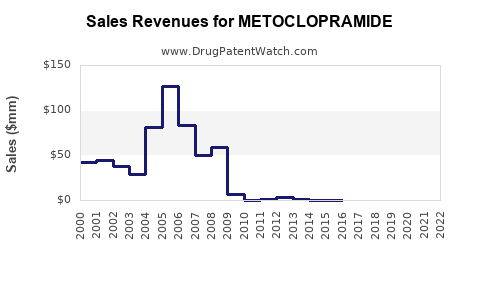
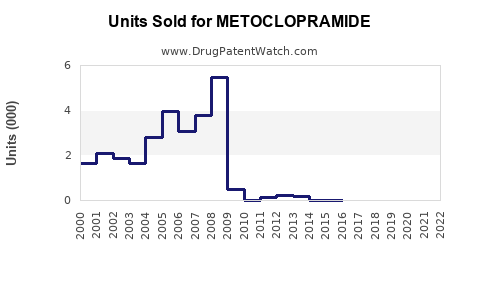
Annual Sales Revenues and Units Sold for METOCLOPRAMIDE
| Drug Name | Revenues (USD) | Units | Year |
|---|---|---|---|
| METOCLOPRAMIDE | ⤷ Start Trial | ⤷ Start Trial | 2022 |
| METOCLOPRAMIDE | ⤷ Start Trial | ⤷ Start Trial | 2021 |
| METOCLOPRAMIDE | ⤷ Start Trial | ⤷ Start Trial | 2020 |
| METOCLOPRAMIDE | ⤷ Start Trial | ⤷ Start Trial | 2019 |
| METOCLOPRAMIDE | ⤷ Start Trial | ⤷ Start Trial | 2018 |
| METOCLOPRAMIDE | ⤷ Start Trial | ⤷ Start Trial | 2017 |
| METOCLOPRAMIDE | ⤷ Start Trial | ⤷ Start Trial | 2016 |
| >Drug Name | >Revenues (USD) | >Units | >Year |
Metoclopramide Market Analysis, Sales Forecast, Patent Status, and Generic Entry Risk
Metoclopramide is a mature, low-cost generic antiemetic and prokinetic drug with limited branded revenue. The U.S. market is dominated by generic tablets, orally disintegrating tablets, oral solutions, and injectable products. Gimoti, a branded nasal spray for adults with diabetic gastroparesis, is the main differentiated U.S. product. The active ingredient has no meaningful remaining composition-of-matter exclusivity, and biosimilar risk does not apply because metoclopramide is a small-molecule drug.
A reasonable commercial base case is low-single-digit growth in unit demand and flat-to-low growth in global value. U.S. generic revenue is likely to remain price-competitive, while Gimoti has a higher revenue-per-patient opportunity but faces a narrow labeled population, safety restrictions, reimbursement friction, and established low-cost alternatives.
What is metoclopramide used for?
Metoclopramide is a dopamine D2 receptor antagonist with prokinetic and antiemetic activity. It increases upper gastrointestinal motility and accelerates gastric emptying. U.S. approved and established uses include:
- Symptomatic treatment of documented gastroesophageal reflux disease that fails conventional therapy.
- Short-term treatment of acute and recurrent diabetic gastroparesis.
- Prevention and treatment of nausea and vomiting in selected clinical settings.
- Hospital use through intravenous and intramuscular formulations.
The FDA limits treatment duration because of the risk of tardive dyskinesia, a potentially irreversible movement disorder. The labeling carries a boxed warning recommending avoidance of treatment longer than 12 weeks except in rare cases where the therapeutic benefit justifies the risk (FDA, 2024a).
Gimoti is a metoclopramide nasal spray approved for adults with symptoms associated with acute and recurrent diabetic gastroparesis. It is intended for patients who cannot tolerate or do not respond adequately to oral metoclopramide, rather than for broad use across all nausea or gastrointestinal motility indications (FDA, 2020).
How large is the metoclopramide market?
There is no single audited market total for metoclopramide because the product is sold across hospital, retail, specialty, and international channels under multiple generic and branded labels. Public company filings generally do not disclose global metoclopramide revenue as a separate category.
Analyst market-sizing framework
The following estimate separates the mature generic market from differentiated nasal-spray revenue. It is a scenario model rather than reported industry sales.
| Segment | Estimated 2024 global net sales | 2029 base-case estimate | 2024-2029 outlook |
|---|---|---|---|
| Oral generic metoclopramide | $90 million-$190 million | $85 million-$185 million | Flat to modest decline |
| Injectable generic metoclopramide | $60 million-$130 million | $65 million-$145 million | Low growth from hospital demand |
| Branded and regional products | $20 million-$80 million | $20 million-$85 million | Stable, fragmented |
| Gimoti nasal spray | $5 million-$20 million | $10 million-$40 million | Growth from specialty adoption |
| Total modeled global market | $175 million-$420 million | $180 million-$455 million | Low-single-digit value growth |
The principal uncertainty is the lack of transparent company-level reporting for generic metoclopramide. Unit demand is more stable than revenue because generic price erosion offsets prescription growth.
What are the metoclopramide sales projections through 2029?
The base case assumes that oral generic volume remains broadly stable, injectable demand grows with hospital utilization, and Gimoti gains limited penetration in diabetic gastroparesis.
| Scenario | 2024 estimated market value | 2029 estimated market value | Implied annual growth |
|---|---|---|---|
| Downside | $175 million | $140 million-$180 million | -4% to 0% |
| Base case | $250 million-$300 million | $270 million-$340 million | 1% to 3% |
| Upside | $350 million-$420 million | $400 million-$455 million | 3% to 5% |
Base-case drivers
The base case reflects five factors:
- Generic oral formulations remain the volume foundation.
- Generic price competition limits revenue expansion.
- Hospital injectable use supports a stable revenue floor.
- Diabetic gastroparesis diagnosis and treatment increase demand for prokinetic therapy.
- Gimoti expands selectively among patients with poor oral tolerance or inadequate response.
The forecast does not assume broad replacement of oral metoclopramide by Gimoti. Nasal delivery addresses administration and absorption issues, but the product remains subject to the same active-ingredient safety concerns and a restricted label.
Which companies sell metoclopramide?
The supplier base is fragmented. U.S. generic metoclopramide has historically been marketed by manufacturers including Teva Pharmaceuticals, Hikma Pharmaceuticals, Rising Pharmaceuticals, Zydus Pharmaceuticals, ANI Pharmaceuticals, Amneal Pharmaceuticals, and other FDA-approved suppliers, depending on formulation and current market status.
The main commercial categories are:
| Product category | Representative products | Commercial position |
|---|---|---|
| Oral tablets | Generic metoclopramide tablets | Lowest-cost, highest-volume category |
| Oral solution | Generic metoclopramide oral solution | Used when swallowing or dose adjustment is important |
| Injection | Generic IV and IM products | Hospital and acute-care demand |
| Nasal spray | Gimoti | Branded specialty product for diabetic gastroparesis |
| International brands | Maxolon and regional equivalents | Marketed under different regulatory and commercial structures |
Regulatory availability changes by manufacturer, strength, presentation, and country. A supplier may retain FDA approval while having limited commercial distribution.
What is the FDA regulatory status of metoclopramide?
Metoclopramide is an FDA-approved prescription drug available through abbreviated new drug applications and approved branded applications.
Key FDA milestones
| Milestone | Date or status |
|---|---|
| Original metoclopramide approval | Decades-old approval; original exclusivity expired |
| Generic oral and injectable products | Approved through ANDA pathway |
| FDA boxed warning for tardive dyskinesia | Current labeling requirement |
| Maximum recommended treatment duration | Generally 12 weeks |
| Gimoti approval | June 2020 |
| Current U.S. status | Approved prescription drug; generic and branded products |
The regulatory risk is concentrated in safety labeling and pharmacovigilance rather than in basic approval status. The boxed warning limits chronic use and can reduce physician willingness to prescribe metoclopramide for long-duration gastrointestinal disorders.
What is the Orange Book status of metoclopramide?
The original metoclopramide product has no commercially meaningful remaining new chemical entity exclusivity. Generic oral and injectable products compete through ANDAs.
For Gimoti, Orange Book protection depends on the specific listed patents and current FDA listing status. The product’s commercial protection is expected to rely on formulation, delivery-device, and method-of-use claims rather than on new chemical entity protection for metoclopramide itself (FDA, 2024b).
Practical Orange Book interpretation
- Composition-of-matter protection for metoclopramide is expired.
- Generic tablets, oral solutions, and injections do not face a meaningful new-molecule exclusivity barrier.
- A competing nasal product could face formulation, device, method-of-use, or regulatory approval barriers.
- An ANDA applicant for a listed patented product may need a Paragraph IV certification if it seeks approval before patent expiry.
- Patent listing alone does not guarantee enforceability or commercial blocking power.
What patents protect metoclopramide products?
The traditional metoclopramide market is not protected by an active core-molecule patent estate. The relevant IP categories are:
Formulation patents
Potential formulation protection can cover:
- Nasal delivery systems.
- Excipients that improve absorption.
- Concentration and dose-volume specifications.
- Stability and preservative systems.
- Device compatibility.
- Unit-dose or metered-dose delivery.
These claims are most commercially relevant to Gimoti and future intranasal competitors.
Method-of-use patents
Method claims may cover:
- Treatment of diabetic gastroparesis.
- Administration to patients unable to tolerate oral metoclopramide.
- Dose schedules.
- Use of nasal delivery to address oral administration limitations.
Method-of-use claims are narrower than composition-of-matter claims. Their commercial value depends on label wording, induced-infringement exposure, physician prescribing behavior, and the ability of a generic applicant to obtain a label carve-out.
Manufacturing and process protection
Manufacturing know-how may protect:
- Drug-substance purity.
- Nasal suspension or solution manufacture.
- Spray-device filling and assembly.
- Impurity control.
- Stability and packaging.
Trade secrets and process know-how can delay a competitor even when the active ingredient is public-domain. They usually do not prevent a technically capable competitor from developing an alternative process.
When did metoclopramide lose exclusivity?
Metoclopramide lost meaningful innovator exclusivity many years ago. Generic competition is established across oral and injectable dosage forms. The relevant commercial question is not when metoclopramide itself loses exclusivity, but when a particular differentiated product loses protection.
Gimoti does not receive a new chemical entity term because its active ingredient is metoclopramide. Its protection depends on product-specific patents, regulatory exclusivity, and commercial execution. The FDA approval in 2020 did not restore molecule-level exclusivity.
Are there Paragraph IV challenges to metoclopramide?
Paragraph IV litigation is most relevant to branded metoclopramide products with listed patents, especially differentiated delivery systems such as Gimoti. It is not commercially significant for ordinary generic tablets and injections because those products are already approved and widely marketed.
A Paragraph IV challenger could seek approval for:
- A competing nasal spray.
- A product with a different delivery device.
- A formulation with a noninfringing excipient system.
- A product using a section viii label carve-out for unpatented indications.
The commercial threat from a Paragraph IV filing would depend on whether the challenger can reproduce nasal absorption, dose consistency, tolerability, and device performance. A formulation patent can create litigation risk, but it is generally less durable than a valid composition-of-matter patent.
What generic entry risks exist for Gimoti?
Gimoti faces four main generic or follow-on risks.
1. Oral substitution
Physicians and payers can substitute inexpensive oral metoclopramide where administration is feasible. This is the largest structural constraint on Gimoti’s addressable market.
2. Competing nasal products
A rival may develop a metoclopramide nasal spray with a different device or formulation. Such a product could challenge Gimoti without copying every claimed element of the branded product.
3. Label carve-outs
A generic applicant could omit patented uses while retaining approval for nonprotected indications. The effectiveness of this strategy depends on the scope of listed method claims and the final FDA label.
4. Therapeutic substitution
Patients with gastroparesis may receive domperidone where available, erythromycin, prucalopride in selected cases, antiemetics, dietary therapy, gastric electrical stimulation, or newer investigational agents. These alternatives cap pricing power.
What patent litigation affects metoclopramide?
Metoclopramide litigation is primarily product-specific rather than molecule-wide. The largest potential disputes involve branded nasal delivery, formulation claims, device patents, and methods of treating diabetic gastroparesis.
No broad patent litigation is required for generic tablets or injections to enter the market because those categories already have established generic competition. Litigation involving a branded product could delay a competing nasal product, but it would not restore exclusivity to the underlying active ingredient.
Does metoclopramide face biosimilar risk?
No. Biosimilar regulation applies to biologic products. Metoclopramide is a small-molecule chemical drug and competes through the generic drug pathway, principally ANDAs in the United States and equivalent abbreviated procedures in other jurisdictions.
The relevant risks are generic price erosion, formulation competition, manufacturing compliance, supply interruptions, and therapeutic substitution.
How does metoclopramide compare with competing drugs?
| Product or class | Main advantage | Main limitation | Commercial effect on metoclopramide |
|---|---|---|---|
| Metoclopramide tablets | Low price and broad availability | Tardive dyskinesia risk; oral administration | Retains high volume |
| Gimoti | Nasal administration; differentiated delivery | Narrow label and branded price | Adds specialty revenue |
| Domperidone | Lower central nervous system exposure in some settings | Regulatory restrictions in the U.S.; cardiac risk | Limited U.S. pressure |
| Erythromycin | Prokinetic effect | Tachyphylaxis and drug interactions | Used selectively |
| Ondansetron | Strong antiemetic use | Does not provide equivalent prokinetic activity | Competes mainly for nausea |
| Prucalopride | Established prokinetic activity in constipation | Different primary indication and cost profile | Indirect competitor |
| New gastroparesis therapies | Potentially improved efficacy or tolerability | Development and reimbursement risk | Long-term risk to metoclopramide |
Metoclopramide’s strongest advantage is cost and familiarity. Its weakest points are neurological safety, treatment-duration limits, and the lack of durable molecule-level IP.
What is the revenue exposure for manufacturers?
For generic manufacturers, metoclopramide is generally a portfolio product rather than a major revenue driver. Revenue depends on:
- Contract and group-purchasing organization awards.
- Hospital supply agreements.
- Injectable manufacturing capacity.
- Shortage conditions.
- Retail prescription volume.
- Price competition among ANDA holders.
For the branded nasal product, revenue exposure is more concentrated. A successful commercial strategy requires reimbursement access, gastroenterology and endocrinology adoption, patient support, and proof that nasal administration solves a meaningful oral-treatment problem.
A temporary manufacturing disruption can materially affect a small supplier, but the broader market usually has multiple approved sources. FDA shortage records and enforcement actions should be monitored for injectable products and oral solution availability (FDA, 2024c).
What are the likely generic launch scenarios?
Base case
Generic oral and injectable products continue to supply most demand. Gimoti grows gradually in a limited diabetic gastroparesis segment. Prices remain under pressure, and total market value grows more slowly than unit volume.
Upside case
Gimoti gains payer coverage, physicians use it more often in patients with oral intolerance, and hospital injectable demand remains firm. A second differentiated delivery product could expand the overall market but would also pressure branded pricing.
Downside case
Payers impose restrictive prior authorization, physicians favor inexpensive oral therapy, safety concerns reduce chronic prescribing, and generic manufacturers compete aggressively on price. Gimoti revenue remains small relative to the generic market.
What geographic markets offer the strongest opportunity?
The United States is the most commercially structured market for differentiated metoclopramide products because it supports specialty reimbursement and has a large branded-generic pricing gap. Europe and other developed markets have established metoclopramide use but generally stronger price controls and national reimbursement constraints.
Emerging markets can generate volume through low-cost oral and injectable products. Their value contribution is limited by pricing, local manufacturing, registration requirements, and tender-based procurement.
Geographic expansion for a nasal product requires country-specific evidence, device registration, pharmacovigilance systems, and reimbursement negotiation. Patent coverage must be reviewed country by country because formulation and device patents may have different filing dates, validity, and term adjustments.
How strong is the metoclopramide patent estate?
The patent estate for the active ingredient is weak because the molecule is long genericized. The estate for a differentiated nasal product can be moderate if it combines valid formulation claims, device claims, manufacturing know-how, and enforceable method-of-use claims.
| IP category | Strategic strength |
|---|---|
| Active ingredient | Very weak; expired |
| Oral tablets and solutions | Very weak |
| Injectable products | Very weak, subject mainly to regulatory and manufacturing barriers |
| Nasal formulation | Moderate if claims are technically narrow but enforceable |
| Delivery device | Moderate; dependent on claim breadth and design-around risk |
| Method of use | Moderate to weak; vulnerable to label carve-outs |
| Manufacturing know-how | Potentially useful but difficult to enforce against independent development |
Key Takeaways
- Metoclopramide is a mature generic drug with estimated global annual value of roughly $175 million to $420 million under a scenario-based market model.
- Generic oral and injectable products account for most volume and revenue.
- Gimoti is the main differentiated U.S. product and the principal source of potential branded growth.
- The underlying active ingredient has no meaningful remaining molecule-level exclusivity.
- Formulation, nasal-delivery, device, method-of-use, and manufacturing IP determine the competitive position of branded products.
- Biosimilar risk does not apply.
- The five-year market outlook is low-single-digit growth in value, with substantial downside from generic price erosion.
- The main commercial risk to Gimoti is substitution by low-cost oral metoclopramide, not a new entrant to the broad generic market.
- The main upside depends on specialty reimbursement and adoption in adults with diabetic gastroparesis who cannot use oral therapy effectively.
FAQs
Is metoclopramide still profitable for generic manufacturers?
It can be profitable as part of a broader portfolio, particularly for injectable products, hospital contracts, and periods of constrained supply. Standalone profitability is limited by multiple approved suppliers and low generic pricing.
Can a company patent a new metoclopramide formulation?
Yes. A new formulation, nasal delivery system, device, manufacturing process, or treatment method may qualify for patent protection if it satisfies novelty, nonobviousness, and other statutory requirements. A new formulation does not recreate exclusivity for the active molecule.
Is Gimoti protected by orphan-drug exclusivity?
Gimoti’s commercial protection is based primarily on its approved product, formulation, delivery system, patents, and market positioning. The key regulatory exclusivity question is product-specific and should not be conflated with new chemical entity exclusivity for metoclopramide.
What is the biggest threat to metoclopramide sales?
For generic products, the biggest threat is price erosion and therapeutic substitution. For Gimoti, the largest threat is oral metoclopramide substitution combined with restrictive payer coverage.
Could a new prokinetic drug replace metoclopramide?
A new prokinetic with better long-term safety, broader labeling, and competitive reimbursement could take share from metoclopramide. Replacement would be gradual because metoclopramide has low cost, extensive clinical familiarity, and broad availability.
References
- U.S. Food and Drug Administration. (2020). FDA approves nasal spray to treat diabetic gastroparesis. https://www.fda.gov
- U.S. Food and Drug Administration. (2024a). Reglan (metoclopramide) prescribing information. https://www.accessdata.fda.gov
- U.S. Food and Drug Administration. (2024b). Approved drug products with therapeutic equivalence evaluations: Orange Book. https://www.accessdata.fda.gov
- U.S. Food and Drug Administration. (2024c). Drug shortages database. https://www.accessdata.fda.gov
- DailyMed. (2024). Metoclopramide hydrochloride prescribing information. U.S. National Library of Medicine. https://dailymed.nlm.nih.gov
More… ↓
