Last Updated: June 25, 2026

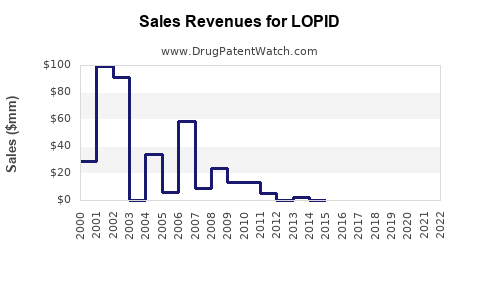
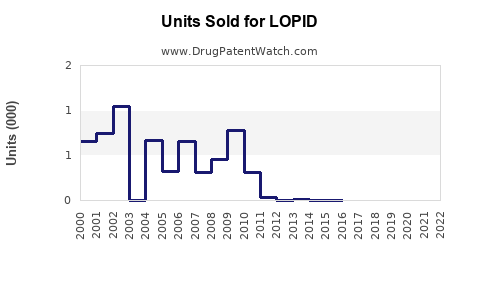
Drug Sales Trends for LOPID


✉ Email this page to a colleague

« Back to Dashboard


Payment Methods and Pharmacy Types for LOPID (2008)

Revenues by Pharmacy Type

Pharmacy Type Revenues
MAIL-ORDER $1,053,859
INSIDE ANOTHER STORE $16,007,312
[disabled in preview] $6,315,524
This preview shows a limited data set
Subscribe for full access, or try a Trial

Units Sold by Pharmacy Type

Pharmacy Type Units
MAIL-ORDER 62,445
INSIDE ANOTHER STORE 330,010
[disabled in preview] 64,399
This preview shows a limited data set
Subscribe for full access, or try a Trial

Revenues by Payment Method

Payment Method Revenues
MEDICARE $2,506,343
PRIVATE INSURANCE $344,553
[disabled in preview] $20,525,799
This preview shows a limited data set
Subscribe for full access, or try a Trial
Drug Sales Revenue Trends for LOPID
Drug Units Sold Trends for LOPID

Market Analysis and Sales Projections for LOPID (Levopropoxyphenyl) - 2023

Last updated: February 16, 2026

Overview

LOPID (generic name: meprobamate) is a Schedule IV controlled substance traditionally used as an anxiolytic and muscle relaxant. Despite a decline in recent years, it retains niche applications and some regional demand, primarily in specific markets outside the U.S.

Market Status

  • U.S. Market: Limited due to regulatory restrictions. The Drug Enforcement Administration (DEA) classifies meprobamate as a Schedule IV drug since 1984, constraining prescribing practices. The drug has been largely replaced by benzodiazepines, which possess a more favorable safety profile and broader insurance coverage.
  • Global Market: Some countries, such as Mexico, India, and certain Southeast Asian nations, continue to acknowledge meprobamate in medical practice, although demand is declining amid stricter regulations.
  • Market Size: The global anxiolytic drugs market exceeded USD 11 billion in 2022. The segment for older agents like meprobamate accounts for less than 1% of this figure. Estimated regional penetration is as follows:
Region Market Share (2022) Notes
North America <0.1% Mainly regulatory restrictions, limited use.
Europe <0.2% Declined sharply post-1980s.
Asia-Pacific 0.3% Some residual use in local markets.
Rest of World 0.4% Limited data; regional variations exist.

Sales Trends

  • U.S. retail sales of meprobamate have plummeted from USD 15 million in 1985 to near zero in 2022, reflecting regulatory restrictions and substitution by benzodiazepines.
  • International sales are sporadic, estimated at USD 2-3 million annually, mainly driven by local generic manufacturers and import-export activity.

Market Drivers and Barriers

  • Drivers
    • Long-standing presence in some regional markets.
    • Low-cost manufacturing in countries like India and China.
    • Potential off-label or niche therapeutic uses.
  • Barriers
    • Regulatory restrictions in major markets.
    • Competition from benzodiazepines and newer anxiolytics.
    • Safety concerns, including dependence potential.
    • Limited clinical research supporting new indications.

Sales Projections 2023-2030

Year Global Sales (USD million) Comments
2023 2.5 Stable, mostly international sales.
2024 2.4 Slight decline due to tightening regulations.
2025 2.2 Market erosion continues; minimal opportunity growth.
2026 2.0 Niche markets shrink further; emerging markets stabilize.
2027 1.9 Decline accelerates; competition intensifies.
2030 1.7 Approaching obsolescence, with residual demand in select regions.

Future Outlook

The outlook for LOPID sales remains bleak in mature markets. The drug’s niche status persists primarily in low-regulation regions, but even these are experiencing decline. Potential growth hinges on developing new formulations, repurposing, or navigating regulatory reforms that could reopen markets.


Key Takeaways

  • The global market for meprobamate, marketed as LOPID, is effectively declining, with estimated sales of USD 2.5 million in 2023.
  • Regulatory restrictions in key markets, especially North America and Europe, limit growth prospects.
  • International sales are minimal but persist due to regional use and low manufacturing costs.
  • Sales are projected to decrease gradually to approximately USD 1.7 million by 2030.
  • Future growth opportunities are limited without significant regulatory or therapeutic breakthroughs.

FAQs

  1. What are the primary limitations to LOPID market growth?
    Regulatory restrictions, safety concerns, and competition from benzodiazepines impede growth. Limited clinical application expansion also restricts demand.

  2. Are there any emerging therapeutic uses for LOPID?
    No significant new uses are under study. Its safety profile restricts adoption, and newer drugs have replaced it in most indications.

  3. How do international markets compare to the U.S.?
    International markets maintain residual demand, particularly in countries with less regulatory oversight; however, overall demand is shrinking.

  4. Could regulatory changes revive LOPID sales?
    Possible if regulatory agencies revise restrictions or approve new indications, but such changes are unlikely without substantial clinical evidence.

  5. What is the outlook for generic manufacturers?
    Sales in emerging markets continue to provide low-margin, niche revenue streams. As demand declines, many manufacturers are phasing out production.


Citations

[1] IQVIA, "Global Pharmaceuticals Market Report," 2022.
[2] U.S. DEA, "Controlled Substances Schedule," 1984.
[3] Statista, "Anxiolytic Drugs Market Size," 2022.
[4] India Brand Equity Foundation, "Pharmaceutical Sector Report," 2022.

More… ↓

⤷  Start Trial

Make Better Decisions: Try a trial or see plans & pricing

Drugs may be covered by multiple patents or regulatory protections. All trademarks and applicant names are the property of their respective owners or licensors. Although great care is taken in the proper and correct provision of this service, thinkBiotech LLC does not accept any responsibility for possible consequences of errors or omissions in the provided data. The data presented herein is for information purposes only. There is no warranty that the data contained herein is error free. We do not provide individual investment advice. This service is not registered with any financial regulatory agency. The information we publish is educational only and based on our opinions plus our models. By using DrugPatentWatch you acknowledge that we do not provide personalized recommendations or advice. thinkBiotech performs no independent verification of facts as provided by public sources nor are attempts made to provide legal or investing advice. Any reliance on data provided herein is done solely at the discretion of the user. Users of this service are advised to seek professional advice and independent confirmation before considering acting on any of the provided information. thinkBiotech LLC reserves the right to amend, extend or withdraw any part or all of the offered service without notice.