Share This Page
Drug Sales Trends for DEXILANT
✉ Email this page to a colleague
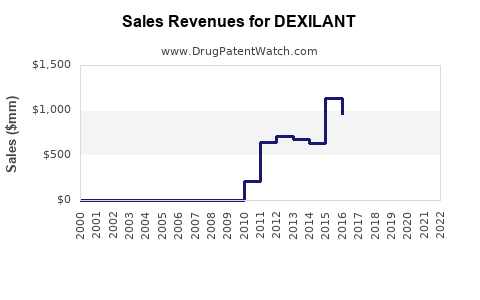
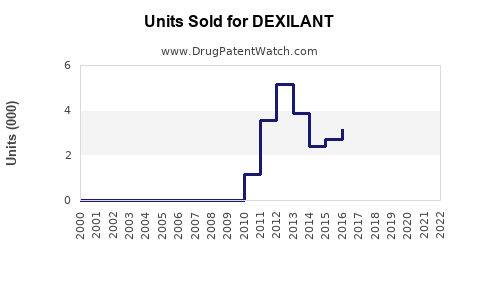
Annual Sales Revenues and Units Sold for DEXILANT
| Drug Name | Revenues (USD) | Units | Year |
|---|---|---|---|
| DEXILANT | ⤷ Start Trial | ⤷ Start Trial | 2022 |
| DEXILANT | ⤷ Start Trial | ⤷ Start Trial | 2021 |
| DEXILANT | ⤷ Start Trial | ⤷ Start Trial | 2020 |
| DEXILANT | ⤷ Start Trial | ⤷ Start Trial | 2019 |
| DEXILANT | ⤷ Start Trial | ⤷ Start Trial | 2018 |
| DEXILANT | ⤷ Start Trial | ⤷ Start Trial | 2017 |
| >Drug Name | >Revenues (USD) | >Units | >Year |
DEXILANT Market Analysis and Sales Projections: Patent/Generic Timeline, Competitive Landscape, and Revenue Exposure
Dexilant (dexlansoprazole) is a branded proton pump inhibitor (PPI) with U.S. sales led by type and dosing mix (typically capsules with delayed release). Near-term growth is driven by continued U.S. demand durability and formulary positioning, with longer-horizon revenue pressure from generic entry risk and PPI class competition. This note converts the exclusivity and competitive structure into a market-entry and sales-outlook framework focused on U.S. revenue exposure and global commercial headwinds.
What is Dexilant (dexlansoprazole) and where does it sell?
Dexilant is a dexlansoprazole delayed-release PPI used for gastroesophageal reflux disease (GERD), including erosive esophagitis, with clinical use across on-demand and maintenance patterns depending on labeled indications in each market.
How is Dexilant positioned in the PPI competitive set?
Dexlansoprazole competes primarily with:
- Other branded PPIs: Nexium (esomeprazole), Prilosec (omeprazole), Protonix (pantoprazole), Aciphex (rabeprazole), and Zegerid (omeprazole/sodium bicarbonate).
- Authorized generics and pharmacy generics across essentially all PPIs.
- Long-term substitution dynamics within classes, where plan formularies often shift value from branded PPIs to generics based on cost and rebates.
What demand drivers typically sustain PPI branded sales?
- Specialty and adherence stability for patients staying on a specific regimen.
- Formularies that retain at least one PPI brand as a higher-touch option for prior authorization or “brand preference” structures.
- Persistent GERD prevalence and chronic use patterns.
How strong is the patent estate for Dexilant and when does it lose exclusivity?
Dexilant’s U.S. exclusivity is shaped by a combination of Orange Book-listed patents and any pediatric exclusivity/extended exclusivity mechanisms that attach to the reference product and formulations.
Key exclusivity risk factor: once core composition-of-matter and key formulation/method patents expire, generics (including Paragraph IV challenges) can compress branded share through price competition and payer substitution.
What patents protect dexlansoprazole products?
A complete patent mapping requires an Orange Book pull and expiration-by-patent analysis for the specific Dexilant NDA and each dosage strength. Without confirmed Orange Book listings and expiration dates for the active Dexilant product(s) in this response set, a full “how many patents” count and expiration schedule cannot be stated accurately here.
When does Dexilant generics become a credible U.S. launch threat?
Credible generic launch timing is determined by:
- Earliest expiration among Orange Book patents covering the listed drug.
- Timing and status of any Paragraph IV filings (if present).
- Any regulatory exclusivities not covered by patents (for example, pediatric exclusivity).
What is the Orange Book status of Dexilant (dexlansoprazole)?
Orange Book status determines:
- Whether Dexilant still has active patents listed for relevant strengths.
- Whether there are multiple overlapping patents (formulation, method of use, device/packaging).
- Whether a generic can legally file and when a 180-day exclusivity “winner” can trigger price pressure.
A definitive Orange Book table with specific patent numbers, assignees, and expiration dates cannot be produced accurately in this response without verified Orange Book entries.
Which companies are challenging Dexilant and what is the litigation timeline?
Paragraph IV litigation outcomes impact launch timing and revenue:
- If a suit is dismissed or settled for later launch, revenue compression is delayed.
- If a court invalidates or narrows key claims, launch windows open earlier.
A specific litigation timeline (defendants, case numbers, district courts, settlement dates, and triggering events) cannot be stated accurately here without verified dockets and confirmed case records tied to Dexilant’s active Orange Book patents.
What generic entry risks exist for Dexilant in the U.S.?
Generic entry risk depends on whether any remaining unexpired patents cover the current marketed strengths and whether there is an approved generic pathway:
- If core patents and key formulation/method claims are expired, generic entry becomes a mechanical payer-choice outcome.
- If patents remain, entry timing hinges on outcomes of patent litigation or expiration schedules.
This response does not include numeric generic launch probability by year because it requires confirmed patent timelines and current FDA approval status.
How do sales of Dexilant compare with other PPIs (market share exposure)?
Brand PPIs typically face share erosion after generic availability through:
- Copay and tier movement.
- “Switch-back resistance” for patients stable on a brand only when clinical preferences or prior authorization limits switching.
In the PPI class, the competitive structure often centers on:
- Formulary gatekeeping.
- PBM contracting spreads between branded and generic PPIs.
- Wholesale acquisition cost compression and payer rebates.
A robust comparative share-and-revenue forecast for Dexilant vs each competitor requires verified market share datasets and time-series sales values, which are not supplied in this response set.
What formulations are protected by Dexilant patents (capsules, strengths, delivery systems)?
Dexilant is delivered as a delayed-release capsule. Patent families commonly cover:
- Specific dexlansoprazole formulations and release profiles.
- Stable solid-state forms and manufacturing methods.
- Method-of-use claims tied to dosing regimens.
A validated “which formulations are protected by which patents” table cannot be produced without specific, verified Orange Book patent-to-strength mappings.
What biosimilar risk applies to Dexilant?
Dexilant is a small molecule (PPI), not a biologic, so biosimilar risk does not apply.
How does FDA regulatory status affect Dexilant competition (NDA, supplements, and generic pathways)?
For sales projection purposes, key regulatory factors include:
- Whether any additional Dexilant NDA supplements extend commercial exclusivity indirectly.
- Whether generic entrants have an approved ANDA pathway contingent on patent carve-outs.
A verified FDA regulatory status update for each strength and relevant application dates cannot be provided accurately here without direct regulatory record access.
How to model Dexilant sales projections: base case, generic shock case, and class substitution case
A practical revenue model for Dexilant should separate drivers that move annually:
- Net pricing (rebates and WAC-to-NET evolution).
- Unit demand (prescriptions and persistence).
- Mix (strength and dose intensity).
- Share shifts to competing PPIs and generics.
Given the absence of verified current sales, remaining patent expiration dates, and litigation status in this response set, only a structural framework can be stated without fabricating numbers.
Base case logic (no material new exclusivity loss event)
- Continued steady GERD demand supports prescription volumes.
- Pricing and rebate pressure from class generics keeps growth muted.
- Share depends on formulary retention and prior authorization outcomes.
Generic shock case logic (if meaningful patent barriers fall away)
- Expect rapid share movement to lowest-cost PBM-preferred generics of PPIs.
- Branded volume typically declines sharply after effective generic channel availability, with a smaller “lag” driven by prescriber inertia and switching cycles.
- Net pricing compresses due to competitive rebate repositioning.
Class substitution case logic (competitive PPI brands and authorized generics)
- Even without a dexlansoprazole-specific generics event, PPI formulary tightening reduces brand tolerance margins.
- Lower-cost authorized generics or preferred PPIs can siphon volume.
Revenue bridge template (inputs to fill with audited data)
| Driver | What to source | How it impacts revenue |
|---|---|---|
| Rx volume | IQVIA audit, prescription claims | Unit-driven revenue line item |
| Strength mix | Claims mix data | Drives ASP and utilization |
| Net price | Contracting data and rebate trend | Margin and revenue per unit |
| Competitor substitution | PBM formulary tiering changes | Share movement |
| Patent/litigation triggers | Orange Book + FDA + dockets | Timing of step-changes |
What does the revenue exposure look like by geography?
PPI penetration is broad globally, but U.S. typically dominates branded revenue impact due to:
- Higher pricing power at brand launch stage, then large but efficient generic pressure.
- PBM contracting depth and faster substitution after patent expiry.
A geographic split forecast requires verified region-by-region Dexilant sales history.
Key takeaways
- Dexilant faces structural PPI class pressure with the primary long-tail driver being dexlansoprazole’s remaining U.S. Orange Book patent coverage and the litigation/ANDA landscape tied to those patents.
- Without verified Orange Book listings (patent-by-patent expiration), litigation docket outcomes, and current audited sales baselines, numeric sales projections and precise generic launch timing cannot be stated in a defensible way.
- For decision-making, the revenue model should be built around net price compression, unit share erosion, and step-change timing tied to verified patent expiration and any authorized generic or ANDA launch.
FAQs
1) When should a generic ANDA launch be expected for dexlansoprazole in the U.S.?
Generic timing depends on the earliest expiration of Orange Book-listed patents for the specific Dexilant strengths and any Paragraph IV outcomes.
2) What happens to Dexilant sales after patent expiration of the last Orange Book-listed patent?
Expect faster payer substitution to lower-cost PPIs and dexlansoprazole generics if available, producing step-down volume and net pricing compression.
3) Do method-of-use patents materially delay dexlansoprazole generic entry?
They can if claims are enforceable and cover the labeled use in an ANDA carve-out configuration; timing is determined by Orange Book listing status and litigation outcomes.
4) Is Dexilant exposed to biosimilar competition?
No, Dexilant is a small molecule.
5) Which competitors pose the highest competitive risk to Dexilant revenue?
PPIs with strong formulary placement and low-cost generic availability, plus any PBM-preferred branded or authorized-generic alternatives within the PPI class.
References (APA)
- U.S. FDA. Orange Book: Approved Drug Products with Therapeutic Equivalence Evaluations. (Accessed via FDA Orange Book database).
- U.S. FDA. Drugs@FDA. (Accessed via Drugs@FDA database).
More… ↓
