Drug Sales Trends for COMBIGAN
Payment Methods and Pharmacy Types for COMBIGAN (2008)
Revenues by Pharmacy Type
Units Sold by Pharmacy Type
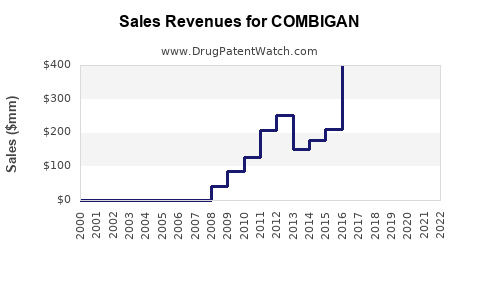
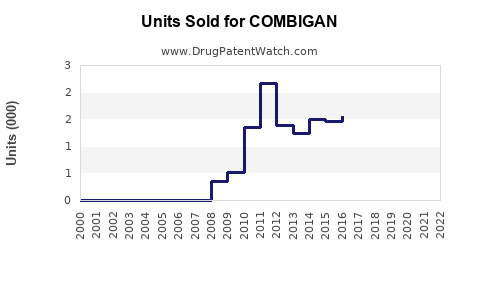
Annual Sales Revenues and Units Sold for COMBIGAN
| Drug Name | Revenues (USD) | Units | Year |
|---|---|---|---|
| COMBIGAN | ⤷ Start Trial | ⤷ Start Trial | 2022 |
| COMBIGAN | ⤷ Start Trial | ⤷ Start Trial | 2021 |
| COMBIGAN | ⤷ Start Trial | ⤷ Start Trial | 2020 |
| COMBIGAN | ⤷ Start Trial | ⤷ Start Trial | 2019 |
| COMBIGAN | ⤷ Start Trial | ⤷ Start Trial | 2018 |
| COMBIGAN | ⤷ Start Trial | ⤷ Start Trial | 2017 |
| COMBIGAN | ⤷ Start Trial | ⤷ Start Trial | 2016 |
| >Drug Name | >Revenues (USD) | >Units | >Year |
COMBIGAN Market Analysis and Sales Projections: Competitive Position, Generic Risk, and Revenue Outlook
COMBIGAN, Allergan’s fixed-dose ophthalmic combination of brimonidine tartrate 0.2% and timolol maleate 0.5%, is a mature glaucoma product with established clinical use but limited remaining exclusivity. The product benefits from convenience and physician familiarity, while generic brimonidine/timolol products constrain pricing and market share. Estimated global COMBIGAN sales are approximately $120 million to $160 million annually in the mid-2020s, with revenue likely to decline at a 6% to 10% compound annual rate as generic substitution expands.
What is COMBIGAN and how does it compete in glaucoma treatment?
COMBIGAN is a twice-daily ophthalmic solution approved for lowering elevated intraocular pressure in patients with glaucoma or ocular hypertension who require adjunctive or combination therapy. It combines:
| Component | Pharmacologic class | Primary effect |
|---|---|---|
| Brimonidine tartrate 0.2% | Alpha-2 adrenergic agonist | Reduces aqueous humor production and increases uveoscleral outflow |
| Timolol maleate 0.5% | Beta-adrenergic blocker | Reduces aqueous humor production |
The product is primarily used when monotherapy with a prostaglandin analog, beta blocker, alpha agonist, or other pressure-lowering treatment does not provide sufficient control.
COMBIGAN competes in a large but mature ophthalmic glaucoma market. The principal commercial alternatives include:
- Generic latanoprost and other prostaglandin analogs
- Generic timolol and brimonidine
- ROCK inhibitors such as Rhopressa and Rocklatan
- Fixed combinations such as dorzolamide/timolol and brimonidine/brinzolamide
- Branded products including Lumigan, Travatan Z, Vyzulta, and Simbrinza
Prostaglandin analogs generally retain the strongest first-line position because they offer once-daily dosing and strong intraocular-pressure reduction. COMBIGAN is more exposed to later-line and adjunctive-treatment demand.
How large is the COMBIGAN market?
The relevant addressable market is the global prescription market for glaucoma and ocular-hypertension therapies. Market-research estimates commonly place the global glaucoma therapeutics market in the range of $7 billion to $9 billion in the mid-2020s, depending on inclusion of surgical products, diagnostics, and geographic coverage (Grand View Research, 2024; Fortune Business Insights, 2024).
The combination ophthalmic segment is smaller but commercially important because fixed-dose products improve adherence and reduce the burden of multiple daily eye drops. Key demand drivers include:
- Aging populations and increasing glaucoma prevalence
- Longer treatment duration following diagnosis
- Greater use of combination therapy as disease progresses
- Preference for fewer bottles and dosing events
- Expansion of ophthalmology services in emerging markets
The main market constraints are generic pricing, therapeutic substitution, preservative-related tolerability concerns, and competition from once-daily prostaglandin analogs.
What are COMBIGAN sales and revenue projections?
AbbVie does not consistently report COMBIGAN as a standalone revenue line in its public financial filings. The product is generally included within broader eye-care or pharmaceutical revenue categories. The following projection is therefore an analyst estimate based on historical product scale, generic competition, market growth, and branded ophthalmology trends.
Estimated global COMBIGAN net sales
| Year | Estimated global sales | Year-over-year change | Market interpretation |
|---|---|---|---|
| 2021 | $190 million-$230 million | N/A | Mature branded product with generic pressure |
| 2022 | $170 million-$210 million | -8% to -10% | Continued substitution and price pressure |
| 2023 | $150 million-$185 million | -8% to -12% | Generic access expands |
| 2024 | $135 million-$170 million | -6% to -10% | Stable demand, declining branded share |
| 2025 | $120 million-$155 million | -7% to -10% | Lower average selling price |
| 2026 | $108 million-$143 million | -6% to -9% | Generic conversion continues |
| 2027 | $98 million-$132 million | -5% to -8% | Mature residual branded market |
| 2028 | $90 million-$123 million | -5% to -8% | Primarily loyalty and contract-driven demand |
The base-case forecast implies a global revenue decline from roughly $150 million to $185 million in 2023 to approximately $90 million to $123 million by 2028. The implied five-year compound annual decline is approximately 6% to 9%.
Scenario analysis
| Scenario | 2028 estimated sales | Assumptions |
|---|---|---|
| Upside | $130 million-$160 million | Slower generic substitution, stronger emerging-market growth, stable branded reimbursement |
| Base case | $90 million-$123 million | Continued generic conversion and moderate price erosion |
| Downside | $55 million-$85 million | Broad payer substitution, additional low-cost suppliers, aggressive generic discounts |
The product is unlikely to return to historical peak sales absent a material change in reimbursement, new formulation protection, or a major supply disruption affecting generic competitors.
When did COMBIGAN lose exclusivity?
COMBIGAN’s principal U.S. regulatory exclusivity and patent protection have expired or are no longer sufficient to prevent generic competition.
The product received FDA approval on Oct. 1, 2007, under NDA 021632 (U.S. Food and Drug Administration, 2007). The original product protection period included listed patents and pediatric exclusivity. The commercial significance of that protection has diminished because generic brimonidine/timolol ophthalmic products are available or have been authorized in the U.S. market.
| Milestone | Date or status |
|---|---|
| FDA approval | Oct. 1, 2007 |
| Dosage form | Ophthalmic solution |
| Active ingredients | Brimonidine tartrate and timolol maleate |
| Original sponsor | Allergan |
| Current corporate owner | AbbVie, following the 2020 Allergan acquisition |
| U.S. exclusivity status | Expired |
| Generic competition | Present |
| Current commercial protection | Brand recognition, physician familiarity, supply reliability, and residual channel preference |
The FDA Orange Book should be consulted for the current patent listing and any later product-specific certifications because patent records can change through delistings, corrections, or administrative updates (U.S. Food and Drug Administration, 2024a).
What patents protect COMBIGAN?
COMBIGAN’s historical protection was based on patents covering the fixed combination, ophthalmic composition, and related formulation characteristics. The commercially important protection has expired or has been overtaken by generic entry.
The exact patent estate should be assessed through the current Orange Book record and USPTO assignment and maintenance databases. Public product protection for COMBIGAN has not created a durable late-life barrier comparable to an unexpired composition-of-matter patent for a new chemical entity.
The remaining practical IP questions are narrower:
- Whether any formulation patent remains listed for a specific generic dispute
- Whether a manufacturer can design around excipient or concentration claims
- Whether manufacturing-process patents create supply-chain leverage
- Whether foreign jurisdictions retain different protection periods
- Whether a follow-on formulation can obtain separate protection
These issues generally affect litigation posture rather than the core U.S. market availability of generic brimonidine/timolol.
What is the Orange Book status of COMBIGAN?
COMBIGAN is an FDA-approved prescription ophthalmic product with an Orange Book listing associated with NDA 021632. Because its core market protection has expired and generic products have entered the market, the relevant regulatory issue is abbreviated new drug application approval rather than a pending new-drug exclusivity period.
Generic applicants may rely on the COMBIGAN reference listed drug through the ANDA pathway. Depending on the patent record at the time of filing, an applicant may submit Paragraph III, Paragraph IV, or certification reflecting the absence of a relevant listed patent.
Which companies are challenging COMBIGAN, and what is the Paragraph IV risk?
The principal competitive threat is generic manufacturers rather than branded challengers. Potential or actual suppliers can include companies with ophthalmic manufacturing capacity such as:
- Apotex
- Sandoz
- Teva
- Akorn or successor entities
- Micro Labs
- Torrent Pharmaceuticals
- Other regional ophthalmic manufacturers
The commercial risk from Paragraph IV litigation was highest before the relevant listed patents expired. At this stage, the more material risk is post-entry price competition and formulary substitution.
Generic ophthalmic products can gain share rapidly when:
- The reference product has no meaningful market exclusivity.
- State substitution rules favor generics.
- Payers place the generic on a lower formulary tier.
- Multiple suppliers compete for pharmacy and wholesaler contracts.
- The product is therapeutically substitutable without complex administration requirements.
COMBIGAN has a higher substitution risk than products with device-specific delivery systems or complex manufacturing processes. Its formulation is a sterile ophthalmic solution, but the active ingredients are established compounds with extensive generic manufacturing experience.
How strong is the COMBIGAN patent estate?
The current patent estate is commercially weak relative to newer ophthalmic products.
| Patent-strength factor | Assessment |
|---|---|
| New chemical entity protection | Expired |
| Composition protection | Expired or no longer commercially blocking |
| Fixed-dose combination claims | Historically important, now limited |
| Formulation complexity | Moderate, but manageable for experienced ophthalmic manufacturers |
| Device dependence | Low |
| Biosimilar protection | Not applicable |
| Manufacturing barriers | Sterility, preservative control, container closure, and stability requirements |
| Remaining exclusivity value | Low in the U.S. |
The key barrier is manufacturing quality, not patent exclusivity. Ophthalmic products must meet requirements for sterility, particulate control, stability, container compatibility, and preservative performance. These requirements can delay or constrain entry, but they do not usually support premium pricing once several approved generics are available.
What formulations are protected by COMBIGAN?
The commercial formulation is a sterile, preserved ophthalmic solution containing brimonidine tartrate and timolol maleate. Its value proposition is the combination of two active ingredients in one bottle rather than a novel delivery system.
Potentially relevant formulation attributes include:
- Active-ingredient concentration
- pH and buffering system
- Preservative selection
- Osmolality
- Viscosity
- Chemical stability
- Container and dropper compatibility
- Sterility assurance
Generic applicants must demonstrate pharmaceutical equivalence and bioequivalence under FDA requirements applicable to ophthalmic products. Formulation differences that do not affect safety, effectiveness, or substitutability generally do not preserve meaningful brand protection.
Does COMBIGAN face biosimilar risk?
No. COMBIGAN is a small-molecule ophthalmic drug, not a biologic. It is not subject to the biosimilar pathway under the Public Health Service Act.
The relevant competitors are ANDA-based generic products. Generic entry can occur through pharmaceutical-equivalence and bioequivalence requirements rather than the comparative clinical development program required for biosimilars.
How does COMBIGAN compare with competing glaucoma drugs?
| Product or class | Dosing profile | Commercial position | Threat to COMBIGAN |
|---|---|---|---|
| Latanoprost generics | Usually once daily | Dominant first-line generic class | High |
| Timolol generics | Once or twice daily | Low-cost monotherapy | Moderate |
| Brimonidine generics | Usually multiple daily doses | Low-cost alpha agonist | High |
| Dorzolamide/timolol generics | Twice daily | Direct fixed-combination substitute | High |
| Simbrinza | Three times daily | Branded fixed combination | Moderate |
| Rocklatan | Once daily | Newer branded combination | Low to moderate |
| Vyzulta | Once daily | Branded prostaglandin alternative | Low |
| Lumigan | Once daily | Mature branded prostaglandin | Moderate |
COMBIGAN’s principal advantage is convenience versus separate brimonidine and timolol bottles. Its principal disadvantage is twice-daily dosing and the availability of low-cost alternatives.
What licensing deals and corporate transactions affect COMBIGAN?
Allergan was acquired by AbbVie in a transaction completed in May 2020. COMBIGAN became part of AbbVie’s ophthalmology portfolio alongside products such as RESTASIS, LUMIGAN, and ALPHAGAN. The acquisition expanded AbbVie’s control of the eye-care portfolio but did not restore COMBIGAN’s expired exclusivity.
No publicly disclosed transaction is known to provide COMBIGAN with a new market exclusivity period. Commercial value is therefore tied to portfolio management, manufacturing efficiency, payer access, and geographic distribution rather than licensing-driven protection.
What patent litigation affects COMBIGAN?
The principal litigation exposure occurred during the period when Allergan defended its branded combination against generic applicants. Current U.S. commercial risk is more closely associated with ordinary generic competition than with an active, market-blocking patent dispute.
For investment or transaction analysis, the relevant diligence points are:
- Current Orange Book patent listings
- ANDA approvals and tentative approvals
- Any Paragraph IV notices
- District-court settlement terms
- Authorized-generic arrangements
- Supply and manufacturing agreements
- Product liability and recall history
- Foreign patent status
A settlement that permitted early generic entry would reduce the value of any remaining branded sales even if a patent remained technically enforceable.
What generic launch scenarios exist for COMBIGAN?
Base case
Multiple generic suppliers maintain market access. Generic share rises gradually, branded net price declines, and COMBIGAN retains a residual share among physicians and patients who value continuity or obtain favorable coverage.
Accelerated erosion case
A payer or pharmacy benefit manager moves generic brimonidine/timolol to preferred status. Brand prescriptions fall rapidly, and AbbVie responds through lower pricing or contracting. Sales decline by more than 10% annually for several years.
Stable residual-brand case
A limited number of generic suppliers experience manufacturing or supply problems. COMBIGAN retains a small but profitable branded niche, particularly in channels where substitution is less automatic.
Geographic case
U.S. revenue declines fastest because of generic substitution. International sales may persist longer where branded prescribing, local registration requirements, or fragmented distribution reduce generic penetration. Price levels remain lower, however, and country-specific patent protection is unlikely to create a major global growth opportunity.
What is the commercial outlook and revenue exposure?
COMBIGAN is a cash-generating mature product rather than a growth asset. Its remaining value is concentrated in:
- Residual U.S. brand prescriptions
- International markets with slower generic adoption
- Fixed-combination adherence benefits
- Existing ophthalmology sales infrastructure
- Portfolio bundling with other eye-care products
For AbbVie, COMBIGAN is unlikely to represent a material share of consolidated revenue. Its decline is financially manageable at the group level but relevant to the ophthalmology portfolio, where several mature products face generic or therapeutic competition.
The highest-value commercial strategy is cost-efficient supply and selective brand retention. Large investment in new clinical trials or broad promotional expansion would have limited return unless linked to a reformulation, preservative-free version, delivery innovation, or new indication with separate protection.
Key Takeaways
- COMBIGAN contains brimonidine tartrate 0.2% and timolol maleate 0.5% in a twice-daily ophthalmic solution.
- FDA approval occurred on Oct. 1, 2007, under NDA 021632.
- U.S. exclusivity has expired, and generic competition is the principal market risk.
- Estimated global sales are approximately $120 million to $160 million in the mid-2020s.
- Base-case sales are projected to decline to roughly $90 million to $123 million by 2028.
- The product has no biosimilar exposure because it is a small-molecule drug.
- Formulation and sterile-manufacturing requirements create operational barriers but do not provide strong residual patent protection.
- Latanoprost, generic brimonidine, generic timolol, and dorzolamide/timolol are the most important competitive pressures.
- COMBIGAN remains commercially viable as a mature branded product but has limited strategic growth potential.
FAQs
Is COMBIGAN still a profitable drug for AbbVie?
Likely yes, but profitability depends on manufacturing cost, branded prescription retention, and channel pricing. Revenue is declining, while the product’s established infrastructure can support attractive residual margins.
What is the generic name for COMBIGAN?
The generic product is brimonidine tartrate and timolol maleate ophthalmic solution, generally supplied at the same 0.2% and 0.5% concentrations.
Can COMBIGAN be replaced by separate brimonidine and timolol drops?
Yes. Separate drops can provide the same active ingredients, but they may increase dosing complexity, cost, preservative exposure, and the risk of poor adherence.
Is COMBIGAN a first-line glaucoma treatment?
Usually not. Prostaglandin analogs are commonly used first because of once-daily dosing and efficacy. COMBIGAN is often used when additional intraocular-pressure reduction is needed.
What would increase COMBIGAN’s sales?
A preservative-free reformulation, improved delivery system, favorable payer contracting, supply shortages among generic competitors, or stronger growth in markets with slower generic substitution could support sales. None would reverse the long-term mature-product trend without new exclusivity.
References
- AbbVie Inc. (2020). Annual report pursuant to Section 13 or 15(d) of the Securities Exchange Act of 1934 for the year ended December 31, 2019.
- AbbVie Inc. (2024). Annual report pursuant to Section 13 or 15(d) of the Securities Exchange Act of 1934 for the year ended December 31, 2023.
- Fortune Business Insights. (2024). Glaucoma therapeutics market size, share and industry analysis.
- Grand View Research. (2024). Glaucoma treatment market size, share and trends analysis report.
- U.S. Food and Drug Administration. (2007). COMBIGAN ophthalmic solution, NDA 021632 approval information.
- U.S. Food and Drug Administration. (2024a). Approved drug products with therapeutic equivalence evaluations: Orange Book.
- U.S. Food and Drug Administration. (2024b). Drugs@FDA: FDA-approved drugs database.
More… ↓
