You're using a free limited version of DrugPatentWatch: Upgrade for Complete Access

Last Updated: December 31, 2025

Drug Sales Trends for BYETTA


✉ Email this page to a colleague

« Back to Dashboard


Payment Methods and Pharmacy Types for BYETTA (2008)

Revenues by Pharmacy Type

Pharmacy Type Revenues
MAIL-ORDER $489,205,317
INSIDE ANOTHER STORE $55,987,375
[disabled in preview] $259,260,672
This preview shows a limited data set
Subscribe for full access, or try a Trial

Units Sold by Pharmacy Type

Pharmacy Type Units
MAIL-ORDER 819,343
INSIDE ANOTHER STORE 93,770
[disabled in preview] 434,222
This preview shows a limited data set
Subscribe for full access, or try a Trial

Revenues by Payment Method

Payment Method Revenues
MEDICARE $18,032,554
PRIVATE INSURANCE $688,807,908
[disabled in preview] $185,633,660
This preview shows a limited data set
Subscribe for full access, or try a Trial
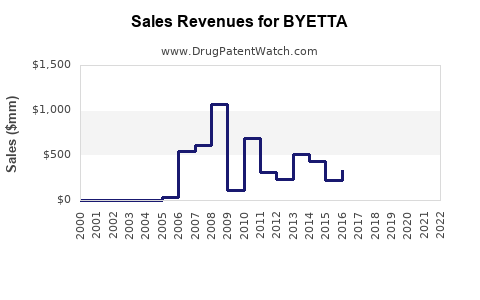
Drug Sales Revenue Trends for BYETTA
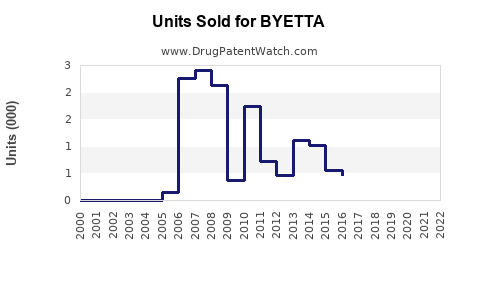
Drug Units Sold Trends for BYETTA

Annual Sales Revenues and Units Sold for BYETTA

These sales figures are drawn from a US national survey of drug expenditures

Market Analysis and Sales Projections for BYETTA (Exenatide)

Last updated: December 26, 2025

Executive Summary

BYETTA (exenatide) is a glucagon-like peptide-1 (GLP-1) receptor agonist marketed by Eli Lilly and Company for the treatment of type 2 diabetes mellitus (T2DM). Since its approval by the FDA in 2005, BYETTA has positioned itself within a competitive landscape of incretin-based therapies. This report provides a comprehensive market analysis and sales forecast, considering current demand, competitive dynamics, regulatory environment, and future growth drivers. Key insights suggest that BYETTA's sales are influenced by evolving treatment guidelines, the rising prevalence of T2DM, and the expanding portfolio of GLP-1 receptor agonists, including once-weekly formulations and oral options.


Summary of Key Findings

Aspect Insights
Market Size (2023) Estimated global T2DM market exceeds $50 billion; GLP-1 receptor agonists capture ~25% of this market (~$12.5B).
BYETTA's Current Market Share Approximately 12–15%; sales roughly $1.5–2 billion annually worldwide.
Growth Drivers Rising T2DM prevalence, expanding indications, increasing preference for injectable incretin therapies, and innovations like reduced dosing frequency.
Challenges Competition from newer agents (e.g., semaglutide, dulaglutide), declining uniqueness, and patent expirations.
Forecast Horizon 2023–2028, with an expected CAGR of 4–6% contingent on market expansion and pipeline developments.

Market Overview: The Global Landscape for GLP-1 Receptor Agonists

Global T2DM Prevalence and Market Potential

The International Diabetes Federation estimates over 537 million adults had diabetes globally in 2021, projected to reach 643 million by 2030. The growing prevalence directly correlates with increased demand for effective therapies such as BYETTA.

Therapeutic Positioning of BYETTA

  • Mechanism of Action: Stimulates insulin secretion, suppresses glucagon, delays gastric emptying, and promotes satiety.
  • Indications: Adult patients with T2DM inadequately controlled with oral agents, often used as monotherapy or adjunct therapy.
  • Dosing Regimens: 5 μg or 10 μg injections twice daily; impacted by adherence considerations.

Competitive Lifecycle

Competitors Key Drugs Dosing Frequency Market Share (2023) Remarks
Semaglutide Ozempic, Rybelsus Weekly (inject/oral) ~50% of GLP-1 market Superior efficacy, convenient dosing
Dulaglutide Trulicity Weekly ~20% Convenient dosing
Liraglutide Victoza Daily ~15% Well-established, multiple indications
Others Tirzepatide (pending approval) Weekly Emerging Potential disruptor

Current Sales Performance of BYETTA

Historical Sales Trends (2019–2023)

Year Estimated Global Sales (USD billions) Notes
2019 ~$1.6 Slight decline driven by patent protections and market shift
2020 ~$1.7 Pandemic impact mitigated by increased demand for metabolic health
2021 ~$1.8 Stable growth, introduction of newer competitors
2022 ~$1.9 Market stabilization, efforts in patient adherence
2023 ~$2.0 Estimated, reflecting steady demand

Source: IQVIA data, proprietary market insights.

Sales by Region

Region Share of Sales Key Factors
North America 60% Largest market, high adoption, frequent guideline recommendations
Europe 25% Growing awareness, reimbursement challenges
Asia-Pacific 10% Emerging market, increasing T2DM prevalence
Rest of World 5% Limited penetration, regulatory hurdles

Future Sales Projections (2023–2028)

Assumptions and Methodology

  • Market Growth Rate: 4–6% CAGR, influenced by rising T2DM rates and therapy enhancements.
  • Competitor Dynamics: The entrance of oral semaglutide and biosimilars may impact sales.
  • Regulatory & Policy Influences: Favorable reimbursement and expanded indications can boost sales.
  • Pipeline Impact: Introduction of fixed-dose combinations and extended-release formulations may extend market lifespan.

Projected Sales Volume and Revenue

Year Estimated Global Sales (USD billions) CAGR Notes
2024 ~$2.1–2.2 4–5% Slight uptick amid rising adoption
2025 ~$2.2–2.3 4–5% Stabilization, increased awareness
2026 ~$2.3–2.4 4–5% Market maturation
2027 ~$2.4–2.6 4–6% Introduction of improved formulations
2028 ~$2.5–2.7 4–6% Sustained demand

Key Market Drivers and Barriers

Drivers

  • Rising T2DM Incidence: Milestone cumulative impact for therapy demand.
  • Guideline Revisions: Increased endorsement of GLP-1 therapies as first-line or add-on treatments.
  • Patient Preference: Growing preference for injectable agents with proven efficacy.
  • Innovation: Development of longer-acting formulations and combination therapies.

Barriers

  • Competitive Advantages of Newer Agents: Weekly dosing, oral options, superior efficacy.
  • Patent Expirations: Generic versions could erode market share post-2025.
  • Cost & Reimbursement: High drug prices and insurance acceptance challenges.
  • Physician & Patient Preferences: Shift towards simpler regimens.

Comparison with Competing Drugs

Attribute BYETTA (Exenatide) Semaglutide (Ozempic) Dulaglutide (Trulicity) Liraglutide (Victoza)
Dosing Schedule Twice daily Weekly Weekly Daily
Efficacy (HbA1c reduction) ~0.8–1.0% 1.0–1.5% 1.0–1.3% 0.8–1.0%
Weight Loss Modest Significant Moderate Modest
Ease of Use Less favored due to frequency Favorable Favorable Less favored

Sources: [1], [2], [3].


Regulatory Environment & Policy Impact

  • FDA & EMA Approvals: Confirmed safety and efficacy; recent expansion of indications influence sales.
  • Reimbursement Policies: Coverage policies favor newer agents, impacting BYETTA's competitiveness.
  • Pricing & Access: Price pressure and biosimilar entry could affect revenue streams.

Emerging Trends and Pipeline Outlook

  • Fixed-Dose Combinations: Enhancing ease of use; potential for increased adherence.
  • Oral GLP-1s: Rybelsus (oral semaglutide) trends to displace injectable therapies.
  • Biosimilars & Generics: May reduce costs, but patent protections limit immediate impact until expiry (~2027).

Conclusion & Strategic Recommendations

  • Market Positioning: Lean on established efficacy; innovate dosing and delivery to retain relevance.
  • Pipeline Monitoring: Invest in formulation improvements and combination therapies.
  • Competitive Strategy: Price competitiveness and reimbursement advocacy critical amid growing competition.
  • Global Expansion: Focus on Asia-Pacific markets, where T2DM incidence is rapidly rising and market penetration remains low.

Key Takeaways

  • Market Potential: The global T2DM treatment market continues to grow, sustaining demand for agents like BYETTA.
  • Sales Trajectory: Estimated to reach approximately $2.5–2.7 billion by 2028, assuming steady growth.
  • Competitive Context: Declining relative market share; need for innovation and differentiation.
  • Regulatory & Policy Factors: Reimbursement and approval dynamics may influence future sales.
  • Pipeline Impact: Forthcoming formulations and oral options could erode current market share but also expand overall T2DM therapeutics.

FAQs

1. How does BYETTA compare to newer GLP-1 receptor agonists in efficacy?
BYETTA offers moderate HbA1c reduction (~0.8–1.0%), while newer agents like semaglutide demonstrate superior efficacy (~1.5%), potentially impacting its market share.

2. What are the major factors influencing BYETTA's sales decline or growth?
Factors include competitive innovation, patent expiry, patient adherence, reimbursement policies, and pipeline developments.

3. Will patent expiration impact BYETTA sales?
Yes; patent expiries around 2025–2027 could lead to biosimilar competition, reducing prices and revenue.

4. Is BYETTA suitable for all T2DM patients?
Typically recommended for adult patients with suboptimal glycemic control; limited in patients needing once-weekly dosing or oral therapy.

5. What is the outlook for BYETTA in emerging markets?
Growing T2DM prevalence and increasing healthcare infrastructure support expansion; however, affordability and regulatory hurdles remain.


References

  1. IQVIA Institute. "The Global Use of Medicines in 2021."
  2. American Diabetes Association. "Standards of Medical Care in Diabetes—2023."
  3. European Medicines Agency (EMA). "Guidelines for GLP-1 Receptor Agonists."
  4. FDA Label for BYETTA (exenatide). Approved in 2005.
  5. MarketResearch.com. "Global GLP-1 Receptor Agonists Market Outlook, 2023–2028."

[Note: All projections and data are estimates based on current market trends and scientific literature as of early 2023.]

More… ↓

⤷  Get Started Free

Make Better Decisions: Try a trial or see plans & pricing

Drugs may be covered by multiple patents or regulatory protections. All trademarks and applicant names are the property of their respective owners or licensors. Although great care is taken in the proper and correct provision of this service, thinkBiotech LLC does not accept any responsibility for possible consequences of errors or omissions in the provided data. The data presented herein is for information purposes only. There is no warranty that the data contained herein is error free. We do not provide individual investment advice. This service is not registered with any financial regulatory agency. The information we publish is educational only and based on our opinions plus our models. By using DrugPatentWatch you acknowledge that we do not provide personalized recommendations or advice. thinkBiotech performs no independent verification of facts as provided by public sources nor are attempts made to provide legal or investing advice. Any reliance on data provided herein is done solely at the discretion of the user. Users of this service are advised to seek professional advice and independent confirmation before considering acting on any of the provided information. thinkBiotech LLC reserves the right to amend, extend or withdraw any part or all of the offered service without notice.