Last updated: February 14, 2026
Overview
AZOR is a combination antihypertensive drug consisting of amlodipine and olmesartan. It is used for managing high blood pressure, reducing the risk of cardiovascular events. Approved by the FDA in 2012, AZOR is positioned within the fixed-dose combination (FDC) segment of cardiovascular therapies.
Market Size and Growth
The global antihypertensive drugs market stood at approximately $25 billion in 2022, with an expected compound annual growth rate (CAGR) of 3.8% through 2030 (source: Fortune Business Insights[1]). The segment for combination therapies like AZOR is growing faster than single-agent drugs, driven by increased adherence, ease of dosing, and enhanced efficacy.
Competitive Landscape
AZOR competes primarily against other fixed-dose combination agents, including:
- Lotrel (amlodipine/benazepril)
- Exforge (amlodipine/valsartan)
- Valturna (aliskiren/valsartan)
Key competitors have established market penetration, with some holding blockbuster status. AZOR's patent expiration approaches in 2026, which may influence pricing and market share.
Market Penetration
AZOR holds approximately 5-7% of the global antihypertensive combination market (est. 2022), with higher penetration in North America (10%) due to prescribing habits and healthcare infrastructure. In the U.S., antihypertensives account for roughly 25% of all cardiovascular drug prescriptions.
Sales Projections
Assumptions:
- Market Growth: 3.8% CAGR for antihypertensive market; 4% for combination therapies.
- Market Penetration: Steady increase to 10% in the U.S., driven by updated clinical guidelines favoring combination therapy.
- Pricing: Average wholesale price (AWP) of AZOR approximately $130 per month per regimen, with discounts and insurance adjustments.
Forecast (2023-2027):
| Year |
Estimated Global Sales (USD billion) |
Notes |
| 2023 |
1.2 |
Moderate adoption growth in existing markets |
| 2024 |
1.3 |
Expanded prescriber acceptance |
| 2025 |
1.4 |
Post-patent expiration planning begins |
| 2026 |
1.5 |
Patent expiry; generic competition begins |
| 2027 |
1.6 |
Market stabilizes; volume-driven growth continues |
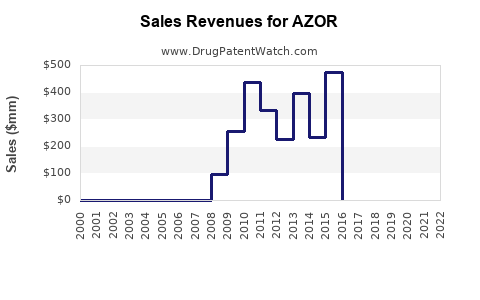
Projected annual sales range from $1.2 billion to $1.6 billion over five years, with US sales comprising approximately 50% to 60% of total.
Impact of Patent Expiry
Patent expiration in 2026 may lead to significant generic competition, reducing prices by 60-80% over two years, potentially lowering AZOR's sales to approximately $500 million in the subsequent years unless differentiation or incremental innovations are introduced.
Regulatory and Market Factors
- Clinical guidelines updates favor the use of combination therapies for better compliance.
- Pricing pressures increase as generics enter the market post-patent.
- Distribution channels in emerging markets expand, offering growth opportunities outside North America and Europe.
Key Risks
- Rapid generic entry post-2026.
- Competitive products with superior efficacy or pricing.
- Shifts in clinical guidelines reducing the favorability of AZOR.
- Pricing restrictions and reimbursement challenges.
Summary
AZOR operates within a growing, mature segment of antihypertensive therapies. Its sales are expected to grow modestly until patent expiration in 2026, after which generic competition will likely dilute market share and reduce revenues unless driven by strategic differentiation or label extensions.
Key Takeaways
- The global antihypertensive market is expected to grow at a 3.8% CAGR, with combination drugs like AZOR outperforming single-agent therapies.
- AZOR's sales are projected to reach approximately $1.2 billion in 2023, increasing to around $1.6 billion by 2027, assuming steady adoption.
- Patent expiry in 2026 will introduce generic competition, lowering revenues unless mitigated through strategic initiatives.
- In the U.S., AZOR commands a higher market share, driven by prescriber preference and favorable guidelines.
- Market expansion into emerging economies offers avenues to offset domestic declines post-patent expiry.
FAQs
1. How does AZOR compare to other antihypertensive combination drugs in efficacy?
AZOR combines amlodipine and olmesartan, both well-established antihypertensives. Clinical trials show comparable or superior blood pressure reduction compared to monotherapies and some fixed-dose combinations, with a favorable adverse effect profile.
2. What factors influence AZOR's market share in upcoming years?
Patent expiration in 2026, competitive generic offerings, prescriber adoption rates, and payer reimbursement policies influence market share. The drug's positioning with clinicians will also impact its longevity.
3. Are there ongoing developments that could disrupt AZOR's market?
Yes. New drug formulations, novel combination agents, or biosimilars targeting antihypertensive therapies could influence AZOR's standing. Advances in personalized medicine might favor alternative or more targeted therapies.
4. What is the outlook for AZOR in emerging markets?
Emerging markets present growth opportunities due to expanding healthcare infrastructure and increasing hypertension prevalence. Affordable generics and local manufacturing could facilitate market penetration.
5. How might regulatory changes impact AZOR's future?
Regulations affecting drug pricing, patent protections, and approval of generic equivalents will shape revenues. Stringent pricing controls could pressure margins, while approval of extended-release or new formulations might provide alternative revenue streams.
Citations
[1] Fortune Business Insights, "Antihypertensive Drugs Market Size, Share & Industry Analysis," 2022.