Drug Sales Trends for ACTONEL
Payment Methods and Pharmacy Types for ACTONEL (2008)
Revenues by Pharmacy Type
Units Sold by Pharmacy Type
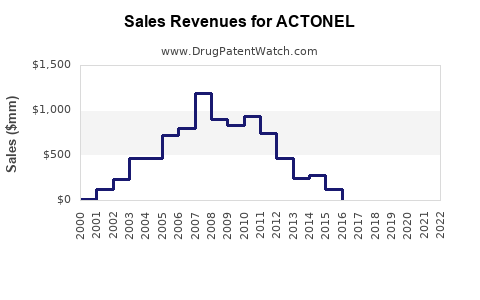
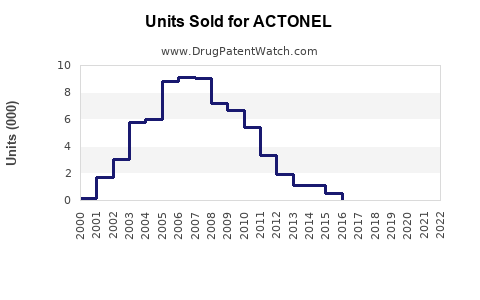
Annual Sales Revenues and Units Sold for ACTONEL
| Drug Name | Revenues (USD) | Units | Year |
|---|---|---|---|
| ACTONEL | ⤷ Start Trial | ⤷ Start Trial | 2022 |
| ACTONEL | ⤷ Start Trial | ⤷ Start Trial | 2021 |
| ACTONEL | ⤷ Start Trial | ⤷ Start Trial | 2020 |
| ACTONEL | ⤷ Start Trial | ⤷ Start Trial | 2019 |
| >Drug Name | >Revenues (USD) | >Units | >Year |
Actonel Market Analysis and Sales Projections: Risedronate, Generic Competition, and Commercial Outlook
Actonel, the branded risedronate osteoporosis product, is a mature small-molecule medicine with limited branded revenue potential. Its principal commercial value has shifted from the Actonel brand to generic risedronate sodium, including daily, weekly, monthly, and delayed-release formulations. Generic erosion, competing bisphosphonates, denosumab, and low-cost treatment alternatives constrain pricing and long-term growth.
Standalone Actonel revenue is not publicly reported as a material current product line by its former commercial owners. The projections below therefore use scenario modeling rather than company guidance.
What is Actonel and how large is its addressable market?
Actonel contains risedronate sodium, an oral nitrogen-containing bisphosphonate that inhibits osteoclast-mediated bone resorption. The product has been approved for postmenopausal osteoporosis, osteoporosis in men, glucocorticoid-induced osteoporosis, and Paget's disease of bone, depending on formulation and market [1].
Actonel commercial profile
| Attribute | Actonel profile |
|---|---|
| Active ingredient | Risedronate sodium |
| Drug class | Oral bisphosphonate |
| Original developers | Procter & Gamble and Sanofi-related commercial operations |
| Main indications | Osteoporosis and Paget's disease |
| Dosage forms | 5 mg daily, 35 mg weekly, 75 mg on two consecutive days monthly, 150 mg monthly; delayed-release versions also exist |
| Regulatory category | Small-molecule prescription drug |
| Current competitive status | Generic and branded-generic competition |
| Biosimilar exposure | None; Actonel is not a biologic |
| Primary markets | United States, Europe, Japan, Canada, and other developed markets |
| Current commercial stage | Mature and largely genericized |
The addressable market is the oral osteoporosis market rather than the branded Actonel market alone. It includes alendronate, risedronate, ibandronate, raloxifene, denosumab, teriparatide, abaloparatide, romosozumab, and intravenous zoledronic acid.
How have Actonel sales changed over time?
Actonel reached peak commercial performance before generic entry. Its historical sales were supported by physician familiarity, dosing flexibility, and use as an alternative to alendronate. Sales later declined because of generic competition, reduced bisphosphonate utilization, safety concerns associated with long-term treatment, and increased use of Prolia, Forteo, Evenity, and intravenous therapy.
Public company reporting does not provide a consistent current standalone revenue series for Actonel. Historical revenue also varied by whether reports included global sales, co-promotion revenue, royalties, or related risedronate formulations.
Historical commercial timeline
| Period | Commercial event | Revenue implication |
|---|---|---|
| 1990s | Actonel launched in major markets | Rapid adoption in osteoporosis |
| 2000s | Expansion of weekly and monthly dosing | Peak branded sales period |
| 2009-2012 | Commercial rights and brand ownership changed among major pharmaceutical companies | Revenue reporting became less comparable across companies |
| 2013-2015 | Generic risedronate entered the U.S. market | Sharp reduction in branded pricing and volume |
| 2015 onward | Generic substitution became dominant | Actonel brand revenue declined to a niche level |
| 2020s | Market shifted toward low-cost oral generics and injectable alternatives | Limited prospects for branded Actonel growth |
The U.S. Food and Drug Administration has approved multiple abbreviated new drug applications for risedronate sodium products, confirming a competitive generic environment [2].
What are Actonel sales projections for 2025 through 2029?
The most defensible projection is that branded Actonel sales will remain small and decline gradually, while the broader risedronate market will remain stable to declining in nominal value.
Because current brand-level revenue is not separately disclosed, the following is a scenario estimate for worldwide commercial sales attributable to the Actonel brand and authorized branded presentations. It excludes total generic risedronate revenue.
Actonel branded sales projection
| Year | Downside case | Base case | Upside case |
|---|---|---|---|
| 2025 | $5 million | $15 million | $30 million |
| 2026 | $4 million | $13 million | $27 million |
| 2027 | $3 million | $11 million | $24 million |
| 2028 | $2 million | $9 million | $21 million |
| 2029 | $1 million | $7 million | $18 million |
| 2025-2029 CAGR | -33% | -17% | -12% |
These estimates reflect a mature brand with limited promotional investment, ongoing substitution by generic risedronate, and continued movement toward alternative osteoporosis therapies. The upside case assumes stable branded prescriptions in selected markets where physicians or patients continue to prefer the originator product.
Broader risedronate market projection
| Year | Estimated global risedronate market range |
|---|---|
| 2025 | $250 million-$450 million |
| 2026 | $240 million-$435 million |
| 2027 | $230 million-$420 million |
| 2028 | $220 million-$405 million |
| 2029 | $210 million-$390 million |
The range includes generic and branded risedronate products. It is materially larger than the Actonel brand opportunity because generic volume remains available at low prices across multiple countries.
What drives demand for Actonel and generic risedronate?
Risedronate demand is tied to osteoporosis diagnosis, fracture risk, treatment persistence, reimbursement, and prescriber preference.
Positive demand factors
- Aging populations in the United States, Europe, Japan, and South Korea.
- Continued diagnosis of postmenopausal osteoporosis.
- Low acquisition cost compared with injectable biologics.
- Established clinical experience with oral bisphosphonates.
- Availability of weekly and monthly dosing.
- Use in patients who cannot access or afford denosumab or anabolic therapies.
- Continued demand in markets with national reimbursement systems.
Negative demand factors
- Generic alendronate is usually cheaper and widely used as first-line therapy.
- Denosumab offers six-month dosing and avoids some gastrointestinal administration issues.
- Oral bisphosphonates have adherence and administration restrictions.
- Long-term treatment requires periodic reassessment and, in some patients, a drug holiday.
- Esophageal irritation and gastrointestinal tolerability reduce persistence.
- Physicians may favor zoledronic acid for patients with adherence problems.
- Low prices limit manufacturer incentives for clinical promotion and brand investment.
The treatment environment also has a sequencing effect. Patients at very high fracture risk may begin with anabolic or bone-forming agents, then transition to an antiresorptive therapy. Risedronate competes most directly for lower-risk or maintenance-treatment patients.
How does Actonel compare with competing osteoporosis drugs?
Actonel versus alendronate
Alendronate is generally the strongest oral generic competitor. It has broad clinical familiarity, low cost, and extensive payer coverage. Risedronate may retain an advantage for patients who experience tolerability problems with alendronate, but that advantage rarely supports a meaningful branded price premium.
Actonel versus Prolia
Prolia, or denosumab, offers twice-yearly administration and has strong commercial positioning in patients who do not tolerate or adhere to oral bisphosphonates. Its limitations include higher cost, injection-based administration, and the need for follow-on antiresorptive management when treatment stops. Amgen continues to report Prolia as a major product, creating a substantially larger commercial platform than Actonel [3].
Actonel versus Reclast
Reclast, or zoledronic acid, is administered intravenously, generally once yearly for osteoporosis. It competes with Actonel among patients with poor oral adherence or gastrointestinal limitations. Infusion infrastructure and administration costs reduce its convenience but can improve treatment persistence.
Actonel versus Evenity, Forteo, and Tymlos
Romosozumab, teriparatide, and abaloparatide target patients with severe osteoporosis or high fracture risk. Their prices are materially higher than generic risedronate. They compete for treatment initiation and sequencing rather than for all Actonel prescriptions.
| Product | Active ingredient | Administration | Main commercial position |
|---|---|---|---|
| Actonel | Risedronate | Oral, daily to monthly depending on formulation | Mature branded and generic oral therapy |
| Generic alendronate | Alendronate | Oral, usually weekly | Low-cost first-line treatment |
| Prolia | Denosumab | Subcutaneous every six months | Branded injectable antiresorptive |
| Reclast | Zoledronic acid | Intravenous, generally annual | Adherence-focused bisphosphonate |
| Evenity | Romosozumab | Monthly injection | High-risk osteoporosis |
| Forteo and generic teriparatide | Teriparatide | Daily injection | Anabolic treatment for high-risk patients |
What patents protect Actonel and when did exclusivity expire?
Actonel is a small molecule with an expired U.S. patent estate for its original active ingredient and principal dosage regimens. Generic entry has already occurred, so patent protection is no longer a significant barrier to U.S. market access.
Patent and exclusivity position
| Protection category | Actonel status |
|---|---|
| Active-ingredient patent | Expired |
| Core composition-of-matter protection | Expired |
| Original method-of-use protection | Expired or commercially non-blocking |
| Formulation patents | Some historical formulation protection; generic alternatives are established |
| Regulatory exclusivity | Expired |
| Current Orange Book barrier | No meaningful brand-level barrier preventing routine generic substitution |
| Paragraph IV risk | Primarily historical rather than a current branded-market issue |
The Orange Book lists FDA-approved drug products and patent information submitted by sponsors. It does not create continuing exclusivity after listed patents expire, and it does not prevent generic competition once statutory and patent requirements are satisfied [4].
Are formulation patents still important?
Formulation patents may have protected delayed-release or combination products, including products designed to coordinate risedronate with calcium supplementation. Those protections did not preserve the original commercial value of the Actonel franchise because standard risedronate formulations became available from generic manufacturers.
A formulation patent could still affect a specific delayed-release or combination product in an individual jurisdiction. It does not restore broad exclusivity for standard risedronate tablets.
Are there Paragraph IV challenges to Actonel?
Paragraph IV litigation was relevant during the period when generic manufacturers sought U.S. approval for risedronate products before or around the expiration of listed patents. It is not a central current risk because generic risedronate products are already marketed.
The current commercial issue is substitution and price erosion, not whether a first generic can enter. Any new Paragraph IV dispute would more likely concern a particular formulation, dosage schedule, or combination product than the basic risedronate molecule.
What is Actonel's FDA and Orange Book status?
Actonel and generic risedronate are FDA-regulated prescription products. The FDA label covers dosing, administration restrictions, contraindications, warnings, renal limitations, hypocalcemia risk, and rare adverse events including osteonecrosis of the jaw and atypical femoral fractures [1].
The commercial status can be summarized as follows:
- FDA approval: established.
- Generic availability: established.
- Orange Book relevance: historical patent and reference-product information.
- Current exclusivity: none of commercial significance for the original brand.
- Biosimilar pathway: not applicable.
- ANDA competition: established.
- Regulatory barrier to launch: routine ANDA requirements, bioequivalence, manufacturing compliance, and market-specific approval.
Which companies compete in the risedronate market?
Competition is fragmented. It includes generic manufacturers, branded-generic suppliers, specialty pharmaceutical companies, and distributors.
Relevant competitive groups include:
- Teva Pharmaceutical Industries.
- Mylan, now part of Viatris.
- Sandoz.
- Amneal Pharmaceuticals.
- Apotex.
- Dr. Reddy's Laboratories.
- Sun Pharmaceutical Industries.
- Regional European and Asian generic manufacturers.
- Contract manufacturers supplying national-market products.
The leading competitor is not a single risedronate company. Market share is divided by country, wholesaler contracts, tender systems, pharmacy substitution rules, and formulation availability.
What manufacturing and intellectual-property barriers remain?
The active ingredient is not difficult to protect through current composition-of-matter patents because the core molecule is mature and genericized. Remaining barriers are operational:
- Compliance with FDA, European Medicines Agency, and local good manufacturing practice standards.
- Reliable sourcing of risedronate active pharmaceutical ingredient.
- Control of tablet dissolution and stability.
- Bioequivalence for delayed-release products.
- Ability to supply multiple strengths and dosing schedules.
- National product registrations and reimbursement listings.
- Tender pricing and wholesaler access.
- Manufacturing economics at low unit prices.
These factors can support temporary supply advantages but generally do not create durable monopoly positions.
What generic launch scenarios exist for Actonel?
Generic entry is already established. Future scenarios relate to market share and product rationalization.
Base case
Generic risedronate remains available but declines gradually as physicians use alendronate, denosumab, and zoledronic acid. Actonel retains a small branded niche in selected markets.
Downside case
Manufacturers reduce product lines because of low margins. Monthly or delayed-release presentations become less available, while standard generic weekly products remain. Actonel brand revenue approaches immaterial levels.
Upside case
Risedronate benefits from an aging population, cost-containment policies, or renewed interest in oral bisphosphonate therapy. The molecule market stabilizes, but most incremental volume goes to generics rather than the Actonel brand.
What is the revenue exposure for a current Actonel owner?
Revenue exposure is low unless the owner controls a high-volume generic portfolio or a differentiated formulation.
| Asset position | Revenue outlook |
|---|---|
| Actonel brand owner | Low and declining |
| Standard generic risedronate supplier | Stable volume, low price, limited margin |
| Delayed-release formulation owner | Potential niche value, subject to patent and approval status |
| API manufacturer | Moderate supply-chain value, dependent on cost and quality |
| Distributor | Low-margin, volume-driven business |
| Osteoporosis portfolio owner | Strategic value through cross-selling with denosumab, teriparatide, or other products |
The principal investment thesis is therefore not branded Actonel growth. It is either low-cost generic supply, a differentiated formulation, or portfolio access to the wider osteoporosis market.
How strong is the Actonel patent estate?
The original Actonel patent estate is commercially weak because the key exclusivity periods have expired and multiple generic products are approved. Residual strength may exist for individual formulation or combination claims in specific countries, but those rights do not materially protect the standard product.
Patent-strength assessment
| Factor | Assessment |
|---|---|
| Core molecule | Weak; expired protection |
| Standard tablet | Weak; generic competition established |
| Weekly dosing | Weak; commercially genericized |
| Monthly dosing | Moderate only if tied to a specific protected formulation or market |
| Delayed release | Potentially stronger at the individual-product level |
| Combination with calcium | Limited strategic protection |
| Manufacturing know-how | Low to moderate; operational rather than exclusionary |
| Litigation leverage | Low for the original brand |
Key Takeaways
- Actonel is a mature risedronate brand with limited current branded-sales potential.
- Generic risedronate, not Actonel, captures most commercial value from the molecule.
- Estimated branded Actonel sales are likely to remain in the low tens of millions of dollars globally, with continued annual decline.
- The broader global risedronate market may remain in the low hundreds of millions of dollars through 2029, but pricing pressure will persist.
- Alendronate is the strongest low-cost oral competitor.
- Prolia, Reclast, Evenity, Forteo, and Tymlos compete for higher-value osteoporosis patients.
- Actonel has no meaningful remaining original U.S. exclusivity.
- Biosimilar risk does not apply because risedronate is a small molecule.
- Any residual IP value is concentrated in delayed-release, combination, or jurisdiction-specific formulations.
- Commercial upside depends on generic manufacturing efficiency or differentiated delivery, not brand relaunch.
FAQs
Is Actonel still sold in the United States?
Actonel has largely been displaced by generic risedronate in the United States. Product availability can vary by dosage form, manufacturer, wholesaler, and pharmacy inventory.
Is generic risedronate as effective as Actonel?
FDA-approved generic risedronate products must meet applicable quality and bioequivalence requirements. Clinical use depends on the same active ingredient, approved strength, formulation, and labeling requirements.
Does Actonel have biosimilar competition?
No. Actonel contains risedronate sodium, a small-molecule active ingredient. Competition occurs through abbreviated new drug applications and generic products, not biosimilar applications.
Could a new Actonel formulation regain market share?
A new formulation could gain limited share if it improves adherence, gastrointestinal tolerability, dosing convenience, or combination therapy. Its commercial ceiling would remain constrained by low-cost standard generic risedronate.
Is Actonel an attractive licensing asset?
The standard Actonel brand is generally a weak licensing asset. A delayed-release formulation, regional product rights, manufacturing platform, or bundled osteoporosis portfolio could have greater value than the legacy brand alone.
References
- U.S. Food and Drug Administration. (2023). Actonel (risedronate sodium) prescribing information.
- U.S. Food and Drug Administration. (2024). Drugs@FDA: FDA-approved drugs and abbreviated new drug applications for risedronate sodium.
- Amgen Inc. (2023). 2023 annual report.
- U.S. Food and Drug Administration. (2024). Approved drug products with therapeutic equivalence evaluations: Orange Book.
More… ↓
