Share This Page
Drug Sales Trends for methimazole
✉ Email this page to a colleague
Payment Methods and Pharmacy Types for methimazole (2007)
Revenues by Pharmacy Type
Units Sold by Pharmacy Type
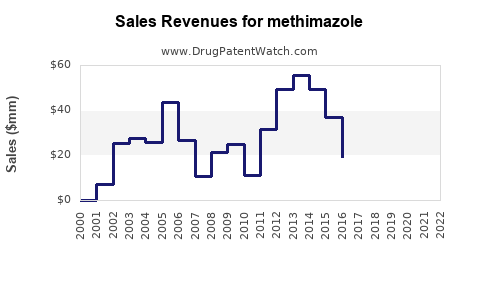
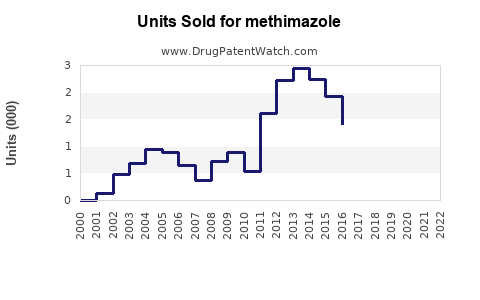
Annual Sales Revenues and Units Sold for methimazole
| Drug Name | Revenues (USD) | Units | Year |
|---|---|---|---|
| METHIMAZOLE | ⤷ Start Trial | ⤷ Start Trial | 2022 |
| METHIMAZOLE | ⤷ Start Trial | ⤷ Start Trial | 2021 |
| METHIMAZOLE | ⤷ Start Trial | ⤷ Start Trial | 2020 |
| >Drug Name | >Revenues (USD) | >Units | >Year |
Methimazole Market Analysis, Sales Forecast, Patent Status, and Competitive Outlook
Methimazole is a mature, low-cost antithyroid medicine used primarily for Graves' disease and hyperthyroidism. The market is generic, fragmented, and exposed to limited patent risk. Demand is stable because patients often require treatment for months or years, but revenue growth is constrained by low prices, generic substitution, radioactive iodine, thyroidectomy, and competing antithyroid drugs such as propylthiouracil.
Public company disclosures do not provide a reliable standalone global sales figure for methimazole. The forecast below is therefore a market-sizing model based on prescription volume, generic pricing, regulatory status, and treatment demand rather than audited manufacturer revenue.
What is methimazole and how large is its addressable market?
Methimazole inhibits thyroid peroxidase and reduces the synthesis of thyroid hormones. In the United States, it is approved for hyperthyroidism and is widely used for Graves' disease. It is available mainly as immediate-release tablets in 5 mg, 10 mg, and 20 mg strengths. Tapazole, the former branded product, no longer drives the market; generic methimazole supplies most demand.
The addressable market has four principal segments:
| Segment | Market role | Commercial outlook |
|---|---|---|
| Graves' disease | Largest chronic-use segment | Stable demand, low pricing |
| Toxic multinodular goiter | Recurrent and chronic use | Stable, older patient population |
| Toxic adenoma | Smaller segment | Often treated with definitive therapy |
| Preoperative or short-term control | Temporary use before surgery or radioiodine | Volume is modest |
Methimazole is generally preferred over propylthiouracil for most nonpregnant adults because of its dosing convenience and lower risk of severe hepatic injury. Propylthiouracil remains important during the first trimester of pregnancy and in thyroid storm, creating a specialized alternative market rather than a direct full-market substitute (American Thyroid Association, 2016).
Estimated market size
The following estimates represent the value of outpatient methimazole tablets at manufacturer, wholesaler, and retail levels combined. They exclude hospital-administered care, physician services, diagnostics, radioactive iodine, and thyroid surgery.
| Geography | Estimated 2025 market value | 2025-2029 volume trend | 2029 modeled value |
|---|---|---|---|
| United States | $50 million-$90 million | Flat to down 1% annually | $45 million-$85 million |
| Europe | $35 million-$70 million | Flat | $35 million-$70 million |
| Japan and South Korea | $25 million-$50 million | Flat to down 1% | $24 million-$48 million |
| China and other Asia-Pacific markets | $35 million-$75 million | Up 1%-3% | $37 million-$84 million |
| Latin America, Middle East, and Africa | $10 million-$30 million | Up 1%-3% | $11 million-$34 million |
| Global total | $155 million-$315 million | Approximately flat | $152 million-$321 million |
The wide range reflects the absence of a consolidated public market dataset and the large difference between list prices, tender prices, generic acquisition prices, and patient-paid prices.
What are the main drivers of methimazole demand?
Demand is supported by the prevalence of Graves' disease, increased thyroid testing, long-term medical management, and access to inexpensive generic treatment.
Disease prevalence
Graves' disease is the principal demand driver in younger and middle-aged adults. Toxic multinodular goiter and toxic adenoma contribute more heavily among older patients. Hyperthyroidism is more common in women, which affects the demographic profile of the treated population.
The American Thyroid Association identifies antithyroid drugs, radioactive iodine, and thyroidectomy as the three main treatment approaches for Graves' disease. Antithyroid therapy is selected when patients prefer to avoid definitive treatment, when pregnancy considerations apply, or when clinicians expect remission after a course of therapy (American Thyroid Association, 2016).
Treatment duration
Methimazole demand is less sensitive to new diagnosis volume than many acute medicines because treatment may continue for 12 to 18 months or longer. Patients with persistent disease, relapse after drug withdrawal, or contraindications to definitive therapy can remain on low-dose treatment for extended periods.
This creates a relatively defensive prescription base. It does not, however, create strong revenue growth because the product is inexpensive and generic substitution is extensive.
Regulatory and clinical factors
The U.S. label includes a boxed warning for agranulocytosis and serious hepatic reactions. Patients require clinical monitoring and must be informed about symptoms such as fever, sore throat, jaundice, or abdominal pain. These safety considerations restrict over-the-counter use and favor prescription products with established manufacturing quality (DailyMed, n.d.).
How does methimazole compare with propylthiouracil and definitive therapies?
Methimazole has the strongest position in routine adult treatment, but its competitive position varies by patient subgroup.
| Therapy | Main use | Commercial effect on methimazole |
|---|---|---|
| Methimazole | First-line medical therapy for most nonpregnant adults | Core demand |
| Propylthiouracil | First trimester, thyroid storm, selected intolerance cases | Limits share in specialized populations |
| Radioactive iodine | Definitive treatment for Graves' disease and toxic nodules | Reduces long-term drug duration |
| Thyroidectomy | Definitive treatment, large goiter, suspicious nodules, selected pregnancy cases | Removes recurring medicine use |
| Beta blockers | Symptom control, not hormone suppression | Complementary rather than substitutive |
Methimazole has a dosing advantage over propylthiouracil because it is often administered once daily, while propylthiouracil generally requires more frequent dosing. Radioactive iodine and surgery are more significant commercial substitutes because they can eliminate chronic antithyroid-drug use.
What is the FDA regulatory status of methimazole?
Methimazole is an established FDA-approved active ingredient marketed in generic tablet products. The product is not a biologic and does not require biosimilar competition analysis.
| Regulatory item | Status |
|---|---|
| FDA pathway | Abbreviated New Drug Application, where applicable |
| Dosage form | Immediate-release oral tablet |
| Common strengths | 5 mg, 10 mg, 20 mg |
| Prescription status | Prescription-only |
| Reference product | Tapazole-related reference product history |
| Orange Book relevance | Approved generic products and therapeutic-equivalence listings |
| Biosimilar exposure | None |
| Regulatory exclusivity | No meaningful current market exclusivity expected |
| Safety monitoring | Required because of agranulocytosis and hepatic risk |
The FDA-approved labeling identifies methimazole tablets for hyperthyroidism and specifies dosing, contraindications, warnings, and adverse reactions (DailyMed, n.d.; U.S. Food and Drug Administration, n.d.).
What patents protect methimazole products?
The original composition-of-matter and basic therapeutic patents for methimazole are long expired. Current commercial protection is not based on a material patent barrier.
Potentially relevant rights may involve:
- Tablet formulations
- Manufacturing processes
- Packaging and stability systems
- Combination products
- Narrow method-of-use claims
- Regional product registrations
These rights are unlikely to prevent generic competition because methimazole is a small-molecule product with longstanding generic availability.
| Patent category | Current commercial significance |
|---|---|
| Active-ingredient patent | Expired |
| Basic use patent | Expired or commercially irrelevant |
| Standard tablet formulation | Generally expired or weak |
| Manufacturing process | May remain enforceable in isolated cases, but usually does not block supply |
| New delivery technology | Limited market evidence |
| Method-of-use patent | Could affect a narrow indication only |
| Pediatric or pregnancy-related use | Usually label and clinical-practice issues, not major exclusivity barriers |
No material Orange Book patent estate is expected to support a new branded methimazole franchise in the United States. Patent litigation and Paragraph IV challenges are therefore not major current market variables.
When does methimazole lose exclusivity?
Methimazole lost practical exclusivity decades ago. The product is already in the post-exclusivity generic phase, and generic manufacturers compete primarily on price, supply reliability, regulatory compliance, and pharmacy access.
The commercial risks associated with loss of exclusivity do not apply in the normal branded-drug sense. There is no expected cliff tied to a near-term patent expiration. Instead, the market has a gradual price-erosion profile:
- Stable or increasing prescription volume
- Declining average selling prices
- Periodic supply disruptions
- Contract and wholesaler concentration
- Limited ability to differentiate a standard tablet
For a company evaluating entry, regulatory approval and reliable manufacturing are more important than patent clearance.
Which companies compete in the methimazole market?
The market includes generic manufacturers and contract suppliers rather than a dominant branded innovator. Depending on country and product availability, suppliers may include major U.S. generic companies, regional pharmaceutical manufacturers, and private-label distributors.
The competitive structure is characterized by:
- Multiple approved generic suppliers.
- Low product differentiation.
- Pharmacy benefit manager and wholesaler price pressure.
- Limited consumer brand loyalty.
- Supply risk concentrated in active pharmaceutical ingredient sourcing and finished-dose manufacturing.
A new entrant would likely need either low-cost manufacturing, a dependable shortage-recovery strategy, a differentiated dosage form, or a distribution agreement. A standard immediate-release tablet without a cost advantage would face limited pricing power.
What are the methimazole sales projections through 2029?
The base case assumes stable treated-patient volume, modest population growth in emerging markets, continued generic price erosion, and no major clinical change in the treatment guidelines.
Global forecast
| Year | Base-case market value | Expected annual change |
|---|---|---|
| 2025 | $220 million | Baseline |
| 2026 | $218 million | -1% |
| 2027 | $217 million | -1% |
| 2028 | $218 million | Flat |
| 2029 | $220 million | 1% |
Scenario analysis
| Scenario | 2029 global value | Principal assumptions |
|---|---|---|
| Downside | $150 million-$180 million | Faster price erosion, greater use of definitive therapy, supply competition |
| Base case | $190 million-$250 million | Stable patient volume and gradual generic deflation |
| Upside | $260 million-$330 million | Higher diagnosis rates, expanded chronic use, stronger Asia-Pacific demand |
The most likely outcome is market stability in volume and gradual decline in value. Methimazole is unlikely to produce high revenue growth without a new formulation, a combination product, or a broader treatment indication.
What generic launch risks exist for methimazole?
A new generic entrant faces moderate operational risk and low intellectual-property risk.
Manufacturing and supply barriers
The main barriers are:
- Consistent API sourcing
- Compliance with current good manufacturing practices
- Dissolution and content-uniformity performance
- Reliable supply of multiple tablet strengths
- Competitive wholesaler pricing
- Avoidance of manufacturing-site observations or warning letters
A product shortage can create temporary pricing opportunities, but shortages are difficult to convert into durable market share. Buyers typically return to the lowest-cost approved suppliers once supply normalizes.
Litigation and settlement exposure
No major current Paragraph IV litigation wave is expected for standard methimazole tablets. Settlement agreements are not a central feature of the market because the relevant exclusivity period has already expired. Any litigation would more likely concern manufacturing, product liability, supply contracts, or a narrowly claimed reformulation.
How strong is the commercial position of methimazole?
Methimazole has a strong clinical position and a weak commercial moat.
| Factor | Assessment |
|---|---|
| Clinical demand | Strong and recurring |
| Generic competition | High |
| Pricing power | Very low |
| Patent protection | Negligible |
| Regulatory complexity | Moderate |
| Supply-chain risk | Moderate |
| Biosimilar risk | None |
| Long-term volume outlook | Stable |
| Revenue growth outlook | Low |
The product is attractive as part of a broad generic portfolio, particularly for manufacturers with established thyroid, endocrine, or hospital distribution. It is less attractive as a standalone branded investment.
What licensing and partnership opportunities exist?
Licensing opportunities are most plausible in:
- Regional commercialization rights
- Government or hospital tenders
- Private-label supply
- Dual sourcing for shortage mitigation
- Pediatric or liquid formulations
- Combination products designed for specific adherence needs
A licensing deal based solely on standard methimazole tablets would likely be price-sensitive and geography-specific. The strongest commercial opportunity would involve a differentiated formulation with regulatory approval and a clear distribution advantage. There is limited evidence that a conventional methimazole product could support substantial upfront payments or royalty rates.
Key Takeaways
- Methimazole is a mature generic medicine with no meaningful current composition-of-matter exclusivity.
- The estimated 2025 global market is approximately $155 million to $315 million, with a base case near $220 million.
- Global revenue is likely to remain broadly flat through 2029 because stable demand is offset by generic price erosion.
- The United States represents a significant market but has limited pricing power and fragmented generic supply.
- Methimazole remains the leading routine medical therapy for many nonpregnant adults with hyperthyroidism.
- Propylthiouracil, radioactive iodine, and thyroidectomy are the main competitive alternatives.
- Patent litigation, Paragraph IV challenges, biosimilars, and settlement agreements are not major current risks.
- Manufacturing quality, supply reliability, and distribution access matter more than patent protection.
- A standalone branded methimazole investment has limited upside unless it includes a differentiated formulation or a specialized regional strategy.
FAQs
Is methimazole a high-revenue pharmaceutical product?
No. Methimazole has recurring demand but low revenue because multiple generic manufacturers supply inexpensive tablets.
Does methimazole have biosimilar competition?
No. Methimazole is a small-molecule drug, not a biologic. Competition comes from generic tablets.
Can a company launch a new methimazole generic?
Yes. The primary requirements are FDA approval, compliant manufacturing, bioequivalence where applicable, and competitive supply economics. Patent barriers are not expected to prevent standard generic entry.
Is methimazole demand increasing?
Prescription demand is likely stable to modestly increasing in many regions because of persistent Graves' disease prevalence and improved diagnosis. Market value is more likely to remain flat or decline because of generic pricing.
What product innovation could increase methimazole revenue?
Potential opportunities include pediatric liquid formulations, modified dosing systems, combination products, and delivery formats that improve adherence. Any innovation would need meaningful clinical or commercial differentiation to overcome generic tablet competition.
References
American Thyroid Association. (2016). 2016 American Thyroid Association guidelines for diagnosis and management of hyperthyroidism and other causes of thyrotoxicosis. Thyroid, 26(10), 1343-1421.
DailyMed. (n.d.). Methimazole tablet prescribing information. U.S. National Library of Medicine. https://dailymed.nlm.nih.gov/
U.S. Food and Drug Administration. (n.d.). Orange Book: Approved drug products with therapeutic equivalence evaluations. https://www.accessdata.fda.gov/scripts/cder/ob/index.cfm
More… ↓
