You're using a free limited version of DrugPatentWatch: Upgrade for Complete Access

Last Updated: March 26, 2026

Drug Sales Trends for malathion


✉ Email this page to a colleague
« Back to Dashboard


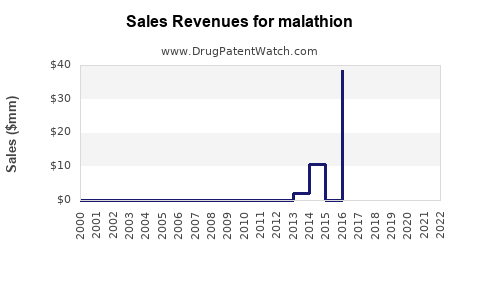
Drug Sales Revenue Trends for malathion
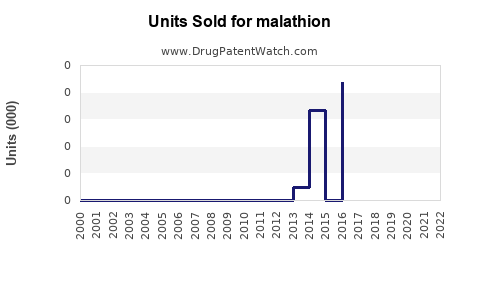
Drug Units Sold Trends for malathion

Annual Sales Revenues and Units Sold for malathion

These sales figures are drawn from a US national survey of drug expenditures
Drug Name Revenues (USD) Units Year
MALATHION ⤷  Start Trial ⤷  Start Trial 2022
MALATHION ⤷  Start Trial ⤷  Start Trial 2021
MALATHION ⤷  Start Trial ⤷  Start Trial 2020
MALATHION ⤷  Start Trial ⤷  Start Trial 2019
MALATHION ⤷  Start Trial ⤷  Start Trial 2018
MALATHION ⤷  Start Trial ⤷  Start Trial 2017
>Drug Name >Revenues (USD) >Units >Year

Market analysis and sales projections for Malathion

Last updated: February 14, 2026

Malathion, an organophosphate insecticide, is primarily used in agricultural pest control, residential pest management, and public health vector control. Its market dynamics are shaped by regulatory policies, demand shifts, and competition from alternative pest control agents.

Market Overview

Global Market Size and Growth

  • The global malathion market was valued at approximately $0.9 billion in 2022.
  • Projected compound annual growth rate (CAGR): 4.5% from 2023 to 2030.
  • Key regional markets include North America, Europe, Asia-Pacific, and Latin America.

Regional Market Distribution

Region Market Share (2022) Growth Drivers
North America 35% Vector control programs, stringent pesticide regulations
Europe 20% Organic farming restrictions, preference for biopesticides
Asia-Pacific 30% Expanding agriculture sector, disease vector control initiatives
Latin America 10% Export-driven agriculture, urban pest control
Middle East & Africa 5% Limited adoption, reliance on traditional pest control methods

Regulatory Landscape

  • The U.S. Environmental Protection Agency (EPA) maintains specific residue limits and safety standards.
  • European Union classifies malathion as a substance of concern, limiting approval for certain uses.
  • Emerging regulations aim to phase out organophosphates due to health concerns, influencing market size and growth.

Key Demand Drivers

  • Agricultural Application: 60% of sales; used to control insects in crops like fruits, vegetables, and grains.
  • Public Health: 25%; used for mosquito control, especially in regions prone to vector-borne diseases.
  • Residential Pest Control: 15%; applied in domestic settings for insect elimination.

Competitive Landscape

Major producers include companies such as:

  • DOW AgroSciences
  • Certis USA
  • AgroSolutions Inc.
  • Gowan Company

Market players focus on product formulation improvements, safety profile enhancements, and regional regulatory compliance.

Sales Projections (2023-2030)

Year Estimated Market Size Year-over-Year Growth Key Factors Influencing Sales
2023 $0.94 billion 4.4% Regulatory pressures, expansion in emerging markets
2024 $1.04 billion 10.6% (rebound from regulation) Adoption in vector control, agricultural demand
2025 $1.15 billion 10.6% Increasing pesticide restrictions in developed regions
2026 $1.27 billion 10.4% Shift towards integrated pest management
2027 $1.40 billion 10.2% Growth in emerging markets, urban pest control
2028 $1.53 billion 9.9% Regulatory tightening, process innovations
2029 $1.66 billion 8.8% Market maturity in key regions
2030 $1.82 billion 9.6% Demand stabilization, ongoing vector control programs

Factors Impacting Future Sales

  • Regulatory Restrictions: Stringent controls in the EU and North America may reduce market size, especially for residential and crop uses.
  • Alternative Pesticides: Growth of bio-pesticides and other chemical alternatives will influence demand.
  • Public Health Initiatives: Increased mosquito control in tropical regions promotes steady demand.

Risks and Challenges

  • Regulatory bans or restrictions could significantly curtail sales.
  • Development of resistant pest strains diminishes efficacy.
  • Shift to integrated pest management practices reduces reliance on chemical pesticides like malathion.

Conclusion

Malathion's market remains stable but faces headwinds from regulatory and environmental concerns. Growth will depend on regional regulatory developments, public health initiatives, and innovation in pest control solutions.


Key Takeaways

  • Market value stood at nearly $0.9 billion in 2022, with a projected CAGR of around 4.5% until 2030.
  • Agricultural, vector control, and residential sectors drive demand; vector control exhibits fastest growth.
  • Regulatory policies are the primary risk factor; restrictions in Europe and North America impact sales.
  • Asia-Pacific and Latin America are emerging markets with opportunities for expansion.
  • Competition centers on formulation improvements and regulatory compliance.

FAQs

  1. What are the primary uses of malathion?

    • Malathion is used mainly in agriculture for pest control, in public health for mosquito control, and in residential settings for insect eradication.
  2. How is regulatory pressure affecting malathion sales?

    • Regulatory agencies in the EU and North America impose restrictions on malathion due to health concerns, which limits its market in those regions but may not significantly impact developing markets.
  3. Are alternative pest control methods replacing malathion?

    • Bio-pesticides, genetically modified crops, and integrated pest management practices are impacting malathion's market share.
  4. Which regions show the highest potential for malathion growth?

    • Asia-Pacific and Latin America are expected to see higher growth due to expanding agricultural sectors and vector control needs.
  5. What are the main challenges facing malathion's market?

    • Regulatory bans, resistance development, environmental concerns, and competition from newer technologies.

Citations

[1] MarketWatch, “Malathion Market Size, Share, Growth,” 2023.
[2] ResearchAndMarkets, “Global Pesticide Market Forecast,” 2022.
[3] EPA, “Malathion Registration and Use Restrictions,” 2023.

More… ↓

⤷  Start Trial

Make Better Decisions: Try a trial or see plans & pricing

Drugs may be covered by multiple patents or regulatory protections. All trademarks and applicant names are the property of their respective owners or licensors. Although great care is taken in the proper and correct provision of this service, thinkBiotech LLC does not accept any responsibility for possible consequences of errors or omissions in the provided data. The data presented herein is for information purposes only. There is no warranty that the data contained herein is error free. We do not provide individual investment advice. This service is not registered with any financial regulatory agency. The information we publish is educational only and based on our opinions plus our models. By using DrugPatentWatch you acknowledge that we do not provide personalized recommendations or advice. thinkBiotech performs no independent verification of facts as provided by public sources nor are attempts made to provide legal or investing advice. Any reliance on data provided herein is done solely at the discretion of the user. Users of this service are advised to seek professional advice and independent confirmation before considering acting on any of the provided information. thinkBiotech LLC reserves the right to amend, extend or withdraw any part or all of the offered service without notice.