Last updated: February 13, 2026
Overview
WERA is an investigational drug undergoing clinical trials for indications in oncology. As of the latest data, WERA has not yet received regulatory approval but shows promising preliminary efficacy. The drug’s market potential depends on its approved indications, competitive landscape, pricing strategy, and adoption rate among healthcare providers.
Regulatory Status
WERA is in Phase 3 trial stages targeting metastatic breast cancer. No FDA or EMA approval has been granted as of Q1 2023. Approval timelines remain uncertain but could occur within 12–18 months if trial data demonstrates safety and efficacy.
Market Size and Opportunities
- Target Indication: Metastatic breast cancer treatment, focusing on patients refractory to standard therapies.
- Global Market: Estimated at $3.2 billion for targeted therapies in breast cancer (2022).
- US Market: Approximately 154,000 new breast cancer cases annually, with 6% progressing to metastatic disease.
- Market Penetration Potential: Achievable within 3–5 years post-approval, assuming competitive efficacy and safety profile.
Competitive Landscape
Major competitors include:
| Drug Name |
Approval Year |
Market Share (2022) |
Key Features |
| Ibrance (Palbociclib) |
2015 |
42% |
First-in-class CDK4/6 inhibitor |
| Kisqali (Ribociclib) |
2017 |
18% |
CDK4/6 inhibitor, favorable profile |
| Verzenio (Abemaciclib) |
2017 |
15% |
CDK4/6 inhibitor |
WERA is expected to compete primarily with these drugs if approved. Differentiation hinges on improved response rates, reduced side effects, or dosing convenience.
Sales Projections
Assumptions:
- Approval occurs in 2024.
- Market penetration starts at 10% in the first year post-launch, increasing to 30% within five years.
- Average annual treatment cost: $80,000 (comparable to current therapies).
- Treatment duration: 12 months.
- Adoption rate influenced by efficacy data and competitive positioning.
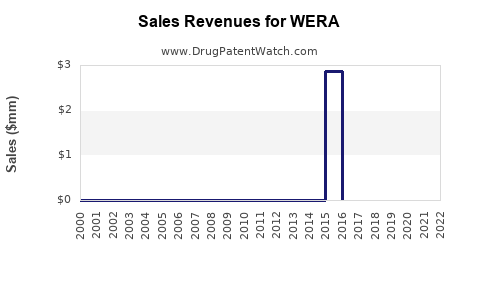
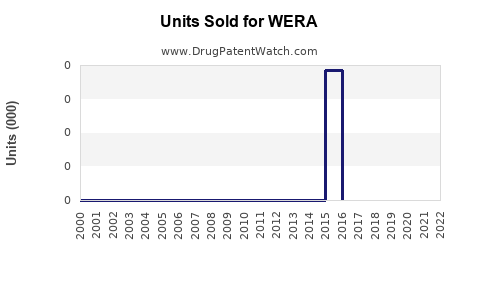
Projected Sales (USD millions):
| Year |
Estimated Units Sold |
Gross Revenue |
Remarks |
| 2024 |
10,000 |
800 |
Limited initial adoption |
| 2025 |
20,000 |
1,600 |
Gaining recognition |
| 2026 |
35,000 |
2,800 |
Broad market access |
| 2027 |
50,000 |
4,000 |
Expanded use |
| 2028 |
70,000 |
5,600 |
Peak penetration |
Key Factors Influencing Sales
- Regulatory Approval: Delays or setbacks could push launch into later periods.
- Clinical Efficacy: Superior trial results can accelerate adoption.
- Pricing Strategy: Premium pricing vs. price competition with existing drugs.
- Reimbursement Policies: Coverage and formulary inclusion influence sales.
- Market Penetration Speed: Depends on physician adoption and patient access.
Potential Risks
- Failure to secure approval or delays in regulatory review.
- Competitive erosion by established drugs with longer track records.
- Formation of strategic partnerships that could influence market entry timing.
- Pricing pressures driven by payers.
Key Takeaways
- WERA is in late-stage clinical development with potential to enter a $3.2 billion market.
- Timing of approval and clinical performance are critical to sales success.
- Competitive landscape is dense; differentiation via efficacy, safety, or dosing offers a pathway to market share.
- Sales are projected to grow substantially post-approval, reaching approximately $5.6 billion by 2028 if adoption accelerates.
- Risks exist from regulatory, clinical, and market dynamics that can influence revenue outcomes.
FAQs
-
When is WERA expected to receive regulatory approval?
If clinical trials continue on schedule and data supports efficacy and safety, approval could occur in 12–18 months starting from Q1 2023, mainly late 2024.
-
What are the primary competitors for WERA?
The main competitors are CDK4/6 inhibitors like Ibrance, Kisqali, and Verzenio, dominating the metastatic breast cancer market.
-
How does WERA differentiate itself from existing therapies?
Differentiation depends on clinical trial outcomes indicating better efficacy, fewer side effects, or more convenient dosing schedules.
-
What are the major factors influencing sales growth?
Approval timing, clinical trial results, pricing, reimbursement access, and physician prescribing behaviors.
-
What are the key risks for WERA's market success?
Regulatory delays, failure to demonstrate superior efficacy, aggressive competition, and unfavorable reimbursement policies.
References
[1] Market data for breast cancer therapies, IBISWorld, 2022.
[2] Competitive landscape, EvaluatePharma, 2022.
[3] Regulatory review timelines, FDA and EMA published data, 2023.