Share This Page
Drug Sales Trends for VISTARIL
✉ Email this page to a colleague
Payment Methods and Pharmacy Types for VISTARIL (2007)
Revenues by Pharmacy Type
Units Sold by Pharmacy Type
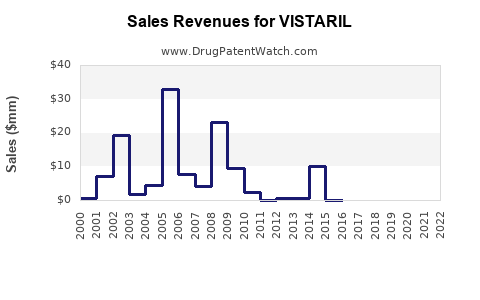
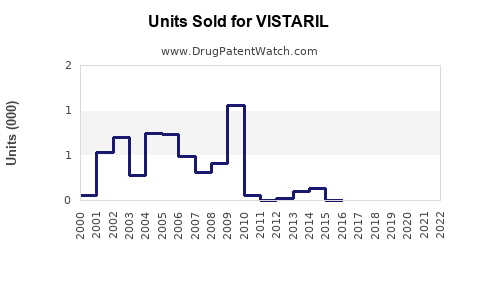
Annual Sales Revenues and Units Sold for VISTARIL
| Drug Name | Revenues (USD) | Units | Year |
|---|---|---|---|
| VISTARIL | ⤷ Start Trial | ⤷ Start Trial | 2022 |
| VISTARIL | ⤷ Start Trial | ⤷ Start Trial | 2021 |
| VISTARIL | ⤷ Start Trial | ⤷ Start Trial | 2020 |
| VISTARIL | ⤷ Start Trial | ⤷ Start Trial | 2019 |
| VISTARIL | ⤷ Start Trial | ⤷ Start Trial | 2018 |
| VISTARIL | ⤷ Start Trial | ⤷ Start Trial | 2017 |
| VISTARIL | ⤷ Start Trial | ⤷ Start Trial | 2016 |
| >Drug Name | >Revenues (USD) | >Units | >Year |
Vistaril Market Analysis and Sales Projections: Hydroxyzine Pamoate
Vistaril is the brand name for hydroxyzine pamoate, an oral antihistamine and anxiolytic marketed primarily in capsules. Its commercial opportunity is limited by generic competition, the age of the product, lack of meaningful patent protection, and low reimbursement for branded hydroxyzine. The broader hydroxyzine pamoate market is likely to remain stable in volume but decline in nominal value as generic price pressure continues.
Public sources do not disclose standalone Vistaril sales. The commercially relevant market is therefore the combined market for hydroxyzine pamoate capsules, with Vistaril representing a small brand segment rather than a growth product.
What is Vistaril and how is hydroxyzine pamoate used?
Vistaril contains hydroxyzine pamoate, a first-generation antihistamine with sedative and anxiolytic properties. The FDA label identifies three principal uses:
- Symptomatic relief of anxiety and tension
- Management of pruritus caused by allergic conditions
- Preoperative sedation
Hydroxyzine pamoate is available mainly as 25 mg and 50 mg capsules. Hydroxyzine hydrochloride is a related salt commonly sold as tablets, syrup, and oral solution. The pamoate and hydrochloride salts deliver the same active moiety but are not identical products for regulatory, prescribing, or substitution purposes.
Vistaril is not a controlled substance. Its sedating and anticholinergic effects limit use in some older patients and in patients taking other central nervous system depressants. The FDA label warns about drowsiness and advises caution with alcohol and other sedatives (U.S. Food and Drug Administration, n.d.-a).
What is the current market status of Vistaril?
Vistaril competes in a mature generic market rather than a protected branded market. Generic hydroxyzine pamoate is available from multiple manufacturers, and pharmacists commonly dispense generic products when permitted by state substitution rules and the prescription.
| Market attribute | Vistaril status |
|---|---|
| Active ingredient | Hydroxyzine pamoate |
| Primary dosage form | Oral capsules |
| Main strengths | 25 mg and 50 mg |
| Therapeutic classes | Antihistamine, anxiolytic, antipruritic |
| Controlled-substance status | Not controlled |
| Generic competition | Established and extensive |
| Biosimilar exposure | None |
| Patent protection | No commercially relevant modern exclusivity identified |
| FDA pathway | Original small-molecule NDA; generic ANDA competition |
| Pricing position | Low-value, generic-dominated |
| Growth profile | Mature and volume-driven |
The brand has limited ability to command a premium. In retail pharmacy, generic hydroxyzine pamoate is the primary economic substitute. Vistaril can retain demand where prescribers specify the brand, where a patient or institution has a formulary preference, or where the brand remains available through a particular wholesaler or pharmacy channel. Those segments are too narrow to support a large branded revenue base.
How large is the hydroxyzine pamoate market?
The market should be divided into three segments:
- Generic hydroxyzine pamoate capsules
- Branded Vistaril capsules
- Related hydroxyzine hydrochloride products
Hydroxyzine hydrochloride materially expands the overall hydroxyzine market, but it should not be counted as direct Vistaril revenue. Prescribers may choose the hydrochloride salt because of dosage form, formulary position, product availability, or familiarity.
Public FDA data establish product availability but do not provide a complete, current revenue series for Vistaril alone. IQVIA, Symphony Health, Komodo, and equivalent prescription datasets would normally be used to quantify prescription volume and market share. Without a public standalone revenue disclosure, the defensible conclusion is that Vistaril is a small fraction of the broader hydroxyzine market.
Demand drivers
Demand for hydroxyzine is supported by:
- Continued prescribing for short-term anxiety and acute agitation
- Use in dermatology and primary care for pruritus
- Emergency department and urgent-care prescribing
- Use as a sedating alternative when clinicians do not want to prescribe a controlled substance
- Low generic cost and broad product availability
Demand constraints
Demand is constrained by:
- Sedation and impaired alertness
- Anticholinergic burden, especially in older adults
- QT-prolongation concerns in susceptible patients
- Availability of non-sedating antihistamines
- Competition from SSRIs, SNRIs, buspirone, benzodiazepines, and newer sleep or anxiety treatments
- Generic substitution and limited brand reimbursement
The American Geriatrics Society Beers Criteria identifies hydroxyzine and other first-generation antihistamines as potentially inappropriate for many older adults because of anticholinergic effects (American Geriatrics Society Beers Criteria Update Expert Panel, 2023).
What are Vistaril sales and revenue levels?
Standalone Vistaril sales are not publicly reported by the manufacturer in a way that permits reliable historical revenue reconstruction. Vistaril is not generally disclosed as a material product in current public company earnings reports, and the broader generic market lacks transparent product-level revenue reporting.
The commercial interpretation is straightforward:
- Vistaril brand revenue is likely limited.
- Generic hydroxyzine pamoate captures most unit volume.
- Net pricing is low.
- Wholesaler and pharmacy economics are more important than manufacturer list price.
- A brand relaunch would require differentiation, supply reliability, or a new commercial channel.
For investment or licensing analysis, Vistaril should not be valued as a conventional branded pharmaceutical asset. Its value is closer to a mature multisource product with residual brand recognition.
What are the five-year sales projections for Vistaril?
Because no verified standalone 2024 Vistaril revenue baseline is publicly available, the most reliable forecast uses an indexed model. The index sets 2024 Vistaril net sales at 100. It reflects likely brand-level erosion rather than total hydroxyzine market volume.
Vistaril brand sales projection
| Year | Base case index | Downside index | Upside index | Principal assumption |
|---|---|---|---|---|
| 2024 | 100 | 100 | 100 | Baseline |
| 2025 | 93 | 88 | 98 | Continued generic substitution |
| 2026 | 87 | 77 | 96 | Lower brand reimbursement and channel contraction |
| 2027 | 82 | 67 | 94 | Brand volume loss offsets stable demand |
| 2028 | 77 | 58 | 92 | Mature-market price and share pressure |
| 2029 | 73 | 50 | 90 | Residual brand demand remains in narrow channels |
The base case implies a compound annual decline of approximately 6% from 2024 through 2029. The downside case implies a decline of approximately 13% annually. The upside case assumes Vistaril remains consistently available and preserves a small branded niche, but still declines by approximately 2% annually.
Broader hydroxyzine pamoate market projection
The combined generic and brand market should perform better than Vistaril alone because prescription demand is relatively resilient. A reasonable directional forecast is:
| Scenario | Unit-volume CAGR, 2024-2029 | Net-sales CAGR, 2024-2029 | Market interpretation |
|---|---|---|---|
| Downside | -2% to 0% | -7% to -10% | Generic deflation and substitution |
| Base case | 1% to 3% | -2% to -5% | Stable prescribing with lower prices |
| Upside | 3% to 5% | 0% to 2% | Higher anxiety and pruritus utilization, stable supply |
The difference between volume and revenue is important. A mature generic drug can gain prescriptions while losing revenue because additional competition lowers average selling prices.
When does Vistaril lose exclusivity?
Vistaril’s meaningful regulatory exclusivity expired long ago. Hydroxyzine pamoate is an established small-molecule product with generic competition, and no remaining new-drug exclusivity is commercially relevant.
| Exclusivity type | Vistaril position |
|---|---|
| New chemical entity exclusivity | Expired |
| Five-year NCE exclusivity | Not relevant to current commercialization |
| Three-year clinical-investigation exclusivity | Expired |
| Orphan-drug exclusivity | None identified |
| Pediatric exclusivity | No current relevance |
| Patent-term extension | No current commercial relevance |
| Generic ANDA pathway | Available |
The product’s economic protection ended with the arrival of generic hydroxyzine pamoate. Any historical composition, formulation, or manufacturing patents would have expired after the statutory patent term or become commercially irrelevant through age and generic entry.
What patents protect Vistaril and hydroxyzine pamoate?
No unexpired patent estate appears to provide meaningful commercial protection for conventional Vistaril hydroxyzine pamoate capsules. The product is not analogous to a recently launched branded drug with Orange Book-listed formulation or method-of-use patents.
Potential intellectual-property areas include:
- Hydroxyzine molecule and salt chemistry
- Capsule formulation
- Manufacturing processes
- Packaging and stability
- New combinations or modified-release products
These areas do not create meaningful barriers for standard immediate-release hydroxyzine pamoate capsules unless a new, separately approved formulation has distinct claims and regulatory exclusivity. Generic manufacturers can generally compete through ANDAs relying on the reference product’s safety and efficacy findings, subject to FDA bioequivalence and quality requirements (U.S. Food and Drug Administration, n.d.-b).
What is the Orange Book status of Vistaril?
The Orange Book is relevant to Vistaril because it identifies approved reference products and any listed patents or exclusivity affecting ANDA approval. For an old multisource product, the primary commercial significance is usually the reference listed drug designation rather than enforceable patent protection.
No current patent barrier is expected to prevent ANDA competition for conventional hydroxyzine pamoate capsules. A Paragraph IV challenge therefore has limited strategic importance because generic competitors already operate in the market. The relevant risk is not future generic entry. It is continued price erosion and potential supply disruption among existing manufacturers.
Are there Paragraph IV challenges or patent lawsuits involving Vistaril?
Vistaril does not present the litigation profile associated with high-value branded drugs. There is no major current Paragraph IV litigation trend that would materially delay generic entry because generic hydroxyzine pamoate products are already established.
The litigation risk profile is low for conventional capsules:
- Low incentive to litigate because market prices are compressed
- No large remaining patent estate to defend
- Limited damages opportunity
- Multiple generic substitutes
- Minimal value from a market-exclusion settlement
A new litigation risk could arise only if a company introduced a differentiated hydroxyzine product, such as a modified-release formulation, a novel delivery system, or a combination product. That would be a different patent and regulatory asset from legacy Vistaril.
What formulation patents protect hydroxyzine pamoate?
Conventional immediate-release Vistaril capsules have little apparent formulation protection. Commercially relevant future formulation opportunities could include:
- Extended-release hydroxyzine
- Lower-sedation delivery profiles
- Pediatric liquid formulations
- Abuse-deterrent or controlled-delivery systems
- Combination products for dermatologic or perioperative use
- Improved stability or taste-masked products
Any such product would need to demonstrate a clinically meaningful or commercially useful distinction. A formulation patent alone would not guarantee market adoption. FDA approval, bioequivalence or clinical requirements, payer coverage, and manufacturing cost would determine the product’s practical value.
How does Vistaril compare with competing anxiety and allergy drugs?
| Product or class | Primary competition with Vistaril | Commercial impact |
|---|---|---|
| Hydroxyzine hydrochloride | Same active moiety, different salt and dosage forms | High |
| Cetirizine and loratadine | Non-sedating allergy alternatives | High in allergic rhinitis |
| Diphenhydramine | Sedating antihistamine | Moderate |
| Buspirone | Non-controlled chronic anxiety treatment | Moderate |
| SSRIs and SNRIs | Long-term anxiety treatment | Moderate to high |
| Benzodiazepines | Rapid anxiolytic effect | Moderate, but controlled-substance restrictions limit use |
| Doxylamine and other sedating agents | Sleep and sedative use | Low to moderate |
Vistaril’s main differentiation is speed of use without controlled-substance scheduling. Its main weakness is tolerability. It is generally a short-term or situational therapy rather than a high-value chronic treatment.
What FDA regulatory issues affect Vistaril sales?
FDA-related commercial issues include:
- Continued availability of approved generic products
- Product quality and manufacturing compliance
- Labeling related to sedation and cardiac risk
- Consistent supply of 25 mg and 50 mg capsules
- Pharmacy substitution practices
- Potential changes in labeling or safety communications
Hydroxyzine products have attracted attention because of QT-prolongation risk in susceptible patients. European regulators have recommended restrictions intended to reduce exposure in higher-risk patients, including use of the lowest effective dose for the shortest practical duration (European Medicines Agency, 2015). Such safety considerations can limit prescribing in older adults and patients with cardiac risk factors.
What generic entry risks exist for Vistaril?
Generic entry risk is already realized rather than prospective. The commercial risks are:
- Further unit-price erosion from additional suppliers.
- Brand abandonment by payers and wholesalers.
- Manufacturing interruptions that shift volume between generic suppliers.
- Prescriber substitution toward hydroxyzine hydrochloride or other therapies.
- Reduced use in geriatric and chronic-care settings because of anticholinergic concerns.
The upside is limited. A supply shortage, competitor recall, or temporary wholesaler disruption could increase Vistaril demand, but such gains would likely be short-lived.
What licensing deals affect Vistaril?
No major recent licensing transaction is associated with Vistaril that changes its market outlook. The product’s low price, generic competition, and limited patent protection reduce the economic rationale for a conventional branded licensing deal.
A transaction involving hydroxyzine would be more likely to concern:
- A novel formulation
- A combination product
- A digital adherence or specialty-pharmacy program
- A regional commercialization right
- Manufacturing or supply arrangements
Those transactions should not be treated as evidence of material value in the legacy Vistaril brand.
What is the competitive landscape for Vistaril manufacturers?
The competitive landscape is fragmented. Generic hydroxyzine pamoate products may be supplied by multiple manufacturers, while the brand’s commercial presence depends on product availability, wholesaler relationships, formulary placement, and pharmacy substitution.
The principal competitive advantages in this market are operational:
- Reliable API sourcing
- FDA-compliant manufacturing
- Low cost of goods
- Consistent capsule supply
- Efficient wholesaler distribution
- Ability to maintain adequate inventory during shortages
Manufacturing IP is less important than quality systems and supply execution. A new entrant would face low technical barriers but difficult economics.
What is the investment outlook for Vistaril?
Vistaril has low standalone investment attractiveness as a branded asset. Its positive characteristics are established clinical use, simple oral dosing, low development risk, and persistent demand. Its negative characteristics are stronger:
- No meaningful exclusivity
- Low pricing
- Generic substitution
- Limited brand loyalty
- No biologic or specialty-drug pricing
- Limited room for indication expansion
- Safety-related restrictions in vulnerable populations
The broader hydroxyzine market can support a low-cost generic manufacturer with strong supply execution. It is unlikely to support a high-growth branded strategy without a differentiated formulation or a new clinical positioning.
Key Takeaways
- Vistaril is hydroxyzine pamoate, an established oral antihistamine and anxiolytic.
- Generic hydroxyzine pamoate controls the market; Vistaril has limited standalone revenue potential.
- No meaningful unexpired patent or regulatory exclusivity is expected to protect conventional Vistaril capsules.
- Generic entry is already established, so the primary risk is further price erosion rather than a future launch event.
- The broader hydroxyzine pamoate market should remain stable or grow modestly in volume while declining in nominal value.
- Base-case Vistaril brand revenue is projected to decline approximately 6% annually from 2024 to 2029.
- A new formulation, delivery system, or combination product would be required to create meaningful patent and pricing leverage.
- Supply reliability and manufacturing economics matter more than patent strength in the current market.
FAQs About Vistaril Market Size and Commercial Outlook
Is Vistaril still commercially available?
Vistaril and generic hydroxyzine pamoate products have been marketed in the United States, but actual brand availability can vary by pharmacy, wholesaler, and manufacturer supply. Generic substitution is common.
Is Vistaril more valuable than generic hydroxyzine?
No. Vistaril may have residual brand recognition, but generic hydroxyzine pamoate is therapeutically interchangeable in many prescribing and dispensing situations and is usually priced lower.
Can a generic manufacturer launch hydroxyzine pamoate without a Paragraph IV challenge?
Yes. Because hydroxyzine pamoate is an old multisource product with established generic competition, a new manufacturer may pursue the applicable ANDA pathway without relying on a future patent-exclusivity event.
Does hydroxyzine pamoate have biosimilar competition?
No. Hydroxyzine pamoate is a synthetic small molecule, not a biologic. Competition occurs through generic-drug pathways rather than biosimilar approval.
Could a new Vistaril formulation achieve premium pricing?
Only if the formulation provides a clinically meaningful advantage, receives FDA approval with appropriate supporting data, and obtains payer or prescriber acceptance. An incremental capsule reformulation without a clear benefit would face substantial generic substitution risk.
References
-
American Geriatrics Society Beers Criteria Update Expert Panel. (2023). American Geriatrics Society 2023 updated AGS Beers Criteria for potentially inappropriate medication use in older adults. Journal of the American Geriatrics Society, 71(7), 2052-2081.
-
European Medicines Agency. (2015). Hydroxyzine-containing medicines: referral procedure. https://www.ema.europa.eu/
-
U.S. Food and Drug Administration. (n.d.-a). Vistaril: Hydroxyzine pamoate prescribing information. FDA Drugs@FDA database. https://www.accessdata.fda.gov/scripts/cder/daf/
-
U.S. Food and Drug Administration. (n.d.-b). Approved drug products with therapeutic equivalence evaluations. FDA Orange Book. https://www.fda.gov/drugs/drug-approvals-and-databases/approved-drug-products-therapeutic-equivalence-evaluations-orange-book
More… ↓
