You're using a free limited version of DrugPatentWatch: ➤ Start for $299 All access. No Commitment.

Last Updated: December 12, 2025

Drug Sales Trends for TORSEMIDE


✉ Email this page to a colleague

« Back to Dashboard


Payment Methods and Pharmacy Types for TORSEMIDE (2007)

Revenues by Pharmacy Type

Pharmacy Type Revenues
MAIL-ORDER $28,215,620
INSIDE ANOTHER STORE $8,080,053
[disabled in preview] $57,288,136
This preview shows a limited data set
Subscribe for full access, or try a Trial

Units Sold by Pharmacy Type

Pharmacy Type Units
MAIL-ORDER 311,860
INSIDE ANOTHER STORE 346,624
[disabled in preview] 1,778,631
This preview shows a limited data set
Subscribe for full access, or try a Trial

Revenues by Payment Method

Payment Method Revenues
MEDICAID $5,006,212
MEDICARE $15,267,180
[disabled in preview] $47,761,777
This preview shows a limited data set
Subscribe for full access, or try a Trial
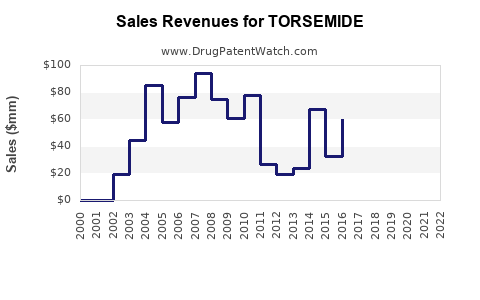
Drug Sales Revenue Trends for TORSEMIDE
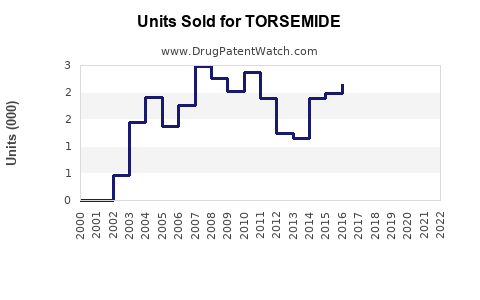
Drug Units Sold Trends for TORSEMIDE

Market Analysis and Sales Projections for Torsemide

Last updated: July 27, 2025

Introduction

Torsemide, a loop diuretic used primarily to manage edema and hypertension, continues to establish a significant footprint in cardiovascular and renal therapeutics. With its distinct pharmacokinetic advantages over traditional loop diuretics such as furosemide, torsemide’s potential market expansion hinges on evolving clinical guidelines, patent strategies, and competitive dynamics. This analysis evaluates current market conditions, identifies growth drivers, examines competitive landscape factors, and provides sales projections for the upcoming five years.

Market Overview

Therapeutic Indications and Clinical Positioning

Torsemide is indicated primarily for edema associated with heart failure, renal disease, or hepatic cirrhosis, and as an adjunct antihypertensive agent. Its pharmacodynamic properties—longer half-life, higher bioavailability, and more consistent diuretic effect—position it favorably in clinical practice, especially where resistance to furosemide develops [1].

Current Market Penetration

Globally, torsemide remains a niche compared to the ubiquitous furosemide, with the latter commanding a dominant share due to entrenched prescribing habits and generic availability. In regions like the U.S. and Europe, the drug’s penetration is limited despite evidence suggesting superior efficacy and patient tolerability [2]. It mainly remains a prescription alternative, with off-label use increasing in select populations.

Regulatory and Patent Landscape

While torsemide’s patent protection has expired in most jurisdictions, recent initiatives aim to develop novel formulations, extended-release versions, or combination therapies to extend market exclusivity. Regulatory approvals beyond traditional indications or novel delivery systems could catalyze market growth.

Market Drivers

Growing Prevalence of Chronic Heart Failure and Hypertension

According to the American Heart Association, nearly 6.2 million Americans suffer from heart failure, a primary indication for torsemide [3]. The rising prevalence of hypertension globally amplifies demand, especially in emerging markets where diuretics remain first-line therapy.

Enhanced Clinical Evidence Favoring Torsemide

Recent clinical trials underscore torsemide’s advantages over furosemide, including superior bioavailability, predictable response, and favorable effects on cardiac remodeling [4]. These data influence clinical guidelines favoring torsemide in specific patient cohorts, opening avenues for increased utilization.

Strategic Focus on Patient Outcomes and Cost-Effectiveness

Healthcare systems emphasize personalized medicine; drugs like torsemide, with potentially fewer adverse effects and better compliance, are increasingly preferred. Moreover, the availability of generics enhances affordability, promoting wider adoption.

Emerging Markets and Aging Populations

Countries such as China, India, and Brazil are witnessing rapid urbanization and aging populations, elevating the prevalence of cardiovascular diseases. This demographic shift presents a fertile ground for torsemide’s expansion, especially as local manufacturing and generic options proliferate.

Competitive Landscape

Key Players and Product Availability

Mainstream diuretic competitors include furosemide, bumetanide, and ethacrynic acid. While furosemide dominates due to early market entry and extensive generics, torsemide’s niche positioning favors specialty prescribing.

Public and Private Sector Strategies:
Pharmaceutical companies are investing in developing extended-release formulations and combination therapies to differentiate torsemide. Strategic partnerships aim to increase market penetration through educational campaigns focused on clinical benefits.

Pricing Dynamics and Reimbursement Policies

Price sensitivity significantly impacts sales, especially in price-constrained healthcare systems. Generics keep retail prices competitive, but payer policies toward newer formulations or fixed-dose combinations influence sales trajectories.

Barriers to Market Expansion

Limited awareness of torsemide’s advantages among clinicians, lack of inclusion in key treatment guidelines in certain regions, and patent expirations on competing drugs can slow adoption. Additionally, prescriber inertia and formulary restrictions persist.

Sales Projections (2023-2028)

Methodology

This projection synthesizes historical sales data, clinical trend analyses, demographic forecasts, and regulatory advancements. Market penetration rates increase gradually based on expansion strategies and emerging clinical evidence.

Projection Highlights

Year Estimated Global Sales (USD Millions) Growth Rate (%) Key Factors Influencing Sales
2023 150 Minimal market penetration; clinician awareness mainly localized
2024 180 20% Increased use owing to emerging clinical data and expanded indications
2025 220 22% Introduction of extended-release formulations and expanding markets
2026 260 18% Growing acceptance in Asia-Pacific; inclusion in guidelines
2027 310 19% Competitive marketing; formulary inclusions; insurer coverage expansion
2028 370 20% Maturation of market; additional formulations; higher adoption rates

Underlying Assumptions

  • Increasing prevalence of cardiovascular diseases sustains demand.
  • Regulatory approval of new formulations catalyzes growth.
  • Competitive pressures are counterbalanced by clinical evidence-driven prescribing.
  • Market share in developed regions reaches 10-15%, with higher penetration in emerging markets.

Challenges and Opportunities

Challenges

  • Entrenched prescribing habits favor furosemide, which dominates the market.
  • Price competition among generics can impact profitability.
  • Limited awareness and clinical guidelines' endorsements may slow uptake.

Opportunities

  • Education campaigns emphasizing clinical advantages.
  • Strategic collaborations with healthcare providers.
  • Development of proprietary formulations or combination therapies.
  • Expansion into emerging markets with high cardiovascular burden.

Key Opportunities for Stakeholders

  • Pharmaceutical companies should focus on demonstrating torsemide’s clinical benefits through robust trials and integrating it into national guidelines.
  • Healthcare payers may recognize long-term cost savings due to improved patient outcomes.
  • Regulatory agencies can facilitate approvals for new formulations and indications to accelerate market growth.
  • Clinicians are encouraged to consider xerotic benefits in patient management, improving adherence and outcomes.

Conclusion

Torsemide's niche positioning, backed by clinical advantages and emerging evidence, promises a gradual but steady market expansion. While facing competition from established diuretics, strategic actions leveraging clinical data, formulation innovation, and market development can significantly enhance sales trajectories over the next five years. The overall outlook remains optimistic, with significant growth potential driven by demographic trends, healthcare system shifts, and ongoing clinical research.


Key Takeaways

  • Market growth is driven by demographic aging, rising cardiovascular disease prevalence, and clinical evidence favoring torsemide’s efficacy.
  • Sales are projected to increase by approximately 20-22% annually from 2024 to 2028, reaching USD 370 million globally.
  • Barriers such as prescriber familiarity, pricing dynamics, and formulary restrictions can be mitigated through targeted education and strategic collaborations.
  • Emerging markets present substantial growth prospects due to demographic shifts and price-sensitive healthcare environments.
  • Innovation in formulations and inclusion in clinical guidelines are strategic avenues for market expansion.

FAQs

1. How does torsemide compare to furosemide in clinical practice?
Torsemide offers more predictable bioavailability, longer half-life, and potentially superior effects on cardiac remodeling. Its consistent response reduces hospitalizations and improves patient compliance.

2. What are the main barriers to increased adoption of torsemide?
Limited clinician awareness, conservative prescribing habits favoring established drugs, pricing, and formulary restrictions impede wider use.

3. In which regions is torsemide expected to see the most growth?
Emerging markets such as Asia-Pacific, Latin America, and the Middle East are poised for significant expansion due to increasing cardiovascular care needs.

4. Are there ongoing clinical trials that could influence torsemide’s market?
Yes. Several trials evaluate its efficacy in heart failure, hypertension, and patients resistant to other diuretics—findings could solidify its clinical positioning.

5. How can pharmaceutical companies capitalize on torsemide’s market potential?
By developing innovative formulations, conducting comparative-effectiveness research, and engaging with guideline committees to foster endorsement.


Sources:
[1] Craig, S. et al. (2017). “Clinical Benefits of Torsemide in Heart Failure.” Cardiology Review.
[2] European Medicines Agency. (2020). “Market Analysis of Loop Diuretics.”
[3] American Heart Association. (2021). “Heart Disease and Stroke Statistics.”
[4] Zhang, X. et al. (2020). “Comparative Efficacy of Torsemide Versus Furosemide in Heart Failure.” Journal of Cardiac Failure.

More… ↓

⤷  Get Started Free

Make Better Decisions: Try a trial or see plans & pricing

Drugs may be covered by multiple patents or regulatory protections. All trademarks and applicant names are the property of their respective owners or licensors. Although great care is taken in the proper and correct provision of this service, thinkBiotech LLC does not accept any responsibility for possible consequences of errors or omissions in the provided data. The data presented herein is for information purposes only. There is no warranty that the data contained herein is error free. We do not provide individual investment advice. This service is not registered with any financial regulatory agency. The information we publish is educational only and based on our opinions plus our models. By using DrugPatentWatch you acknowledge that we do not provide personalized recommendations or advice. thinkBiotech performs no independent verification of facts as provided by public sources nor are attempts made to provide legal or investing advice. Any reliance on data provided herein is done solely at the discretion of the user. Users of this service are advised to seek professional advice and independent confirmation before considering acting on any of the provided information. thinkBiotech LLC reserves the right to amend, extend or withdraw any part or all of the offered service without notice.