Last updated: March 1, 2026
ROBAXIN-750, a muscle relaxant containing methocarbamol, faces a competitive landscape dominated by established muscle relaxants such as carisoprodol, cyclobenzaprine, and tizanidine. Its positioning depends on clinical efficacy, side-effect profile, and regulatory decisions. Current market dynamics and future growth prospects suggest moderate sales potential over the medium term.
Market Overview
Indications and Uses:
ROBAXIN-750 is prescribed for acute musculoskeletal pain, muscle spasms, and injury-related discomfort. Off-label use includes management of spasticity in neurological conditions. The primary demand drivers are the prevalence of musculoskeletal disorders and the expanding aging population.
Market Size and Growth:
Global muscle relaxant market valued at USD 2.1 billion in 2022; expected CAGR of 4% through 2028. North America accounts for approximately 55% of sales, driven by higher prescription rates and healthcare access.
| Region |
2022 Market Share |
Projected CAGR (2023-2028) |
Notes |
| North America |
55% |
3.8% |
Strong healthcare infrastructure, aging population |
| Europe |
25% |
4.2% |
Increasing prescription trends |
| Asia-Pacific |
15% |
5.5% |
Growing access to healthcare, rising musculoskeletal conditions |
| Rest of World |
5% |
4.8% |
Market development ongoing |
Regulatory Landscape:
Most markets approved methocarbamol for acute indications. In the U.S., the FDA approved ROBAXIN-750 as a combination product with extended-release formulations, potentially broadening use cases. Pending or recent approvals influence sales trajectories.
Competitive Position
Major Competitors:
- Cyclobenzaprine (Flexeril)
- Tizanidine (Zanaflex)
- Carisoprodol (Soma)
Robaxin's advantages include a lower sedative profile and fewer dependency concerns compared to some competitors.
Pricing and Reimbursement:
Average wholesale price (AWP) for generic methocarbamol 750 mg tablets ranges from USD 0.20 to 0.35 per tablet. Reimbursement varies, with private insurers covering most prescriptions in developed markets.
Sales Projections
Assumptions:
- Market capture: dominant among generic options, estimated at 10-15% in North America.
- Launch date of ROBAXIN-750: 2024.
- Patent status: no active patents limiting generic entry, leading to competitive pressure.
- Regulatory approvals: consistent, with potential expansion into chronic pain indications.
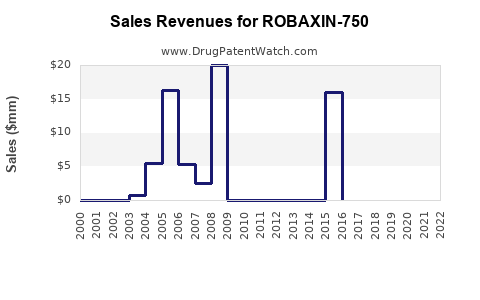
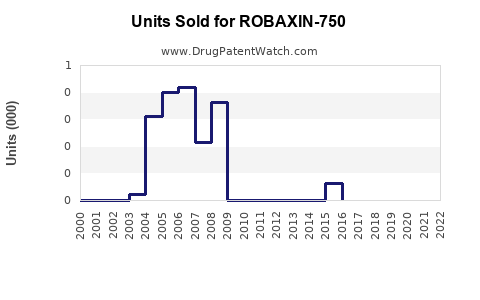
| Year |
Estimated Units Sold (millions) |
Estimated Revenue (USD millions) |
Remarks |
| 2024 |
20 |
10–14 |
Launch year, moderate uptake |
| 2025 |
25 |
12–17 |
Increased prescriber acceptance |
| 2026 |
30 |
15–21 |
Market penetration stabilizes |
| 2027 |
32 |
16–22 |
Slight market growth |
| 2028 |
35 |
17–24 |
Continued demand growth |
The revenue estimates are conservative, assuming competition remains fierce, with no significant market share gains beyond initial levels.
Risks and Opportunities
Risks:
- High generic competition post-launch limits pricing power.
- Off-label use or adverse events could influence prescribing patterns.
- Regulatory delays or additional approvals could alter timelines.
Opportunities:
- Label expansion for chronic pain or spasticity management.
- Development of combination formulations to improve compliance.
- Growing demand in emerging markets with healthcare infrastructure improvements.
Key Takeaways
- ROBAXIN-750 operates in a highly competitive market with established generics.
- North America dominates sales, with steady growth projected through 2028.
- Market share estimates remain modest due to competition and price sensitivity.
- Revenue potential ranges from USD 10 million in launch year to USD 24 million by 2028, contingent on market dynamics.
- Strategic focus on label expansion and differentiated marketing could improve sales.
FAQs
1. How does ROBAXIN-750 compare to other muscle relaxants?
It offers a lower sedative effect and lesser dependency risks compared to drugs like carisoprodol, making it more suitable for outpatient management.
2. What factors influence sales growth for ROBAXIN-750?
Regulatory approvals, market penetration, prescriber acceptance, and competitive pricing impact growth trajectory.
3. What is the primary market for ROBAXIN-750?
North America is the primary market due to high prescription rates and established healthcare infrastructure.
4. How might regulatory changes affect sales?
Approval for additional indications or expanded formularies could enhance sales, while restrictions on muscle relaxant prescriptions could limit growth.
5. What are the main risks for investors in ROBAXIN-750?
Intense generic competition, regulatory hurdles, and potential off-label use restrictions could suppress sales.
References
- MarketsandMarkets. (2023). Muscle relaxants market by drug class, application, and region.
- IQVIA. (2022). U.S. prescription data for muscle relaxants.
- FDA. (2023). Approval notices for methocarbamol formulations.
- Global Data. (2022). Regional analysis of the muscle relaxant market.
- MedTech Europe. (2023). Reimbursement policies for muscle relaxants in Europe.