Drug Sales Trends for ONGLYZA
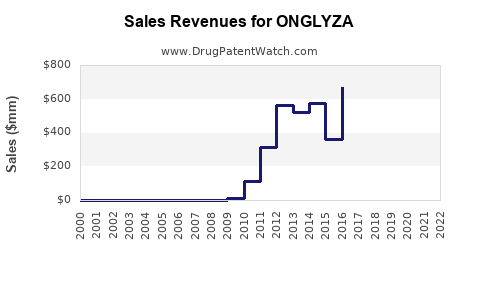
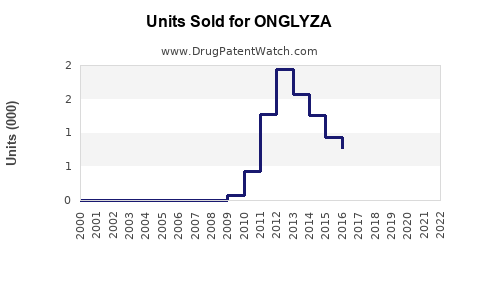
Annual Sales Revenues and Units Sold for ONGLYZA
| Drug Name | Revenues (USD) | Units | Year |
|---|---|---|---|
| ONGLYZA | ⤷ Start Trial | ⤷ Start Trial | 2022 |
| ONGLYZA | ⤷ Start Trial | ⤷ Start Trial | 2021 |
| ONGLYZA | ⤷ Start Trial | ⤷ Start Trial | 2020 |
| ONGLYZA | ⤷ Start Trial | ⤷ Start Trial | 2019 |
| ONGLYZA | ⤷ Start Trial | ⤷ Start Trial | 2018 |
| >Drug Name | >Revenues (USD) | >Units | >Year |
Onglyza Market Analysis and Sales Projections: Saxagliptin Outlook Through 2030
Onglyza, the brand name for saxagliptin, is a mature DPP-4 inhibitor with declining commercial prospects. Its market is constrained by intense generic competition, loss of novelty, cardiovascular safety concerns, and substitution toward GLP-1 receptor agonists and SGLT2 inhibitors. A reasonable base case is for global Onglyza revenue to remain below $200 million annually by 2025 and decline toward $50 million to $100 million by 2030, unless regional licensing or niche use materially changes distribution.
Public companies no longer report a consistent, standalone global sales figure for Onglyza. The projections below therefore use market-based scenarios rather than a company-issued consensus forecast.
What is Onglyza and how does saxagliptin work?
Onglyza contains saxagliptin, an oral DPP-4 inhibitor approved for type 2 diabetes. It inhibits the DPP-4 enzyme, increasing endogenous incretin activity and improving glucose-dependent insulin secretion.
The drug is administered once daily, generally at 2.5 mg or 5 mg doses. A reduced dose is used in patients with renal impairment and in patients receiving strong CYP3A4/5 inhibitors. Onglyza is approved as monotherapy or in combination with other glucose-lowering therapies, including metformin, sulfonylureas and insulin.
FDA regulatory status
The FDA approved Onglyza in July 2009 as an adjunct to diet and exercise for adults with type 2 diabetes. The FDA later approved:
- Onglyza 2.5 mg and 5 mg tablets.
- Kombiglyze XR, a fixed-dose combination of saxagliptin and extended-release metformin.
- Qtern, a fixed-dose combination of saxagliptin and dapagliflozin, in 2017.
Onglyza is not approved for type 1 diabetes, diabetic ketoacidosis or weight-loss treatment. The FDA label includes a warning concerning heart failure risk, particularly in patients with a history of heart failure or renal impairment.[1]
How large is the Onglyza market?
Onglyza operates in the global type 2 diabetes market, which is expanding in patient numbers but shifting toward newer therapies. DPP-4 inhibitors remain widely used because they are oral, generally weight neutral and associated with a low hypoglycemia risk when used without insulin or sulfonylureas. Their commercial position has weakened because GLP-1 receptor agonists and SGLT2 inhibitors provide stronger weight, cardiovascular or renal benefits.
Competitive market structure
| Drug class | Representative products | Commercial position |
|---|---|---|
| DPP-4 inhibitors | Januvia, Tradjenta, Nesina, Onglyza | Mature, price-sensitive oral segment |
| GLP-1 receptor agonists | Ozempic, Rybelsus, Trulicity, Mounjaro | Fast-growing, strong weight-loss demand |
| SGLT2 inhibitors | Jardiance, Farxiga, Invokana | Strong cardiovascular and renal positioning |
| Basal insulin | Lantus, Toujeo, Tresiba | Established, increasingly exposed to biosimilar and follow-on competition |
| Metformin | Generic metformin | First-line, low-cost standard therapy |
Januvia remains the largest historical DPP-4 franchise, while Onglyza has a smaller share and fewer commercial growth drivers. AstraZeneca’s diabetes portfolio has increasingly centered on Farxiga, which has stronger cardiovascular, heart-failure and chronic-kidney-disease indications than saxagliptin.
What were Onglyza’s historical sales?
Onglyza achieved commercial scale after its 2009 launch, but sales remained below the leading DPP-4 products. Public reporting has become less useful because AstraZeneca has not consistently disclosed standalone Onglyza revenue in recent annual reports.
Historical sales were supported by:
- Early adoption of oral DPP-4 therapy.
- Combination use with metformin.
- Use in patients requiring a weight-neutral option.
- Global commercialization through AstraZeneca and regional partners.
- The Qtern combination with dapagliflozin.
Sales later weakened because of:
- Increasing use of GLP-1 receptor agonists.
- SGLT2 inhibitor outcome data.
- Generic pressure across the DPP-4 class.
- The FDA heart-failure warning.
- Rebates and formulary competition.
- Limited differentiation from sitagliptin, linagliptin and alogliptin.
AstraZeneca’s broader diabetes business was materially more dependent on Farxiga than on Onglyza. That distinction matters when evaluating corporate revenue exposure: Onglyza is no longer a major driver of AstraZeneca’s consolidated performance.
What are the Onglyza sales projections through 2030?
The following projection uses a 2024 estimated global revenue base of approximately $150 million to $250 million. The range reflects the lack of current standalone company disclosure and differing regional definitions of branded versus licensed sales.
Base-case projection
| Year | Estimated global Onglyza sales | Annual change | Main assumptions |
|---|---|---|---|
| 2024 | $150 million-$250 million | -10% to -20% | Mature brand, generic erosion in selected markets |
| 2025 | $120 million-$210 million | -10% to -20% | Continued DPP-4 substitution |
| 2026 | $95 million-$175 million | -10% to -18% | More regional generic penetration |
| 2027 | $75 million-$145 million | -10% to -18% | Reduced branded prescribing |
| 2028 | $60 million-$120 million | -10% to -18% | Residual demand in protected or less price-sensitive markets |
| 2029 | $50 million-$100 million | -8% to -17% | Mature tail market |
| 2030 | $40 million-$85 million | -8% to -15% | Predominantly legacy and regional use |
The base case implies a 2024-2030 compound annual decline of approximately 12% to 18%.
Scenario analysis
| Scenario | 2030 global sales | Key assumptions |
|---|---|---|
| Upside | $100 million-$175 million | Slower generic adoption, durable use in renal and elderly populations, successful regional licensing |
| Base case | $40 million-$85 million | Persistent annual erosion and substitution by newer therapies |
| Downside | Below $40 million | Broad generic availability, formulary exclusion and rapid migration to GLP-1 and SGLT2 products |
These figures are directional estimates, not reported company guidance. The most likely commercial outcome is continued decline rather than stabilization or reacceleration.
When did Onglyza lose exclusivity?
Onglyza’s regulatory exclusivity expired long ago. The FDA approved saxagliptin in 2009, so five-year new chemical entity exclusivity would have ended in 2014.[1]
Patent protection is more complex because saxagliptin patents, formulation patents and combination-product patents may have different expiration dates. The relevant commercial question is not only the earliest composition-patent expiry, but whether enforceable patents remained for particular strengths, formulations or combinations.
Patent and exclusivity considerations
| Protection category | Commercial relevance |
|---|---|
| FDA new chemical entity exclusivity | Expired in 2014 |
| Saxagliptin compound patents | Historical core protection; earliest rights expired or approached expiry in the early 2020s |
| Tablet and formulation patents | May have extended protection for specific products or manufacturing routes |
| Saxagliptin/metformin combinations | Separate product and patent analysis required |
| Saxagliptin/dapagliflozin combinations | Qtern has a distinct regulatory and patent profile |
| Pediatric exclusivity | Any applicable six-month extension would have been temporary and is not a current growth factor |
Patent status differs by country. An Orange Book listing is relevant only to U.S. products and does not determine freedom to operate in Europe, Japan, China or emerging markets.
What is the Orange Book status of Onglyza?
Onglyza was approved under NDA 022350. The Orange Book historically listed patents associated with saxagliptin products, including patents covering the active compound and certain product or formulation claims.[2]
The U.S. commercial position has weakened as the principal regulatory exclusivity expired and patent barriers aged. The legal risk for a generic applicant depends on:
- Whether a listed patent remained active at the time of filing.
- Whether the applicant filed a Paragraph IV certification.
- Whether the patent owner sued within the statutory period.
- Whether the product sought approval for Onglyza, Kombiglyze XR or another saxagliptin product.
- Whether the generic applicant carved out patented methods of use.
The Orange Book should be reviewed by NDA and patent number because Onglyza and saxagliptin combination products do not necessarily have identical listings.
Which companies are challenging Onglyza with generics?
Generic competition has emerged through applicants targeting saxagliptin tablets and combination products. The relevant competitors are not limited to one named manufacturer because approvals, tentative approvals, licensing rights and commercial launches vary by jurisdiction.
Potential competitive groups include:
- Large generic manufacturers with global diabetes portfolios.
- Regional manufacturers in India, China, Latin America and Eastern Europe.
- Authorized or licensed distributors.
- Companies developing saxagliptin/metformin combinations.
- Manufacturers using alternative tablet formulations after core compound protection expires.
The main commercial risk comes from price erosion rather than a single competitor. Once several suppliers enter, pharmacy and payer substitution can reduce branded volume rapidly.
Are there Paragraph IV challenges to Onglyza?
Paragraph IV exposure is possible where a generic applicant asserts that an Orange Book-listed patent is invalid, unenforceable or not infringed. A Paragraph IV filing can trigger patent litigation and a 30-month stay of FDA approval under the Hatch-Waxman framework if the patent holder files suit within the statutory period.[3]
For Onglyza, the commercial relevance of Paragraph IV litigation has declined as the product moved beyond its principal exclusivity period. Litigation would matter most if:
- A remaining formulation patent has meaningful term.
- The generic applicant seeks approval before the last relevant patent expiry.
- The branded company claims infringement based on a listed method-of-use patent.
- A settlement delays launch or grants an authorized-generic arrangement.
A complete current litigation conclusion cannot be drawn from the product label alone. Onglyza, Kombiglyze XR and Qtern should be searched separately in FDA and federal court records because litigation involving one product does not automatically apply to the others.
What formulations and methods of use are protected by Onglyza patents?
The historical Onglyza patent estate has included protection related to:
- Saxagliptin and pharmaceutically acceptable salts.
- Solid-state or crystalline forms.
- Oral tablet formulations.
- Dosage strengths.
- Combination therapy with metformin.
- Treatment of type 2 diabetes using saxagliptin.
- Fixed-dose combinations involving other antidiabetic agents.
Method-of-use patents are commercially weaker than composition patents when generic applicants can obtain approval through a label carve-out. Their value depends on whether the patented indication is commercially important and whether physicians, payers or distributors can distinguish the protected use from unprotected uses.
The strongest remaining barriers, where applicable, are usually product-specific formulation claims or combination claims rather than broad disease-treatment claims.
How strong is the Onglyza patent estate?
The Onglyza patent estate is weak as a long-term growth asset and moderate as a short-term defense in selected jurisdictions.
Strengths
- Established regulatory approval.
- Extensive safety and prescribing history.
- Possible residual formulation and combination patents.
- Brand recognition in markets where DPP-4 inhibitors remain common.
- Manufacturing and regulatory experience.
Weaknesses
- New chemical entity exclusivity expired in 2014.
- The core product is clinically differentiated only modestly.
- DPP-4 competitors provide similar oral convenience.
- GLP-1 and SGLT2 products have stronger outcome-driven positioning.
- The FDA heart-failure warning reduces prescriber preference in some patients.
- Patent value is fragmented by product, formulation and country.
- Generic substitution can occur even where some secondary claims remain.
From an investment perspective, Onglyza should be treated as a declining cash-flow asset, not as a platform with substantial patent-driven upside.
What patent litigation and settlements affect Onglyza?
The most relevant litigation risk concerns U.S. ANDA filings for saxagliptin tablets and fixed-dose combinations. Patent settlements can change the actual generic-entry date, but a settlement does not necessarily create durable value for the branded product.
A settlement may include:
- A licensed early-entry date.
- An authorized generic arrangement.
- A supply agreement.
- A covenant not to sue.
- Restrictions on launch timing or formulation.
- Different terms for tablets and combination products.
Settlement terms may remain confidential or be reported in abbreviated form. The absence of a widely publicized settlement should not be interpreted as evidence that generic competition is absent.
What is the biosimilar risk for Onglyza?
Onglyza has no biosimilar risk because saxagliptin is a small-molecule chemical drug. The relevant threat is conventional generic competition under the ANDA pathway.
This distinction affects market forecasting:
- Biosimilar entry generally requires biologic comparability and may involve more complex manufacturing.
- Saxagliptin generics can rely on pharmaceutical equivalence and bioequivalence.
- Generic entry can therefore produce faster price compression.
- Fixed-dose combinations create additional regulatory and manufacturing requirements but do not eliminate generic risk.
How does Onglyza compare with Januvia, Tradjenta and newer diabetes drugs?
| Product | Active ingredient | Class | Relative commercial outlook |
|---|---|---|---|
| Onglyza | Saxagliptin | DPP-4 inhibitor | Declining, mature |
| Januvia | Sitagliptin | DPP-4 inhibitor | Larger franchise, significant patent and generic transition risk |
| Tradjenta | Linagliptin | DPP-4 inhibitor | Durable oral niche, especially where renal dosing is valued |
| Farxiga | Dapagliflozin | SGLT2 inhibitor | Stronger growth and outcome-based demand |
| Jardiance | Empagliflozin | SGLT2 inhibitor | Strong cardiovascular and diabetes position |
| Ozempic/Rybelsus | Semaglutide | GLP-1 receptor agonist | High growth and major category expansion |
| Mounjaro | Tirzepatide | GIP/GLP-1 agonist | High growth, weight-management exposure |
Onglyza’s most defensible niche is oral, weight-neutral glucose lowering for patients who cannot tolerate or access injectable or weight-loss-oriented therapies. That niche is real but commercially limited.
What geographic markets remain important for Onglyza?
The United States remains strategically important because it has historically supported higher branded pricing, but it is also highly exposed to formulary controls and generic substitution.
Key regional considerations include:
- North America: highest pricing but substantial generic and rebate pressure.
- Europe: strong payer control and rapid substitution toward cost-effective alternatives.
- Japan: continued use of oral diabetes therapies, but price revisions reduce long-term revenue.
- China: large diabetic population, intense local competition and centralized procurement risk.
- India: high volume potential but low realized pricing and crowded generic competition.
- Latin America: variable reimbursement and continued use of oral agents.
- Middle East and selected emerging markets: possible residual branded demand through local distributors.
Geographic revenue may persist after U.S. erosion if AstraZeneca or licensees maintain distribution in markets where DPP-4 therapy remains established. Those sales are unlikely to offset global price compression.
What manufacturing and intellectual-property barriers exist?
Manufacturing barriers for saxagliptin are lower than for biologics but are not negligible. Suppliers must control:
- Active pharmaceutical ingredient purity.
- Stereochemical consistency.
- Impurity profiles.
- Solid-state characteristics.
- Tablet dissolution.
- Stability under local climatic conditions.
- Bioequivalence across strengths.
- Combination-product compatibility for metformin formulations.
The core synthesis may be accessible to experienced generic manufacturers. Remaining patents covering a specific crystalline form, process or formulation can require an alternative route or formulation. These barriers may delay entry, but they are unlikely to support premium pricing indefinitely once multiple suppliers qualify.
What generic launch scenarios exist for Onglyza?
Early limited entry
One or two generic suppliers enter selected markets. Brand sales decline gradually, with pricing pressure concentrated in government and managed-care channels.
Broad U.S. entry
Multiple ANDA approvals or launches occur. Net sales fall sharply, potentially by 50% to 80% within two to three years, depending on authorized-generic participation and formulary behavior.
Combination-product substitution
Generic saxagliptin tablets launch before or independently of saxagliptin/metformin combinations. Onglyza loses monotherapy and add-on volume first, while combination products retain a temporary residual niche.
Regional legacy market
U.S. and Western European sales contract substantially, but low-cost branded or licensed sales continue in emerging markets. Global revenue declines more slowly than U.S. revenue but remains structurally negative.
What is the revenue exposure for AstraZeneca and licensees?
Onglyza is unlikely to represent a material percentage of AstraZeneca’s current consolidated revenue. The company’s diabetes growth and strategic value are concentrated in Farxiga, while oncology and biopharmaceutical products account for much larger portions of its portfolio.[4]
The more relevant exposure is held by:
- Regional licensees.
- Generic manufacturers.
- Distributors with branded inventory.
- Companies holding rights to saxagliptin combinations.
- Contract manufacturers supplying legacy markets.
For a potential acquirer, value depends on net sales after rebates, remaining country-specific rights, transfer pricing, inventory commitments and litigation status. Gross prescription volume alone would overstate the asset’s economic value.
Key Takeaways
- Onglyza is a mature saxagliptin brand with declining global revenue.
- FDA new chemical entity exclusivity expired in 2014.
- The product has no biosimilar risk; generic ANDA competition is the principal threat.
- DPP-4 inhibitors are losing share to GLP-1 receptor agonists and SGLT2 inhibitors.
- Estimated global Onglyza sales are approximately $150 million to $250 million in 2024.
- Base-case sales decline to approximately $40 million to $85 million by 2030.
- Remaining patent value is product-specific and jurisdiction-specific.
- Formulation and combination patents may delay entry but are unlikely to create long-term growth.
- Farxiga, not Onglyza, is the strategically important diabetes asset in AstraZeneca’s portfolio.
- The asset is better characterized as a declining regional cash-flow opportunity than as a growth franchise.
FAQs
Is Onglyza still commercially viable after generic entry?
Yes, but primarily in selected regional markets, payer segments and patients who prefer an oral, weight-neutral therapy. Its ability to command premium pricing is limited.
Does Onglyza cause heart failure?
The FDA label includes a warning that saxagliptin may increase the risk of hospitalization for heart failure, particularly in patients with prior heart failure or renal impairment.[1] The warning affects prescribing and payer positioning.
Can a generic company launch saxagliptin without copying the Onglyza brand?
Yes. An ANDA applicant can demonstrate pharmaceutical equivalence and bioequivalence while marketing the product under a generic name, subject to applicable patents, certifications and labeling requirements.
Is Qtern exposed to the same patent risks as Onglyza?
No. Qtern contains saxagliptin and dapagliflozin and has a separate NDA, formulation profile and patent analysis. Onglyza patent status cannot be applied automatically to Qtern.
Could Onglyza sales recover through combination therapy?
A material global recovery is unlikely. Combination therapy can extend residual use, but newer combinations involving SGLT2 inhibitors and GLP-1 therapies have stronger clinical and commercial momentum.
References
- U.S. Food and Drug Administration. (2024). Onglyza (saxagliptin) prescribing information.
- U.S. Food and Drug Administration. (2024). Approved drug products with therapeutic equivalence evaluations: Orange Book.
- U.S. Food and Drug Administration. (2024). Hatch-Waxman amendments and abbreviated new drug applications.
- AstraZeneca. (2024). Annual report and Form 20-F.
- American Diabetes Association. (2024). Standards of care in diabetes. Diabetes Care, 47(Supplement 1).
More… ↓
