Drug Sales Trends for NIASPAN
Payment Methods and Pharmacy Types for NIASPAN (2007)
Revenues by Pharmacy Type
Units Sold by Pharmacy Type
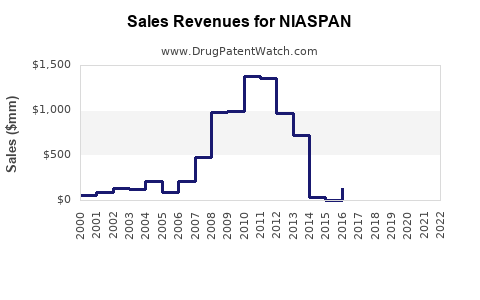
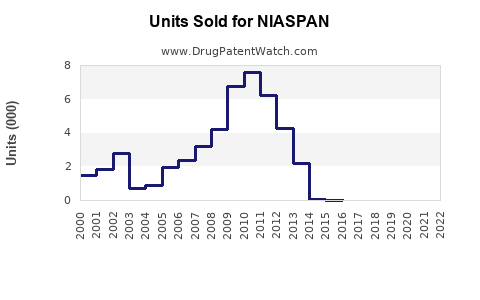
Annual Sales Revenues and Units Sold for NIASPAN
| Drug Name | Revenues (USD) | Units | Year |
|---|---|---|---|
| NIASPAN | ⤷ Start Trial | ⤷ Start Trial | 2022 |
| NIASPAN | ⤷ Start Trial | ⤷ Start Trial | 2021 |
| NIASPAN | ⤷ Start Trial | ⤷ Start Trial | 2020 |
| NIASPAN | ⤷ Start Trial | ⤷ Start Trial | 2019 |
| NIASPAN | ⤷ Start Trial | ⤷ Start Trial | 2018 |
| NIASPAN | ⤷ Start Trial | ⤷ Start Trial | 2017 |
| NIASPAN | ⤷ Start Trial | ⤷ Start Trial | 2016 |
| >Drug Name | >Revenues (USD) | >Units | >Year |
NIASPAN Market Analysis, Sales History, Patent Status, and Revenue Projections
NIASPAN, AbbVie’s extended-release niacin product, is a mature, largely commoditized cardiovascular drug with no meaningful branded growth opportunity. U.S. sales exceeded $1 billion annually at their peak, but the market contracted sharply after clinical evidence showed that adding niacin to statin therapy did not reduce cardiovascular events. AbbVie discontinued active promotion and commercial supply, while generic extended-release niacin remained available at substantially lower prices.
The commercial outlook is therefore divided:
- Branded NIASPAN revenue: effectively zero to immaterial.
- Generic extended-release niacin: low-value, declining or stable niche market.
- New-product opportunity: limited unless supported by a differentiated cardiovascular outcome benefit, improved tolerability, or a combination product with new intellectual property.
What is NIASPAN and what market did it address?
NIASPAN is an extended-release formulation of niacin, also known as nicotinic acid. It was approved by the U.S. Food and Drug Administration for use with diet to reduce elevated total cholesterol, LDL cholesterol, triglycerides, and to increase HDL cholesterol. It was also used in patients with mixed dyslipidemia and hypertriglyceridemia.
The product was designed to address the flushing and dosing problems associated with immediate-release niacin. Its principal commercial competitors included:
| Product | Active ingredient | Formulation | Primary commercial position |
|---|---|---|---|
| NIASPAN | Niacin | Extended release | Branded prescription therapy |
| SLO-NIACIN | Niacin | Sustained release | Prescription niacin |
| Niascor | Niacin | Extended release | Prescription generic-equivalent product |
| Immediate-release niacin | Niacin | Immediate release | Low-cost prescription and OTC use |
| Advicor | Niacin plus lovastatin | Extended release combination | Combination lipid therapy |
| Simcor | Niacin plus simvastatin | Extended release combination | Combination lipid therapy |
NIASPAN’s commercial rationale weakened as statins became the standard of care for LDL reduction. The product had a more defensible position when clinicians sought to increase HDL or reduce triglycerides, but those lipid changes did not translate into demonstrated incremental cardiovascular benefit when niacin was added to effective statin therapy.
How much did NIASPAN generate in sales?
NIASPAN’s U.S. sales peaked at approximately $1.1 billion annually before the market began to decline. The product was one of Kos Pharmaceuticals’ principal assets and remained a major contributor after Abbott Laboratories acquired Kos in 2006. It later became part of AbbVie’s portfolio after Abbott separated its research-based pharmaceutical business.
Historical NIASPAN sales
Public company filings report sales at different levels of precision and sometimes combine product categories. The following figures are rounded estimates based on Abbott and AbbVie annual reports and company disclosures.
| Year | Approximate NIASPAN sales | Commercial context |
|---|---|---|
| 2006 | $400 million-$500 million | Kos acquired by Abbott |
| 2007 | $500 million-$600 million | Continued prescription uptake |
| 2008 | $650 million-$750 million | Expansion of dyslipidemia market |
| 2009 | $750 million-$850 million | High branded pricing and broad use |
| 2010 | Approximately $1.0 billion | Peak-era commercial performance |
| 2011 | Approximately $1.1 billion | Near peak sales |
| 2012 | Approximately $1.1 billion | Market remained large before clinical reversal |
| 2013 | Approximately $1.0 billion | Decline began after outcome evidence |
| 2014 | Approximately $800 million-$900 million | Generic and clinical pressure |
| 2015 | Approximately $600 million-$700 million | Rapid erosion |
| 2016 onward | Materially lower | Product withdrawal and generic substitution |
AbbVie’s 2013 Form 10-K identified lower NIASPAN sales as a principal factor affecting the company’s pharmaceutical results. The decline accelerated after the FDA required changes to the label and after negative cardiovascular-outcome evidence reduced physician demand.[1]
When did NIASPAN lose exclusivity?
NIASPAN lost practical market exclusivity in the mid-2010s as generic extended-release niacin products entered the U.S. market. The relevant patent estate consisted primarily of formulation and controlled-release technology rather than a new chemical entity.
Historical patent protection
NIASPAN’s protection included patents covering controlled-release nicotinic acid compositions and dosage forms. The principal U.S. patent family associated with the product included:
| Patent | General subject matter | Approximate protection period |
|---|---|---|
| U.S. Patent No. 5,637,640 | Controlled-release nicotinic acid composition | Expired in the mid-2010s |
| U.S. Patent No. 6,080,428 | Extended-release niacin formulation | Expired in the late 2010s |
| Related formulation patents | Release profile, dosage form, and manufacturing features | Expired or became commercially immaterial during the late 2010s and early 2020s |
The precise commercial impact of each patent depended on Orange Book listing status, pediatric extensions, patent-term adjustments, and generic approvals. The principal point for market analysis is that the patent barriers no longer support a premium branded franchise.
What is the Orange Book status of NIASPAN?
NIASPAN was approved under NDA 020381. The product’s Orange Book relevance has declined because the commercial product was discontinued and the main formulation patents have expired or no longer provide effective market exclusivity.
The regulatory distinction between “discontinued” and “withdrawn” is important:
- A product may be discontinued for commercial reasons without being withdrawn for safety or efficacy.
- FDA may retain the approval record even when the sponsor stops marketing the product.
- Generic approvals may remain available under abbreviated new drug applications if the reference product and applicable regulatory pathway support substitution.
NIASPAN’s commercial discontinuation was driven primarily by market economics, clinical evidence, and generic competition rather than a finding that the drug was unsafe.
What FDA clinical evidence affected NIASPAN demand?
Two major clinical developments materially reduced the market.
The AIM-HIGH trial evaluated extended-release niacin added to statin therapy in patients with established cardiovascular disease, low HDL cholesterol, and elevated triglycerides. The trial was stopped early because niacin did not produce a significant reduction in major cardiovascular events when added to statin therapy.[2]
The HPS2-THRIVE trial reached a similar conclusion. Extended-release niacin combined with laropiprant did not reduce major vascular events when added to statin therapy and was associated with additional adverse events.[3]
The FDA responded in 2016 by removing the indication that niacin extended-release products and certain fenofibric acid products could be used with statins to reduce the risk of cardiovascular events. The agency concluded that the available evidence did not support cardiovascular benefit from the combination.[4]
This regulatory change weakened the key clinical argument for prescription niacin. HDL elevation alone became insufficient to support broad use.
How strong is the NIASPAN patent estate?
NIASPAN’s current patent estate is commercially weak.
Strengths
- The product had a differentiated extended-release delivery system.
- Formulation patents delayed direct generic competition.
- The product enjoyed substantial physician familiarity.
- The original sponsor established reimbursement and distribution infrastructure.
Weaknesses
- Core composition-of-matter protection was unavailable because niacin is an old molecule.
- Formulation patents have expired or lost practical blocking power.
- The clinical value proposition deteriorated after AIM-HIGH and HPS2-THRIVE.
- Generic niacin products can compete on price.
- Several alternative lipid-lowering classes have stronger outcome data.
- The product is no longer a strategic growth asset for its former sponsor.
Patent strength should therefore be rated low for current commercial defense and moderate historically for delaying generic entry.
Which companies challenged NIASPAN exclusivity?
Generic competition came from manufacturers of extended-release and sustained-release niacin, including Teva Pharmaceuticals, Watson Pharmaceuticals, Sandoz, and other abbreviated new drug application holders. Generic entry reduced prescription prices and limited the ability of the brand to sustain market share after patent barriers weakened.
Paragraph IV litigation was commercially relevant during the period when generic manufacturers sought approval before the expiration of NIASPAN formulation patents. The precise litigation record varied by ANDA, patent, and product strength. The overall market outcome was generic entry followed by rapid erosion of branded demand.
Because NIASPAN is no longer a meaningful branded growth product, current Paragraph IV activity is unlikely to be a material valuation driver. The relevant risk has shifted from patent litigation to generic pricing and continued prescription-volume contraction.
What formulation patents protected NIASPAN?
The product’s intellectual property focused on extended-release delivery. The principal technical objectives were:
- Controlling the release rate of niacin.
- Reducing the rapid plasma concentration increase associated with immediate-release niacin.
- Improving dosing convenience through once-daily administration.
- Attempting to reduce, but not eliminate, cutaneous flushing.
- Maintaining a commercially acceptable dissolution profile.
These patents protected pharmaceutical composition and release characteristics rather than a novel therapeutic mechanism. That distinction limited the duration and strength of NIASPAN’s exclusivity compared with products protected by composition-of-matter patents.
What method-of-use patents protected NIASPAN?
NIASPAN’s principal protection was formulation-based. Method-of-use protection was less important than the approved lipid-management indications and the product’s regulatory exclusivities.
The relevant uses included treatment of:
- Primary hypercholesterolemia.
- Mixed dyslipidemia.
- Hypertriglyceridemia.
- Low HDL cholesterol in selected dyslipidemic patients.
The commercial value of these uses declined when clinical evidence failed to show that pharmacologically increasing HDL with niacin improved cardiovascular outcomes in statin-treated patients.
What is the current competitive landscape for niacin?
Niacin now competes against therapies with stronger outcome data and more targeted mechanisms.
| Therapy class | Examples | Market position relative to NIASPAN |
|---|---|---|
| Statins | Atorvastatin, rosuvastatin, simvastatin | First-line LDL reduction |
| Ezetimibe | Zetia and generics | Low-cost LDL reduction |
| PCSK9 inhibitors | Repatha, Praluent | High-intensity LDL reduction |
| ATP citrate lyase inhibitor | Nexletol | Alternative oral LDL therapy |
| Fibrates | Fenofibrate, gemfibrozil | Triglyceride-focused use |
| Omega-3 products | Vascepa, generic omega-3 products | Triglyceride and selected cardiovascular use |
| Niacin | Generic extended-release and immediate-release products | Narrow, low-cost niche |
The strongest competitive threat comes from generic statins and ezetimibe in routine dyslipidemia, and from PCSK9 inhibitors and other specialty therapies in high-risk patients. Niacin retains limited use where clinicians prioritize triglyceride reduction, HDL elevation, or low-cost therapy, but these uses do not support the former NIASPAN price structure.
What revenue exposure did NIASPAN create for AbbVie?
NIASPAN was a material revenue contributor during the Abbott and early AbbVie periods. At peak sales, it represented a meaningful portion of the company’s pharmaceutical revenue base. Its decline created exposure in several areas:
- Loss of high-margin branded revenue.
- Reduced utilization of AbbVie’s lipid-management sales infrastructure.
- Lower contribution from related products such as combination lipid therapies.
- Increased dependence on larger franchises, including Humira and other specialty products.
- Reduced portfolio value for additional investment in niacin research.
The product’s deterioration was manageable for a diversified pharmaceutical company but severe for a company whose valuation depended on sustained branded lipid revenue.
What are the NIASPAN sales projections for 2025 to 2030?
No credible forecast supports a return of branded NIASPAN sales. The product is commercially mature, clinically disadvantaged, and exposed to generic substitution.
Base-case forecast
| Year | Branded NIASPAN revenue | U.S. generic extended-release niacin market | Expected market condition |
|---|---|---|---|
| 2025 | $0-$5 million | $20 million-$40 million | Niche prescriptions, low pricing |
| 2026 | $0-$5 million | $18 million-$38 million | Stable-to-declining volume |
| 2027 | $0-$4 million | $17 million-$36 million | Continued generic substitution |
| 2028 | $0-$4 million | $16 million-$34 million | Limited specialist use |
| 2029 | $0-$3 million | $15 million-$32 million | Aging product category |
| 2030 | $0-$3 million | $14 million-$30 million | Low-value residual market |
These figures represent an analytical scenario rather than company guidance. They assume no new cardiovascular-outcome evidence, no major reformulation, no new branded relaunch, and continued availability of low-cost alternatives.
Upside scenario
A commercial recovery would require at least one of the following:
- A new formulation with materially lower flushing and better adherence.
- Evidence of cardiovascular benefit in a clearly defined population.
- A combination product with a differentiated mechanism.
- New reimbursement support for a specific triglyceride or metabolic indication.
- Acquisition by a company with a low-cost specialty-drug strategy.
Under that scenario, a reformulated niacin product could potentially reach $50 million-$150 million in annual U.S. sales, but this would represent a new product strategy rather than a recovery of legacy NIASPAN.
Downside scenario
The generic market could decline below $15 million annually if:
- Clinicians abandon niacin for nearly all dyslipidemia indications.
- Generic manufacturers consolidate or discontinue supply.
- Payers impose additional utilization controls.
- Alternative triglyceride therapies gain broader reimbursement.
- FDA labeling further narrows practical use.
What generic launch risks exist for NIASPAN?
Generic launch risk is no longer a future event for the legacy product. It is an established condition.
The principal risks are:
- Price compression from multiple ANDA holders.
- Substitution from extended-release to immediate-release niacin.
- Pharmacy benefit manager exclusion of branded products.
- Product discontinuation by low-margin generic suppliers.
- Reduced physician familiarity among younger prescribers.
- Clinical preference for therapies with hard cardiovascular-outcome data.
The remaining market may be less vulnerable to a single generic entrant because it is already heavily commoditized. The larger risk is category-level decline rather than a new wave of generic litigation.
What manufacturing and IP barriers remain?
Manufacturing barriers are modest. Extended-release niacin requires control of dissolution, tablet coating or matrix behavior, content uniformity, and stability. These requirements can complicate ANDA development, but they do not create a durable barrier comparable to complex biologics, inhaled products, long-acting injectables, or drug-device combinations.
The remaining barriers are primarily commercial:
- Demonstrating bioequivalence.
- Maintaining a consistent extended-release profile.
- Managing flushing and tolerability.
- Securing economically viable manufacturing.
- Obtaining payer coverage in a low-price market.
Geographic patent coverage is also weak. U.S. and major international formulation patents have largely expired or lost commercial importance. Any remaining rights are unlikely to block broad generic access across North America, Europe, and other mature markets.
What is the investment outlook for NIASPAN?
NIASPAN is a declining legacy asset, not a platform for branded growth. Its value is limited to residual generic demand, potential licensing of historical formulation know-how, or use as a low-cost base for a reformulation program.
A buyer evaluating the asset should assign:
- Near-zero value to legacy branded revenue.
- Low value to expired or expiring formulation patents.
- Limited value to historical physician awareness.
- Higher value only to a validated new formulation or new clinical indication.
- Minimal probability of a return to peak-era sales without new outcome evidence.
Key Takeaways
- NIASPAN is an extended-release niacin product that once generated about $1.1 billion in annual sales.
- Sales declined after AIM-HIGH and HPS2-THRIVE failed to show cardiovascular benefit when niacin was added to statin therapy.
- FDA labeling changes in 2016 removed support for the statin-combination cardiovascular risk-reduction indication.
- Formulation patents, rather than composition-of-matter patents, were the main source of exclusivity.
- Generic extended-release niacin has replaced the branded market.
- Branded NIASPAN revenue is expected to remain zero to immaterial through 2030.
- The U.S. generic extended-release niacin market is likely to remain a low-value niche worth approximately $14 million-$40 million annually.
- A meaningful commercial recovery would require a new formulation, new clinical evidence, or a new indication.
FAQs About NIASPAN Market and Patent Outlook
Is NIASPAN still available in the United States?
Legacy branded NIASPAN is no longer a significant marketed product. Generic extended-release niacin products may remain available through selected manufacturers and pharmacies.
Did AbbVie withdraw NIASPAN because of safety concerns?
The commercial decline reflected generic competition, reduced clinical demand, and negative cardiovascular-outcome evidence. The product was not removed solely because FDA determined that niacin was unsafe.
Can a generic manufacturer still challenge NIASPAN patents?
A generic manufacturer can challenge any unexpired, enforceable patent relevant to an approved reference product. For NIASPAN, the principal commercial patent barriers have expired or become immaterial.
Is niacin still used for cholesterol management?
Yes, but use is limited. Statins, ezetimibe, PCSK9 inhibitors, bempedoic acid, fibrates, and selected omega-3 products have reduced niacin’s role.
Could a new niacin formulation become commercially successful?
A new formulation would need to solve a clinically important problem, such as flushing or adherence, and demonstrate value beyond lipid-number changes. Improved tolerability alone would likely be insufficient without evidence of meaningful cardiovascular benefit.
References
- AbbVie Inc. (2014). Annual report pursuant to Section 13 or 15(d) of the Securities Exchange Act of 1934 for the fiscal year ended December 31, 2013.
- NIH National Heart, Lung, and Blood Institute. (2011). NIH stops clinical trial of combination cholesterol treatment.
- HPS2-THRIVE Collaborative Group. (2014). Effects of extended-release niacin with laropiprant in high-risk patients. New England Journal of Medicine, 371(3), 203-212.
- U.S. Food and Drug Administration. (2016). FDA modifies cholesterol-lowering statin label and withdraws approval of niacin-statin combination indications.
- U.S. Food and Drug Administration. (2024). Approved drug products with therapeutic equivalence evaluations: The Orange Book.
- Kos Pharmaceuticals, Inc. (2006). Form 10-K annual report for the fiscal year ended December 31, 2005.
- Abbott Laboratories. (2012). Annual report pursuant to Section 13 or 15(d) of the Securities Exchange Act of 1934 for the fiscal year ended December 31, 2011.
More… ↓
