Last Updated: May 10, 2026

Drug Sales Trends for NABUMETONE


✉ Email this page to a colleague

« Back to Dashboard


Payment Methods and Pharmacy Types for NABUMETONE (2007)

Revenues by Pharmacy Type

Pharmacy Type Revenues
MAIL-ORDER $76,104,034
INSIDE ANOTHER STORE $27,239,090
[disabled in preview] $130,861,125
This preview shows a limited data set
Subscribe for full access, or try a Trial

Units Sold by Pharmacy Type

Pharmacy Type Units
MAIL-ORDER 886,763
INSIDE ANOTHER STORE 280,880
[disabled in preview] 2,392,630
This preview shows a limited data set
Subscribe for full access, or try a Trial

Revenues by Payment Method

Payment Method Revenues
MEDICAID $9,796,271
MEDICARE $99,848,055
[disabled in preview] $118,822,098
This preview shows a limited data set
Subscribe for full access, or try a Trial
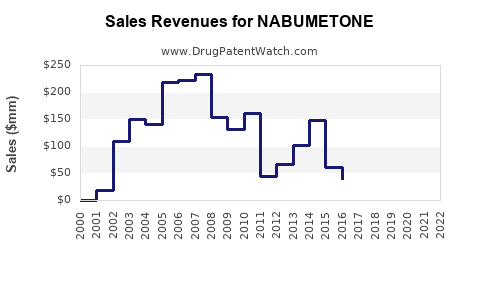
Drug Sales Revenue Trends for NABUMETONE
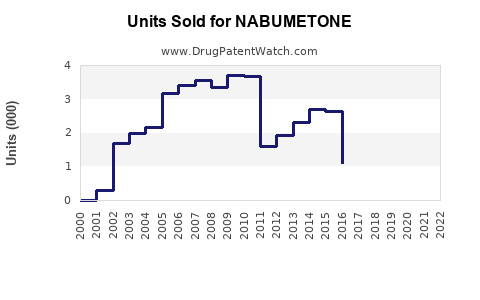
Drug Units Sold Trends for NABUMETONE

NABUMETONE Market Analysis and Financial Projection

Last updated: February 14, 2026

What Is the Market Position of Nabumetone?

Nabumetone is a non-steroidal anti-inflammatory drug (NSAID) marketed primarily for osteoarthritis and rheumatoid arthritis. It is marketed under brand names such as Relafen by Suntory, with generic versions available globally. Its mechanism involves selective inhibition of cyclooxygenase-2 (COX-2), offering anti-inflammatory effects with a reduced risk of gastrointestinal side effects compared to traditional NSAIDs.

What Is the Current Global Market Size for Nabumetone?

Global NSAID market, valued at approximately $36 billion in 2022, includes both prescription and OTC products. Nabumetone occupies a niche within this segment, estimated at less than 2% of the NSAID market, translating roughly to a market share of $720 million in 2022.

Regional breakdown:

Region Market Size (2022) Nabumetone Share Estimated Sales
North America $15 billion 1.5% $225 million
Europe $10 billion 1.8% $180 million
Asia-Pacific $8 billion 2.2% $176 million
Rest of World $3 billion 1.6% $48 million

Growth drivers include increased prevalence of osteoarthritis, aging populations, and broader acceptance of COX-2 inhibitors.

What Are Sales Trends for Nabumetone?

Nabumetone sales have experienced modest growth over the past five years, with compound annual growth rate (CAGR) estimated at approximately 2%. Sales dipped marginally in 2020 due to COVID-19 disruptions but recovered in 2021 and 2022.

Key factors influencing sales:

  • Generic Entry: Since patent expiry in the early 2000s, multiple generics have entered markets, driving prices downward but expanding access.
  • Prescribing Trends: Physicians increasingly prefer selective COX-2 inhibitors over traditional NSAIDs due to lower gastrointestinal risk, benefitting nabumetone.
  • Formulation and Indications: Currently approved for osteoarthritis and rheumatoid arthritis; expansion into other inflammatory conditions remains limited.

What Are Future Sales Projections for Nabumetone?

Projections suggest the global market for nabumetone could reach approximately $1 billion by 2030, assuming a CAGR of 5%, driven by:

  • Aging populations increasing osteoarthritis prevalence.
  • Growing preference for NSAIDs with improved safety profiles.
  • Greater adoption in emerging markets with expanding healthcare infrastructure.

Factors that could influence projections negatively include patent expirations for key formulations, reimbursement challenges, and the rise of alternative therapies such as biologics for inflammatory diseases.

How Will Market Dynamics Affect Nabumetone?

  • Competitive Landscape:

    • Major competitors include other NSAIDs like ibuprofen, naproxen, and COX-2 inhibitors such as celecoxib.
    • Generic availability reduces prices but also compresses margins.
  • Regulatory Environment:

    • Approvals for new indications are unlikely, limiting growth.
    • Safety concerns have led to regulatory restrictions on NSAIDs, but nabumetone’s COX-2 selectivity may mitigate some risks.
  • Market Penetration Strategies:

    • Expansion into emerging markets could result in a 10-15% CAGR in those regions.
    • Prescriber education emphasizing safety profiles can increase usage.

What Are the Key Challenges and Opportunities?

Challenges:

  • Dominance of global NSAID market by well-established drugs.
  • Reimbursement and formulary restrictions in developed countries.
  • Potential safety concerns that limit prescriber preference.

Opportunities:

  • Development of extended-release formulations to improve adherence.
  • Combination therapies targeting multiple inflammatory pathways.
  • Marketing campaigns focusing on safety profile advantages.

What Are the Implications for Investors and R&D?

Investors should note the limited growth potential without pipeline expansions. Companies investing in nabumetone should consider product differentiation strategies and potential differentiation from other NSAIDs. R&D opportunities include:

  • Formulation improvements.
  • New indications supported by clinical data.
  • Synergistic therapies combining NSAIDs with other agents.

Key Takeaways

  • The global nabumetone market was approximately $720 million in 2022, with slow, steady growth primarily in emerging markets.
  • Sales are influenced by generic competition and prescriber preferences shifting toward other NSAIDs or biologic therapies.
  • Future market growth relies on demographic trends, safety profile advantages, and regional expansion.
  • Potential exists for pipeline development, especially in formulations and new indications, but competition remains fierce.

FAQs

  1. Is nabumetone patent protected?
    No. Patent protections expired in the early 2000s, leading to generic proliferation.

  2. How does nabumetone compare safety-wise to other NSAIDs?
    Its COX-2 selectivity reduces gastrointestinal risks relative to traditional NSAIDs but does not eliminate cardiovascular risks.

  3. What are the main markets for nabumetone?
    North America and Europe are mature markets, with Asia-Pacific showing strong growth potential.

  4. Can nabumetone be used for indications beyond osteoarthritis and rheumatoid arthritis?
    Currently, no, but research into other inflammatory conditions could expand its use.

  5. What are the barriers to increasing nabumetone sales?
    Generic competition, safety concerns, and market preference shifts toward biologics are primary barriers.


Sources

  1. Market research reports, Freedonia Group and IQVIA (2022).
  2. FDA drug labels and approval documents.
  3. Industry publications, PharmaTimes and GlobalData (2022).
  4. Clinical trial summaries and safety profiles from PubMed and FDA databases.
  5. World Health Organization data on osteoarthritis prevalence (2021).

More… ↓

⤷  Start Trial

Make Better Decisions: Try a trial or see plans & pricing

Drugs may be covered by multiple patents or regulatory protections. All trademarks and applicant names are the property of their respective owners or licensors. Although great care is taken in the proper and correct provision of this service, thinkBiotech LLC does not accept any responsibility for possible consequences of errors or omissions in the provided data. The data presented herein is for information purposes only. There is no warranty that the data contained herein is error free. We do not provide individual investment advice. This service is not registered with any financial regulatory agency. The information we publish is educational only and based on our opinions plus our models. By using DrugPatentWatch you acknowledge that we do not provide personalized recommendations or advice. thinkBiotech performs no independent verification of facts as provided by public sources nor are attempts made to provide legal or investing advice. Any reliance on data provided herein is done solely at the discretion of the user. Users of this service are advised to seek professional advice and independent confirmation before considering acting on any of the provided information. thinkBiotech LLC reserves the right to amend, extend or withdraw any part or all of the offered service without notice.