Share This Page
Drug Sales Trends for LEFLUNOMIDE
✉ Email this page to a colleague
Payment Methods and Pharmacy Types for LEFLUNOMIDE (2007)
Revenues by Pharmacy Type
Units Sold by Pharmacy Type
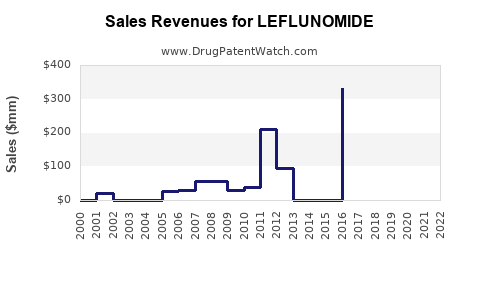
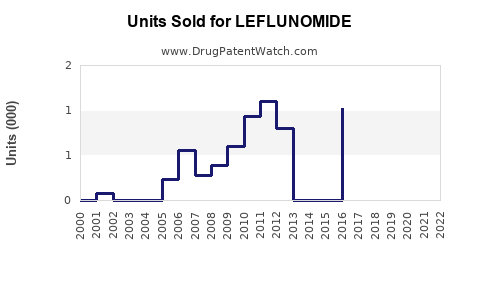
Annual Sales Revenues and Units Sold for LEFLUNOMIDE
| Drug Name | Revenues (USD) | Units | Year |
|---|---|---|---|
| LEFLUNOMIDE | ⤷ Start Trial | ⤷ Start Trial | 2022 |
| LEFLUNOMIDE | ⤷ Start Trial | ⤷ Start Trial | 2021 |
| LEFLUNOMIDE | ⤷ Start Trial | ⤷ Start Trial | 2020 |
| LEFLUNOMIDE | ⤷ Start Trial | ⤷ Start Trial | 2019 |
| LEFLUNOMIDE | ⤷ Start Trial | ⤷ Start Trial | 2018 |
| LEFLUNOMIDE | ⤷ Start Trial | ⤷ Start Trial | 2017 |
| >Drug Name | >Revenues (USD) | >Units | >Year |
Leflunomide Market Analysis, Sales Forecast, Patent Status, and Generic Competition
Leflunomide is a mature, low-cost generic disease-modifying antirheumatic drug used mainly for rheumatoid arthritis and, in some markets, psoriatic arthritis. The market is no longer driven by Sanofi’s Arava brand. It is characterized by broad generic availability, limited pricing power, low regulatory barriers, and continued clinical demand in cost-sensitive markets.
A reasonable global ex-manufacturer revenue estimate for leflunomide products is approximately $180 million to $260 million in 2024, excluding teriflunomide products marketed for multiple sclerosis. The base-case forecast is for a low-single-digit annual decline through 2030 as prices fall in mature markets, partly offset by volume growth in China, India, Latin America, and other emerging markets.
What is leflunomide used for?
Leflunomide is an oral immunomodulatory small molecule that inhibits dihydroorotate dehydrogenase, reducing pyrimidine synthesis and lymphocyte proliferation. Its principal approved use is active rheumatoid arthritis in adults.
The product is generally available as 10 mg, 20 mg, and 100 mg tablets. The 100 mg strength is used as a loading dose in some labeling regimes, although many clinicians avoid loading because of tolerability concerns.
Key clinical characteristics include:
| Attribute | Leflunomide |
|---|---|
| Active ingredient | Leflunomide |
| Brand originator | Arava |
| Originator company | Sanofi, formerly Aventis and Hoechst Marion Roussel |
| FDA dosage forms | Oral tablets |
| Common strengths | 10 mg and 20 mg; 100 mg loading-dose tablets in some markets |
| Primary indication | Rheumatoid arthritis |
| Drug class | Conventional synthetic DMARD |
| Administration | Once daily after initiation |
| Major safety concerns | Hepatotoxicity, teratogenicity, immunosuppression, serious infection, hypertension |
| FDA reference product approval | 1998 |
| Current market structure | Predominantly generic |
The drug remains clinically relevant where physicians require an oral DMARD and where methotrexate is unsuitable, poorly tolerated, or insufficiently effective. The American College of Rheumatology continues to identify conventional synthetic DMARDs, including leflunomide, within rheumatoid arthritis treatment algorithms, although methotrexate generally retains first-line status in the United States (Fraenkel et al., 2021).
How large is the leflunomide market?
Public companies do not generally disclose standalone leflunomide revenue. Sanofi stopped treating Arava as a material growth product after generic competition. Current market estimates therefore require a bottom-up model based on prescription volume, generic prices, geographic mix, and manufacturer revenue.
Estimated 2024 market by region
| Region | Estimated share of global revenue | Estimated 2024 revenue | Market characteristics |
|---|---|---|---|
| North America | 20%-25% | $40 million-$60 million | High generic penetration and low unit prices |
| Europe | 20%-25% | $40 million-$60 million | Tendering and reimbursement pressure |
| China | 20%-25% | $35 million-$60 million | Large rheumatoid arthritis population and expanding generic access |
| India and South Asia | 10%-15% | $20 million-$35 million | Low prices but broad physician familiarity |
| Latin America | 8%-12% | $15 million-$25 million | Fragmented branded-generic market |
| Other markets | 8%-12% | $15 million-$25 million | Mixed regulatory and reimbursement conditions |
| Total | 100% | $180 million-$260 million | Excludes teriflunomide |
China and India are more important to volume than to revenue because average selling prices are substantially lower than in the United States and Western Europe. The United States remains commercially relevant for manufacturers with efficient pharmacy and wholesaler distribution, but it is no longer an attractive branded market.
What are the leflunomide sales projections through 2030?
The base case assumes stable patient demand, continued generic price erosion, limited new indications, and no major supply disruption.
| Year | Bear case | Base case | Bull case |
|---|---|---|---|
| 2024 | $180 million | $220 million | $260 million |
| 2025 | $174 million | $216 million | $260 million |
| 2026 | $168 million | $212 million | $260 million |
| 2027 | $162 million | $208 million | $260 million |
| 2028 | $157 million | $205 million | $260 million |
| 2029 | $152 million | $202 million | $260 million |
| 2030 | $147 million | $200 million | $260 million |
Values represent estimated global ex-manufacturer revenue and are not company guidance.
The base case implies a compound annual growth rate of approximately negative 1.6% from 2024 to 2030. The decline is modest because the market has already experienced the largest phase of generic substitution. Further revenue erosion will come mainly from tendering, pharmacy substitution, and reductions in branded-generic prices.
Key forecast drivers
- Generic price erosion in the United States and Europe.
- Rheumatoid arthritis prevalence and diagnosis rates.
- Continued use in markets where biologic DMARDs remain unaffordable.
- Physician familiarity with once-daily oral treatment.
- Competition from methotrexate, sulfasalazine, hydroxychloroquine, JAK inhibitors, and biologic therapies.
- Regulatory restrictions related to pregnancy and hepatic safety.
- Availability of low-cost domestic manufacturers in China and India.
The bull case requires stronger patient-volume growth in emerging markets and limited further price compression. The bear case assumes accelerated migration to methotrexate, biologics, and targeted synthetic DMARDs, combined with aggressive procurement pricing.
How does leflunomide compare with competing rheumatoid arthritis drugs?
Leflunomide competes in two different markets: low-cost conventional synthetic DMARDs and higher-priced targeted therapies.
| Drug or class | Position versus leflunomide | Pricing profile | Competitive effect |
|---|---|---|---|
| Methotrexate | Primary first-line alternative | Very low | Limits use in treatment-naive patients |
| Sulfasalazine | Conventional synthetic alternative | Very low | Competes in combination and milder disease |
| Hydroxychloroquine | Used in selected disease profiles | Very low | Limited direct substitution |
| JAK inhibitors | Oral targeted alternatives | High | Compete for patients needing escalation |
| TNF inhibitors | Established biologic alternatives | High, increasingly biosimilar-driven | Reduce long-term use in advanced disease |
| IL-6, CD20 and other biologics | Advanced-treatment alternatives | High | Compete after conventional DMARD failure |
| Teriflunomide | Active metabolite used for multiple sclerosis | Higher than leflunomide | Separate indication and patent history |
Leflunomide’s main commercial advantage is cost. Its main disadvantages are safety monitoring, long elimination time, teratogenicity, and a less favorable position than methotrexate in standard treatment algorithms.
What is the FDA regulatory status of leflunomide?
Arava received FDA approval in 1998 for active rheumatoid arthritis. Leflunomide is available through abbreviated new drug applications as an immediate-release oral tablet. Generic products generally rely on pharmaceutical equivalence and bioequivalence rather than new clinical efficacy trials.
The FDA label requires attention to:
- Liver enzyme monitoring.
- Pregnancy avoidance and accelerated drug elimination when clinically indicated.
- Serious infection risk.
- Bone marrow suppression.
- Peripheral neuropathy.
- Blood pressure monitoring.
- Drug interactions, including with warfarin and certain hepatotoxic agents.
The product is not a biologic and does not face biosimilar substitution rules. Generic substitution is governed by ordinary small-molecule pharmaceutical-equivalence standards.
What patents protect leflunomide and Arava?
The original Arava patent estate is expired in the United States. The principal U.S. compound patent historically associated with Arava was U.S. Patent No. 5,705,571, assigned to Hoechst Marion Roussel. Its effective term extended into the 2010s, with public patent records commonly identifying an expiration in 2014 after applicable term adjustments and extensions.
| Patent category | Historical position | Current commercial effect |
|---|---|---|
| Compound patent | U.S. Patent No. 5,705,571 | Expired |
| Basic composition protection | Expired | No current blocking protection |
| Tablet formulation | No durable market exclusivity | Generic products widely available |
| Method of treatment | Historical and secondary protection | No meaningful current barrier |
| Manufacturing process | Potentially relevant to individual suppliers | Does not block ordinary generic entry |
| Pediatric exclusivity | Not a current barrier | Expired or irrelevant to present entry |
The economic value of the estate is therefore concentrated in manufacturing efficiency, regulatory approvals, supply reliability, and distribution rather than patent exclusivity.
What formulations are protected by leflunomide patents?
Commercial leflunomide products are conventional immediate-release tablets. There is no widely recognized, commercially dominant extended-release or differentiated delivery system that has created a new exclusivity period around the molecule.
Potential formulation claims may cover excipient selection, particle size, dissolution, stability, or manufacturing steps. These claims can affect individual suppliers but generally do not create a broad market barrier once the original compound patent has expired.
When did leflunomide lose exclusivity?
Leflunomide lost practical U.S. exclusivity during the period when generic manufacturers entered following expiration of the core Arava patent estate. Generic competition became commercially meaningful in the early 2010s.
The product now has:
- No meaningful U.S. compound patent protection.
- No active branded exclusivity comparable to a new chemical entity period.
- No biosimilar exclusivity issue.
- No durable formulation moat.
- Broad generic competition across major markets.
The exact timing of individual generic approvals varied by manufacturer and jurisdiction. The relevant commercial conclusion is that generic entry occurred long ago and has fully reset pricing.
Are there Paragraph IV challenges to Arava?
Paragraph IV challenges were relevant during the transition from Arava exclusivity to generic entry. Generic applicants could challenge listed patents by asserting invalidity, unenforceability, or non-infringement.
Current commercial risk does not depend on a new Paragraph IV event. The relevant U.S. patents have expired, and leflunomide is already a mature generic market. Any litigation involving a new supplier would more likely concern manufacturing processes, labeling, supply contracts, antitrust issues, or product liability than a foundational composition patent.
What is the Orange Book status of Arava?
Arava is the FDA reference-listed drug for leflunomide tablets. Its Orange Book significance is now primarily regulatory rather than commercial. The product provides the reference standard for generic applications, but it does not retain a meaningful patent-based barrier to approval.
Generic applicants can use the abbreviated pathway if they demonstrate pharmaceutical equivalence and bioequivalence and address the reference product’s labeling. The absence of active blocking patents reduces the risk of delayed generic approval.
Which companies compete in the leflunomide market?
The market is fragmented. Competition includes multinational generic companies, regional manufacturers, and branded-generic producers.
Potential suppliers include:
- Teva Pharmaceutical Industries.
- Viatris and legacy Mylan operations.
- Sandoz.
- Dr. Reddy’s Laboratories.
- Sun Pharmaceutical Industries.
- Zydus Lifesciences.
- Cipla.
- Torrent Pharmaceuticals.
- Hikma Pharmaceuticals.
- Regional Chinese manufacturers.
- Local branded-generic companies in Latin America and Southeast Asia.
The actual competitive set differs by country because regulatory approvals, tender participation, and local manufacturing requirements vary. No single company has a durable global monopoly.
What licensing deals affect leflunomide?
No current licensing transaction appears to control the global leflunomide market. The original product was developed within the Hoechst and Aventis/Sanofi organization. Commercial rights were subsequently overtaken by generic competition.
Any current licensing economics are more likely to involve:
- Local distribution rights.
- Private-label supply.
- Contract manufacturing.
- Government tenders.
- Registration partnerships.
- Regional branded-generic commercialization.
These arrangements generally do not change the overall market structure or create meaningful molecule-level exclusivity.
What patent litigation affects leflunomide?
Leflunomide has low current patent-litigation risk. The primary patent disputes occurred around generic entry and the expiration of the original Arava patent estate.
Current litigation risk is more likely to arise from:
- Product liability claims involving hepatotoxicity or pregnancy exposure.
- Manufacturing deviations and recalls.
- Procurement and supply disputes.
- Alleged patent infringement involving a specific process.
- Competition-law claims related to generic pricing or market allocation.
The absence of a live composition patent substantially reduces the probability of a litigation-driven market interruption.
What generic launch scenarios exist for leflunomide?
A new entrant would face a low technical barrier but a difficult commercial environment.
Scenario 1: U.S. tablet launch
A manufacturer obtains FDA approval for 10 mg and 20 mg tablets and competes through wholesaler contracting. The principal risks are low net pricing, pharmacy benefit manager pressure, and limited market share available in a mature generic category.
Scenario 2: Emerging-market branded generic
A company launches a branded generic in India, China, Latin America, or Southeast Asia. This strategy can generate higher gross margins than U.S. commodity supply but requires physician promotion, local registration, and distribution investment.
Scenario 3: Institutional and tender supply
A manufacturer competes for hospital and government contracts. Volume can be substantial, but margins are vulnerable to annual price resets and supplier concentration.
Scenario 4: Combination or differentiated product
A company develops a combination product or modified formulation. This may improve commercial positioning, but the clinical and regulatory case must be strong enough to offset development and registration costs.
How strong is the leflunomide patent estate?
The patent estate is weak from an exclusivity perspective and moderate from a manufacturing-control perspective.
| Dimension | Assessment |
|---|---|
| Composition patent | Expired |
| Formulation protection | Limited |
| Method-of-use protection | Limited current value |
| Manufacturing know-how | Potentially useful |
| Regulatory barrier | Low for approved strengths |
| Biosimilar barrier | Not applicable |
| Litigation leverage | Low |
| Supply-chain leverage | Moderate for reliable suppliers |
| Commercial moat | Low |
Manufacturing quality, cost control, regulatory compliance, and supply continuity matter more than patent ownership.
What is the investment outlook for leflunomide?
Leflunomide is a defensive generic opportunity rather than a high-growth pharmaceutical asset. Attractive returns are most likely for manufacturers that already have:
- Approved oral solid-dose facilities.
- Existing rheumatoid arthritis distribution.
- Low-cost active pharmaceutical ingredient supply.
- Access to emerging-market tenders.
- A portfolio strategy that spreads fixed regulatory and commercial costs across multiple products.
A standalone leflunomide launch in the United States is unlikely to support premium valuation. The molecule can contribute incremental revenue and manufacturing utilization, but it is unlikely to materially change the growth profile of a large generic company.
Key Takeaways
- Leflunomide is a mature generic DMARD with estimated 2024 global revenue of $180 million to $260 million.
- Base-case revenue is projected to decline modestly to about $200 million by 2030.
- The market excludes teriflunomide, which has a separate multiple sclerosis indication and patent history.
- Arava’s core patent protection has expired, and current patent barriers are minimal.
- There is no meaningful biosimilar risk because leflunomide is a small molecule.
- Methotrexate is the principal low-cost competitor; biologics and JAK inhibitors compete in treatment escalation.
- Emerging markets provide the strongest volume opportunity, while the United States and Europe remain price-sensitive generic markets.
- Manufacturing efficiency, tender access, and supply reliability are more important than patent ownership.
- The commercial opportunity is best suited to established generic manufacturers rather than new branded entrants.
FAQs
Is leflunomide still profitable for generic manufacturers?
Yes, but profitability depends on manufacturing cost, regional pricing, and portfolio scale. U.S. standalone margins are likely to be limited, while branded-generic and tender markets may offer better returns.
Does leflunomide compete directly with teriflunomide?
No. Teriflunomide is the active metabolite of leflunomide but is marketed primarily for multiple sclerosis. The two products have different labels, prescribers, reimbursement dynamics, and patent histories.
Can a company obtain new exclusivity for a leflunomide formulation?
Potentially, but a new formulation would need a credible patent position and clinical or commercial differentiation. Conventional immediate-release tablets do not offer meaningful new exclusivity.
Is leflunomide demand growing in China and India?
Patient volume is likely to grow in both markets as rheumatoid arthritis diagnosis and treatment access expand. Revenue growth is weaker because prices are low and local competition is extensive.
What is the biggest risk to leflunomide sales?
The largest risk is continued substitution by methotrexate and newer targeted therapies, combined with generic price erosion. Safety monitoring and reproductive restrictions also limit use in some patient groups.
References
-
American College of Rheumatology. (2021). 2021 American College of Rheumatology guideline for the treatment of rheumatoid arthritis. Arthritis Care & Research, 73(7), 924-939.
-
European Medicines Agency. (2023). Arava: Product information. European Union.
-
U.S. Food and Drug Administration. (1998). Arava (leflunomide) prescribing information. U.S. Department of Health and Human Services.
-
U.S. Food and Drug Administration. (2024). Approved drug products with therapeutic equivalence evaluations: Orange Book. U.S. Department of Health and Human Services.
-
U.S. Patent and Trademark Office. (1998). U.S. Patent No. 5,705,571: Leflunomide. U.S. Department of Commerce.
-
Sanofi. (2011). Annual report and financial statements. Sanofi.
More… ↓
