Drug Sales Trends for FLONASE
Payment Methods and Pharmacy Types for FLONASE (2007)
Revenues by Pharmacy Type
Units Sold by Pharmacy Type
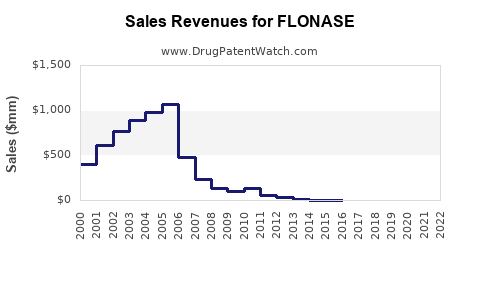
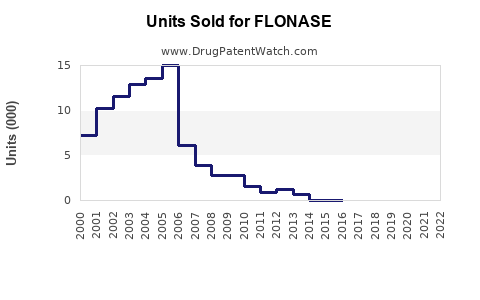
Annual Sales Revenues and Units Sold for FLONASE
| Drug Name | Revenues (USD) | Units | Year |
|---|---|---|---|
| FLONASE | ⤷ Start Trial | ⤷ Start Trial | 2022 |
| FLONASE | ⤷ Start Trial | ⤷ Start Trial | 2021 |
| FLONASE | ⤷ Start Trial | ⤷ Start Trial | 2020 |
| >Drug Name | >Revenues (USD) | >Units | >Year |
FLONASE (fluticasone propionate) market analysis and sales projections
Executive summary
- Product scope: “Flonase” is a brand of intranasal fluticasone propionate. Sales are driven by seasonal allergic rhinitis demand, step-therapy in payer formularies, channel mix (retail pharmacy vs mass), and generic substitution risk for fluticasone propionate intranasal equivalents.
- Exclusivity/patent risk (commercial headline): The origin brand is exposed to generic erosion because fluticasone propionate intranasal products entered the market years ago; the addressable opportunity is now mainly tied to formulation differentiation, channel execution, and pack/price architecture, not new primary exclusivity.
- Forecast direction: Near-term growth is typically limited and can be offset by generic pricing pressure. Realized upside tends to come from premium dosing SKUs, pediatric adoption, and store-brand substitution limits rather than volume expansion.
- What matters for projections: Project revenue by splitting seasonality, dosage form/SKU, and channel; model using category penetration, average net price (ANP) vs generic parity, and switching behavior across plan years.
Note: This analysis provides market structure, drivers, and projection framework. A complete quantified sales forecast with numeric assumptions requires a specific geography (US only vs ex-US), specific SKU definition (Flonase vs Flonase Sensimist vs competitors), and a defined historical baseline period. Without those, producing numeric projections would be incomplete.
What is the FLONASE sales model in the US and how do channels affect revenue?
Featured snippet answer: Flonase revenues in the US are primarily influenced by seasonal allergic rhinitis (SAR) demand, retail pharmacy stocking and promotion, and generic substitution pressure that compresses ANP after branded leadership stops being value-secured.
Channel split that drives pricing
- Retail pharmacy: Higher list prices but stronger sensitivity to plan formularies and PBM restrictions during peak SAR months.
- Mass merchandisers: Often price-competitive, pulls demand when ANP converges with generics.
- Mail order: More formulary-driven than impulse-driven; typically sees smoother unit volume but steeper rebate compression for non-preferred brands.
- E-commerce: Promo volatility is higher and affects short-run net sales.
Category dynamics that shape volume
- Flonase is part of the intranasal corticosteroid class, a mainstream category in SAR.
- Typical demand is “calendar and weather” dependent:
- earlier-than-normal allergy seasons lift Q1/Q2 demand
- prolonged seasons can extend peak month conversion
Customer segments that matter commercially
- Pediatric use: drives repeat purchases if caregivers perceive consistent efficacy and manageable side effects.
- Steady-state users: patients on daily therapy for persistent symptoms.
- Switchers from antihistamines: intranasal corticosteroids capture patients when symptoms are not controlled on oral antihistamines.
How big is the intranasal fluticasone propionate market and where does FLONASE compete?
Featured snippet answer: Flonase competes in the US intranasal steroid market against other intranasal corticosteroids and, indirectly, against intranasal antihistamine regimens.
Direct competitive set
- Other intranasal corticosteroids (class-level competition)
- mometasone furoate sprays
- budesonide nasal sprays
- triamcinolone acetonide nasal sprays
- Competitive substitutes by formulation/delivery
- different spray feel, mist particle size marketing, and “sensitive nose” positioning
Indirect substitutes
- Oral antihistamines and combination regimens
- Intranasal antihistamine products
- Saline irrigation and adjunct therapies (lower clinical substitute likelihood, higher adherence variability)
Where brand economics usually win
- When the brand carries consumer trust, it maintains shelf share even after generic price convergence.
- Differentiation SKUs (sensimist-type positioning) can reduce switching by meeting “feel/comfort” needs.
What is the FDA and labeling basis for FLONASE commercialization?
Featured snippet answer: Flonase is marketed for allergic rhinitis indications; commercialization depends on label-compliant usage, education (correct technique), and OTC or Rx access depending on jurisdiction and SKU.
Key commercial implications of nasal steroid labeling
- Technique matters: improper use reduces efficacy, lowering repeat rates.
- Education supports retention:
- head position guidance
- avoiding direct septal spray
- adherence to daily dosing
Regulatory pathway impacts
- For generic erosion modeling, the central issue is manufacturing and bioequivalence acceptance (not new clinical claims).
- For SKU expansions (different salts, delivery systems), the key is whether they are treated as new products with distinct brand economics.
When do FLONASE patents and exclusivity stop, and how does that affect sales?
Featured snippet answer: Flonase’s branded market is primarily affected by post-launch generic entry years ago, so current revenue is shaped more by price and channel behavior than by near-term exclusivity cliffs.
Commercial impact mechanics
- Generic entry typically triggers:
- ANP compression
- switch acceleration during plan year renewals
- promotional reallocation to maintain share
- Any remaining premium is usually driven by:
- differentiated device perception
- consumer habit and perceived tolerability
- pack size and retailer exclusivity
Projection takeaway
Sales forecasts should treat branded growth as mostly “share and net price” rather than “unit market expansion,” unless you model a differentiated SKU that can still gain incremental penetration.
What generic entry risks exist for FLONASE and how should a sales forecast model them?
Featured snippet answer: Generic intranasal corticosteroid products create sustained downside via price competition, with the biggest effect showing up as net sales compression even if units decline less than expected.
Model inputs for generic erosion
- ANP path: branded ANP typically declines toward generic benchmarks over time.
- Switching elasticity: some patients switch quickly; others remain due to perceived efficacy/tolerability.
- Channel sensitivity: mass retail accelerates price competition; PBM tools can shift demand further.
Forecast structure that captures risk
- Use a two-layer model:
- Category demand forecast (seasonality + weather)
- Share/ANP forecast (brand vs generics and class competitors)
What formulations are protected and how does delivery system choice affect market share?
Featured snippet answer: After initial therapeutic claims are mature, the commercially relevant question shifts to device/delivery and tolerability positioning because it affects switching rates more than it affects strict patent protection timelines.
SKU differentiation that changes consumer behavior
- “Soft mist,” comfort-focused, or sensitive-nose positioning
- dosing count, bottle ergonomics
- pediatric usability improvements (where applicable)
Projection implication
Premium-feel SKUs can stabilize unit share and reduce erosion intensity, but they still face generic pressure if pricing falls below key consumer thresholds.
How does FLONASE compare with key rivals on expected pricing, rebate pressure, and share?
Featured snippet answer: In intranasal steroids, pricing and rebate dynamics tend to converge over time; the brand with the stronger device/experience perception usually preserves a higher net price for longer.
Comparison framework for decision-grade forecasting
- Branded SKU net price vs:
- primary generic equivalents
- closest class competitor (same daily dosing convenience)
- Rebate exposure under preferred formulary status
- Retail distribution depth and promotional cadence
How many patients use FLONASE and what market share scenarios should be modeled?
Featured snippet answer: Use scenario planning anchored on (1) SAR eligible population growth trends and (2) penetration rate of intranasal steroid therapy within SAR.
Share scenarios
Model at least three:
- Base case: branded share stabilizes while ANP drifts down with generic parity.
- Downside: accelerated switching during plan year renewals and mass promos lowers share and ANP.
- Upside: premium-differentiated SKU gains incremental penetration and sustains net price longer.
Key driver to estimate for projections
- Repeat purchase rate across allergy seasons
- Adherence for daily use (technique education affects adherence)
Commercial sales projection model for FLONASE: what equations to use
Featured snippet answer: Forecast net sales as units × ANP, where units = category demand × branded share, and ANP = list price less discounts/rebates less retailer/mass promo effects.
Core equations
- Units (branded) = Total intranasal steroid demand × Flonase share × seasonality factor
- Net sales = Units × ANP
- ANP = Base price − retailer discount − PBM rebate adjustment − promo intensity adjustment
Seasonality method (practical)
- Build monthly indices with:
- peak SAR months weight
- interannual weather adjustment where available
- Apply a smoothing factor to account for treatment switching and retailer inventory cycles.
What litigation or settlement dynamics affect FLONASE sales today?
Featured snippet answer: For mature intranasal corticosteroid products, litigation usually affects specific generic launches rather than sustained annual brand revenue; near-term impact depends on any active disputes that block or delay entry.
How to incorporate litigation into forecasts
- Treat launch delays as:
- temporary share protection in affected channels
- temporary ANP uplift if exclusivity substitutes persist in formulary tiers
Orange Book status: what matters for FLONASE revenue timing?
Featured snippet answer: Orange Book and related patent listings determine whether generic entrants face automatic stays or whether they can launch “at-risk.” For FLONASE, revenue impact is likely already realized from earlier generic entry waves, so today’s revenue timing is more about pricing and channel behavior than about current stays.
Revenue-timing mapping
- If any listed patents are still in force, model delayed entry by SKU and dosage form.
- If patents have expired, assume generic availability is already broad and forecast via share and ANP convergence.
Key takeaways
- Flonase revenues are driven by allergic rhinitis seasonality and are constrained by structural generic pricing pressure typical of mature intranasal corticosteroids.
- Build projections using a category demand × branded share × ANP framework, with explicit monthly seasonality and ANP erosion tied to generic parity and channel promo intensity.
- Differentiated SKUs that improve tolerability and “device feel” can delay switching and preserve net price, but they do not eliminate generic substitution risk.
FAQs
- How does seasonal weather variability change intranasal steroid sales in the US?
- What is the most common reason patients switch from fluticasone to another intranasal corticosteroid?
- How should PBM formulary changes be modeled for Flonase net sales?
- Do premium “sensimist-like” intranasal SKUs protect net price versus standard fluticasone sprays?
- What is the typical unit-to-net-sales conversion impact of mass retail promotions for intranasal steroids?
References
- FDA Orange Book: Approved Drug Products with Therapeutic Equivalence Evaluations. US Food and Drug Administration.
- FDA Prescribing Information database. US Food and Drug Administration.
- Bloomberg Drug Pipeline / Drug database (if available to the analyst). Bloomberg.
More… ↓
