Share This Page
Drug Sales Trends for ETODOLAC
✉ Email this page to a colleague
Payment Methods and Pharmacy Types for ETODOLAC (2007)
Revenues by Pharmacy Type
Units Sold by Pharmacy Type
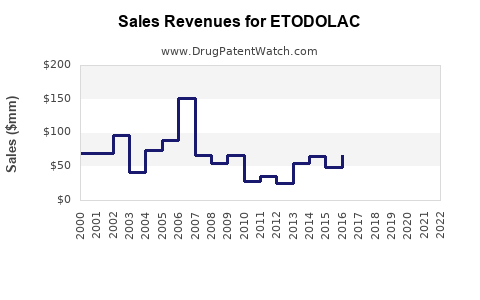
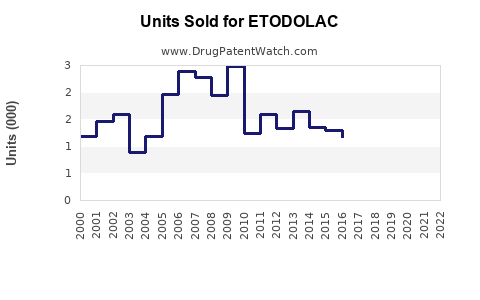
Annual Sales Revenues and Units Sold for ETODOLAC
| Drug Name | Revenues (USD) | Units | Year |
|---|---|---|---|
| ETODOLAC | ⤷ Start Trial | ⤷ Start Trial | 2022 |
| ETODOLAC | ⤷ Start Trial | ⤷ Start Trial | 2021 |
| ETODOLAC | ⤷ Start Trial | ⤷ Start Trial | 2020 |
| ETODOLAC | ⤷ Start Trial | ⤷ Start Trial | 2019 |
| ETODOLAC | ⤷ Start Trial | ⤷ Start Trial | 2018 |
| ETODOLAC | ⤷ Start Trial | ⤷ Start Trial | 2017 |
| >Drug Name | >Revenues (USD) | >Units | >Year |
Etodolac Market Analysis, Sales Projections, Patent Status, and Competitive Outlook
Etodolac is a mature, off-patent nonsteroidal anti-inflammatory drug marketed primarily as a low-cost generic for osteoarthritis, rheumatoid arthritis, and acute pain. Its commercial outlook is stable but limited by intense competition from ibuprofen, naproxen, diclofenac, meloxicam, celecoxib, and other NSAIDs. Product-specific public sales data are not reported consistently, so the projections below are modeled estimates based on generic pricing, prescription volume, geographic availability, and category demand rather than audited manufacturer revenue.
What is the current market position of etodolac?
Etodolac is a selective cyclooxygenase-2-preferring NSAID, although it is not classified as a modern selective COX-2 inhibitor like celecoxib. It is available in immediate-release tablets and extended-release tablets. The drug is used for:
- Osteoarthritis
- Rheumatoid arthritis
- Acute pain
- Chronic musculoskeletal pain
The original U.S. brand, Lodine, was developed by Wyeth and later associated with legacy Pfizer assets. Brand commercialization has largely disappeared in the United States, leaving generic manufacturers to supply the market.
The commercial product has four main characteristics:
| Factor | Etodolac market implication |
|---|---|
| Patent position | Core composition and product protection have expired |
| FDA status | Approved prescription NSAID with generic competition |
| Pricing | Low generic pricing; limited margin per prescription |
| Demand | Chronic arthritis demand supports recurring use |
| Competition | High, with several lower-cost and better-known NSAIDs |
| Growth profile | Mature or declining in developed markets; selective growth in emerging markets |
Etodolac does not have the commercial scale of ibuprofen, naproxen, diclofenac, or celecoxib. Its demand is concentrated in prescriber segments that value prior patient response, extended-release dosing, or perceived gastrointestinal tolerability relative to some older NSAIDs.
How large is the etodolac market?
No single public source provides a consolidated, audited global revenue figure for etodolac across generic manufacturers, hospital channels, retail pharmacies, and international markets. A practical market estimate must therefore distinguish between manufacturer sales, pharmacy spending, and total market value.
A reasonable 2025 global manufacturer-revenue estimate for prescription etodolac is approximately $80 million to $180 million. The range reflects:
- Low generic prices in the United States and Western Europe
- Greater branded or semi-branded pricing in selected emerging markets
- Continued use of extended-release products
- Fragmented generic supply
- Limited transparency around non-U.S. sales
Estimated 2025 market allocation:
| Region | Estimated share of global etodolac revenue | Market characteristics |
|---|---|---|
| North America | 25%-35% | Predominantly generic; low unit pricing |
| Europe | 20%-30% | Country-specific reimbursement and prescribing |
| Asia-Pacific | 25%-35% | Larger population base and broader generic use |
| Latin America | 8%-12% | Mixed branded-generic market |
| Middle East and Africa | 5%-10% | Smaller but fragmented markets |
The United States likely represents a larger share of prescription volume than of revenue because generic acquisition prices are low. International markets can generate higher revenue per unit where etodolac is sold under local brands or through private-pay channels.
What are the etodolac sales projections through 2030?
The base-case outlook is for flat to modestly declining global revenue, offset by population growth and increased chronic pain treatment in emerging markets.
Global etodolac revenue projection
| Year | Downside case | Base case | Upside case |
|---|---|---|---|
| 2025 | $75 million | $125 million | $180 million |
| 2026 | $72 million | $125 million | $185 million |
| 2027 | $69 million | $124 million | $189 million |
| 2028 | $66 million | $124 million | $193 million |
| 2029 | $63 million | $123 million | $197 million |
| 2030 | $60 million | $122 million | $201 million |
| 2025-2030 CAGR | -4.4% | -0.5% | 2.2% |
These projections are market-model estimates, not company-reported forecasts.
What drives the base case?
The base case assumes:
- Continued generic availability in major markets.
- Stable prescription use for osteoarthritis and rheumatoid arthritis.
- Further price erosion in the United States.
- Moderate volume growth in Asia-Pacific and Latin America.
- No significant new branded formulation.
- No material withdrawal of major generic suppliers.
- Continued substitution by meloxicam, celecoxib, naproxen, and diclofenac.
The highest-value commercial opportunity is not the standard immediate-release tablet. It is the extended-release product, particularly where once-daily dosing supports adherence and where local reimbursement permits a price premium.
Which formulations are protected by etodolac patents?
The main etodolac product forms are:
- Immediate-release tablets
- Extended-release tablets
- Capsules in certain markets
- Multiple strengths, including 200 mg, 300 mg, 400 mg, and 500 mg immediate-release tablets
- Extended-release strengths commonly marketed at 400 mg, 500 mg, and 600 mg, depending on jurisdiction
Core U.S. patent protection has expired. Current commercial barriers relate primarily to manufacturing capability, regulatory filings, bioequivalence, supply contracts, and local registrations rather than enforceable composition patents.
Extended-release formulations historically had greater technical value because they required dissolution control, polymer selection, manufacturing-process consistency, and bioequivalence testing. Those characteristics may have delayed generic entry in some markets, but they do not create durable exclusivity after patent expiry and regulatory approval of competing products.
What is the FDA regulatory status of etodolac?
Etodolac is an FDA-approved prescription NSAID. The U.S. labeling identifies indications for osteoarthritis and rheumatoid arthritis, with immediate-release products also used for acute pain. The FDA label contains the class-wide NSAID boxed warnings for increased risk of serious cardiovascular thrombotic events and gastrointestinal bleeding, ulceration, and perforation.[1]
Key FDA regulatory points include:
| Regulatory issue | Status |
|---|---|
| Drug class | Prescription NSAID |
| U.S. reference product | Lodine |
| Immediate-release products | Generic approvals available |
| Extended-release products | Generic approvals available in the U.S. market |
| OTC status | Not an OTC U.S. product |
| Pediatric positioning | Limited relative to common OTC NSAIDs |
| Main safety restrictions | Cardiovascular, gastrointestinal, renal, hepatic, and pregnancy-related risks |
The FDA label warns against use around coronary artery bypass graft surgery and identifies increased fetal renal and cardiovascular risks with NSAID use later in pregnancy.[1]
What is the Orange Book status of etodolac?
The original Lodine reference product is no longer the commercial center of the market. The relevant Orange Book position is therefore generic approval and reference-product history rather than an active branded patent franchise.
There is no current commercial basis for treating etodolac as a protected branded product in the United States. Any remaining Orange Book-listed patents or exclusivity entries must be checked against the current FDA Orange Book and product-specific listing because generic listings and discontinued-reference-product records can change over time.[2]
The practical conclusion is that a new etodolac applicant would face ordinary generic competition rather than a meaningful branded patent barrier.
When does etodolac lose exclusivity?
Etodolac has already lost its core U.S. patent exclusivity. The original product was approved in the early 1990s, and generic approvals have been available for many years. Its commercial position is therefore best characterized as post-exclusivity generic maturity.
There is no expected single “loss of exclusivity” event comparable to a major branded drug approaching patent expiry. The economic erosion occurred over several stages:
| Stage | Commercial effect |
|---|---|
| Original brand launch | High product-level pricing and promotional control |
| First generic entry | Rapid price and share erosion |
| Multiple generic entry | Commodity pricing |
| Brand discontinuation or reduced promotion | Loss of brand premium |
| Mature generic phase | Revenue tied to supply reliability and contracts |
Are there Paragraph IV challenges for etodolac?
Paragraph IV litigation risk is currently low because etodolac is an old generic drug with expired core patents and a mature approval base. Paragraph IV challenges are most relevant when a company seeks approval before listed patents expire. That situation is not central to the current etodolac market.
Potential future litigation could arise from:
- A newly developed extended-release formulation
- A combination product
- A novel dosage regimen
- A manufacturing process patent
- A branded product using etodolac in a new indication
Such patents would protect a specific product or method, not the historical etodolac molecule across the market.
Which companies compete in the etodolac market?
Etodolac is supplied by multiple generic manufacturers and distributors. The competitive set varies by country and changes as companies enter or leave the market.
In the United States, generic NSAID competition includes manufacturers such as:
- Teva Pharmaceuticals
- Solco Healthcare
- Rising Pharmaceuticals
- AvKARE
- Zydus Pharmaceuticals
- Amneal Pharmaceuticals
- Various contract manufacturers and repackagers
The list of active suppliers should be verified against current FDA product listings because generic availability changes frequently.[2]
Etodolac also competes therapeutically with:
| Drug | Competitive advantage |
|---|---|
| Ibuprofen | Very low cost; OTC availability; broad consumer recognition |
| Naproxen | Long duration; OTC and prescription availability |
| Diclofenac | Strong anti-inflammatory efficacy; extensive international use |
| Meloxicam | Once-daily dosing; common chronic arthritis use |
| Celecoxib | COX-2 selectivity; lower gastrointestinal risk in selected patients |
| Ketoprofen | Established NSAID with international availability |
| Acetaminophen | Non-NSAID alternative for pain, without anti-inflammatory activity |
Etodolac's most direct prescription competitors are meloxicam, naproxen, diclofenac, and celecoxib. Its differentiation is limited and depends mainly on clinical familiarity, patient response, dosage form, and formulary position.
What generic entry risks exist for etodolac manufacturers?
The principal risk is price compression, not patent litigation.
Commercial risks
- Pharmacy benefit managers may prefer lower-cost NSAIDs.
- Retail substitution can move volume between suppliers.
- Large buyers can impose aggressive contract pricing.
- Extended-release products may lose share to once-daily meloxicam.
- Chronic NSAID prescribing may be constrained by safety concerns.
- Supply interruptions can cause temporary gains but do not establish durable market share.
Regulatory risks
Manufacturers must maintain compliance with:
- Current Good Manufacturing Practice requirements
- FDA postmarket adverse-event reporting
- Bioequivalence standards
- Stability and dissolution specifications
- Labeling requirements
- Drug supply-chain and serialization obligations
The active pharmaceutical ingredient is commercially available from multiple sources, reducing single-source dependence. The more material manufacturing barrier is consistent production of extended-release tablets and control of dissolution performance.
How strong is the etodolac patent estate?
The legacy etodolac patent estate is weak as a current revenue-protection mechanism.
| Patent-estate factor | Assessment |
|---|---|
| Composition-of-matter protection | Expired |
| Core product protection | Expired |
| Immediate-release formulation protection | Expired or commercially irrelevant |
| Extended-release protection | Historical protection; no broad current barrier |
| Method-of-use protection | Limited practical value for established indications |
| Manufacturing protection | Potentially relevant only to specific processes |
| Generic substitution barrier | Low |
| Litigation leverage | Low |
A new entrant would compete on cost, supply reliability, formulation quality, regulatory execution, and distribution rather than molecule-level exclusivity.
What patent litigation affects etodolac?
There is no widely recognized current U.S. patent litigation campaign affecting the entire etodolac market. Historical disputes involving etodolac formulations or generic approvals do not appear to create a current industry-wide entry barrier.
A company evaluating an etodolac product should still conduct a jurisdiction-specific freedom-to-operate review covering:
- Current Orange Book listings
- Pending continuation patents
- Formulation patents
- Process patents
- Labeling claims
- Combination products
- Country-specific registrations
For standard immediate-release generic etodolac, the expected litigation burden is materially lower than for a recently approved branded NSAID.
Are biosimilars relevant to etodolac?
No. Etodolac is a chemically synthesized small molecule, not a biologic. Biosimilar pathways do not apply. Competition proceeds through conventional generic-drug approvals, including abbreviated new drug applications in the United States and equivalent national pathways in other jurisdictions.
The relevant competitive risk is generic substitution, not biosimilar erosion.
What licensing deals could increase etodolac value?
Licensing potential is limited for unmodified etodolac. A conventional generic tablet has little strategic licensing value unless it provides:
- A registered product in a market where the licensor lacks approval
- An extended-release technology
- A lower-cost manufacturing platform
- A differentiated combination product
- A hospital or government supply contract
- A geographic registration portfolio
The strongest licensing angle is regional commercialization. A manufacturer with regulatory approvals in Asia-Pacific, Latin America, the Middle East, or Eastern Europe could license those rights to a multinational distributor. The economics would likely be based on supply price, minimum purchase commitments, and territory rights rather than large upfront payments.
What is the revenue exposure for manufacturers?
Etodolac is unlikely to represent a material revenue concentration for diversified pharmaceutical companies. It may matter more to:
- Small generic companies with narrow product portfolios
- Contract manufacturers
- Regional distributors
- Firms holding hospital tenders
- Companies selling extended-release NSAID products
Revenue quality is generally low to moderate because:
- Unit prices are compressed.
- Products are substitutable.
- Buyers can dual-source or multi-source.
- Brand loyalty is weak.
- Patent protection does not support premium pricing.
A manufacturer with a differentiated extended-release product or a strong regional registration network can achieve better margins than a seller of standard immediate-release tablets.
What are the most likely etodolac launch scenarios?
Base-case scenario
Generic supply remains stable. U.S. revenue declines slightly because of price competition, while emerging-market volume offsets part of the decline. Global revenue remains near current levels through 2030.
Downside scenario
More suppliers enter, reimbursement prices fall, and prescribers shift toward meloxicam, celecoxib, or naproxen. Global revenue declines at approximately 3%-5% annually.
Upside scenario
A manufacturer secures broad regional registrations, hospital contracts, or an extended-release product with reliable once-daily dosing. Volume grows in emerging markets, producing low-single-digit annual revenue growth despite generic pricing.
The upside case does not depend on renewed molecule-level exclusivity. It depends on execution, geographic access, and supply reliability.
How does etodolac compare with meloxicam and celecoxib?
| Attribute | Etodolac | Meloxicam | Celecoxib |
|---|---|---|---|
| Patent status | Mature generic | Mature generic, some market-specific protection history | Generic in the U.S.; stronger historical brand franchise |
| Dosing | Immediate or extended release | Commonly once daily | Once or twice daily |
| Brand strength | Low | Moderate | High |
| Generic pricing | Low | Low | Low to moderate |
| Differentiation | Limited | Convenient dosing | COX-2 selectivity |
| Commercial growth | Flat to declining | More resilient | More resilient in selected segments |
| Main use | Arthritis and acute pain | Chronic arthritis | Arthritis and acute pain |
Etodolac can remain commercially viable, but it lacks the dosing convenience and brand recognition that support stronger competitive positioning for meloxicam and celecoxib.
Key Takeaways
- Etodolac is a mature, off-patent prescription NSAID with extensive generic competition.
- Estimated 2025 global manufacturer revenue is approximately $80 million to $180 million, with a base case near $125 million.
- Base-case global revenue is projected to remain broadly flat through 2030, with a modeled 2025-2030 CAGR of approximately -0.5%.
- The United States is a high-volume, low-price market; emerging markets offer greater volume and potentially higher unit economics.
- Immediate-release etodolac has limited commercial differentiation.
- Extended-release formulations offer the clearest remaining product-level opportunity.
- Paragraph IV and biosimilar risks are low or irrelevant under the current market structure.
- The main threats are price erosion, therapeutic substitution, reimbursement pressure, and supply competition.
- The most attractive commercial strategy is regional generic expansion, hospital contracting, or differentiated extended-release manufacturing.
- The legacy patent estate does not provide a meaningful current barrier to standard generic entry.
FAQs
Is etodolac still commercially available in the United States?
Yes. Etodolac remains available through generic prescription products, although product availability varies by strength, dosage form, supplier, and pharmacy inventory.
Is etodolac more profitable than ibuprofen?
Usually not on a per-unit basis. Prescription etodolac can generate higher reimbursement in selected channels, but ibuprofen benefits from much larger volume, broad OTC recognition, and extensive distribution.
Can a company obtain new patents on etodolac?
A company may patent a genuinely novel formulation, delivery system, combination, manufacturing process, or method of use. It cannot obtain a new composition-of-matter patent on the known etodolac molecule merely by filing a later application.
Does etodolac have an extended-release market opportunity?
Yes, but the opportunity is specialized. Extended-release products can command better positioning where once-daily dosing, adherence, or regional formulary access matters. The opportunity is constrained by competition from meloxicam and other once-daily NSAIDs.
What is the primary investment risk in etodolac?
The main risk is commodity pricing. Revenue depends on volume, procurement contracts, manufacturing cost, and geographic reach rather than durable patent exclusivity.
References
- U.S. Food and Drug Administration. (2023). Etodolac tablets prescribing information. FDA.
- U.S. Food and Drug Administration. (2025). Approved drug products with therapeutic equivalence evaluations: Orange Book. FDA.
- U.S. Food and Drug Administration. (1991). Lodine NDA approval history and product information. FDA Drugs@FDA.
- U.S. Food and Drug Administration. (2015). Guidance for industry: Waiver of in vivo bioavailability and bioequivalence studies for immediate-release solid oral dosage forms. FDA.
- U.S. Food and Drug Administration. (2020). Nonsteroidal anti-inflammatory drugs: Drug safety communication. FDA.
- World Health Organization. (2023). WHO guideline for the pharmacological treatment of persisting pain in adults with medical illnesses. World Health Organization.
More… ↓
