Share This Page
Drug Sales Trends for EPIDUO
✉ Email this page to a colleague
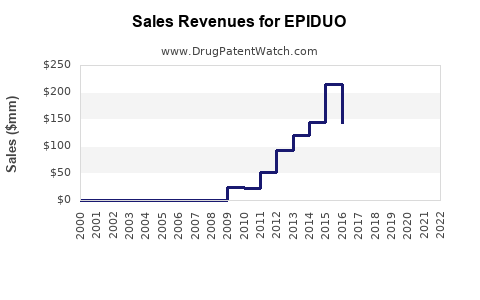

Annual Sales Revenues and Units Sold for EPIDUO
| Drug Name | Revenues (USD) | Units | Year |
|---|---|---|---|
| EPIDUO | ⤷ Start Trial | ⤷ Start Trial | 2022 |
| EPIDUO | ⤷ Start Trial | ⤷ Start Trial | 2021 |
| EPIDUO | ⤷ Start Trial | ⤷ Start Trial | 2020 |
| EPIDUO | ⤷ Start Trial | ⤷ Start Trial | 2019 |
| >Drug Name | >Revenues (USD) | >Units | >Year |
Epiduo Market Analysis and Sales Projections: Adapalene and Benzoyl Peroxide Acne Treatment
Epiduo is a topical acne product containing adapalene 0.1% and benzoyl peroxide 2.5%. Its commercial position is constrained by generic competition, low switching costs, and widespread availability of separate adapalene and benzoyl peroxide products. Epiduo Forte, containing adapalene 0.3% and benzoyl peroxide 2.5%, addresses patients requiring higher adapalene strength and remains the more defensible branded formulation.
A reasonable base-case forecast places combined U.S. net sales for branded Epiduo and Epiduo Forte at approximately $35 million to $55 million in 2025, declining to $22 million to $38 million by 2030. The broader adapalene/benzoyl peroxide category, including generics and substitutes, is materially larger and could generate U.S. retail sales of roughly $250 million to $400 million annually by 2030, depending on prescription volume, pricing, and over-the-counter substitution.
What is Epiduo and how does it compete in acne treatment?
Epiduo is a prescription topical gel for acne vulgaris. It combines:
| Product | Active ingredients | Strength | FDA approval |
|---|---|---|---|
| Epiduo | Adapalene and benzoyl peroxide | 0.1% / 2.5% | 2008 |
| Epiduo Forte | Adapalene and benzoyl peroxide | 0.3% / 2.5% | 2015 |
| Generic equivalents | Adapalene and benzoyl peroxide | Usually 0.1% / 2.5% | Approved through ANDA pathway |
Adapalene is a topical retinoid that normalizes keratinization and reduces inflammation. Benzoyl peroxide has antimicrobial activity and helps reduce the risk of bacterial resistance associated with topical antibiotic therapy. The fixed-dose combination simplifies treatment compared with prescribing the two ingredients separately.
The product competes with:
- Generic adapalene gel.
- Generic benzoyl peroxide products.
- Separate prescription adapalene and benzoyl peroxide products.
- Tretinoin and trifarotene.
- Clindamycin-based combinations.
- Oral isotretinoin for severe disease.
- Over-the-counter Differin, the branded adapalene 0.1% product.
Epiduo’s clinical value is strongest when physicians want a single prescription combining a topical retinoid and benzoyl peroxide. Its commercial value is weaker when payers require generic substitution or when patients purchase lower-priced over-the-counter alternatives.
What is the U.S. FDA status of Epiduo and Epiduo Forte?
The FDA approved Epiduo under NDA 022320 in December 2008 for the topical treatment of acne vulgaris in patients aged 12 years and older. The FDA later approved Epiduo Forte under NDA 207917 for patients aged 12 years and older with acne vulgaris.[1][2]
The products are topical prescription drugs, not biologics. Biosimilar risk is therefore not relevant. The principal entry threat is generic substitution through abbreviated new drug applications.
Epiduo and Epiduo Forte have standard topical-drug characteristics:
- Low manufacturing complexity relative to sterile injectables.
- Limited cold-chain requirements.
- Established active pharmaceutical ingredients.
- High potential for contract manufacturing.
- Formulation and process consistency as the principal technical barriers.
The regulatory pathway is less difficult than for complex dermatology products such as microsphere injections, transdermal systems, or biologics. Generic applicants still need to demonstrate pharmaceutical equivalence and establish bioequivalence under the applicable FDA framework for topical products.
What patents protect Epiduo and when does Epiduo lose exclusivity?
Epiduo’s original commercial exclusivity has ended. Generic versions of adapalene and benzoyl peroxide gel are available in the United States, and branded Epiduo competes in a market where prescription substitution is common.
The relevant protection has historically involved:
- The fixed combination of adapalene and benzoyl peroxide.
- The gel formulation and vehicle.
- Manufacturing and composition claims.
- Method-of-use claims for treating acne.
- Separate protection for the higher-strength Epiduo Forte formulation.
Patent protection should be evaluated through the current FDA Orange Book, USPTO Patent Center, and individual ANDA litigation records. Patent listings can change through delisting, expiration, litigation, or settlement. A definitive freedom-to-operate conclusion cannot be based solely on the product label.
For commercial forecasting, the practical conclusion is clear: Epiduo does not have the exclusivity profile of a newly launched prescription dermatology product. The brand must compete through formulary positioning, physician familiarity, patient adherence, distribution, and differentiation of the fixed-dose formulation.
Does Epiduo face Paragraph IV challenges?
Generic applicants can file Paragraph IV certifications against listed patents where they assert that a patent is invalid, unenforceable, or will not be infringed. Because generic Epiduo products are already marketed, any foundational Paragraph IV risk has largely been absorbed into the competitive landscape.
The remaining risk is more likely to involve:
- Later-listed formulation patents.
- Epiduo Forte-specific patents.
- Manufacturing patents.
- Method-of-use claims.
- Patent disputes affecting particular generic applicants rather than the entire category.
Paragraph IV activity can delay an individual generic launch, but it does not necessarily preserve long-term brand pricing when multiple suppliers enter.
How large is the Epiduo and topical acne market?
The relevant market has three layers:
| Market layer | 2025 estimated U.S. annual value | Growth outlook through 2030 |
|---|---|---|
| Branded Epiduo and Epiduo Forte | $35 million-$55 million | Declining or flat |
| All prescription adapalene/BPO products | $120 million-$220 million | Low single-digit growth |
| Broad topical acne market | $1.5 billion-$2.5 billion | Mid-single-digit growth |
These are analytical estimates rather than reported manufacturer revenue. They reflect prescription volume, average realized price, generic penetration, payer discounts, and patient use of over-the-counter substitutes.
The broad acne market benefits from several structural factors:
- High prevalence among adolescents and young adults.
- Continued diagnosis and treatment of adult female acne.
- Greater use of combination therapy.
- Increased demand for tolerable topical regimens.
- Expansion of dermatology telehealth and direct-to-consumer prescribing.
Epiduo’s addressable market is smaller than the overall acne market because it competes with low-cost generics and is usually prescribed for patients appropriate for topical therapy rather than systemic treatment.
What are Epiduo sales projections through 2030?
The following base-case forecast estimates U.S. branded sales for Epiduo and Epiduo Forte combined.
| Year | Base-case sales | Bear case | Bull case |
|---|---|---|---|
| 2025 | $45 million | $35 million | $55 million |
| 2026 | $43 million | $30 million | $57 million |
| 2027 | $41 million | $27 million | $59 million |
| 2028 | $38 million | $24 million | $61 million |
| 2029 | $35 million | $21 million | $62 million |
| 2030 | $32 million | $18 million | $64 million |
The base case assumes continued generic price pressure, moderate prescription growth, stable brand recognition, and limited premium retention for Epiduo Forte. The bull case assumes stronger physician preference for fixed-dose therapy, favorable formulary placement, improved adherence messaging, and slower generic erosion. The bear case assumes aggressive payer substitution, additional generic entrants, and increased use of over-the-counter adapalene.
A simplified revenue model is:
Net sales = treated patients × annualized prescriptions per patient × realized price per prescription
The most important variable is realized price. Prescription growth alone does not protect revenue if payers force generic substitution or if manufacturer rebates increase.
Which companies compete with Epiduo?
The competitive landscape includes brand manufacturers, generic drugmakers, and companies selling individual ingredients.
| Competitor category | Representative products | Commercial threat |
|---|---|---|
| Generic combination products | Adapalene/benzoyl peroxide gels | Direct price substitution |
| OTC adapalene | Differin and store-brand equivalents | Reduces prescription demand |
| Topical retinoids | Tretinoin, trifarotene | Clinical substitution |
| Benzoyl peroxide products | Washes, gels, creams | Ingredient substitution |
| Antibiotic combinations | Clindamycin/benzoyl peroxide | Alternative mechanism |
| Oral therapies | Doxycycline, isotretinoin | Escalation in moderate or severe acne |
Differin has particular commercial importance because adapalene 0.1% is available without a prescription in the United States. Patients and clinicians can recreate part of Epiduo’s therapeutic approach through separate products, although the dosing experience and formulation are not identical.
What formulations are protected by Epiduo?
Epiduo’s commercial differentiation is based on the fixed-dose gel rather than a novel active ingredient. Relevant formulation attributes include:
- A single topical vehicle containing both active ingredients.
- Adapalene 0.1% in standard Epiduo.
- Adapalene 0.3% in Epiduo Forte.
- Benzoyl peroxide 2.5% in both products.
- A formulation intended for once-daily application.
Formulation patents, if enforceable, can be more commercially relevant than broad method-of-use patents because they may directly affect generic product design. Their strength depends on claim scope, written-description support, prior art, prosecution history, and the ability of generic manufacturers to design around the claimed vehicle or process.
The manufacturing barrier is moderate. Benzoyl peroxide presents stability and handling considerations, while adapalene requires controlled dispersion and consistent content uniformity. These factors can create quality risks, but they are unlikely to prevent entry by experienced topical manufacturers.
What patent litigation and settlement risks affect Epiduo?
The principal litigation risks are typical of a mature branded topical:
- ANDA litigation over formulation or composition patents.
- Delisting or expiration of Orange Book patents.
- Allegations involving manufacturing-process patents.
- Commercial agreements that permit an authorized generic.
- Launches following patent settlement dates.
- Product liability and labeling disputes.
Settlement agreements can materially alter market timing even when the brand retains nominal patent rights. A generic launch at a negotiated date may produce revenue erosion before final patent expiration. Authorized generic arrangements can preserve part of the brand owner’s economics while accelerating lower-priced supply.
No biosimilar settlement framework applies because Epiduo is a small-molecule topical product.
How strong is the Epiduo patent estate?
Epiduo’s patent estate is commercially weak to moderate for long-term revenue protection.
Its strengths are:
- Recognized fixed-dose combination.
- Established clinical use.
- Potential formulation-specific claims.
- Brand familiarity among dermatologists.
- Higher-strength differentiation through Epiduo Forte.
Its weaknesses are:
- Generic availability.
- Low-cost active ingredients.
- OTC access to adapalene.
- Straightforward topical manufacturing.
- Limited switching friction.
- Weak protection from broad method-of-use claims once the active ingredients are established.
The strongest remaining commercial asset is likely the product franchise and prescribing habit rather than broad exclusivity.
What generic launch scenarios exist for Epiduo?
Base-case scenario
Generic products continue to gain share gradually. Brand net sales fall by approximately 5% to 10% annually, while total category volume increases modestly. Epiduo Forte retains a higher share of branded revenue because the 0.3% adapalene strength has greater differentiation.
Downside scenario
Additional generic suppliers obtain favorable payer coverage. Brand prescriptions decline sharply, and net price falls through rebates. U.S. branded sales could fall below $25 million by 2027.
Upside scenario
The manufacturer secures preferred formulary access, emphasizes adherence and simplified combination therapy, and maintains a meaningful premium for Epiduo Forte. Revenue remains near $55 million to $65 million annually through 2030.
How does Epiduo compare with other acne drugs?
| Product | Main advantage | Main commercial weakness |
|---|---|---|
| Epiduo | Fixed retinoid/BPO combination | Generic and OTC substitution |
| Epiduo Forte | Higher adapalene strength | Smaller eligible patient segment |
| Tretinoin | Broad clinical familiarity | Irritation and multiple generic options |
| Trifarotene | Newer retinoid positioning | Higher cost and limited payer access |
| Clindamycin/BPO | Familiar antibiotic combination | Antibiotic stewardship concerns |
| Oral isotretinoin | High efficacy for severe acne | Monitoring, tolerability, and safety burden |
Epiduo is best positioned as a convenient first-line or early combination therapy for inflammatory and comedonal acne. It is less competitive for severe acne requiring oral treatment and less economically attractive when payers prioritize generic monotherapies.
What is the investment outlook for Epiduo?
Epiduo is a mature branded dermatology asset with predictable but declining economics. The investment case depends on whether the holder can preserve branded pricing, increase Epiduo Forte utilization, and expand non-U.S. distribution.
Key value drivers include:
- Brand-to-generic conversion rate.
- Epiduo Forte share of total franchise sales.
- Average realized price after rebates.
- Formulary tier placement.
- Prescription persistence.
- International regulatory and reimbursement access.
- Any authorized-generic or licensing arrangement.
The product is unlikely to justify a high valuation based on exclusivity alone. It may remain attractive as part of a broader dermatology portfolio with shared sales infrastructure and complementary acne products.
Key Takeaways
- Epiduo combines adapalene 0.1% and benzoyl peroxide 2.5%; Epiduo Forte raises adapalene to 0.3%.
- FDA approval dates are 2008 for Epiduo and 2015 for Epiduo Forte.
- Generic competition and OTC adapalene materially limit branded pricing power.
- Estimated combined U.S. branded sales are approximately $35 million to $55 million in 2025.
- Base-case branded sales decline to about $32 million by 2030.
- Epiduo Forte is the stronger commercial product because of its higher adapalene strength.
- Biosimilar risk does not apply; ANDA-based generic entry is the relevant threat.
- The patent estate provides limited long-term protection relative to the value of the commercial franchise.
- The broad adapalene/benzoyl peroxide category should grow even as branded Epiduo sales decline.
FAQs
Is Epiduo still patent protected?
Some formulation, manufacturing, or method-of-use rights may remain relevant depending on the jurisdiction and current patent listings, but the product is already exposed to generic competition. Current Orange Book and USPTO records control the definitive analysis.
Is Epiduo Forte more valuable than regular Epiduo?
Usually, yes. Epiduo Forte has a higher adapalene concentration and may retain more branded demand, although its eligible patient population and payer coverage are narrower.
Can patients buy Epiduo over the counter?
No. Epiduo remains a prescription product in the United States. Adapalene 0.1% is available over the counter, but the fixed combination with benzoyl peroxide is not equivalent to purchasing Epiduo.
What is the main generic threat to Epiduo?
The main threat is substitution with generic adapalene/benzoyl peroxide gel or separate generic adapalene and benzoyl peroxide products. Payer-mandated substitution is more important than a single litigation event.
Does Epiduo have biosimilar competition?
No. Epiduo is a small-molecule topical drug, so biosimilar competition does not apply. Generic drug competition through the ANDA pathway is the relevant regulatory and commercial risk.
References
-
U.S. Food and Drug Administration. (2008). Epiduo (adapalene and benzoyl peroxide) gel, NDA 022320: Prescribing information. FDA.
-
U.S. Food and Drug Administration. (2015). Epiduo Forte (adapalene and benzoyl peroxide) gel, NDA 207917: Prescribing information. FDA.
-
U.S. Food and Drug Administration. (2024). Approved drug products with therapeutic equivalence evaluations: Orange Book. FDA.
-
U.S. Food and Drug Administration. (2024). Drugs@FDA: FDA-approved drugs database. FDA.
-
U.S. Food and Drug Administration. (2016). Draft guidance for industry: Topical dermatologic corticosteroids and other topical drug products, bioequivalence recommendations. FDA.
More… ↓
