Share This Page
Drug Sales Trends for DRONEDARONE
✉ Email this page to a colleague
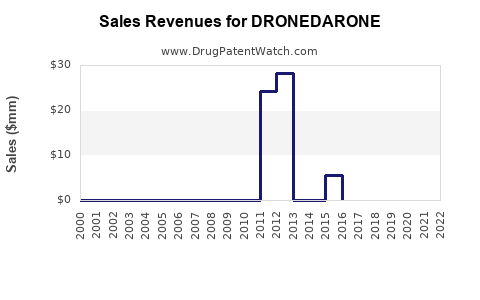
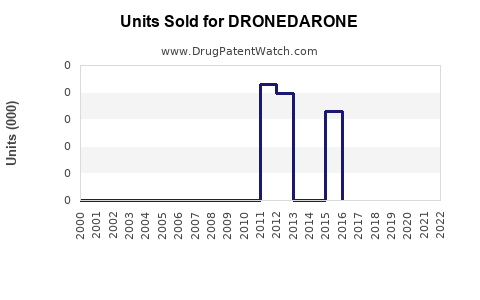
Annual Sales Revenues and Units Sold for DRONEDARONE
| Drug Name | Revenues (USD) | Units | Year |
|---|---|---|---|
| DRONEDARONE | ⤷ Start Trial | ⤷ Start Trial | 2022 |
| DRONEDARONE | ⤷ Start Trial | ⤷ Start Trial | 2021 |
| DRONEDARONE | ⤷ Start Trial | ⤷ Start Trial | 2020 |
| DRONEDARONE | ⤷ Start Trial | ⤷ Start Trial | 2019 |
| >Drug Name | >Revenues (USD) | >Units | >Year |
Dronedarone Market Analysis and Sales Projections
Dronedarone is a mature antiarrhythmic marketed primarily as Multaq by Sanofi for selected patients with atrial fibrillation or atrial flutter. Its commercial position is supported by long-term use, physician familiarity, and limited therapeutic alternatives, but constrained by safety restrictions, generic competition, and competition from catheter ablation and other rhythm-control medicines.
Base-case global sales are estimated at approximately $450 million to $550 million in 2024, with a gradual decline to $300 million to $400 million by 2030. The principal risk is price erosion from generic dronedarone tablets. The principal upside is continued use in older patients who need rhythm control but are unsuitable for amiodarone or invasive ablation.
What is dronedarone and how is it used?
Dronedarone is an oral Class III antiarrhythmic drug. It is approved in the United States under the brand name Multaq for reducing the risk of hospitalization for atrial fibrillation in patients who are in sinus rhythm or who will be cardioverted to sinus rhythm.
The approved dose is 400 mg twice daily with meals. The product is available as film-coated tablets.
| Attribute | Dronedarone profile |
|---|---|
| Brand | Multaq |
| Active ingredient | Dronedarone hydrochloride |
| Primary manufacturer | Sanofi |
| FDA approval | July 2009 |
| Dosage form | 400 mg oral tablet |
| Main use | Maintenance of sinus rhythm and reduction of cardiovascular hospitalization in selected AF patients |
| Therapeutic class | Class III antiarrhythmic |
| Key alternatives | Amiodarone, sotalol, dofetilide, flecainide, propafenone, catheter ablation |
| Major markets | United States, Europe, Japan and selected international markets |
The FDA label restricts use in patients with symptomatic heart failure with recent decompensation or severe left ventricular systolic dysfunction. Dronedarone is also contraindicated in patients with permanent atrial fibrillation because of increased cardiovascular and mortality risks observed in clinical studies.[1]
How large is the dronedarone market?
The global market for branded and generic dronedarone is estimated at roughly $500 million annually, although reported market size varies by geography, currency, and whether hospital and retail channels are combined.
The United States accounts for the largest share of commercial value because of higher prices and greater use of branded or authorized-generic products. Europe has a substantial patient population but lower net prices. Japan and other developed markets contribute smaller, stable revenue pools.
| Market | Estimated 2024 share of global value | Market characteristics |
|---|---|---|
| United States | 55% to 65% | Highest price per prescription; generic pressure increasing |
| Europe | 20% to 25% | Lower pricing; national reimbursement controls |
| Japan | 5% to 10% | Smaller addressable population and local reimbursement |
| Other markets | 10% to 15% | Uneven diagnosis, reimbursement and availability |
Dronedarone occupies a narrower segment than amiodarone because it is not appropriate for patients with advanced heart failure, permanent atrial fibrillation, or certain high-risk cardiovascular conditions. Its value proposition is strongest in patients requiring rhythm-control therapy but for whom physicians want to avoid amiodarone-related pulmonary, thyroid, hepatic and ocular toxicity.
What are the historical sales of Multaq?
Sanofi has reported Multaq as a mature cardiovascular product with annual sales generally in the several-hundred-million-euro range. Public annual reports have shown relative resilience compared with many older branded medicines, reflecting continued prescribing in atrial fibrillation and the absence of a direct low-cost substitute for every patient segment.[2]
Reported sales have been affected by:
- Regulatory warnings and label restrictions after safety findings.
- Increased use of catheter ablation.
- Generic competition in some markets.
- Pricing controls in Europe.
- Greater use of newer anticoagulants and expanded rhythm-control strategies.
- Continued physician preference for avoiding long-term amiodarone in selected patients.
Because Sanofi's public reporting does not always provide a uniform global product-level series across every reporting period, historical comparisons should use the company's annual reports rather than third-party estimates that may combine geographic sales differently.
What are the 2024-2030 sales projections for dronedarone?
The following projections use a market-based model incorporating current branded sales, generic entry, prescription retention, and declining net prices. Values are global net sales in U.S. dollars.
| Year | Downside case | Base case | Upside case |
|---|---|---|---|
| 2024 | $450 million | $525 million | $575 million |
| 2025 | $390 million | $500 million | $565 million |
| 2026 | $335 million | $470 million | $550 million |
| 2027 | $300 million | $440 million | $535 million |
| 2028 | $270 million | $410 million | $520 million |
| 2029 | $245 million | $375 million | $505 million |
| 2030 | $220 million | $350 million | $490 million |
The base case assumes gradual generic penetration rather than an immediate full substitution event. It also assumes that Multaq retains meaningful share in patients for whom physicians value its safety profile relative to amiodarone.
The downside case assumes broad generic availability in the United States, rapid payer substitution, and increased adoption of catheter ablation. The upside case assumes slower generic uptake, stable reimbursement, and continued growth in rhythm-control treatment among older patients with symptomatic paroxysmal or persistent atrial fibrillation.
What drives the dronedarone sales forecast?
The forecast depends on four commercial variables:
- Generic availability and substitution. Generic dronedarone would reduce average selling prices and shift prescriptions away from Sanofi's branded product.
- Atrial fibrillation prevalence. Aging populations and higher diagnosis rates support underlying demand.
- Treatment selection. Physicians increasingly use early rhythm control, ablation and newer care pathways.
- Safety-driven segmentation. Dronedarone remains unsuitable for several high-risk populations, limiting total market expansion.
The underlying atrial fibrillation population is growing, but that growth does not translate one-for-one into dronedarone sales. Many patients are managed with rate control, anticoagulation, ablation or other antiarrhythmic agents.
What is the FDA regulatory status of dronedarone?
The FDA approved Multaq in 2009. The approved use is limited to patients with a history of atrial fibrillation or atrial flutter who are in sinus rhythm or will undergo cardioversion.
The FDA added a boxed warning after clinical evidence showed increased mortality and cardiovascular events in patients with severe heart failure and in patients with permanent atrial fibrillation.[1]
Important regulatory restrictions include:
- Do not use in patients with symptomatic heart failure with recent hospitalization or New York Heart Association Class IV heart failure.
- Do not use in patients with permanent atrial fibrillation.
- Monitor cardiac rhythm during treatment.
- Discontinue treatment if the patient develops permanent atrial fibrillation.
- Monitor renal function, liver-related symptoms and drug interactions.
These restrictions reduce the addressable population but also define a clinically identifiable segment in which dronedarone can remain commercially relevant.
What patents protect dronedarone and Multaq?
Dronedarone's principal composition-of-matter protection is no longer the main commercial barrier. The original product has been on the market since 2009, and generic-drug activity has materially changed the exclusivity profile.
The relevant protection categories are:
| Protection category | Commercial relevance |
|---|---|
| Active-ingredient patents | Generally expired or no longer sufficient to block ordinary generic entry |
| Tablet formulation patents | May create narrower barriers if listed and enforceable |
| Manufacturing patents | Can restrict particular processes but usually do not block all generic production |
| Method-of-use patents | May cover patient subgroups or treatment methods, subject to validity and infringement limits |
| Regulatory exclusivity | Original new-drug exclusivity has expired |
| Trademark | Multaq branding remains protected separately from the active ingredient |
An Orange Book analysis must distinguish listed patents from patents that can actually prevent an ANDA launch. A formulation or method-of-use patent may support a Paragraph IV dispute, but it does not necessarily block approval of a generic product with a permitted label or alternative formulation.
The commercial conclusion is that dronedarone has a mature patent estate. Its remaining value is more likely to arise from formulation, labeling and manufacturing positions than from broad molecule protection.
What is the Orange Book and Paragraph IV status of dronedarone?
The FDA Orange Book identifies approved products, therapeutic equivalence ratings and, where applicable, patents and exclusivity information for listed drugs.[3]
For dronedarone, the main competitive question is whether an ANDA applicant can obtain approval with:
- A Paragraph III certification delaying launch until patent expiration.
- A Paragraph IV certification asserting that listed patents are invalid, unenforceable or not infringed.
- A section viii statement omitting a patented method of use from the generic label.
- A negotiated settlement that permits an earlier launch.
A Paragraph IV filing can trigger patent litigation within 45 days if the NDA holder or patent owner sues. Litigation alone does not establish that a patent is strong. The practical value of the patent depends on claim scope, remaining patent term, the generic's proposed labeling and the likelihood of an injunction.
Publicly available information does not establish a single, permanent Paragraph IV outcome for every dronedarone product and jurisdiction. Generic entry should therefore be assessed at the product, applicant and patent-listing level rather than inferred from the existence of generic competition alone.
Which companies compete with dronedarone?
Dronedarone competes with both medicines and procedures.
Drug competitors
| Competitor | Competitive position |
|---|---|
| Amiodarone | More potent and broadly used, but has substantial long-term toxicity concerns |
| Sotalol | Used for rhythm control; requires attention to renal function and QT prolongation |
| Dofetilide | Effective in selected patients but generally requires monitored initiation |
| Flecainide | Used mainly in patients without significant structural heart disease |
| Propafenone | Similar rhythm-control positioning in selected patients |
| Beta blockers and calcium-channel blockers | Rate-control alternatives rather than direct rhythm-control substitutes |
| Anticoagulants | Manage stroke risk but do not replace antiarrhythmic therapy |
Procedural competitors
Catheter ablation is the principal non-drug competitor. Earlier ablation is increasingly used in symptomatic patients with paroxysmal or persistent atrial fibrillation. Ablation can reduce long-term reliance on antiarrhythmic drugs, particularly in patients with recurrent symptomatic episodes.
Dronedarone remains more commercially defensible in patients who prefer drug therapy, are not suitable for ablation, or require pharmacologic rhythm control after cardioversion.
How does dronedarone compare with amiodarone?
Amiodarone is generally more effective at maintaining sinus rhythm, but it has a more burdensome chronic safety profile. Dronedarone has lower efficacy in some comparative analyses but avoids the iodine-containing structure associated with several amiodarone toxicities.
| Factor | Dronedarone | Amiodarone |
|---|---|---|
| Rhythm-control efficacy | Moderate | High |
| Long-term thyroid toxicity | Lower concern | Material concern |
| Pulmonary toxicity | Lower concern | Material concern |
| Hepatic monitoring | Required | Required |
| Use in severe heart failure | Contraindicated in key populations | May be used in selected patients |
| Dosing convenience | Twice daily | Variable |
| Generic price pressure | Increasing | Extensive |
| Physician role | Selective alternative | Broad but risk-limited |
Dronedarone's commercial opportunity is not to replace amiodarone across the full market. It is to capture patients for whom lower systemic toxicity and outpatient use justify lower efficacy.
What generic launch risks exist for Multaq?
The largest risk is a rapid conversion from branded Multaq to generic dronedarone after multiple suppliers enter the market. Generic erosion can reduce branded revenue by 50% to 80% within several years, depending on the number of approved suppliers, payer policy and pharmacy substitution.
Generic launch scenarios
Limited-entry scenario. One or two generic suppliers enter with supply constraints. Multaq retains a meaningful share, and price erosion is moderate.
Standard-entry scenario. Several ANDA holders launch. Payers favor generic substitution, and branded revenue falls sharply over three to five years.
Aggressive-entry scenario. Multiple suppliers enter after patent disputes or settlements. Generic share rises quickly, and branded revenue declines toward a specialty-maintenance level.
Manufacturing complexity is unlikely to create a durable barrier comparable with injectable biologics. Dronedarone is an oral small-molecule tablet, and generic manufacturers generally face lower technical barriers than biosimilar developers.
Is there biosimilar risk for dronedarone?
No. Dronedarone is a chemically synthesized small molecule, not a biologic. Biosimilar regulation does not apply.
The relevant competitive pathway is an abbreviated new drug application, or ANDA, under section 505(j) of the Federal Food, Drug, and Cosmetic Act. Generic manufacturers must demonstrate pharmaceutical equivalence and bioequivalence rather than conduct the full clinical development program required for a new active ingredient.
What is the commercial outlook for dronedarone?
Dronedarone is likely to remain a profitable mature product but not a high-growth asset. Its commercial durability depends on maintaining a differentiated position against amiodarone and preserving prescribing in patients who are not immediate ablation candidates.
Sanofi's revenue exposure is meaningful but limited relative to its larger immunology, vaccines and specialty-care franchises. A base-case decline from approximately $525 million in 2024 to $350 million in 2030 would represent a compound annual decline of about 6%.
The asset remains attractive for:
- Generic manufacturers seeking a cardiovascular product with established demand.
- Specialty pharmaceutical companies with cardiology sales forces.
- Licensing buyers targeting mature branded products with stable cash flow.
- Contract manufacturers with tablet-production capabilities.
Its attractiveness is lower for companies seeking high-growth, first-in-class or biologic opportunities.
How strong is the dronedarone patent estate?
The patent estate is commercially moderate to weak as a broad exclusivity platform and stronger as a litigation or timing tool around specific formulations, manufacturing processes or method-of-use claims.
| Patent-strength factor | Assessment |
|---|---|
| Broad molecule protection | Low after long market tenure |
| Remaining regulatory exclusivity | Low |
| Formulation protection | Potentially relevant, but claim-specific |
| Method-of-use protection | Narrow and label-dependent |
| Manufacturing barriers | Moderate for a specific process, low for the product overall |
| Generic substitution risk | High to moderate, depending on market |
| Litigation leverage | Dependent on live listed patents and applicant certifications |
Geographic protection is uneven. U.S. patent and FDA rules differ from European national patent enforcement and regulatory systems. A generic launch may occur in one region while litigation or regulatory review continues in another.
Key Takeaways
- Dronedarone is a mature oral antiarrhythmic marketed as Multaq by Sanofi.
- Estimated global 2024 sales are approximately $450 million to $575 million, with a base case of $525 million.
- Base-case sales are projected to decline to about $350 million by 2030.
- Generic substitution is the largest commercial risk.
- The FDA restricts use in permanent atrial fibrillation and severe or recently decompensated heart failure.
- Amiodarone is the primary drug comparator; catheter ablation is the main procedural competitor.
- Dronedarone has no biosimilar risk because it is a small-molecule drug.
- Remaining patent value is likely concentrated in formulation, method-of-use and manufacturing claims rather than broad active-ingredient protection.
- The product remains commercially relevant in selected rhythm-control patients but has limited growth potential.
FAQs
When did the FDA approve dronedarone?
The FDA approved Multaq, Sanofi's dronedarone product, in July 2009 for selected patients with atrial fibrillation or atrial flutter.
Is dronedarone safer than amiodarone?
Dronedarone avoids several important long-term toxicities associated with amiodarone, but it is less effective in some patients and is contraindicated in important heart-failure and permanent-atrial-fibrillation populations.
Can generic dronedarone replace Multaq?
Yes. FDA-approved generic dronedarone products can be therapeutically equivalent to Multaq when they meet FDA requirements and receive an AB rating. Actual substitution depends on product availability, payer policy and pharmacy practice.
Does dronedarone reduce atrial-fibrillation stroke risk?
Dronedarone is an antiarrhythmic and does not replace anticoagulation when anticoagulation is clinically indicated. Stroke prevention should be assessed separately using the patient's thromboembolic risk profile.
Is dronedarone a growth product for pharmaceutical investors?
Dronedarone is primarily a mature cash-flow product. Its investment profile depends on generic timing, net-price erosion, Sanofi's remaining market share and the durability of rhythm-control prescribing rather than on rapid prescription growth.
References
- U.S. Food and Drug Administration. (2023). Multaq (dronedarone hydrochloride) prescribing information.
- Sanofi. (2023). Universal registration document and annual financial report 2023.
- U.S. Food and Drug Administration. (2024). Approved drug products with therapeutic equivalence evaluations: Orange Book.
More… ↓
