Share This Page
Drug Sales Trends for COLCHICINE
✉ Email this page to a colleague
Payment Methods and Pharmacy Types for COLCHICINE (2007)
Revenues by Pharmacy Type
Units Sold by Pharmacy Type
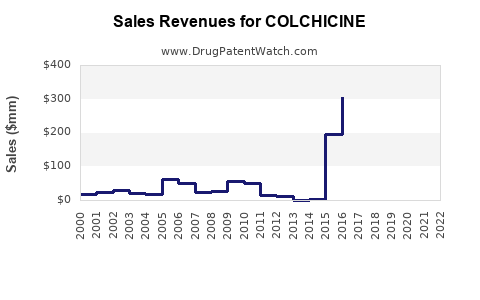
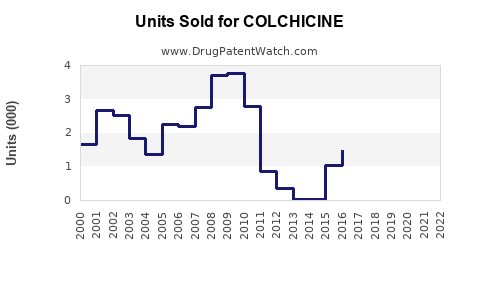
Annual Sales Revenues and Units Sold for COLCHICINE
| Drug Name | Revenues (USD) | Units | Year |
|---|---|---|---|
| COLCHICINE | ⤷ Start Trial | ⤷ Start Trial | 2022 |
| COLCHICINE | ⤷ Start Trial | ⤷ Start Trial | 2021 |
| COLCHICINE | ⤷ Start Trial | ⤷ Start Trial | 2020 |
| COLCHICINE | ⤷ Start Trial | ⤷ Start Trial | 2019 |
| COLCHICINE | ⤷ Start Trial | ⤷ Start Trial | 2018 |
| >Drug Name | >Revenues (USD) | >Units | >Year |
Colchicine Market Analysis, Sales Forecast, Patent Exclusivity, and Generic Competition
Colchicine is a mature, low-cost anti-inflammatory drug with durable demand in gout, familial Mediterranean fever, pericarditis, and selected cardiovascular indications. The market is dominated by generic tablets, while branded products such as Colcrys and Mitigare retain value through reimbursement positioning, supply reliability, formulation differentiation, and prescriber familiarity.
The commercial outlook is stable rather than high-growth. Global colchicine sales are likely to remain concentrated in oral solid products, with volume growth driven by the aging population, rising gout prevalence, broader use in recurrent pericarditis, and expanded cardiovascular prescribing. Net prices will remain under pressure because generic colchicine is widely available in the United States and major international markets.
What is the current colchicine market size?
Public market estimates for colchicine differ materially because some reports include only branded products, while others include generic sales, hospital purchasing, combination products, or all anti-gout medicines. A practical market definition includes oral colchicine tablets and capsules used for gout, familial Mediterranean fever, pericarditis, and cardiovascular prevention.
| Market segment | 2024 commercial position | Growth outlook through 2030 |
|---|---|---|
| U.S. generic colchicine | Largest segment by prescription volume | Low single-digit volume growth; continuing price erosion |
| U.S. branded colchicine | Smaller volume, higher unit economics | Flat to low growth |
| European generic colchicine | Broad availability, country-specific reimbursement | Low single-digit growth |
| Latin America and Asia-Pacific | Increasing diagnosis and access | Mid-single-digit volume growth |
| Hospital and specialty use | Limited relative to outpatient prescriptions | Stable, with episodic growth in pericarditis |
| Cardiovascular use | Expanding clinical evidence base | Faster growth from a smaller base |
A reasonable base-case estimate places the worldwide colchicine market, including branded and generic oral products, in the range of approximately $700 million to $1.1 billion in 2024. The broad range reflects the lack of a single public source covering generic and branded sales across all countries.
Under a base-case model, global market value reaches approximately $850 million to $1.35 billion by 2030. That implies a nominal compound annual growth rate of roughly 3% to 4%, with unit growth exceeding revenue growth because of generic price compression.
What drives colchicine demand?
The main demand drivers are:
- Increasing gout prevalence associated with obesity, chronic kidney disease, diabetes, and aging.
- Greater use of prophylactic colchicine when initiating urate-lowering therapy.
- Continued use in familial Mediterranean fever, particularly in Turkey, Israel, the Middle East, and North Africa.
- Expanded use in recurrent pericarditis.
- Cardiovascular studies supporting low-dose colchicine in atherosclerotic disease.
- Wider access to low-cost generic treatment in emerging markets.
The main restraints are narrow therapeutic margins, renal and hepatic dosing limitations, drug interactions, generic substitution, and physician caution in older patients.
How much revenue does colchicine generate?
Exact product-level revenue is difficult to isolate because most sales are generic and manufacturers generally report colchicine within broader portfolios. Branded disclosure is also limited.
U.S. revenue exposure
The United States is the most commercially important market because of high diagnosis rates, relatively high pharmacy prices, and the historical branded price premium created after FDA approval of Colcrys.
A reasonable 2024 U.S. market model is:
| U.S. segment | Estimated 2024 net sales |
|---|---|
| Generic colchicine | $250 million-$450 million |
| Colcrys | $100 million-$250 million |
| Mitigare and other branded products | $25 million-$100 million |
| Institutional and specialty distribution | $25 million-$75 million |
| Total U.S. market | $400 million-$875 million |
These figures are market estimates rather than reported consolidated company revenue. Gross sales can materially exceed net sales after rebates, discounts, pharmacy benefit manager concessions, and government pricing.
The U.S. market has high prescription volume but weak pricing power for manufacturers selling standard 0.6 mg tablets. Margin performance depends on manufacturing cost, supply reliability, wholesaler contracts, and formulary access.
Revenue projection, 2025-2030
| Scenario | 2024 global sales | 2030 global sales | 2024-2030 CAGR | Primary assumptions |
|---|---|---|---|---|
| Bear case | $700 million | $780 million | 1.8% | Accelerated generic price erosion and limited cardiovascular uptake |
| Base case | $900 million | $1.10 billion | 3.4% | Stable gout demand, modest pericarditis growth, controlled price decline |
| Bull case | $1.10 billion | $1.45 billion | 4.7% | Broader low-dose cardiovascular use and stronger emerging-market access |
The base case assumes global prescription volume grows approximately 4% annually, while average realized price declines by roughly 0.5% to 1.0% annually. In the United States, revenue growth is likely to lag volume growth because payer pressure will continue to lower net prices.
What are the main colchicine products and manufacturers?
Colcrys
Colcrys is the principal U.S. branded colchicine product. It is marketed under FDA NDA 022352 and is available as a 0.6 mg oral tablet. The product received FDA approval in 2009 for acute gout flares and gout prophylaxis, followed by approval for familial Mediterranean fever.[1]
Colcrys established an FDA-approved branded product in a market that previously relied heavily on unapproved colchicine products. Its commercial advantages include an established label, recognized safety information, and historical prescriber familiarity. Its weaknesses are generic substitution and limited differentiation from standard generic 0.6 mg tablets.
Mitigare
Mitigare is a 0.6 mg colchicine capsule marketed in the United States under NDA 204820. It was approved for prophylaxis of gout flares in adults.[2] The capsule presentation offers a modest dosage-form distinction but does not create a strong barrier against standard oral colchicine tablets.
Generic colchicine
Generic colchicine is supplied by multiple manufacturers and distributors, including companies with broad U.S. generic portfolios. Availability has varied over time by supplier, dosage form, and wholesaler channel.
Generic products generally compete on:
- Wholesale acquisition cost.
- Medicaid and Medicare reimbursement.
- Pharmacy benefit manager contracts.
- Supply reliability.
- Tablet or capsule availability.
- FDA-approved labeling and manufacturing compliance.
Because colchicine has a narrow therapeutic index, manufacturers with reliable quality systems and uninterrupted supply can retain customers even when their list price is not the lowest.
What is the FDA regulatory status of colchicine?
Colchicine is FDA-approved in several oral products and indications. The principal U.S. regulatory categories are:
| Product or category | FDA status | Key use |
|---|---|---|
| Colcrys 0.6 mg tablet | NDA 022352 | Gout flares, gout prophylaxis, familial Mediterranean fever |
| Mitigare 0.6 mg capsule | NDA 204820 | Prophylaxis of gout flares |
| Generic colchicine tablets or capsules | ANDAs | Therapeutically equivalent substitution where approved |
| Unapproved historical colchicine products | Subject to FDA enforcement framework | Legacy products displaced by approved products |
The FDA has emphasized colchicine’s narrow therapeutic index and clinically important interactions with CYP3A4 and P-glycoprotein inhibitors. Toxicity risk is elevated in renal or hepatic impairment and with interacting drugs such as strong CYP3A4 inhibitors.[3]
Regulatory differentiation is limited for standard immediate-release oral products. New commercial value would require a meaningful dosing, safety, adherence, delivery, or indication advantage.
What is the Orange Book status of Colcrys and Mitigare?
Colcrys and Mitigare are FDA-approved prescription products listed through the FDA’s drug approval and patent systems. Orange Book relevance depends on the specific NDA, approved dosage form, and patents listed by the sponsor.
The principal competitive effect of Orange Book listings has historically been to support patent litigation against ANDA applicants. Because colchicine is an old active ingredient and generic products have entered the market, the remaining patent value is concentrated in listed use claims, formulation claims, and any enforceable regulatory exclusivity.
Orange Book-listed patent positions should be checked against the current FDA Orange Book and Patent Certifications database before making a launch or litigation decision. Patent status can change through expiration, delisting, terminal disclaimers, pediatric extensions, or court decisions.[4]
What patents protect colchicine products?
Colchicine’s active ingredient is old and cannot support a new composition-of-matter patent for the underlying molecule. Modern protection has focused on approved methods of use, dosing regimens, formulations, and manufacturing or analytical controls.
Historical Colcrys patent estate
The most commercially important U.S. patent associated with Colcrys was U.S. Patent No. 7,176,206, which covered methods involving colchicine for gout-related treatment. The patent became the subject of ANDA litigation and settlement activity involving generic applicants.
The historical estate also included additional patents directed to colchicine treatment methods and related claims. The practical strength of this estate declined as:
- Core patent terms approached expiration.
- Generic manufacturers challenged validity and infringement.
- Courts narrowed or invalidated claims.
- Generic approvals became available.
- Prescribers and payers shifted toward substitution.
Patent protection for colchicine today is therefore fragmented and product-specific. A manufacturer cannot assume that a patent covering one indication blocks all generic use.
What formulations are protected by colchicine patents?
Potentially relevant formulation categories include:
- Immediate-release 0.6 mg tablets.
- Capsule presentations.
- Modified-release or extended-release products.
- Liquid or pediatric formulations.
- Fixed-dose combinations.
- Formulations designed to reduce gastrointestinal intolerance.
- Formulations intended to improve dose accuracy or adherence.
A formulation patent has commercial value only if the product has meaningful prescription demand and the claim cannot be readily designed around. A tablet-versus-capsule distinction alone generally provides limited market protection when physicians and payers accept multiple oral dosage forms.
What manufacturing and IP barriers exist?
The active pharmaceutical ingredient is commercially available from multiple sources, which limits the strength of manufacturing exclusivity. Manufacturing barriers are more likely to arise from:
- API impurity control.
- Potency uniformity at low dose.
- Cross-contamination controls.
- Stability and dissolution performance.
- Supplier qualification.
- Regulatory compliance at API and finished-dose facilities.
These factors can delay a product or cause shortages, but they usually do not create durable legal exclusivity.
When does colchicine lose exclusivity?
Colchicine’s active ingredient has no meaningful remaining composition-of-matter exclusivity. The relevant exclusivity analysis concerns product-specific patents, FDA regulatory exclusivity, and market access.
| Exclusivity category | Commercial significance |
|---|---|
| Active ingredient exclusivity | Expired because colchicine is an established molecule |
| Colcrys approval exclusivity | Expired |
| Mitigare approval exclusivity | Expired or no longer a meaningful barrier to standard generic entry |
| Method-of-use patents | Historically important; value depends on claim scope and expiration |
| Formulation patents | Relevant only to the protected dosage form |
| Pediatric exclusivity | Product-specific and time-limited |
| ANDA market exclusivity | Applicant-specific and dependent on first-filer status |
The principal barrier to generic entry is no longer the molecule itself. It is the combination of patent certifications, litigation timing, regulatory review, manufacturing readiness, and commercial contracting.
Which companies are challenging colchicine patents?
Historically, major generic companies filed ANDAs for colchicine products and faced patent litigation involving Colcrys-related patents. The litigation landscape included large generic manufacturers such as Mylan, Watson/Actavis, and other ANDA applicants.
Generic challenges have generally relied on:
- Paragraph IV invalidity claims.
- Non-infringement arguments.
- Obviousness challenges.
- Lack of written description or enablement.
- Narrow interpretation of method-of-treatment claims.
- Carve-outs from patented indications.
Current competitive assessment should focus less on new Paragraph IV activity against old Colcrys patents and more on whether a sponsor is developing a differentiated colchicine formulation or a new indication with fresh patent claims.
What Paragraph IV risks exist for colchicine?
Paragraph IV risk is limited for ordinary generic colchicine because multiple generic products already compete in the market. The greater risk applies to:
- Newly patented colchicine formulations.
- Extended-release products.
- Combination products.
- Cardiovascular indications with new method-of-use claims.
- Products using a distinct delivery technology.
A generic applicant can reduce infringement exposure by using a skinny label that removes a patented indication, where permitted under the FDA’s regulatory framework. The commercial result depends on whether physicians prescribe the product for non-patented uses and whether payers impose restrictions.
What is the biosimilar risk for colchicine?
There is no biosimilar risk because colchicine is a small-molecule drug, not a biologic. Competitive risk comes from generic ANDA products, authorized generics, branded-generic products, and reformulated small-molecule products.
The absence of biosimilar exposure does not reduce competitive pressure. Generic substitution is typically more direct and more aggressive for oral colchicine than biosimilar substitution is for complex biologics.
How does colchicine compare with competing gout drugs?
Colchicine competes with NSAIDs, corticosteroids, allopurinol, febuxostat, and newer urate-lowering or anti-inflammatory therapies. Its competitive position depends on the treatment stage.
| Drug class | Primary role | Relative colchicine advantage | Relative disadvantage |
|---|---|---|---|
| Colchicine | Flare treatment and prophylaxis | Low cost, oral dosing, established use | Narrow therapeutic index and interactions |
| NSAIDs | Acute flare treatment | Comparable anti-inflammatory effect in selected patients | Renal, gastrointestinal, and cardiovascular risks |
| Corticosteroids | Acute flares | Useful when NSAIDs or colchicine are unsuitable | Metabolic and systemic adverse effects |
| Allopurinol | Long-term urate lowering | Not a direct substitute | Does not rapidly treat acute inflammation |
| Febuxostat | Long-term urate lowering | Alternative in selected patients | Cardiovascular safety concerns and higher cost |
| IL-1 inhibitors | Refractory inflammation | Potent option in selected cases | High cost and administration burden |
Colchicine remains defensible where clinicians need low-cost prophylaxis during initiation or escalation of urate-lowering therapy. Its use in recurrent pericarditis provides an indication outside conventional gout competition.
What is the outlook for cardiovascular colchicine sales?
Low-dose colchicine has attracted cardiovascular interest because of its anti-inflammatory mechanism and clinical-study results in coronary disease populations. The commercial opportunity is substantial in theory because cardiovascular disease is much larger than gout.
The practical outlook is more limited. Adoption depends on:
- Confirmatory clinical evidence.
- Guideline recommendations.
- FDA-approved labeling.
- Reimbursement.
- Patient selection.
- Long-term safety and adherence.
- Physician acceptance of low-dose chronic therapy.
Without broad regulatory approval and guideline-driven use, cardiovascular prescribing is unlikely to transform colchicine into a multibillion-dollar product. Under a favorable scenario, cardiovascular use could add $100 million to $300 million in annual global sales by 2030, mostly through low-cost generic products rather than premium branded pricing.
What generic launch scenarios exist?
Scenario 1: Continued generic erosion
This is the most probable scenario. Multiple suppliers maintain availability, pharmacies substitute generic products, and branded products retain only selected coverage or patient segments. U.S. colchicine revenue declines in nominal terms while prescription volume grows modestly.
Scenario 2: Supply disruption
A manufacturing or quality event at a major API or finished-dose supplier could create temporary shortages. Remaining suppliers could gain volume and improve realized pricing. This would be a supply-driven opportunity, not durable exclusivity.
Scenario 3: Differentiated formulation launch
An extended-release, liquid, pediatric, or interaction-mitigating product could support a higher price if it demonstrates clinical or adherence value. Patent protection would need to cover the actual commercial formulation and survive obviousness and design-around challenges.
Scenario 4: Cardiovascular expansion
A new cardiovascular label could materially increase volume. Because standard colchicine is generic, the revenue benefit would likely accrue to manufacturers with strong distribution, payer access, and regulatory positioning rather than to a single originator.
How strong is the colchicine patent estate?
The colchicine patent estate is weak for the underlying molecule and standard oral products but can be moderate for narrow formulation or method-of-use claims.
| Patent category | Strength |
|---|---|
| Composition of matter | Very weak or unavailable |
| Standard 0.6 mg tablet | Weak after generic entry |
| Branded method-of-use claims | Low to moderate, depending on surviving claims |
| Modified-release formulation | Moderate if clinically differentiated |
| Combination product | Moderate if the combination has a distinct clinical rationale |
| Manufacturing process | Usually low unless difficult to design around |
| New cardiovascular method of use | Potentially moderate, but vulnerable to label carve-outs |
Commercial diligence should evaluate claim scope, expiration, terminal disclaimers, Orange Book listing status, ANDA certifications, and actual prescribing by indication.
What are the key licensing and business-development opportunities?
Licensing value is limited for ordinary generic colchicine. More attractive opportunities include:
- Regional rights in high-prevalence gout markets.
- Authorized-generic arrangements.
- Reformulated products with improved tolerability.
- Pediatric or liquid presentations.
- Combination products with urate-lowering agents.
- Cardiovascular development rights.
- API supply and dual-source manufacturing agreements.
A licensing transaction based solely on standard 0.6 mg colchicine tablets would likely depend on manufacturing cost, geographic access, and supply reliability rather than patent exclusivity.
Key Takeaways
- Colchicine is a mature, globally distributed small-molecule market dominated by generic oral products.
- Estimated worldwide sales were approximately $700 million to $1.1 billion in 2024, depending on market definition.
- Base-case global sales could reach approximately $1.1 billion by 2030, with volume growth offset by generic price erosion.
- Colcrys and Mitigare retain branded value but face extensive generic competition.
- The active ingredient has no meaningful remaining composition-of-matter exclusivity.
- Patent value is concentrated in method-of-use, formulation, combination, and selected manufacturing claims.
- There is no biosimilar risk; the relevant threats are ANDA generics and reformulated small-molecule products.
- Cardiovascular use is the main potential growth catalyst, but broad commercial impact depends on regulatory approval, evidence, and reimbursement.
- The strongest commercial opportunities are differentiated formulations, reliable supply, emerging-market distribution, and expanded indications.
FAQs About Colchicine Market Sales and Competition
Is colchicine a profitable generic drug?
It can be profitable when manufacturing costs are low, supply is reliable, and the manufacturer has efficient pharmacy and wholesaler contracts. Standard tablet pricing is exposed to intense generic competition.
Which colchicine product has the strongest brand position?
Colcrys has the strongest U.S. brand recognition because it was the principal FDA-approved branded colchicine product for gout and familial Mediterranean fever. Its commercial position is limited by generic substitution.
Can a new colchicine product receive FDA exclusivity?
Yes. A new formulation, combination, or indication can receive product-specific regulatory exclusivity or patent protection if it satisfies FDA and patentability requirements. The old active ingredient itself cannot receive new composition-of-matter protection.
Is colchicine used more for gout or cardiovascular disease?
Gout and gout prophylaxis remain the core commercial uses. Cardiovascular use is clinically important but remains smaller and more dependent on evidence, guidelines, labeling, and reimbursement.
What would increase the value of a colchicine patent portfolio?
The strongest value drivers would be a clinically differentiated formulation, a broad and defensible approved indication, limited design-around options, enforceable Orange Book claims, and evidence that payers will reimburse the protected product at a premium.
References
- U.S. Food and Drug Administration. (2009). Colcrys approval letter and prescribing information, NDA 022352. FDA.
- U.S. Food and Drug Administration. (2010). Mitigare prescribing information, NDA 204820. FDA.
- U.S. Food and Drug Administration. (2023). Colchicine prescribing information and drug safety communications. FDA.
- U.S. Food and Drug Administration. (2024). Approved drug products with therapeutic equivalence evaluations. FDA.
- U.S. Food and Drug Administration. (2024). Drugs@FDA: FDA-approved drugs database. FDA.
- Dalbeth, N., Lautenschlager, S., & Wolfe, H. (2014). Mechanism of action of colchicine in the treatment of gout. Clinical Therapeutics, 36(10), 1465-1479.
- Tardif, J.-C., Kouz, S., Waters, D. D., et al. (2019). Efficacy and safety of low-dose colchicine after myocardial infarction. New England Journal of Medicine, 381(26), 2497-2505.
- Tardif, J.-C., Kouz, S., Bertrand, O. F., et al. (2021). Colchicine for prevention of ischemic cardiovascular events in stable coronary disease. New England Journal of Medicine, 383(4), 352-361.
More… ↓
