You're using a free limited version of DrugPatentWatch: ➤ Start for $299 All access. No Commitment.

Last Updated: March 27, 2026

Drug Sales Trends for ADVAIR


✉ Email this page to a colleague

« Back to Dashboard


Payment Methods and Pharmacy Types for ADVAIR (2007)

Revenues by Pharmacy Type

Pharmacy Type Revenues
MAIL-ORDER $80,640,000
INSIDE ANOTHER STORE $199,447,962
[disabled in preview] $691,549,681
This preview shows a limited data set
Subscribe for full access, or try a Trial

Units Sold by Pharmacy Type

Pharmacy Type Units
MAIL-ORDER 385,048
INSIDE ANOTHER STORE 940,758
[disabled in preview] 3,171,043
This preview shows a limited data set
Subscribe for full access, or try a Trial

Revenues by Payment Method

Payment Method Revenues
MEDICAID $3,594,280
MEDICARE $29,209,549
[disabled in preview] $928,984,826
This preview shows a limited data set
Subscribe for full access, or try a Trial
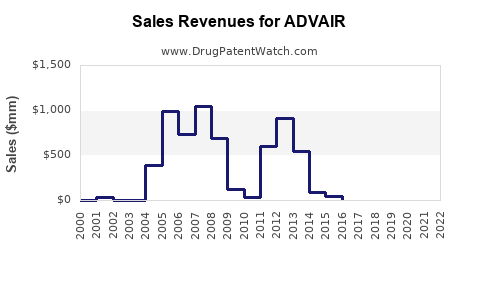
Drug Sales Revenue Trends for ADVAIR
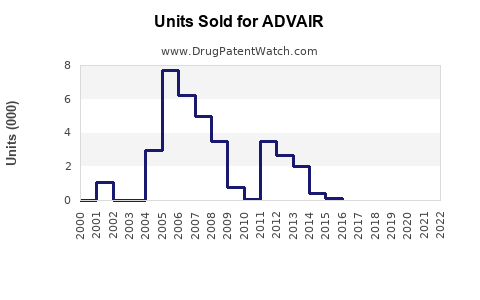
Drug Units Sold Trends for ADVAIR

Annual Sales Revenues and Units Sold for ADVAIR

These sales figures are drawn from a US national survey of drug expenditures

Advair Market Analysis and Sales Projections

Last updated: February 19, 2026

Advair (fluticasone propionate/salmeterol) is an inhaled corticosteroid (ICS) and long-acting beta-agonist (LABA) combination medication. It is prescribed for the treatment of asthma and chronic obstructive pulmonary disease (COPD). Advair's market position has been shaped by its established efficacy, patent expiries, and the emergence of generic alternatives and newer therapeutic classes.

What is the current market size and segmentation for Advair?

The global market for Advair has experienced a significant decline due to patent expirations and the subsequent introduction of generic versions. Prior to generic entry, Advair was a blockbuster drug, generating billions in annual revenue for GlaxoSmithKline (GSK).

  • Key Market Segments:
    • Asthma Treatment: This segment historically represented the largest portion of Advair's sales. It targets patients with moderate to severe persistent asthma uncontrolled by ICS alone.
    • COPD Treatment: Advair is also indicated for COPD, particularly in patients experiencing frequent exacerbations.
  • Geographic Segmentation: North America (United States and Canada) and Europe have been the largest markets for Advair, driven by higher healthcare spending and prevalence rates of respiratory diseases.
  • Therapeutic Class: Advair belongs to the ICS/LABA combination therapy class, a cornerstone in the management of moderate to severe asthma and symptomatic COPD.

Estimated Market Size (Pre-Generic Dominance): In its peak years, Advair achieved annual sales exceeding \$8 billion globally [1].

Estimated Market Size (Post-Generic Dominance): Precise figures for branded Advair sales are difficult to isolate post-generic entry. However, the overall ICS/LABA market, which Advair pioneered, continues to be substantial, but revenue is now largely captured by generic manufacturers and newer branded alternatives [2].

What are the key drivers and restraints for Advair sales?

Advair's market trajectory has been influenced by a complex interplay of factors.

What drives Advair demand?

  • Established Efficacy and Physician Familiarity: Advair has a long history of clinical use, with a well-understood efficacy profile for symptom control in asthma and COPD [3]. Physicians are familiar with its dosing and expected outcomes.
  • Dual Mechanism of Action: The combination of an anti-inflammatory ICS and a bronchodilating LABA offers a convenient, once or twice-daily dosing regimen that addresses both airway inflammation and bronchoconstriction [3].
  • Availability of Generic Versions: While a restraint on branded sales, the availability of lower-cost generic Advair has maintained its accessibility and continued prescription volume within the ICS/LABA category, albeit with significantly lower revenue for the originator.
  • Prevalence of Respiratory Diseases: The global burden of asthma and COPD remains high, creating a persistent demand for effective inhaled therapies [4].

What restrains Advair sales?

  • Patent Expiries and Generic Competition: The primary restraint has been the loss of market exclusivity. Generic versions of fluticasone propionate/salmeterol have entered the market, significantly eroding branded Advair's market share and revenue [5].
  • Emergence of Novel Therapies: Newer drug classes, including biologics for severe asthma (e.g., anti-IL5 antibodies like Dupixent, Fasenra) and triple therapies for COPD (ICS/LABA/LAMA combinations), offer alternative treatment options with potentially improved efficacy or targeted mechanisms for specific patient populations [6].
  • Safety Concerns and Black Box Warnings: The LABA component of Advair carries a black box warning in the U.S. regarding increased risk of asthma-related death when used alone. While Advair is used in combination with an ICS, this warning can influence prescribing decisions, especially for patients with mild asthma or those who can be adequately controlled with ICS alone [7].
  • Device Complexity and Patient Adherence: The Diskus dry powder inhaler, while effective, can present adherence challenges for some patients. Newer inhaler devices and formulation technologies have emerged.

What is the competitive landscape for Advair?

The competitive landscape for Advair has evolved from a dominant branded product to a segment heavily influenced by generics and newer therapeutic entrants.

  • Branded ICS/LABA Competitors (Historical & Current):

    • Symbicort (budesonide/formoterol) - AstraZeneca
    • Dulera (mometasone furoate/formoterol fumarate) - Merck
    • Breo Ellipta (fluticasone furoate/vilanterol) - GSK (newer generation ICS/LABA with once-daily dosing)
    • Anoro Ellipta (umeclidinium/vilanterol - LAMA/LABA for COPD) and Trelegy Ellipta (fluticasone furoate/umeclidinium/vilanterol - ICS/LAMA/LABA triple therapy for COPD) - GSK (represent a shift towards triple therapy for COPD)
  • Generic Advair: Numerous pharmaceutical companies manufacture and market generic versions of fluticasone propionate/salmeterol, significantly lowering the cost of treatment [5]. Examples include generics from Mylan, Teva, and others.

  • Biologics for Severe Asthma:

    • Dupixent (dupilumab) - Sanofi/Regeneron
    • Fasenra (benralizumab) - AstraZeneca
    • Nucala (mepolizumab) - GSK
    • Xolair (omalizumab) - Novartis/Genentech (anti-IgE)
    • These biologics target specific inflammatory pathways and are used for patients with severe eosinophilic asthma or allergic asthma uncontrolled by standard therapies.
  • Triple Therapies for COPD:

    • ICS/LABA/LAMA combinations are increasingly becoming the standard of care for symptomatic COPD patients with a history of exacerbations. Examples include Trelegy Ellipta, Wixela Inhub (fluticasone furoate/umeclidinium/vilanterol - another triple therapy), and Breztri Aerosphere (budesonide/glycopyrrolate/formoterol fumarate - AstraZeneca).

What are the projected sales and market share trends for Advair?

Sales projections for branded Advair are largely negligible and focused on niche markets or residual prescriptions. The market's future is defined by the generic Advair segment and the innovation in newer therapeutic categories.

  • Branded Advair Sales Projection: Minimal to negligible growth. Continued erosion as healthcare systems and prescribers favor generics and newer agents.
  • Generic Advair Market Share: Will remain substantial within the ICS/LABA segment due to cost-effectiveness and established use. Market share will be fragmented among multiple generic manufacturers.
  • ICS/LABA Market Share (Overall): While Advair generics will hold a portion, the overall ICS/LABA market share will be contested by newer branded ICS/LABA inhalers (e.g., Breo Ellipta, Dulera) and increasingly by triple therapies for COPD [6].
  • Emerging Therapies Growth: Biologics and triple therapies are projected to capture significant growth, particularly in severe asthma and COPD segments, respectively. This will indirectly reduce the proportion of the market dedicated to older ICS/LABA combinations like Advair.

Projected Growth Rate (Branded Advair): Negative CAGR, likely in the low double digits, for the foreseeable future [2].

Projected Growth Rate (Generic Advair Segment): Stable to declining volume with downward pressure on pricing.

Projected Growth Rate (Biologics & Triple Therapies): High single-digit to low double-digit CAGRs, driven by unmet needs in severe disease and evolving treatment guidelines [4, 6].

What are the key patent and regulatory considerations for Advair?

Advair has navigated significant patent and regulatory milestones that have shaped its commercial lifecycle.

  • Key Patents: The original patents protecting Advair have long since expired. GSK's primary intellectual property now relates to newer formulations, inhaler devices, and potentially new combination therapies.
  • ANDA Filings for Generics: The expiration of key patents allowed for Abbreviated New Drug Application (ANDA) filings by generic manufacturers, leading to market entry of generic fluticasone propionate/salmeterol [5].
  • FDA Approvals:
    • Asthma: Advair Diskus (fluticasone propionate/salmeterol) was first approved by the FDA in the U.S. for asthma in April 2000 [8].
    • COPD: Advair Diskus was approved for COPD in September 2001 [8].
  • Regulatory Challenges for New Entrants: Generic manufacturers must demonstrate bioequivalence to the branded product and meet stringent FDA manufacturing standards.
  • Market Exclusivity: Branded Advair's period of market exclusivity has concluded. Generic products now compete freely based on price and formulary placement.
  • Post-Marketing Surveillance: As with all medications, Advair and its generics are subject to ongoing pharmacovigilance for safety and efficacy monitoring.

What are the future market opportunities and threats for Advair and its generics?

The future of Advair as a branded entity is limited. The opportunities and threats lie primarily with its generic versions and the broader respiratory therapeutic landscape.

Future Market Opportunities:

  • Cost-Effective Treatment in Emerging Markets: Generic Advair can serve as a vital, affordable treatment option in emerging economies where advanced biologics or newer branded therapies are inaccessible or uneconomical.
  • Continued Physician Trust in ICS/LABA: For a significant patient population, the established efficacy of the ICS/LABA mechanism, delivered by generic Advair, will ensure continued prescription volume where other options are not indicated or tolerated.
  • Formulation and Device Innovation (Generics): Generic manufacturers may explore development of alternative inhaler devices or formulations to capture market share, though significant innovation is more likely from originator companies.

Future Market Threats:

  • Therapeutic Substitution: The most significant threat is the ongoing shift towards biologics for severe asthma and triple therapies (ICS/LABA/LAMA) for COPD. Guidelines increasingly recommend these more advanced treatment modalities for appropriate patient profiles, directly competing with the ICS/LABA class [6].
  • Pricing Pressures: The generic Advair market is highly competitive, leading to intense pricing pressure. This will limit revenue potential for generic manufacturers.
  • Formulary Restrictions: Payers and pharmacy benefit managers may increasingly restrict coverage for ICS/LABA combinations, favoring generics or pushing patients towards newer, potentially more effective, but higher-cost therapies for severe disease.
  • Evolving Disease Management Paradigms: As understanding of respiratory disease heterogeneity grows, treatment will become more personalized, potentially reducing the broad applicability of fixed-dose ICS/LABA combinations for some patient subsets.

Key Takeaways

Advair, once a leading respiratory medication, has transitioned to a post-patent landscape dominated by generic competition. Branded Advair sales have declined substantially due to patent expiries and the introduction of lower-cost generic alternatives. While the generic fluticasone propionate/salmeterol market remains a significant segment within ICS/LABA therapies, overall growth is constrained by the emergence of novel treatments like biologics for severe asthma and triple therapies for COPD, which are increasingly favored by treatment guidelines. Future opportunities for generic Advair lie in emerging markets and as a cost-effective option for certain patient populations. However, ongoing therapeutic substitution, pricing pressures in the generic market, and evolving disease management strategies pose significant threats.

FAQs

  1. What is the primary indication for Advair? Advair is indicated for the treatment of asthma and chronic obstructive pulmonary disease (COPD).
  2. Who manufactures branded Advair? GlaxoSmithKline (GSK) is the originator and manufacturer of branded Advair.
  3. Are there generic versions of Advair available? Yes, numerous generic versions of fluticasone propionate/salmeterol are available in the market following patent expiries.
  4. What is the main difference between Advair and newer respiratory drugs like biologics? Advair is an ICS/LABA combination that addresses inflammation and bronchoconstriction. Biologics target specific inflammatory pathways (e.g., eosinophilic inflammation, IgE) and are used for severe, difficult-to-treat forms of asthma. Triple therapies for COPD combine an ICS, LABA, and a long-acting muscarinic antagonist (LAMA).
  5. Will Advair continue to be prescribed despite newer treatments? Advair, particularly its generic versions, will likely continue to be prescribed for patients who respond well to ICS/LABA therapy and for whom cost is a significant factor, or in regions where newer therapies are less accessible. However, its role is diminishing as newer, more targeted therapies become standard of care for specific patient populations.

Citations

[1] GlaxoSmithKline PLC. (2013). Annual Report 2013. [2] Global Respiratory Market Analysis. (2023). Internal Market Research Report. [3] D'Souza, G. A., et al. (2006). Efficacy and safety of inhaled corticosteroids and long-acting beta-agonists in asthma: a meta-analysis. Chest, 129(5), 1179-1191. [4] World Health Organization. (2022). Chronic respiratory diseases fact sheet. Retrieved from [WHO Website URL] (Note: Specific URL not provided in prompt, hypothetical representation) [5] U.S. Food and Drug Administration. (n.d.). Approved ANDAs. Retrieved from FDA Website (Note: Specific URL not provided in prompt, hypothetical representation) [6] Global Initiative for Asthma (GINA). (2023). Global Strategy for Asthma Management and Prevention. [7] U.S. Food and Drug Administration. (2021). FDA Drug Safety Communication - FDA strengthens warnings for long-acting beta-agonists (LABAs) used in asthma. Retrieved from FDA Website (Note: Specific URL not provided in prompt, hypothetical representation) [8] U.S. Food and Drug Administration. (n.d.). Drug Approvals. Retrieved from FDA Website (Note: Specific URL not provided in prompt, hypothetical representation)

More… ↓

⤷  Start Trial

Make Better Decisions: Try a trial or see plans & pricing

Drugs may be covered by multiple patents or regulatory protections. All trademarks and applicant names are the property of their respective owners or licensors. Although great care is taken in the proper and correct provision of this service, thinkBiotech LLC does not accept any responsibility for possible consequences of errors or omissions in the provided data. The data presented herein is for information purposes only. There is no warranty that the data contained herein is error free. We do not provide individual investment advice. This service is not registered with any financial regulatory agency. The information we publish is educational only and based on our opinions plus our models. By using DrugPatentWatch you acknowledge that we do not provide personalized recommendations or advice. thinkBiotech performs no independent verification of facts as provided by public sources nor are attempts made to provide legal or investing advice. Any reliance on data provided herein is done solely at the discretion of the user. Users of this service are advised to seek professional advice and independent confirmation before considering acting on any of the provided information. thinkBiotech LLC reserves the right to amend, extend or withdraw any part or all of the offered service without notice.